Physical Address
304 North Cardinal St.
Dorchester Center, MA 02124
Physical Address
304 North Cardinal St.
Dorchester Center, MA 02124


A plain-English guide to rage quit in crypto slang and DAO governance.
Rage quit in crypto means leaving a trade, platform, project, or DAO after frustration overwhelms your original plan.
You may see the phrase after a brutal drawdown, a bad support loop, a meme-coin rug scare, or a governance fight. Sometimes it means someone sold in anger. Sometimes it means a DAO member used a formal exit right built into smart contracts.
That split is the trick. A rage quit can be an emotional mistake, a clean risk cut, or a code-level treasury exit. The phrase sounds dramatic because it is. First ask what someone is leaving, and whether the exit fixes the real problem.
Rage quit means leaving because frustration beats the plan. In crypto, that exit can be selling a coin, closing an app account, leaving a project community, abandoning a trading style, or walking away from the market for a while.
The phrase comes from gaming culture, where someone quits after losing or getting tilted. Crypto borrowed it because markets are volatile, social feeds are loud, and many products still make users feel like they are solving a puzzle while the chart punches back.
Most everyday rage quit usage is emotional. A trader takes losses, gets tired of the noise, and sells everything. A user loses patience with support and deletes an exchange app. A meme-coin buyer sees the chat turn ugly and leaves before the next “dev cooking” post arrives.
The DAO meaning is more specific. In some DAO designs, a member can formally exit before a contested decision executes. They burn or surrender their membership shares, redeem a proportional claim on treasury assets, and lose future governance rights.
The phrase has two layers. Most people use rage quit as slang for an angry exit. DAO builders may use it as a technical term for a protected exit path. Confusing those meanings leads to bad takes on both markets and governance.
So “rage quit” needs context every time. Ask what is being exited, what triggered it, and whether money, access, or voting rights changed. Without those details, the phrase is mostly noise with extra caps lock.
Rage quit shows up when crypto users feel stuck between sunk costs and a broken experience. The same words can describe a trader dumping a token, a customer leaving an app, or a DAO member using a contract feature.
Context changes the meaning. A rage quit after a meme-coin dump is usually emotional selling. A rage quit from a DAO treasury can be a planned smart-contract action. A rage quit from an exchange may be a user deciding that support, fees, or account friction is no longer worth the headache.
Start with the context before reading too much into the phrase.
| Context | What Rage Quit Means There |
|---|---|
| Spot or perp trading | Selling after losses, liquidations, failed entries, or exhaustion. |
| Meme-coin communities | Leaving a chat, position, or launch after rug fear or social chaos. |
| Exchanges and apps | Closing an account after support delays, freezes, fees, or bad UX. |
| Broader market cycles | Giving up on crypto after months of disappointment or opportunity cost. |
| DAOs | Exiting governance through a formal treasury withdrawal mechanism. |
The market version often overlaps with exit liquidity. When early sellers escape into late buyers, the people left behind can feel trapped. That is where rage quit language gets sharp.
Not every exit is childish. Leaving a broken app, risky token, or hostile community can be a sane move. The weak version is quitting because a candle embarrassed you. The stronger version is leaving because the facts changed.
Crypto users rage quit when the pain of staying starts to feel larger than the possible upside. Losses are the obvious trigger, but they are rarely the only one.
A trader might be down badly, then get hit by liquidation fees, tax cleanup, bridge delays, gas spikes, spam DMs, and CT victory laps from people who were also wrong last week. That combination turns a normal loss into a full-system annoyance.
Common rage quit triggers include:
The emotional version usually comes from tilt. The user is not reviewing a thesis. They are trying to make the discomfort stop. That can lock in a bad price, create a tax mess, or push them into another impulsive trade.
Still, rage quit language can point at a real problem. If a project keeps changing rules, a platform keeps blocking access, or a community turns into pure pressure, leaving may be the cleanest way to cut risk. Crypto sometimes calls that rage. Your account balance may call it overdue.
The pattern to watch is repetition. One bad day is noise. Repeated friction from the same product, project, or trading setup is a signal that the setup may be wrong for you.
Rage quit overlaps with several crypto slang terms, but it does a different job. It describes the exit and the emotional break behind it, not only the trade execution.
That is why a rage quit can include selling, quitting a chat, leaving a DAO, or deleting an app. The other terms usually point to a narrower behavior. A quick sell is not always a rage quit. Staying too long is almost the opposite.
The split looks like this.
| Term | How It Differs From Rage Quit |
|---|---|
| Jeeting | Jeeting is quick selling, often early or nervously, while rage quit is a broader angry exit. |
| Panic selling | Panic selling is fear-driven execution during stress, while rage quit can include leaving the whole setup. |
| Capitulation | Capitulation is broad surrender across many holders or the market, while rage quit can be one user or group. |
| Bagholding | Bagholding means staying stuck with a losing asset, while rage quit means finally leaving. |
| Exit liquidity | Exit liquidity describes who buys from sellers, while rage quit describes the seller’s exit behavior. |
If someone says “the jeets are out,” they usually mean short-term sellers have left. If they say a user rage quit, they are usually pointing at emotion, burnout, or a public break with the project.
The comparison also helps with timing. A user can be called one of the jeets for selling early and still avoid becoming the last loyal holder in a dead chart. Crypto slang is not known for mercy. Shocking, I know.
The point is simple: do not let slang decide the trade. A rage quit can be late, early, rational, or reckless. The label is weaker than the reason behind the exit.
A rage quit is rational when the original reason for staying is broken. It is just tilt when the only reason is anger after a loss, a bad reply, or a red candle.
The difference is not mood. It is evidence. A broken thesis, security risk, account issue, governance abuse, or trust failure can justify leaving. Embarrassment alone usually cannot.
Use one clean test before the checklist: would you make the same exit if nobody saw the chart, the group chat, or your old bullish post? If the answer changes, social pressure is probably driving more of the decision than risk control.
Run through these checks before turning frustration into an irreversible exit:
Security changes the order. If your wallet, account, or approval permissions are at risk, move funds first and think later. A slow, noble review is less useful when the door is already open.
For non-security decisions, the pause is the edge. Rage compresses the timeline. It makes “I need a smaller position” sound like “I need to delete crypto from my life.” Those are very different decisions.
A DAO rage quit is a formal governance exit. It lets a member leave the DAO and redeem a proportional share of treasury assets before an unwanted decision takes effect.
The best-known model is MolochDAO-style governance. Gitcoin lays out a propose, vote, grace-period, ragequit, and execution pattern where dissenting members can exit before a passed proposal spends treasury funds. It also notes that MolochDAO distributed more than $1 million to Ethereum public goods.
The usual flow looks like this:
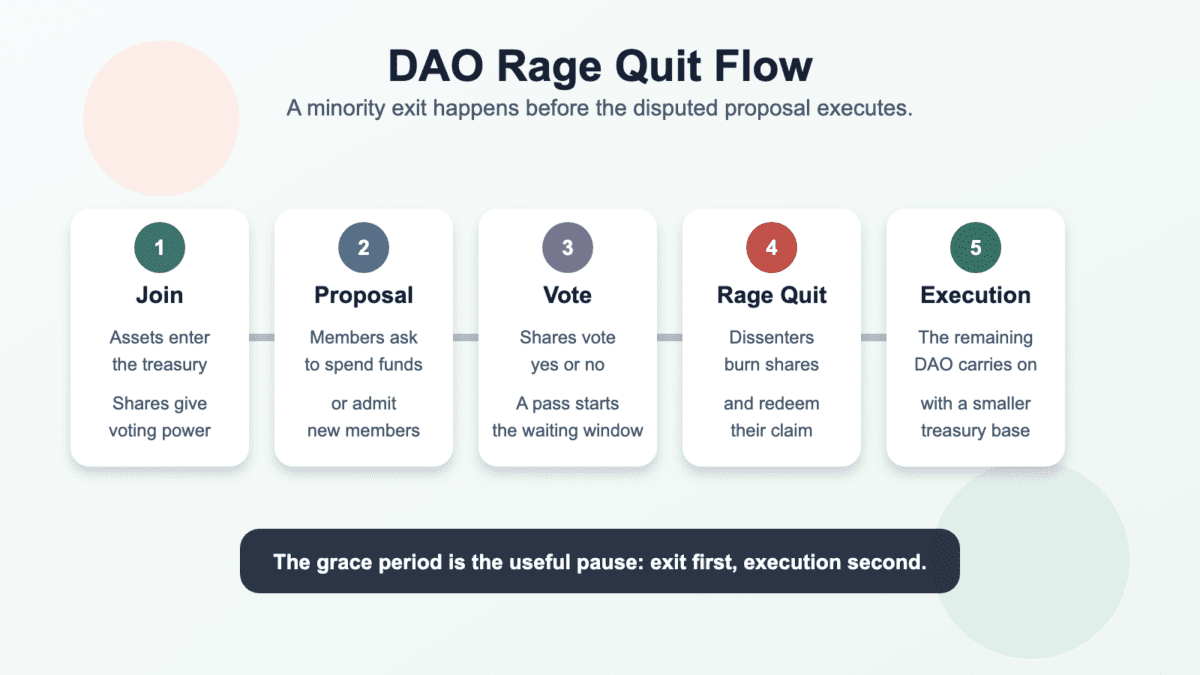
The grace period is the key. It gives minority members time to leave before the majority’s decision changes the treasury. Without that exit, a majority could push through spending that minority members strongly reject.
That makes DAO rage quit a minority-protection tool. It reduces the need to trust the majority forever. If the group changes direction, a member can take their slice of the shared assets and step away.
The tradeoff is treasury stability. A controversial proposal can trigger exits, drain liquidity, or pressure the DAO into compromise. The mechanism protects members, but it can make governance slower and more fragile.
DAO rage quit also changes social pressure. Members know that a bad proposal may not only lose a vote. It may push capital out the door. That threat can discipline governance, but it can also turn every major decision into a treasury stress test.
A rage quit can signal exhaustion, broken trust, or a turning point in sentiment. It does not prove a bottom, a top, or a clean buy signal by itself. Read it as pressure, not permission.
When many users rage quit after long losses, the market may be near emotional fatigue. Sellers stop arguing. They leave. That can look like capitulation, but markets can stay miserable after everyone posts their farewell speech.
The reverse can also appear near hype. If a community mocks every seller and frames any exit as weakness, the mood can start to look like a top signal. The crowd may be more confident than the liquidity can support.
In a token community, rage quits can show that trust is breaking. Maybe the roadmap drifted. Maybe insiders sold. Maybe support vanished. When exits become public and contagious, the project has a credibility problem, not only a price problem.
In a DAO, rage quits are even more concrete. They can reduce treasury assets, shrink the voting base, and force the remaining members to confront whether the disputed proposal is worth the cost.
In meme-coin markets, the signal can be uglier. Some launches feel player-versus-player because every exit needs someone else to buy the other side. Rage quit chatter there often means the social game has stopped being fun for the slower wallets.
You avoid a bad rage quit by separating the problem from the impulse. The goal is not to stay forever. The goal is to leave for the right reason, in the right order.
First, name the problem. Is the asset broken, the platform broken, the position too large, or your patience gone? Those answers lead to different actions. Selling a coin does not fix a compromised wallet. Closing an app does not fix a poor trading plan.
A bad rage quit usually bundles every problem into one dramatic move. A better exit unbundles them. You may need a smaller position, cleaner records, a new wallet, fewer apps, or a break from CT. Those are not the same fix.
Use this checklist before making a non-security exit:
That last point is not etiquette theater. Public rage can make you defend a bad decision just because you said it loudly. Crypto screenshots have a long memory and no interest in your character development.
If there is an active account, wallet, or contract risk, skip the pause. Secure funds, revoke approvals, rotate credentials, and document what happened. Calm is useful. Speed is better when the risk is live.
Rage quit sits near several other crypto terms. The best ones help you tell whether someone exited too early, stayed too long, or got caught in a market where someone else needed them as the buyer.
Two nearby ideas help most once the basic rage quit meaning is clear:
Other terms in the same cluster describe timing and market structure. One term may show who sold first. Another may show who bought too late. Another may capture the mood after everyone is tired of losing.
If you are sorting a real exit, map the behavior first. Did the person sell, stop posting, migrate funds, or use a governance exit? Each answer changes the read.
That is why slang can be useful and risky at the same time. It compresses a messy behavior into one quick label. It also tempts communities to mock the person instead of checking whether the exit was actually reasonable.
Use these terms as labels, not verdicts. They can describe behavior quickly, but they cannot tell you whether the exit was smart.
Rage quit in crypto means exiting a position, platform, project, or DAO after frustration, loss, burnout, or broken trust. Most users mean an angry sell or public exit, but DAO users may mean a formal on-chain withdrawal right.
Rage quit is not the same as panic selling. Panic selling describes fear-driven trade execution, while rage quit can include selling, closing accounts, leaving communities, or exiting DAO governance after frustration.
A DAO rage quit is a governance exit that lets a member leave and redeem a proportional share of treasury assets. The member gives up future governance rights, but avoids staying in a DAO after a decision they strongly reject.
A rage quit can be a good decision when it removes real risk, broken trust, or an oversized position. It is weaker when the only trigger is anger after a normal market move.
People say rage quitting is a bottom signal because mass exits can show exhaustion after a long decline. It is only a clue. Markets can keep falling after users give up, so the phrase should not become a trading system.
Avoid rage quitting a crypto position by writing down the reason for exit, reducing size before selling everything, and pausing if there is no active security risk. If funds are at risk, secure them first.
If you feel like rage quitting crypto, slow the decision down unless funds are in danger. A rushed exit can be as expensive as a rushed entry.
Use a short order of operations:
That split is where the answer usually appears. If the platform is the problem, move venues or funds. If the asset thesis failed, exit the asset. If the position size is the problem, cut exposure. If the whole market is making you miserable, stepping away may be the cleanest trade.
Keep the note boring. “I am leaving because the team broke X promise” is useful. “I hate this market” may be honest, but it gives future you almost nothing to review.
Also save the admin work for before the goodbye post. Export records, note cost basis where you can, and make sure you can still access accounts after withdrawals settle. Future tax season has no sympathy for dramatic timing.
Rage quit works as a phrase because it admits the emotion. It should not be the whole process. Let the feeling alert you, then make the exit boring enough that future you can live with it.