Physical Address
304 North Cardinal St.
Dorchester Center, MA 02124
Physical Address
304 North Cardinal St.
Dorchester Center, MA 02124


Understand the risk engine before using crypto leverage.
A risk engine in crypto is the automated system that checks collateral, price feeds, leverage, liquidity, and rules before allowing, restricting, or liquidating positions.
You usually meet the risk engine through visible labels: liquidation price, health factor, margin ratio, account equity, warning alerts, insurance fund, or ADL. Those labels are the dashboard. The engine is the rule system underneath. Its first job is to stop bad debt from spreading through the venue or protocol.
A risk engine in crypto is the automated guardrail behind margin, perpetual futures, DeFi lending, and other collateral-based products. It watches the account or position, compares it with venue or protocol rules, and decides whether the next action is allowed.
The action can be quiet. A trade opens, an order is accepted, or a dashboard shows a safe health factor. It can also be loud: a warning, a blocked order, a forced margin increase, partial liquidation, full liquidation, insurance fund use, or auto-deleveraging. The engine usually checks these moving parts:
The engine is counting risk for everyone in the product, not only the account on the screen. A perps venue has counterparties and an insurance fund. A lending market has borrowers, depositors, liquidators, and collateral parameters. If one position slips below the required backing, the loss can stop being private.
So a risk engine is closer to market plumbing than a personal risk coach. A trader may see a liquidation as a personal failure or platform betrayal. The risk engine sees a position that crossed a rule threshold and needs to be reduced before losses spill into the wider system.
In practice, the same idea appears under different labels. On a centralized exchange, it may sit behind margin ratio, risk tiers, and liquidation price. In DeFi lending, it may show up as health factor and liquidation threshold. On an onchain perp DEX, it may involve smart contracts, keepers, mark prices, and backstops. The label changes, but the job stays the same: measure whether risk can stay open.
A crypto risk engine reads a position by turning several live inputs into one account-health view. The exact formula changes by venue, but the logic is familiar: how much risk is open, what backs it, and how fast that backing can disappear.
A simple leveraged trade shows the gap. If you post $1,000 of collateral and open a 5x position, you may control roughly $5,000 of exposure before fees and funding. A 10% adverse move is not a 10% problem for your collateral. It can be about half the account buffer before costs. The risk engine then checks the position against its rule set:
| Input | What It Tells The Risk Engine |
|---|---|
| Mark Price Or Oracle Price | The price used for account-health checks, not always the last traded price. |
| Collateral Value | How much backing the account has after haircuts or eligibility rules. |
| Position Size | How much exposure the user has open. |
| Leverage Or Debt | How quickly losses can consume the buffer. |
| Fees And Funding | Costs that can reduce the account even if spot price stalls. |
| Margin Mode | Whether risk is isolated to one position or shared across the account. |
The calculation keeps moving. A liquidation price can move because funding gets charged, collateral falls, a cross-margin position opens elsewhere, or the mark price changes while the last trade on your favorite chart looks calmer.
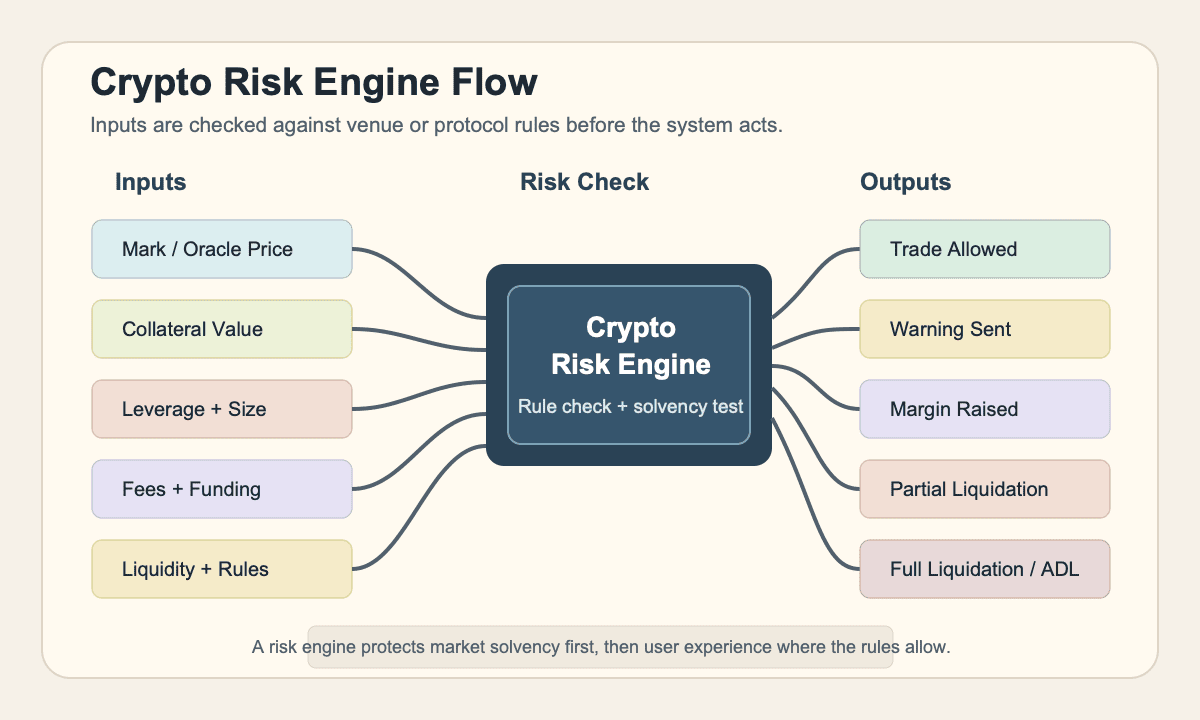
So the screen number is not a promise. It is a current estimate from a moving calculation. If you do not know which price source, collateral haircut, margin mode, or fee model feeds that number, you are trusting a black box with very sharp corners.
A crypto risk engine protects the market first because someone must absorb losses if a position falls below its collateral. That “someone” might be lenders, liquidity providers, counterparties, an insurance fund, or the venue itself.
For the user, that can feel backwards. The interface may show helpful alerts and safety colors, but the deeper purpose is solvency. The engine exists to prevent a losing account from turning into bad debt that other users or the platform must cover.
The platform can still design a fairer user experience:
Perpetual futures make this easy to miss. One trader’s loss can become another trader’s settlement risk if the system cannot close the losing side fast enough. In crowded perps markets, PVP mechanics make the risk feel personal because every forced exit happens inside a market where other participants may be hunting weak positioning.
But fairer alerts and cleaner rules do not change the priority. System first, user second. If the risk engine waits too long, the loss can move from one account into the shared market structure. A liquidation can be fair by the rules and still be painful: the user wanted more time, while the engine wanted the debt contained.
When a risk engine triggers liquidation, it starts reducing risk because the account no longer meets the required margin, collateral, or health threshold. The exact sequence depends on the product, but the goal is the same: bring the system back inside its solvency rules.
Some venues warn first. Some cancel risk-increasing orders. Some liquidate only enough to restore the account above a threshold. Others close the full position when the buffer is gone or the product design requires it. The sequence often looks like this:
| Risk-Engine Action | What The User Sees |
|---|---|
| Warning Or Health Alert | A margin ratio, health factor, or liquidation warning changes. |
| Order Restriction | New risk-increasing trades may be blocked or canceled. |
| Partial Liquidation | Part of the position or collateral is sold to restore account health. |
| Full Liquidation | The position is closed because the remaining buffer is too thin. |
| Insurance Fund Use | A backstop covers losses that account collateral cannot cover. |
| ADL | Profitable opposing positions may be reduced as a last resort. |
Aave Labs reported in December 2025 that the protocol had processed nearly 295,000 liquidations worth more than $3.3 billion since launch. The design described there gives a useful DeFi example: liquidations can use dynamic repayment amounts and variable incentives instead of one fixed close factor. Modern risk engines can be staged, parameter-driven systems rather than one blunt red button.
Forced exits still need a market. If liquidators, order books, or auctions cannot absorb the position cleanly, the exit can be worse than the neat liquidation number users saw earlier. That is where exit liquidity becomes more than slang. It is the difference between closing risk and pushing price through thin demand. ADL is the final unpleasant branch in some derivatives systems, so know how the queue works before you trade size.
Mark prices and oracles matter to a crypto risk engine because the engine may not use the last trade you see on a chart. It uses the reference price defined by the venue or protocol.
The reference price can protect users from noisy single-venue wicks. It can also confuse them when the liquidation trigger does not match the candle they were watching. The chart may show one last traded price, while the risk engine checks an index price, mark price, or oracle feed. The difference is usually intentional:
Mark prices, indexes, and oracles reduce some manipulation paths, but they do not make liquidations automatically fair. Oracles can lag. Indexes can be stressed. Thin markets can move faster than updates. A stale or manipulated input can make the engine react late, early, or at a price users dispute.
A useful warning: do not compare only your stop-loss price with the chart candle. Compare the venue’s liquidation rules with the mark or oracle source that actually feeds the risk engine. That check is boring until it saves you from arguing with a dashboard after the position is already gone.
CEX, DEX, and DeFi lending risk engines differ by where the rules run, who can inspect them, and who executes liquidation. The same idea appears in each place, but the trust model changes.
A centralized exchange can run a fast internal risk engine. It may offer smooth alerts and deep venue liquidity, but users depend on the exchange’s accounting, matching engine, policy, and disclosures. The user sees the result, not always the full rule path.
| Venue Type | How The Risk Engine Usually Works |
|---|---|
| Centralized Exchange | Internal systems track account equity, margin, mark price, insurance funds, and liquidation rules. |
| Onchain Perp DEX | Smart contracts, keepers, mark prices, and liquidity backstops coordinate liquidation. |
| DeFi Lending Protocol | Health factor, collateral thresholds, oracle prices, and liquidator incentives decide when collateral can be sold. |
| Portfolio Margin Venue | Several positions may be measured together, so one hedge can affect another risk limit. |
Onchain perps and DeFi lending expose more of the machinery. Smart contracts, oracle feeds, liquidation bots, governance parameters, and public health metrics may be visible. But visibility does not remove risk. It just moves the work from “trust the venue” to “understand the dependencies.”
Spot holding works differently. A spot holder can be down badly and still keep the asset if they control it and no loan or margin rule forces a sale. A leveraged account does not have that luxury. The clean contrast with bagholder risk is choice versus forced exit: a bagholder may be stuck by choice or liquidity, while a leveraged trader can be forced out by rules.
Strip away the labels, and the user-side checks get simpler:
In DeFi lending, health factor is the beginner-friendly label to know. It compares collateral strength with borrowed value and protocol thresholds. If it falls too low, liquidators may repay part of the debt and take collateral at an incentive. The point is not “CEX bad, DeFi good” or the reverse. Ask which inputs you can verify, how liquidations execute, and who absorbs losses when the engine cannot close risk cleanly.
A crypto risk engine can fail or frustrate users when its inputs, timing, incentives, or backstops break under stress. Not every bad outcome means misconduct. Some are design limits showing up exactly when markets stop being polite.
The common failure modes are practical:
Stop-loss orders deserve special caution. They can reduce risk, but they are not a liquidation shield. During a fast move, an order may trigger late, fill partially, execute at a worse price, or fail under venue-specific bands.
Position sizing makes every weakness sharper. A trader who goes full port leaves little room for fee drift, mark-price moves, oracle lag, or one ugly wick. The risk engine does not care that the trade thesis had a great thread attached.
> Thin buffers turn small design limits into account-level problems.
Cross margin adds another trap. It can delay liquidation by using a wider account balance, which feels helpful. But it can also let one bad position consume funds you thought were separate.
DeFi adds layered dependencies. A lending account may depend on the collateral token, oracle, liquidation incentive, liquidator speed, chain congestion, governance parameters, and market depth. Being right about the asset can still lose to being wrong about the stack around it. Keep the view calm but skeptical. A risk engine can be well designed and still produce harsh outcomes during stress.
Traders should check a crypto risk engine before using leverage, borrowing against collateral, or depositing into a product that can force-sell assets. The goal is not perfect safety. It is knowing what can change while your position is open.
Start with the questions the interface often hides:
Then match those answers to your own position. A small isolated trade with a clear mark price and wide buffer is a different risk from a large cross-margin position using volatile collateral. A DeFi loan with a healthy buffer can still change quickly if collateral liquidity thins or borrowing costs jump.
Do not stop at the liquidation price. Check the inputs behind it. If a platform cannot explain the price source, close factor, backstop, ADL rule, or health-factor math in plain language, size down or leave. Basic hygiene counts when a product can close your position without asking how your day is going.
No. A liquidation engine is usually one part of a broader crypto risk engine. The risk engine checks collateral, prices, leverage, account health, limits, and backstops. Liquidation is one action it may trigger when the position fails those checks.
A risk engine can reduce some disorderly losses by enforcing collateral rules, but it does not protect traders from losing money. Its first job is to protect the venue, protocol, lenders, or counterparties from bad debt.
A risk engine can liquidate before your chart hits a stop-loss because it may use mark price, oracle price, account equity, fees, funding, or margin rules instead of the last traded price you are watching. A stop-loss also needs execution, and fast markets can make that messy.
Last price is the most recent trade on a venue. Mark price is the reference price the risk engine uses for account-health checks. Mark price often blends broader market data so one noisy trade does not decide liquidation by itself.
A DeFi lending risk engine uses health factor to compare collateral strength with borrowed value and protocol thresholds. When the health factor falls below the required level, liquidators may repay debt and take collateral according to the protocol’s rules.
Yes. A risk engine can struggle during a flash crash if prices move faster than updates, liquidity vanishes, or liquidators cannot act quickly enough. The engine may still follow its rules, but fills, alerts, and backstops can perform worse under stress.
Start with the product’s risk rules before you open the position. If you cannot find the liquidation source, margin threshold, oracle design, or ADL policy, you do not understand the trade yet.
Then decide whether the position deserves size. A crypto risk engine can only follow its own inputs. It will not pause because your thesis is early, your collateral almost covers the move, or the dashboard looked calm ten minutes ago.
Use a small checklist before adding size:
Each answer changes the real buffer. Funding can shrink it while price stalls. A mark-price gap can move it before the last trade catches up. Cross margin can spend balances you were treating as separate.
If those answers are hard to find, do not assume the missing details are harmless. Opaque rules usually show up at the worst moment: when volatility is high, bots are faster than you, and support cannot rewrite the engine’s decision after the fact.
Then test your own assumptions. Ask what happens if the mark price gaps, fees hit, collateral falls, or liquidity thins. If the answer is “the risk engine handles it,” keep reading. That sentence is where expensive surprises like to hide.