Physical Address
304 North Cardinal St.
Dorchester Center, MA 02124
Physical Address
304 North Cardinal St.
Dorchester Center, MA 02124


A plain-English guide to SLOP trade slang, token confusion, and exit risk.
A SLOP trade is a short-term crypto bet on low-effort AI content, meme-coin attention, or a specific SLOP token.
The phrase is messy because crypto uses “slop” in several ways at once. It can mean AI-generated junk content, low-effort meme-coin hype, a ticker on a DEX, or a trade that depends on attention arriving faster than risk checks.
Do not start by asking whether SLOP trade is “real” in the abstract. First ask which SLOP, which chain, which contract, and which crowd is pushing the trade.
SLOP trade means a context-dependent crypto trade around “slop” as a meme, AI-content label, or token ticker. The phrase is informal, so the first job is to identify which meaning someone is using.
In one feed, SLOP trade may refer to buying a token with the ticker SLOP. In another, it may mean trading the broader AI-slop meme, where low-effort AI art, bot-written posts, and absurd narratives become market fuel. In a risk conversation, it can simply mean chasing a thin, messy attention trade.
Before reading a chart, separate three questions:
The phrase helps only after you separate the meanings. It becomes dangerous when people pretend it is precise.
Think of SLOP trade as a warning label first. It tells you the asset may depend more on social velocity than durable demand. It also tells you to slow down before assuming a chart, ticker, or meme refers to the same thing everyone else means.
> A SLOP trade is not an official trading method. It is slang for trading a slop-themed token or a low-quality attention narrative.
Older non-crypto meanings of “slop trade” also exist, including historical clothing uses and generic messy-market slang. In crypto, the phrase usually points to AI content, meme coins, token tickers, or fast DEX speculation.
SLOP trade became a crypto phrase because online markets now turn jokes, AI content, and low-effort narratives into tradable objects. A phrase can start as an insult, then become a ticker, a Telegram slogan, and a DEX chart before the joke cools down.
“Slop” usually means something low quality. In AI culture, it often means mass-produced content that looks polished but feels empty. In crypto, that same idea maps neatly onto bot posts, copy-paste token launches, recycled memes, and communities that run on attention more than substance.
AI slop can work as promotion fuel because volume looks like activity. A feed full of generated images, polite shill posts, and repeated token slogans can make a tiny coin feel bigger than it is.
That does not mean every AI-made meme is a scam. It means AI content can blur the line between real demand and manufactured buzz. A token can wear an AI hat and still be a puddle.
Digital slop is often a criticism of low-effort coins, NFTs, posts, and launches. It is not a technical category. It is a value judgment from people tired of seeing the same chart, joke, and promise recycled with a new ticker.
CT slang carries that shorthand quickly. Crypto social feeds compress meaning, so one dismissive phrase can carry culture, risk, and sarcasm in the same sentence.
Use the label as a clue, not a verdict:
When someone calls a token a slop trade, ask what they mean. Are they talking about AI content, a specific SLOP ticker, weak token quality, or a short-term rotation?
SLOP trade is broader than one token, and that is where beginners get caught. Similar names can point to different assets, chains, pools, trackers, or community jokes.
One token-specific origin example shows the speed. Crypto Briefing reported in October 2024 that an AI-linked SLOP meme coin surged 56,000% within 24 hours of creation after a launch narrative involving Namshub. That story can explain one SLOP result, but it should not define every SLOP trade you see later. Use this table to separate the most common collisions before looking at any chart.
| Term | What To Check |
|---|---|
| Slop | Whether the speaker means low-quality AI content, low-effort crypto content, or a general insult. |
| Digital slop | Whether the phrase is criticism, not proof that a token is fraudulent or AI-generated. |
| SLOP | The exact ticker, contract address, chain, pool, and official links. |
| AI Slop | Whether it is a separate token, theme, or search result from the SLOP ticker you saw. |
| slop.club | The project name, token mapping, chain, and whether the page matches the trade you plan to inspect. |
| SLOP trade | Whether people mean a token trade, an AI meme trade, or a risky attention rotation. |
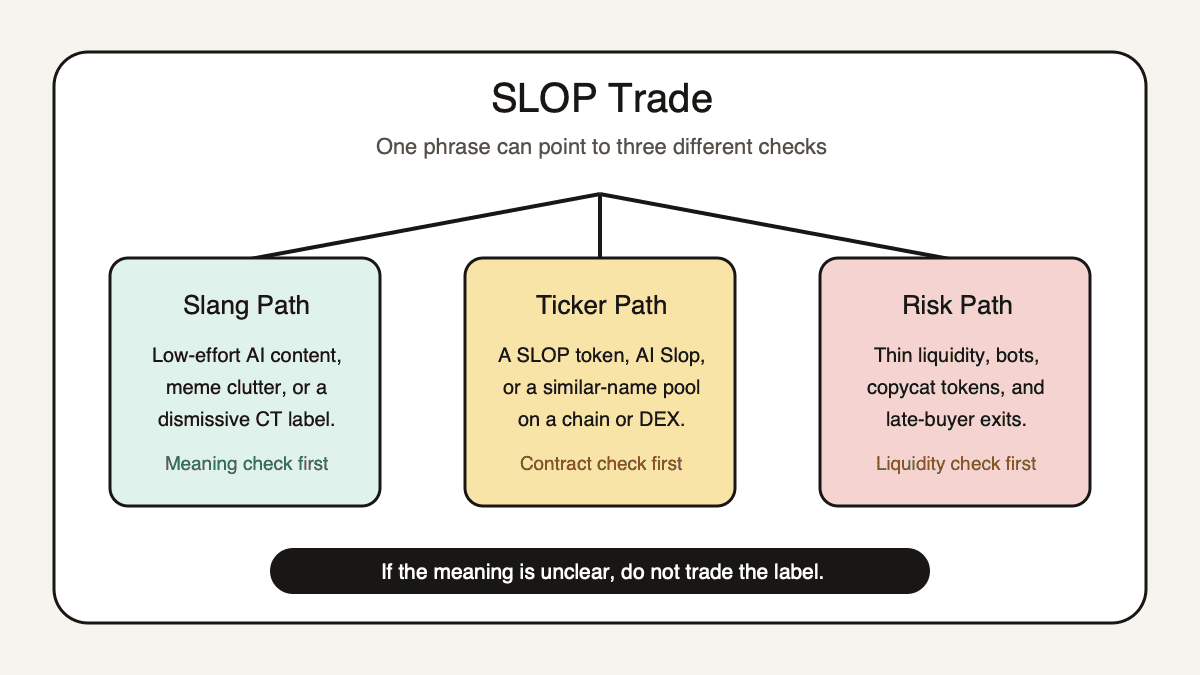
Start with identity. Names are cheap in crypto. The same label can appear on multiple chains, while fake pools and copycat tokens borrow attention from whatever phrase is moving.
So start with the contract, not the meme. Then check the chain, liquidity pool, official links, and whether the token you found matches the source that started the conversation.
A SLOP trade usually starts with attention before it has much market depth. The meme, AI post, ticker, or social dunk comes first, then liquidity and price action try to catch up.
The path often looks familiar:
This flow is common in crypto trenches, where traders watch new launches, wallet moves, and social pressure before a token has broad visibility.
The attention spike is the moment the phrase becomes tradable. It might be one viral post, a token page, a creator story, or a wave of people mocking “digital slop” while still watching the chart.
Attention is useful, but it is not demand by itself. A token can trend because people are buying, because bots are active, or because everyone is staring at the same tiny pool.
The liquidity test asks whether paper interest can survive real trades. Tiny pools can produce violent candles, ugly fills, and exits that move price far more than the chart suggests.
Slippage is the quiet fee in the room. If a small swap changes the expected output too much, the trade may be less liquid than the feed makes it look.
The holder churn begins when early excitement meets selling pressure. Early wallets may trim, new buyers may chase, and the community may discover that attention fades faster than bags.
Rarely, a slop-themed coin keeps a real community. More often, the trade becomes a fast test of whether enough buyers arrive after the first holders want out.
SLOP trades are risky because low-liquidity attention markets punish slow checks. The chart can move before you know who controls supply, where liquidity sits, or whether the crowd is real.
Execution risk comes first. A tiny pool can show a huge candle because one small buy moved the price, not because deep demand arrived. The next buyer may get a worse fill, then discover that selling the same size pushes the pool back down.
Information risk comes next. Early wallets, deployers, bots, and paid promoters can understand the setup before public buyers do. By the time the trade reaches a wider feed, the best entry may already be gone.
The risk stack is usually bigger than price volatility:
Social risk finishes the job. The louder the feed gets, the harder it can feel to ask basic questions about contract control, liquidity, or who already bought. That pressure is part of the trade, not noise around it.
A SLOP trade can also create the classic bagholder problem. Someone buys after the story peaks, watches liquidity fade, then holds because selling would make the loss real.
Not every failed slop-themed coin is a rug. Some simply lose attention. But a quiet abandonment pattern can still act like a soft rug when insiders or early holders leave while public buyers keep hoping.
> If the trade needs urgency, loyalty, and silence around risk, the setup is already telling you something. Real opportunities can survive a few minutes of verification.
Checking a SLOP trade means proving the asset is the one you think it is, then testing whether the market can support your entry and exit. The meme comes last.
Start with identity and mechanics before price. A token can have the right name and still be the wrong contract. A pool can exist and still be too thin for your size.
Use this checklist before connecting a wallet or signing a swap.
| Check | Risk It Catches |
|---|---|
| Contract address | Copycat tickers can use the same name while pointing to a different token. |
| Chain and pool | Similar tokens can exist on Solana, Ethereum, Base, or another network. |
| Official links | Random posts can push fake routes, fake sites, or stale token pages. |
| Liquidity depth | A tiny pool can make small buys look like explosive demand. |
| Slippage preview | Bad fills can turn a winning idea into a losing execution. |
| Holder concentration | A few large wallets can crush exits by selling into new demand. |
| Deployer behavior | Wallet history can reveal repeated launches, supply moves, or suspicious control. |
| Sell route | A paper gain is not profit if your exit breaks the price. |
Wallet safety belongs in this section, not after the trade. Use a separate trading wallet, review approvals, and stop when a signature prompt does not match the action. CryptoProcent’s wallet setup hub fits when the problem is custody, approvals, and safer DEX interaction.
Then check your own size. A trade that looks liquid for a tiny test swap may fail for the position you actually want to enter or exit.
A SLOP trade is usually narrower than an AI narrative trade. One focuses on a slop-themed token or low-effort attention asset, while the other follows a broader market story around AI crypto.
That difference changes the risk. A broader AI trade may involve infrastructure tokens, agent coins, data projects, or larger assets with deeper markets. A SLOP trade may depend on a single joke, one ticker, one DEX pool, and a crowd that can vanish by dinner.
Ask which exposure you actually mean:
The first version is mostly a token-identity problem. You need the exact contract, chain, pool, liquidity, and holder map. A funny AI story does not save you if the market is too thin to exit.
The second version is a narrative problem. You still need risk checks, but you are judging whether the wider AI theme has enough depth to last beyond one viral chart. That may mean comparing actual usage, market depth, token design, and whether the story keeps attracting new attention after the first wave.
The third version is pure attention risk. It can move fast because the meme is easy to understand, but it can fade just as quickly once the joke stops feeling fresh.
AI involvement can make a story louder. It does not automatically create liquidity, utility, fair distribution, or staying power. The word “AI” can attract attention, but attention is not a balance sheet.
Use the split before you size the trade. If you are buying the AI theme, compare market depth, usage, token design, and narrative durability. If you are buying a SLOP trade, check whether the specific pool can survive real selling.
A SLOP trade turns into exit liquidity when late buyers become the route earlier holders use to leave. That can happen even when the meme is funny and the chart still looks alive.
The shift is often subtle. The feed still looks excited, but the trade has changed from discovery to distribution. Early wallets no longer need to convince everyone forever. They only need enough fresh demand to sell into.
The warning signs are usually visible:
None of those signs proves fraud by itself. Together, they show a market where timing matters more than belief. If the price already moved hard and the pool cannot absorb normal selling, late entries are funding someone else’s exit.
This is the exact setting where exit liquidity stops being a meme and becomes the trade structure. New demand lets earlier positions sell, and late buyers discover that “up only” was mostly a distribution plan.
Paper gains make the trap harder to see. A wallet may show profit, but the exit route may be shallow enough that selling your full size wrecks the price.
> The fix is not cynicism. It is order. Check liquidity, holders, sell routes, and social timing before you let the joke become your cost basis.
Related SLOP trade terms help decode the posts around the chart. Keep them selective, because a glossary dump is not risk management.
Start with the language layer. SLOP trade posts often assume you already know where the joke came from, why a ticker is spreading, and what kind of crowd is watching the pool. If you miss that context, a warning can look like hype and hype can look like a warning.
Two pages cover the context around most SLOP trade posts:
After that, sort the rest by the problem in front of you. Post-hype holding is a different issue from quiet abandonment, and both are different from a hard claim about blocked selling or liquidity pulls.
Do not use every nearby phrase as a shortcut for “bad token.” That blurs the useful distinctions. A project can have sloppy marketing without blocked selling, and a funny meme can still have brutal liquidity math.
Use the term that matches the risk. If the problem is language, decode the slang. If the problem is identity, verify the token. If the problem is exit risk, stop reading slogans and inspect the pool.
SLOP trade is not a formal trading strategy. It is informal crypto slang for trading a slop-themed token, AI-slop narrative, or low-quality attention asset.
No. SLOP trade can include AI Slop, but it can also refer to a SLOP ticker, a meme-coin rotation, or a broader low-effort hype trade.
No. Many SLOP-related searches point to Solana-style meme coins, but similar names, tickers, and slop narratives can appear on other chains.
Yes, some traders can make money on SLOP trades, usually by entering early and exiting before liquidity weakens. Beginners often see the trade later, when risk is worse.
SLOP trade posts call meme coins digital slop when they see them as low-effort, repetitive, attention-driven, or detached from real utility. It is criticism, not proof of fraud.
Before a SLOP trade, check the exact contract address, chain, official links, liquidity pool, holder concentration, and sell route. Never trust a ticker name by itself.