Physical Address
304 North Cardinal St.
Dorchester Center, MA 02124
Physical Address
304 North Cardinal St.
Dorchester Center, MA 02124


A plain guide to smart account recovery, gas, and wallet risk.
A smart account is a blockchain account controlled by smart contract logic instead of only one fixed private key.
That can make a crypto wallet feel more like a modern app. A smart account can support passkeys, recovery rules, spending limits, transaction batching, session keys, and sponsored gas. But the tradeoff is not free magic with a nicer login screen. Code, recovery setup, upgrade rules, gas routes, and dapp support become part of the custody question.
A smart account in crypto is a wallet-style blockchain account with rules written into smart contract code. The account can decide which signer is valid, which actions are allowed, how fees are paid, and whether extra checks are needed before a transaction runs.
The official ERC-4337 smart accounts page frames smart accounts as smart contract-based wallets with custom logic for authentication, authorization, fee payment, nonce management, and execution. That is the useful technical anchor, minus the headache.
The definition has a practical use: a smart account is part of the wallet’s control system, not just a prettier login. If the account rules accept a passkey for one action and a multisig for another, those rules decide what happens before the chain sees the final transaction.
Keep these labels separate:
The same wallet screen can hide different account models. One account may move with a simple seed phrase. Another may depend on a contract deployed by a wallet factory, a signer stored on a device, and recovery steps created before trouble starts.
Keep the boundaries clear. A smart account is a wallet-control model. It is not an exchange login, a legal contract, or automatic safety just because the word “smart” showed up in the brochure.
It is also not always a normal seed-phrase wallet. Some smart wallets use passkeys, recovery keys, guardians, multisig signers, or product-specific recovery flows. The account may be self-custodial, but the recovery path decides how that control works when life happens.
A smart account changes who can authorize actions and how the account reacts before funds move. A regular EOA wallet usually relies on one private key or seed phrase. If that key signs, the chain accepts the transaction.
A smart account can add rules between intent and execution. That extra layer can help with recovery, limits, multisig approval, or gas handling. It can also add new failure points if the wallet app, chain, signer, or account code does not support what you are trying to do.
For broader custody context, compare the smart account model with the wider crypto wallet category before assuming every wallet label means the same control path.
| Account setup | What changes for the user |
|---|---|
| Regular EOA wallet | One private key or seed phrase usually controls signing, recovery, and portability. |
| Smart account | Smart contract rules can control signing, spending limits, recovery, gas, and permissions. |
| Smart wallet app | The app hides some complexity, but its recovery and chain support rules still matter. |
| Hardware wallet | The device protects the key, but the account is usually still an EOA unless paired with smart account logic. |
| Multisig wallet | Several signers may need to approve actions, often through a smart account setup. |
| Exchange account | The exchange controls wallet infrastructure, while you control account access under its terms. |
The user-facing difference shows up when something goes wrong. With an EOA, the question is often “Do I still have the seed phrase?” With a smart account, the question becomes “Do I still control the signer and the recovery rules for this exact account?”
That is a bigger checklist, but it is also the point. Smart accounts move wallet design away from one brittle key and toward programmable controls. The price is that you need to understand the program you are trusting.
A smart account can make wallet actions more flexible because the account can enforce custom rules before execution. Instead of every transaction being a raw signature from one key, the account can ask whether the action fits its policy.
That policy can be simple or quite strict. A wallet might let a passkey approve small payments, require multisig for large transfers, sponsor fees for certain actions, or give a game session key limited permission for a short time.
Here are the main features users usually notice:
| Feature | What it helps with |
|---|---|
| Transaction batching | Combines steps like approve and swap into one smoother flow. |
| Spending limits | Caps how much can move without extra approval. |
| Multisig approval | Requires more than one signer for sensitive actions. |
| Social recovery | Lets trusted guardians help restore access under set rules. |
| Passkeys | Replaces some seed-phrase UX with device or cloud-backed authentication. |
| Session keys | Allows limited actions without signing every small interaction. |
| Sponsored gas | Lets an app or paymaster cover fees under specific conditions. |
| Token-paid fees | May allow gas payment in another token when supported. |
For app-heavy flows such as GameFi, session keys can reduce the pain of signing every small move. That does not mean the game gets unlimited access. A careful session key should limit action type, spending amount, duration, and target app.
The caveat is simple: a smart account can do these things only when the wallet, chain, app, and account design support them. A feature list is not a guarantee. It is a menu, and some menus have small print.
A smart account works by separating the signer from the account rules. The signer proves intent, then the smart account checks whether the requested action fits its programmed policy before anything executes onchain.
In the ERC-4337 model, the user creates an operation, often called a UserOperation, rather than sending a normal transaction directly. Infrastructure then helps route it for validation and execution.
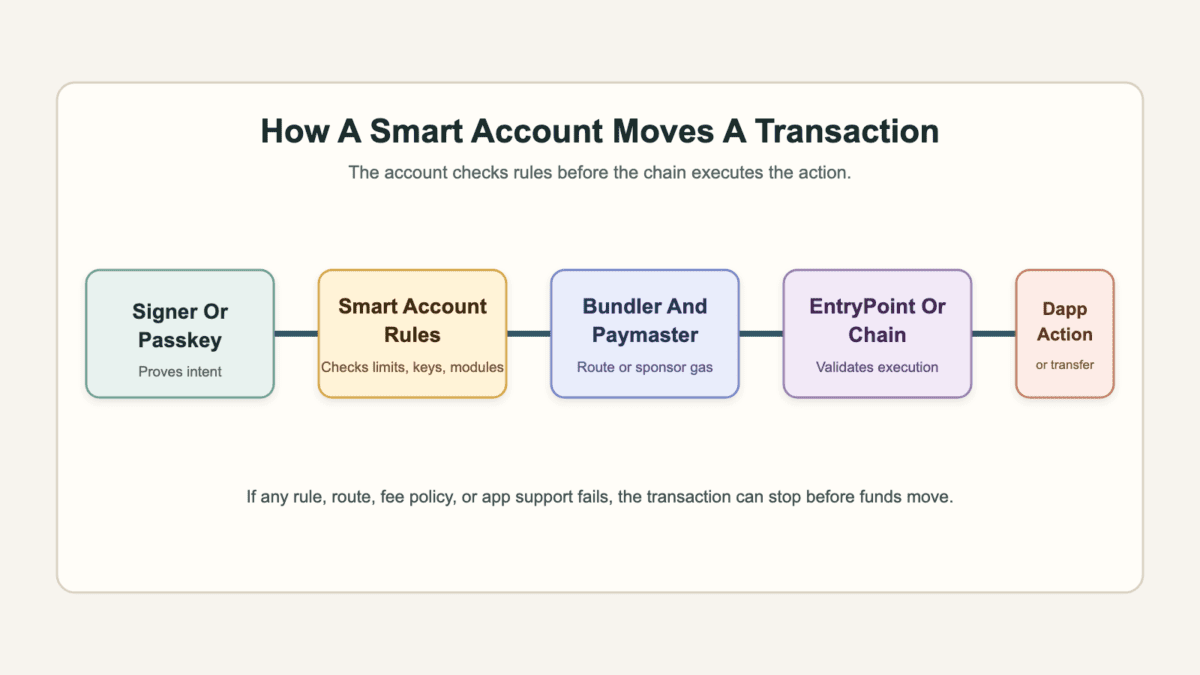
The signer is the thing that proves you approved the action. It could be a private key, passkey, hardware device, multisig signer, recovery key, or another method the wallet supports.
This is why “no seed phrase” does not mean “no signing risk.” The signer still matters. If it is lost, phished, reset, synced to the wrong cloud account, or replaced badly, the smart account may not accept your next action.
The smart account contract checks whether the action is valid for that account. It may verify the signer, enforce a spending limit, check a module, require another approval, or reject an action that breaks its rules.
That check is where smart accounts get useful. It is also where bad design can bite. A flawed module, unsafe upgrade, or confusing recovery rule can turn “programmable” into “please open a support ticket and breathe slowly.”
A bundler can package smart account operations and submit them for execution. A paymaster can sponsor gas or let another fee policy handle the cost.
Those roles are infrastructure, not charity. If the bundler route is down, the paymaster refuses the action, or the chain does not support the flow, the smart account transaction can fail or ask for native gas.
EIP-7702 is a newer path that can let an existing EOA behave more like a smart account by using delegated code. That can support account-like features without forcing every user through a brand-new account type.
For users, the plain point is enough: ERC-4337 smart accounts and EIP-7702-style delegation are different routes toward smarter wallet behavior. The wallet app should explain which route it uses, what recovery looks like, and how to exit.
Smart account recovery depends on the wallet’s signer and recovery design. A passkey smart wallet may not recover like a normal 12-word seed phrase wallet, even when both appear inside the same app.
That confusion is expensive. Users often assume “recovery phrase” means “import this anywhere and see the same account.” With some smart account products, the phrase or recovery key may restore a signer path, not recreate the exact account like an EOA seed phrase.
Before trusting a smart account, separate these pieces:
| Recovery method | What it does and does not restore |
|---|---|
| EOA seed phrase | Usually restores the same private-key account in compatible wallets. |
| Passkey | May restore signing access only if the device or cloud passkey is available. |
| Device-bound passkey | Can fail if the original device is lost and no backup path exists. |
| Cloud-synced passkey | Can help across devices, but cloud account access becomes part of recovery. |
| Recovery key | May restore access only if created before loss and used as instructed. |
| Social recovery | Lets guardians approve recovery, but guardian loss or collusion adds risk. |
| Multisig signer set | Protects against one lost key, but enough signers must remain available. |
A smart account can still be self-custodial. Ask whether you control enough of the signer and recovery path to move funds without a company account, original device, or support team rescuing you.
Use a small balance to test recovery-related steps before moving serious funds. If the wallet cannot clearly explain what happens after phone loss, cloud lockout, passkey reset, or signer compromise, that silence is a risk signal.
Smart account fees can feel smoother because the account may batch actions, use a paymaster, or let an app cover gas. But “gasless” usually means someone else pays under set rules, not that the chain stopped charging fees.
The fee path can break for mundane reasons. The action may be unsupported. The paymaster may reject it. The token used for fees may not be accepted. The recovery step may still require native gas. A bridge may not understand the signing flow.
Batching can also hide several steps behind one button. A single smart account action might approve a token, swap it, and send the result to another contract. If one step fails, the whole bundle may fail or return a confusing error.
Paymasters add another policy layer. They may sponsor fees for a specific app, chain, token, or user action. They can also refuse anything outside that policy, which is why a wallet can feel gasless in one flow and suddenly ask for native gas in the next.
When a smart account transaction fails, check these points first:
Tiny balances can become annoying here. A small amount of crypto dust may look moveable until fees, route limits, or recovery costs make the exit uneconomical.
The clean habit is to keep fallback gas where the wallet recommends it and test one outbound transfer. Smooth UX is great. A test send is better.
If the wallet cannot explain why a fee changed, slow down before adding more funds. A smart account should make routine use easier, not make basic exits feel like a support ticket.
A smart account can be safer than a regular wallet for some risks, but it does not delete wallet risk. It changes the shape of it.
The upside is that smart accounts can reduce single-key failure. Spending limits, multisig approvals, social recovery, session keys, and passkeys can all make one stolen or misplaced key less catastrophic.
The tradeoff deserves equal airtime:
| Risk reduced | Risk added or moved |
|---|---|
| One lost seed phrase can wipe out access. | Recovery rules can be misunderstood or set up badly. |
| One stolen key can drain the account. | Malicious modules or permissions can expand access. |
| Every action needs full wallet signing. | Session keys can be dangerous if limits are loose. |
| Large transfers may lack extra checks. | Upgrade control can change account behavior. |
| Users may approve too many repeated prompts. | App support and paymaster rules can block execution. |
Security also depends on defaults. A smart account with audited code, limited modules, clear upgrade control, and tested recovery can be strong. A smart account with vague recovery, hidden admin powers, and broad permissions can be a very polished way to make a bad mistake.
Watch for fake recovery help. If you lose access, scammers may offer “smart wallet recovery” services that ask for keys, passkeys, recovery phrases, or remote access. That is not recovery. That is a faster drain.
Smart account compatibility depends on the chain, wallet app, account contract, and dapp. An address showing assets on one app does not prove every bridge, dapp, or wallet can control that account.
The sticky point is signatures. Some dapps expect normal EOA signatures. Smart accounts may use contract-based signature validation, often discussed through EIP-1271. If the dapp does not support that path, the account may fail at connect, sign, swap, bridge, or claim time.
Chain support deserves the same caution. A wallet may support a smart account on one L2 but not on another. A bridge may show the address correctly, while the destination app still cannot accept the account’s signing method.
Portability is where many users get surprised. Importing a recovery phrase into another wallet may show a different account if the smart account address depends on a contract, factory, signer, chain, or wallet-specific setup.
Run these checks before you rely on a smart account:
So keep four ideas separate: the account address, the signer, the wallet app, and the supported chain. When people blur those together, funds start playing hide-and-seek.
The practical move is boring but effective. Test the exact app, chain, bridge, and recovery path you plan to use. A smart account that works beautifully in one app can still be the wrong home for funds you need elsewhere.
Before you keep real funds in a smart account, test the exit path. The goal is boring confidence: you can send in, send out, recover access, and use your intended dapps without guessing.
Do not move your whole balance into a new wallet setup because the first login felt pleasant. A full port into an untested smart account can turn a small UX experiment into a portfolio problem.
Start by deciding what job the account should do. Daily app use, small DeFi actions, team approvals, and long-term storage do not need the same setup. A smart account can be excellent for one job and overcomplicated for another.
Use this routine before you size up:
Also learn who can upgrade the account logic. Some smart accounts are immutable. Others can be upgraded or extended through modules, hooks, plugins, or admin controls.
That does not make them bad. It means the upgrade path belongs in your risk check. If the wallet hides it, ask why.
For larger balances, separate convenience from storage. A smart account used for frequent dapp actions can hold spending money, while colder funds stay in a setup with a recovery path you already understand.
Smart account examples appear in several wallet products, but the product name is not the guarantee. Safe, Coinbase or Base Smart Wallet, MetaMask smart account features, and Gnosis-related smart wallet tools all show the category in different ways.
The right way to read examples is descriptive, not promotional. Notice what each product asks you to trust, how recovery works, which chains it supports, and whether it can sign for the apps you use.
Safe-style setups usually put multisig and account rules near the center. Passkey wallets put onboarding and recovery design closer to the front. Familiar wallet brands may add smart account features behind screens users already know.
Those differences change the questions you ask before sending funds. A team treasury should care about signer sets and upgrade rules. A daily wallet should care about recovery, gas support, and whether favorite apps accept its signatures.
| Example | What To Notice |
|---|---|
| Safe | Multisig and account rules are central to the design. |
| Coinbase Or Base Smart Wallet | Passkeys and app-like onboarding are common user touchpoints. |
| MetaMask Smart Account Features | Smart account behavior can sit inside a familiar wallet brand. |
| Gnosis-Related Smart Wallets | The term often appears around mature contract-account tooling. |
Two users can both say “smart wallet” and mean different control models. One may mean a multisig treasury. Another may mean a passkey wallet for daily onchain payments.
So use examples to ask better questions, not to copy someone else’s setup. What signs? What recovers? What pays gas? What happens if the app disappears?
Related smart account terms are useful when they explain the account’s moving parts. They are noise when they become a wall of acronyms with no custody consequence attached.
Start with account abstraction. It is the broader design idea behind making blockchain accounts behave less like raw private-key locks and more like programmable accounts with rules. ERC-4337 is one route toward that. EIP-7702 is another path that can let an EOA act more like a smart account through delegated code.
The wallet terms sit closer to the user. An EOA is the older private-key account model. A smart wallet is the user-facing app. A passkey is one possible signer. A session key is a limited signer for specific actions. A multisig setup requires several signers before sensitive actions move.
Two neighboring CryptoProcent guides can help when the smart account conversation branches into adjacent risks:
The most useful habit is to translate each term into control. Who can approve? Who can recover? Who can upgrade? Who can stop the transaction?
Once you can answer those questions, the acronyms become less noisy. Still annoying, perhaps, but less noisy.
Start with a smart account only after you understand its recovery and exit path. Convenience is useful, but custody should be boring before it gets expensive.
That means starting with the parts that can strand funds. A login that works today is not enough. You also need to know how the account signs, how it recovers, what gas path it uses, and which apps can accept it.
Use these actions first:
Write the recovery path in one plain sentence: which signer opens the account, which backup restores it, and which fee token may be needed to leave. If that sentence is impossible to write, the setup is not ready for serious funds.
Then decide what job the account should have. A smart account may be excellent for daily dapp use, app payments, or team approvals. It may not be your best first choice for long-term cold storage until you have tested recovery and exit more than once.
Messy first tests are useful data. Confusing recovery wording, unsupported dapps, unclear fees, or missing exit instructions are not small details when the balance grows.
The clean rule is simple: make the smart account prove itself with small money before you trust it with large money.
No. A smart account is the programmable account onchain, while a smart wallet is usually the app or product that helps you use it.
The terms overlap in casual crypto talk. Still, the distinction helps when you compare recovery, app support, fees, and portability.
A smart account can enforce custom rules before a transaction runs. A regular EOA wallet usually relies on one private key or seed phrase to authorize transactions.
That extra logic can support limits, recovery, batching, session keys, and gas sponsorship. It can also add code and compatibility risk.
A smart account may or may not use a seed phrase. Some use passkeys, recovery keys, social recovery, multisig signers, or wallet-specific recovery flows.
If a smart wallet gives you a recovery phrase, confirm exactly what it restores. It may not behave like a normal 12-word EOA seed phrase.
You can recover a smart account only if its recovery setup covers that loss. Cloud-synced passkeys, recovery keys, guardians, or multisig signers may help, but only when configured correctly.
Do not assume support can restore access later. Test recovery with low value while you still control the account.
A smart account can pay gas in USDC or another token only when the wallet, chain, dapp, and paymaster support that flow. It is not universal.
If the paymaster rejects the action or the chain needs native gas, the transaction may fail or ask for native funds.
Traders can use a smart account for active dapp use if recovery, fees, and compatibility are tested. They should avoid parking a full trading balance there on day one.
Use small transfers first, keep fallback gas, and separate active funds from long-term holdings until the setup feels boring.