Physical Address
304 North Cardinal St.
Dorchester Center, MA 02124
Physical Address
304 North Cardinal St.
Dorchester Center, MA 02124


A plain guide to smart wallet recovery, gas, dapp support, and safety tradeoffs.
A smart wallet is a crypto wallet whose account behavior is controlled by smart contract logic instead of only one fixed private key.
That can make crypto feel less like key management homework. A smart wallet can support passkeys, recovery rules, spending limits, transaction batching, session keys, and sponsored gas. But it also makes code, upgrades, recovery setup, gas routes, and app support part of the custody question.
The real check is simple: can you recover it, move funds out, use your target dapps, and understand who can approve actions when something breaks?
A smart wallet in crypto is a user-facing wallet that uses smart contract rules to control account behavior. The wallet may still look like a normal app, but the account can check extra conditions before approving an action.
The official ERC-4337 Documentation describes smart accounts as smart contract-based accounts with custom logic for authentication, authorization, fee payment, nonce management, and execution. That is the technical anchor behind many smart wallet features.
The labels get messy fast, so keep them separate:
A smart wallet is not an exchange account. It is not a legal contract. It is not always a normal seed-phrase wallet. And it is not automatically safer because the word “smart” is doing some heavy lifting.
The useful distinction is control. A regular wallet usually asks whether one key signed. A smart wallet can ask whether the signer is allowed, whether the amount is within a limit, whether another signer is needed, or whether a recovery rule applies.
That flexibility is the point. It is also the tradeoff. You need to know the wallet’s rules before those rules become the reason your funds feel stuck.
A smart wallet changes the control model behind wallet actions. A regular self-custody wallet usually uses an EOA, where one private key or seed phrase controls signing and recovery.
A smart wallet can put a programmable rule layer between your approval and the final onchain action. That can help with recovery, batching, gas, limits, and team approvals. It can also add new failure points if the app, chain, signer, or contract logic does not support what you need.
For broader custody context, compare smart wallet behavior with regular self-custody, hardware wallets, embedded wallets, and exchange accounts before assuming every wallet label means the same control path.
| Wallet Setup | What Changes For The User |
|---|---|
| Regular EOA Wallet | One private key or seed phrase usually controls signing, recovery, and portability. |
| Smart Wallet | Smart contract rules can control signing, limits, recovery, fee handling, and permissions. |
| Hardware Wallet | The key stays on a separate device, but the account is often still a regular EOA. |
| Multisig Wallet | Several signers may need to approve actions, usually through smart wallet-style logic. |
| Embedded Wallet | The wallet is built into an app, so recovery and export rules need extra scrutiny. |
| Exchange Account | The platform controls wallet infrastructure, while you control account access under its terms. |
The failure mode changes too. With a regular EOA, the first question is often whether you still have the seed phrase. With a smart wallet, you also need to know whether you still control the signer and recovery path for this exact account.
That may sound like more work because it is. The payoff is that a smart wallet can add guardrails a plain EOA cannot. The cost is that you must understand those guardrails before you lean on them.
A smart wallet can make repeated crypto actions less clumsy by giving the account more flexible rules. Instead of asking one key to approve everything, the wallet can apply different checks for different actions.
That opens the door to features that feel closer to normal app UX. The important caveat: not every smart wallet supports every feature, and not every chain or dapp accepts every smart wallet flow.
Here is what users usually notice first:
| Feature | What It Helps With |
|---|---|
| Transaction Batching | Combines steps like approve and swap into one cleaner action. |
| Spending Limits | Caps routine transfers without blocking all wallet use. |
| Multisig Approval | Requires more than one signer for sensitive actions. |
| Social Recovery | Lets trusted guardians help restore access under set rules. |
| Passkeys | Replaces some seed phrase friction with device or platform authentication. |
| Session Keys | Grants limited app permissions for a short time or narrow action set. |
| Sponsored Gas | Lets an app or paymaster cover fees under specific conditions. |
| Token-Paid Fees | May allow fees in another token when the wallet and chain support it. |
For app-heavy flows such as GameFi, session keys can reduce constant signing. A game might let a limited key approve small in-game actions without giving the app full wallet control.
That is useful only when limits are clear. A good session key should restrict the app, action type, spend amount, and duration. A loose session key is just a permission slip with expensive handwriting.
The same rule applies to gas sponsorship and batching. A smart wallet can make routine actions smoother, but each convenience should come with a visible boundary. If the wallet hides limits, approvals, or fee rules, the easier button deserves suspicion.
A smart wallet works by separating approval from account rules. The signer says, “I want this action.” The smart wallet checks whether that action is allowed.
In many ERC-4337-style flows, the user creates a UserOperation instead of sending a normal transaction directly. Infrastructure then helps package, validate, and submit that operation.
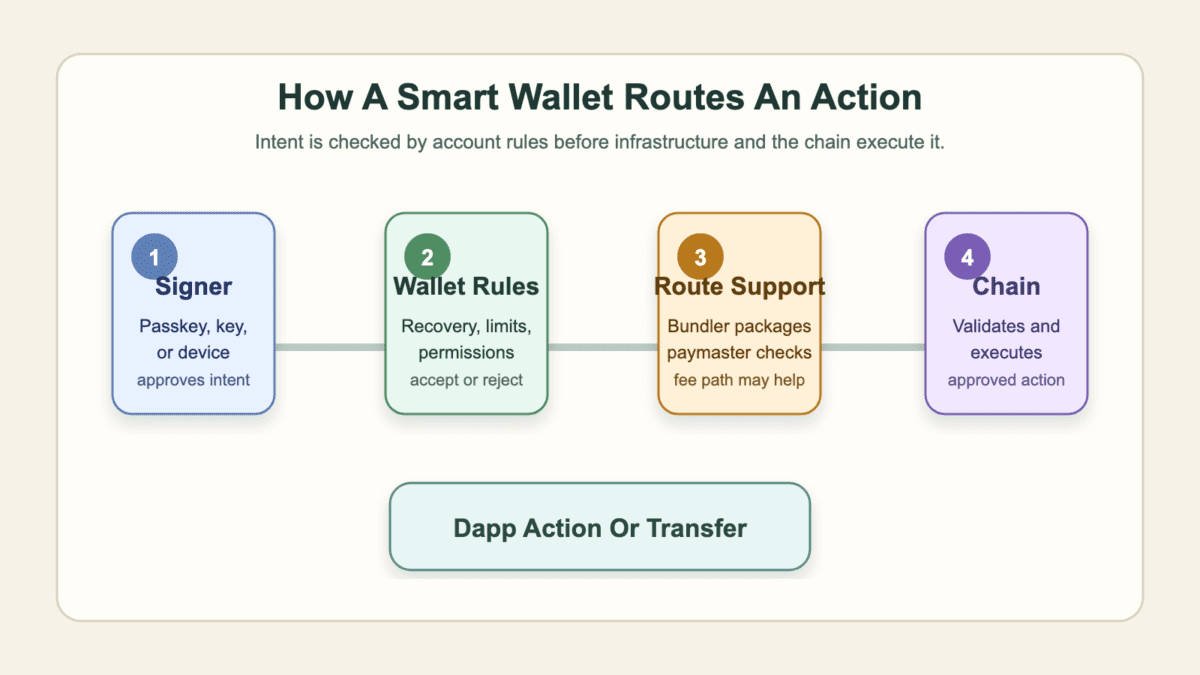
The signer is what proves you approved an action. It could be a private key, passkey, hardware device, recovery key, multisig signer, or another method the wallet supports.
This is why “no seed phrase” does not mean “no signing risk.” The signer can still be lost, phished, reset, synced to the wrong cloud account, or replaced badly.
The smart wallet contract checks whether the requested action fits the account policy. It may verify the signer, enforce a limit, check a module, require another approval, or reject the action.
That rule check is where smart wallets become useful. It is also where bad design can bite. A flawed module, confusing recovery rule, or unsafe upgrade path can turn smooth UX into slow panic.
A bundler can package smart wallet operations and submit them for execution. A paymaster can sponsor gas or approve another fee path.
Those roles are infrastructure, not magic. If the bundler route is down, the paymaster refuses the action, or the chain does not support the flow, the transaction can fail or ask you for native gas.
EIP-7702 is a newer Ethereum path that can let an existing EOA act more like a smart wallet through delegated code. It is not the same route as deploying a new smart account, but it points at the same user-facing goal.
For users, the important part is simpler. ERC-4337 smart accounts and EIP-7702-style delegation are different paths toward smarter wallet behavior. The wallet app should explain which path it uses, how recovery works, and how to revoke or exit smart features.
Smart wallet recovery depends on the wallet’s signer and recovery design. A passkey smart wallet may not recover like a normal 12-word seed phrase wallet, even when both appear inside the same app.
This is where many users get hurt. They assume a recovery phrase means “import this into any wallet and see the same account.” In some smart wallet products, a phrase or recovery key may restore a signer path, not recreate the smart wallet like a regular EOA seed phrase.
Separate the recovery pieces before funding the account:
| Recovery Method | What It Does And Does Not Restore |
|---|---|
| EOA Seed Phrase | Usually restores the same private-key account in compatible wallets. |
| Passkey | May restore signing access only if the device, platform, or password manager still has it. |
| Device-Bound Passkey | Can fail if the original device is lost and no backup path exists. |
| Cloud-Synced Passkey | Helps across devices, but cloud account access becomes part of recovery. |
| Recovery Key | May restore access only if created before loss and stored correctly. |
| Social Recovery | Lets guardians approve recovery, but guardian loss or collusion adds risk. |
| Multisig Signer Set | Protects against one lost key, but enough signers must remain available. |
A smart wallet can still be self-custodial. The real question is whether you control enough of the signer and recovery path to move funds without a company account, original device, or support team rescuing you.
Test the recovery setup before you need it. Add a backup passkey if the wallet allows it. Save recovery keys away from the phone they protect. And never assume identity verification at a related exchange can restore a self-custody smart wallet.
If the wallet cannot explain what happens after phone loss, passkey deletion, cloud lockout, or signer compromise, read that silence as a risk signal. Crypto has enough traps without funding a mystery box.
Smart wallet fees can feel smoother because the account may batch actions, use a paymaster, or let another token cover fees. But “gasless” usually means someone else pays under rules, not that the chain stopped charging.
The fee path can break for ordinary reasons. The chain may be unsupported. The paymaster may reject the action. The token used for fees may not qualify. A recovery step may still require native gas.
Batching can hide several steps behind one button. A single smart wallet action might approve a token, swap it, and send the result to another contract. If one step fails, the whole action can fail or return a confusing error.
When a smart wallet transaction fails, check these points first:
Tiny balances can become annoying here. A small dust balance may look movable until fees, route limits, or recovery costs make the exit uneconomical.
The clean habit is boring and effective. Keep fallback gas where the wallet recommends it, then test one outbound transfer before adding more funds. Smooth UX is nice. A working exit is nicer.
A smart wallet can be safe enough for some real funds, but it does not delete wallet risk. It reduces some risks and moves others into code, recovery rules, modules, upgrades, and app support.
The upside is meaningful. Spending limits can reduce damage from a bad click. Multisig can stop one compromised signer. Session keys can limit app access. Passkeys can reduce seed phrase exposure for users who would otherwise store recovery words badly.
The tradeoff deserves equal airtime:
| Risk Reduced | Risk Added Or Moved |
|---|---|
| One lost seed phrase can wipe out access. | Recovery rules can be misunderstood or never set up. |
| One stolen key can drain everything. | Malicious modules or broad permissions can expand access. |
| Every action needs full wallet signing. | Session keys can be dangerous when limits are loose. |
| Large transfers may lack extra checks. | Upgrade control can change account behavior. |
| Users may approve repeated prompts. | App support and paymaster rules can block execution. |
Security also depends on defaults. A smart wallet with audited code, limited modules, clear upgrade controls, and tested recovery can be strong. A smart wallet with vague recovery, hidden admin powers, and broad permissions can be a polished mistake.
Watch fake recovery help. Scammers may offer “smart wallet recovery” services that ask for passkeys, recovery phrases, keys, remote access, or wallet signatures. That is not recovery. That is a drain with customer service energy.
For long-term storage, a smart wallet needs a higher bar than a nice login. Use small active balances until the recovery path, upgrade model, permissions, and exit routes are boring.
Smart wallet compatibility depends on the chain, wallet app, account contract, and dapp. Seeing assets at an address does not prove every bridge, exchange, marketplace, or app can use that account correctly.
The sticky point is signatures. Some dapps expect normal EOA signatures. Smart wallets may use contract-based signature validation, often discussed through EIP-1271. If the dapp does not support that path, the wallet can fail at connect, sign, swap, bridge, or claim time.
Chain support deserves the same caution. A wallet may support a smart wallet on Base or another L2 but not on every network you use. A bridge may display the address correctly while the destination app cannot accept the signing method.
Portability is another surprise. Importing a phrase into another wallet may show a different account if the smart wallet address depends on a contract, factory, signer, chain, or wallet-specific setup.
Run these checks before relying on a smart wallet:
The goal is not to scare you away from smart wallets. It is to keep account design from becoming a surprise exit tax. If your funds may need to move quickly, test the route while nothing is urgent.
Smart wallet examples show up in consumer apps, multisig tools, passkey wallets, and embedded app wallets. The names may look familiar, but the recovery and control models can differ sharply.
Coinbase Smart Wallet and Base-related wallet flows are common places users see passkeys and seedless onboarding. Safe and Gnosis are familiar in multisig and treasury contexts. MetaMask smart account features connect the term to existing wallet users. Argent, Loopring, and embedded app wallets show how smart wallet ideas can appear inside specific products or chains.
Use examples to recognize the category, not to assume identical behavior. Product names do not tell you whether the wallet supports your chain, lets you export anything useful, sponsors gas for your action, or recovers after device loss.
The checks stay the same across examples:
Product-specific support pages can help with details, but category rules matter more than brand familiarity. A smart wallet is a design pattern. Each product decides how much of that pattern to expose, simplify, or hide behind friendly screens.
So avoid brand-based confidence. The best example is the one you have tested with a small send, a recovery setup, and the exact dapp or exit route you plan to use.
Before you keep funds in a smart wallet, prove the wallet can recover, connect, send, and exit under your real use case. The setup should earn more capital slowly.
Do not move a full balance into a new smart wallet just because onboarding felt easy. In trading slang, going full port before testing recovery and exits is how a convenience feature becomes a portfolio hostage situation.
Use this pre-funding routine:
Recovery is the uncomfortable check. Some wallets let you test safely with a low-value account. Others do not. Either way, you should know what happens after phone loss, passkey deletion, cloud account lockout, or app downtime.
Also think about account size. A smart wallet can be excellent for daily app use, small DeFi allocations, payments, games, or team workflows. It may be the wrong first home for long-term holdings if you have not tested recovery.
The standard is simple: fund the wallet only after the exit path feels boring. Crypto excitement belongs in markets, not in basic account recovery.
Related smart wallet terms help decode wallet copy without turning the topic into a glossary swamp. The most important distinction is between the product you see and the account layer doing the work.
A smart account is the programmable account under many smart wallets. A smart contract wallet is the broader technical category. Account abstraction is the architecture goal: make accounts flexible enough to support better signing, recovery, fees, and permissions.
ERC-4337 is one account abstraction route. It uses terms such as UserOperation, bundler, EntryPoint, and paymaster. EIP-7702 is another Ethereum path that can let existing EOAs gain smart-wallet-style behavior through delegated code.
Other terms describe specific features. A passkey is an authentication method. A session key is a limited permission key. A paymaster can sponsor or approve a fee path. A multisig requires more than one signer. Gas sponsorship means a user may not pay gas directly for an eligible action.
If the broader custody choice still feels fuzzy, start with the crypto wallets category. It helps separate wallet types, account control, and storage habits before a smart-wallet feature pitch blurs them together.
If the problem is tiny stuck balances, crypto dust is the cleaner next concept. Smart wallet fees, paymaster rules, and recovery costs can make small leftover amounts harder to move than they look.
Use these terms as warning labels and checklists, not trivia. When a wallet advertises one of them, ask what it changes for recovery, fees, permissions, and exits. The useful meaning lives in the next action the term changes.
Start with a smart wallet by testing the boring parts first: recovery, sending, dapp support, gas, and exits. A polished onboarding screen is not enough proof.
Use these actions before moving meaningful funds:
Run the test on the exact chain and app you expect to use. A smart wallet that works cleanly on one L2, game, bridge, or swap app may still fail somewhere else. The address can look right while the signing method, paymaster policy, or recovery flow does not match the next step.
Once those checks pass, a smart wallet can be useful for active crypto use. It can reduce repeated signing, make app onboarding easier, and add controls a regular wallet lacks.
But keep the job clear. Use a smart wallet where its features solve a real problem. Do not use it as a vault until you understand the signer, recovery path, upgrade controls, and exit route.
Write those four answers down before adding size. If you cannot explain who signs, how recovery works, who can change wallet logic, and how funds leave, the wallet is still in test mode. Convenience is great. Recoverable convenience is the point.
A smart wallet is a crypto wallet controlled by programmable account rules instead of only one fixed private key. It can support features such as passkeys, recovery rules, spending limits, batching, and sponsored gas.
A smart wallet and a smart account are closely related, but not exactly the same. The smart wallet is usually the app or product users see. The smart account is the programmable account layer that enforces the rules.
A smart wallet may or may not have a seed phrase. Some use passkeys, recovery keys, guardians, or multisig signers. If a smart wallet shows a recovery phrase, confirm whether it restores the full account or only part of the access path.
You can recover a smart wallet after losing your phone only if its recovery setup supports that scenario. Check whether you created a backup passkey, recovery key, guardian setup, or another approved recovery method before the loss.
A smart wallet may still need gas. Sponsored gas and token-paid fees can help, but they depend on the chain, action, wallet, and paymaster policy. Some recovery, bridge, or unsupported actions may still require native gas.
Traders should keep funds in a smart wallet only after testing recovery, dapp support, fees, and exit routes. A smart wallet can help active use, but funds needed quickly should not depend on an untested account path.