Physical Address
304 North Cardinal St.
Dorchester Center, MA 02124
Physical Address
304 North Cardinal St.
Dorchester Center, MA 02124

Social recovery helps recover wallets without handing friends your seed.
Social recovery is a crypto wallet recovery setup where preselected guardians can approve a change of wallet control if the normal signer is lost or unsafe.
It sits in the awkward middle ground between “I hold my own coins” and “one lost seed phrase ruins my week forever.” Social recovery can make self-custody less brittle, but it also creates a recovery path that needs careful guardian choice, testing, and alerting.
Social recovery in crypto is a wallet recovery design that separates everyday wallet use from emergency recovery authority. You still use a normal signer, such as a phone key, passkey, hardware key, or app signer, for ordinary transactions.
The recovery side is different. A social recovery wallet has guardians, which are preselected people, devices, institutions, or wallet addresses that can help approve a recovery action when access is lost or the signer is compromised.
The basic parts are easy to name:
That last point is the part many users miss. Social recovery usually does not rebuild your old seed phrase. It changes which signer controls the wallet after the recovery rule is satisfied.
So no, good social recovery is not “give five friends a copy of your seed.” That would be a group project in losing money. The better version gives guardians limited recovery authority, often inside a smart account, without giving each one daily spending power.
Imagine a wallet with five guardians and a 3-of-5 threshold. If you lose your phone, three guardians can approve a new signer. If only one guardian panics, disappears, or clicks something odd, the threshold should stop that single mistake from taking over the wallet.
Social recovery exists because self-custody gives users control, but traditional wallet recovery often puts too much weight on one permanent secret. A seed phrase is powerful. It is also very easy to lose, expose, misstore, or misunderstand.
For many users, the choice is not “perfect self-custody or laziness.” It is a practical custody tradeoff. Keeping funds on an exchange can be convenient, but account freezes, withdrawal delays, platform failures, KYC issues, and support queues are separate risks.
Moving funds to self-custody removes some platform risk. Then the user inherits seed storage risk. A phone can break. A hardware wallet can be lost. A paper backup can burn, flood, fade, or get thrown out during a move by someone being aggressively tidy.
Wallet type shapes that risk. Users comparing hot wallets, hardware wallets, smart wallets, and app wallets should understand the wider wallet security context before choosing any recovery model.
Social recovery tries to reduce the “one thing must survive forever” problem. Instead of relying only on a seed phrase, the wallet can require several independent recovery approvals.
That design can help when:
But social recovery is not a free upgrade. It spreads recovery authority across a few people, devices, or services. That can lower seed-loss risk while adding guardian, contract, provider, and social engineering risk.
The useful question is which failure mode you are more likely to manage well.
Social recovery works by letting a wallet follow a prewritten recovery rule when the normal signer is lost, replaced, or suspected to be unsafe. In current smart-account designs, that rule can include guardians, a threshold, a delay, and a final signer rotation.
The Ethereum IPTF pattern describes the model around components such as an account, guardians, recovery logic, approvals, and safeguards. It also notes that deployed recovery windows range from 36 hours to 14 days.
The user-facing version is simpler: the wallet already knows who can help, how many approvals are enough, and how long the owner has to cancel a bad attempt.
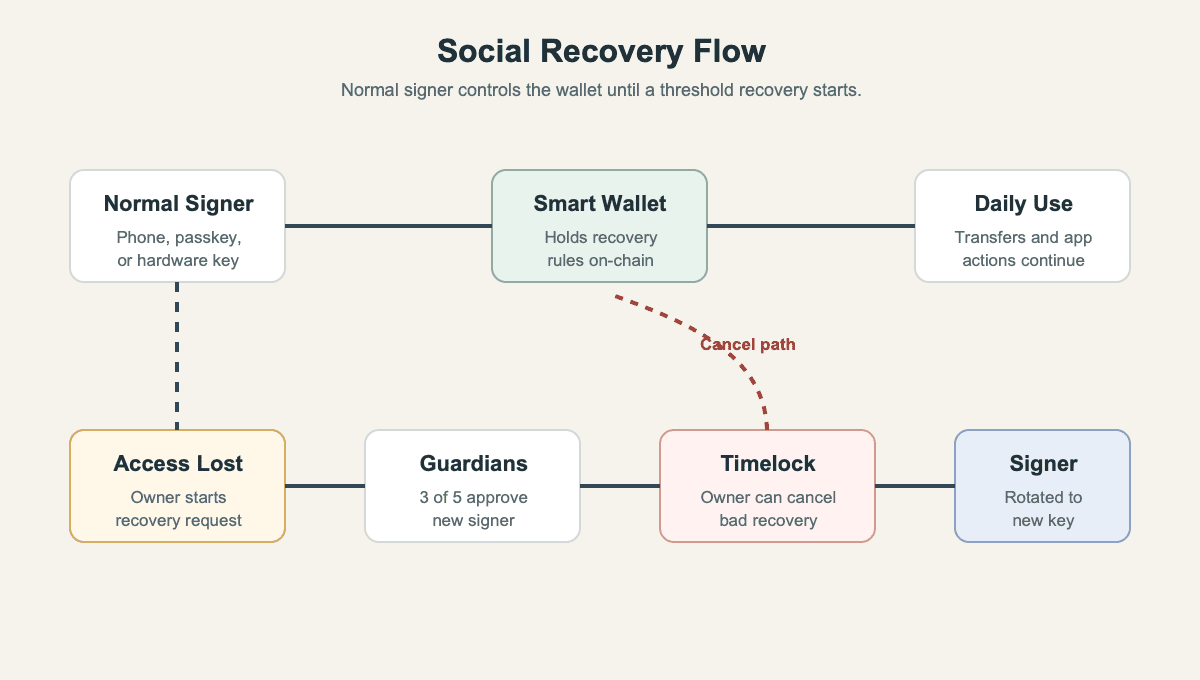
_A social recovery flow changes wallet control only after the guardian threshold and delay rules are satisfied._
Setup usually starts before anything goes wrong. You choose guardians, set a threshold, confirm contact methods, and record how recovery should be started. A common example is 3-of-5: five guardians exist, but any three can approve recovery.
Then normal use continues. Your everyday signer still sends transactions, connects to apps, or manages funds. Guardians do not need to approve every swap or transfer unless the wallet design also gives them normal spending authority, which would be a different setup.
Recovery starts when you lose access or need to replace the signer. The wallet or recovery module asks guardians to approve a new signer. Those approvals should be specific to recovery, not vague permission slips.
The threshold protects against one weak guardian. If one person loses a phone or gets tricked, that alone should not rotate control. A threshold also protects against simple unavailability, because one missing guardian should not block recovery forever.
A timelock or grace period adds a second defense. If an attacker tricks enough guardians, the current owner may get an alert and cancel before the rotation finishes. Without that delay, a bad recovery can become final too quickly.
After the waiting period, the wallet rotates control to the new signer. The funds are still in the same wallet account. What changed is the signer allowed to control it.
Testing closes the gap between design and reality. A setup that looks safe on a product page can feel very different when three guardians are asleep, one changed phones, and the app wants gas on a chain you forgot existed.
Social recovery is one recovery model, not a synonym for every seedless or multi-party wallet design. Seed phrases, multisig, MPC, and passkeys can all reduce one kind of risk while exposing another.
The clean comparison is recovery authority. Ask what changes control, what can fail, and who or what must be available when stress hits.
| Model | What It Changes For Recovery |
|---|---|
| Seed phrase | One backup can restore a wallet, but anyone with that phrase can usually control it. |
| Social recovery | A guardian threshold can rotate control when the normal signer is lost or unsafe. |
| Multisig | Several signers usually approve ordinary spending, not only emergency recovery. |
| MPC or key shares | Signing power is split across parties or devices, often without one complete private key in one place. |
| Passkeys | Login and signing can feel easier, but platform, device, cloud, or recovery-provider dependency still needs review. |
| Vendor recovery | A provider may help restore access, which can be useful or uncomfortable depending on control, identity checks, and policy. |
Seed phrases are simple and portable, but they are unforgiving. If you lose the phrase and the device, recovery may be impossible. If someone else finds the phrase, they may not need your permission.
Multisig is often stronger for shared treasury control. It can require several signers for spending, so no single person can move funds alone. Social recovery is narrower: it usually focuses on changing who controls the wallet after loss or compromise.
MPC and key-share wallets split signing material. That can reduce single-key exposure, but it may introduce server, provider, device, or recovery-process dependency. The phrase “threshold” appears in both worlds, which is where many comparisons start melting.
Passkeys can improve wallet UX. They can also hide platform dependencies behind a familiar login feel. A passkey wallet may still need a separate recovery policy if the device, account, or cloud path fails.
Skip the label race. Focus on what you need recovered, who can approve it, how long it takes, and how you cancel a hostile attempt.
Social recovery fits users who want self-custody but do not want one seed phrase or one device to be the only route back to funds. It is most useful when access loss is a realistic risk and the wallet is active enough to justify setup work.
Active DeFi users can benefit because hot wallets and L2 wallets face more daily interaction risk. If the signer is lost or compromised, a tested recovery path can help rotate control and protect what remains.
It can also fit medium-value self-custody. A huge cold treasury may need a more formal setup, but a meaningful active wallet can justify guardian recovery if the user can rehearse it properly.
Good-fit cases usually look like this:
Be cautious when the setup depends on unreliable people, one household, one cloud account, or one vendor path you do not understand. A social recovery wallet is only as serious as the people and systems behind the threshold.
Large cold-storage stacks deserve extra restraint. If the funds are life-changing, recovery design needs audited contracts, hardware-backed signers, written procedures, guardian independence, and repeated testing. “My cousin knows crypto” is not an audit.
Some disciplined users may prefer seed phrases, metal backups, and hardware wallets. That is fine. Social recovery is useful when it solves a real recovery problem, not when it adds a dashboard to a setup that already works.
Choosing guardians for social recovery is really choosing who can help change wallet control during stress. Pick for independence, reachability, and judgment, not just for who answers group chats quickly.
A good guardian does not need to be a full-time security engineer. They do need to understand the recovery responsibility, avoid fake support flows, keep their own device secure, and respond when needed.
Guardian diversity is part of the security model. Five guardians under one roof, one company account, or one cloud login are not really five independent guardians. That is a single cluster wearing five name tags.
| Guardian Check | Recovery Risk Reduced |
|---|---|
| Independent relationship | Collusion and social pressure are harder when guardians do not all answer to the same person. |
| Reliable contact | Recovery fails if enough guardians vanish during the one week you need them. |
| Basic wallet comfort | A guardian should recognize the real recovery flow and reject fake links. |
| Device diversity | One phone provider, cloud account, or household failure should not remove the whole set. |
| Geographic spread | Local disaster, travel, or family conflict should not block every approval. |
| Privacy awareness | Guardians may reveal part of your social graph if the setup is handled carelessly. |
| Periodic review | People change phones, jobs, names, wallets, and threat models. The guardian list must keep up. |
Privacy deserves its own pause. A guardian setup can reveal who you trust, which wallets are linked, or who might be pressured. If identity exposure is part of your risk model, read up on guardian privacy before you hand the recovery role to obvious public contacts.
Social pressure is another quiet risk. A guardian may be tricked by a fake emergency, a fake support account, or a message that looks like it came from you. Recovery instructions should tell guardians what to verify before approving anything.
Review the set on a calendar. Replace stale guardians, confirm contact methods, and keep instructions current. A guardian list from three phones ago is not a recovery plan. It is an archaeological layer.
Social recovery risk comes from the extra recovery path. The same feature that can save access can also become a target for attackers, confused guardians, weak thresholds, or bad wallet modules.
> Social recovery can help after lost access, but it cannot rewind a completed transfer, bad approval, bad trade, or project failure.
The biggest human risk is guardian collusion or guardian compromise. If enough guardians coordinate, get pressured, or get tricked, they may approve a hostile recovery. Timelocks and alerts reduce that risk, but they do not replace careful guardian choice.
Social engineering is the everyday version. An attacker might impersonate you, fake a wallet support flow, claim there is an urgent migration, or send guardians a recovery link that looks official. The scam does not need every guardian. It only needs the threshold.
Stale guardian sets cause the quieter failures:
Wallet spam and malicious interactions sit beside social recovery, not inside it. A recovery setup will not protect you from approving a malicious token interaction, clicking a claim trap, or engaging with suspicious dust tokens.
The same boundary applies to market and project risk. If a token team drains liquidity in a hard rug, social recovery does not restore the token’s value. It protects access control, not every way crypto can disappoint you.
Contract or module bugs are also real. Smart-account recovery depends on code, configuration, upgrades, alerts, and the specific recovery module. A beautiful threshold rule is not much comfort if the implementation is weak.
Provider-controlled recovery needs a separate check. If a company, server, identity process, or support workflow can approve part of recovery, ask what happens when that provider changes policy, goes offline, freezes an account, or gets targeted.
The best setup gives you several defenses at once: independent guardians, a sane threshold, clear alerts, a waiting period, tested cancellation, and a recovery flow guardians can explain without squinting.
Testing social recovery means proving the recovery path works before the wallet holds funds you cannot afford to lose. Do not full-port into an untested wallet. That is not conviction. That is admin cosplay with gas fees.
Start with a tiny balance and a low-stakes account. The point is to test process, not to impress yourself with a ceremonial first deposit.
Run the test like a checklist:
Guardian contact also needs rehearsal. Do your guardians know what message they should expect? Can they identify the real app or wallet flow? Do they know not to approve recovery from a random DM, email, or search-result link?
Alerts are just as important. You should know where recovery notices appear, how fast they arrive, and what action cancels a bad attempt. A timelock is less useful if the warning lands in an inbox you stopped checking last bull market.
Then schedule a review. Repeat the contact check when a guardian changes device, loses access, moves, or becomes less reliable. Recovery plans age. Some age like cheese. Some age like browser extensions.
Start with your actual wallet risk, not the feature name. Social recovery is useful when it reduces a failure mode you genuinely face and when you can maintain the guardian set over time.
First, map assets by value and usage. Keep tiny app funds, active DeFi wallets, long-term cold storage, and exchange balances in separate risk buckets. One recovery model does not need to govern every coin you own.
Then choose the wallet type. If the wallet is a smart account, understand which chain it lives on, how recovery is started, who the guardians are, what threshold applies, and whether a timelock exists.
Match the setup to the size and activity of the wallet. A small app wallet may only need a simple rehearsal and reachable guardians. A larger self-custody wallet needs more care: stronger signers, cleaner written steps, guardian independence, and a cancellation path you have actually seen work.
Do not let the wallet app’s setup screen make the decision for you. The app can suggest defaults, but you still own the tradeoff between recovery speed, guardian independence, and attack resistance.
Use these next actions:
Keep exchange custody as a separate risk bucket. It may still be convenient for trading, fiat access, or small balances, but it is not the same as self-custody recovery.
The right social recovery setup should feel boring after testing. Boring is good. Boring means the recovery path has already been rehearsed, not discovered during a crisis with three people texting “what app was this again?”
No. Social recovery should not require giving guardians your seed phrase. A good setup gives guardians limited recovery authority, often through a smart wallet rule, so enough of them can approve a signer change without seeing your master backup.
If a product or person asks you to share a seed phrase with guardians, pause. That is seed sharing, not the social recovery model most users mean.
No. Social recovery can help rotate control after lost access or suspected signer compromise, but it cannot reverse a completed on-chain transfer. If funds already left the wallet, recovery rules cannot pull them back.
It may still help protect remaining assets. Move carefully, save transaction details, and avoid anyone claiming guaranteed recovery in DMs.
Social recovery can be safer for users who are likely to lose a seed phrase, but it can be riskier if guardians are weak, alerts are missing, or the wallet code is poorly designed. It changes the failure mode rather than deleting risk.
Seed phrases concentrate recovery in one secret. Social recovery spreads emergency authority across a threshold. The safer choice depends on which setup you can maintain better.
Many social recovery wallet setups use a threshold such as 2-of-3 or 3-of-5 guardians, but the right number depends on value, guardian reliability, and how quickly you need recovery. More guardians can add resilience, but also more maintenance.
Avoid thresholds that are too easy to abuse or too hard to reach. A 3-of-5 setup is common because it can tolerate missing guardians without letting one person take over.
A single guardian usually should not be able to steal funds if the threshold is set correctly. The risk rises when enough guardians collude, get compromised, or approve a malicious recovery.
Timelocks, alerts, independent guardians, and cancellation paths reduce that risk. They do not help much if every guardian uses the same weak account or approves anything that looks urgent.
Social recovery is most common in smart-account environments, especially Ethereum-style wallets and L2s. Bitcoin does not use the same account-abstraction model, though users can build related recovery ideas with multisig, scripts, inheritance tools, or custodial services.
That means a Bitcoin setup may not look like an Ethereum social recovery wallet. Check the exact wallet design instead of assuming the same feature exists on every chain.