Physical Address
304 North Cardinal St.
Dorchester Center, MA 02124
Physical Address
304 North Cardinal St.
Dorchester Center, MA 02124


A practical guide to crypto solvers, intents, fills, and signing risk.
A solver in crypto is a market participant that tries to fill a signed trade outcome by finding a valid execution path that can still make money.
You will usually see the term near intents, DEX auctions, chain abstraction, CoW Protocol, UniswapX, 1inch Fusion, or cross-chain swaps. The user asks for a result, such as “swap this token for at least that token,” and the solver tries to deliver it without breaking the signed limits.
A solver can make DeFi feel cleaner because the app hides some routing work. But the trade still carries real risk: price impact, weak liquidity, bridge paths, wallet approvals, MEV, and failed fills can still land in your lap.
A solver in crypto is the actor that tries to turn a user’s requested outcome into an actual onchain result. That actor may be a bot, market maker, professional trader, routing service, or protocol participant.
The term describes market structure, not a token ticker, math tool, or generic AI helper.
The key word is “outcome.” In a normal swap, you usually pick a route through a pool or aggregator. In an intent-style flow, you sign what you want to receive, the deadline, and the limits. Solvers then decide whether they can fill that request profitably.
Here is the plain version:
A solver is still a profit-seeking counterparty, not your legal agent. Its profit may come from a fee, spread, arbitrage edge, inventory advantage, or auction reward. Your protection comes from the order rules, settlement contract, app design, and your own signing limits.
In practice, the user sees the polished version: one quote, one signature, one expected result. Under the surface, the solver is checking route options, inventory, gas, and settlement rules to see whether the order is worth filling.
The useful definition is simple: a competing execution actor that tries to fill a signed crypto outcome. Less sci-fi. More market plumbing.
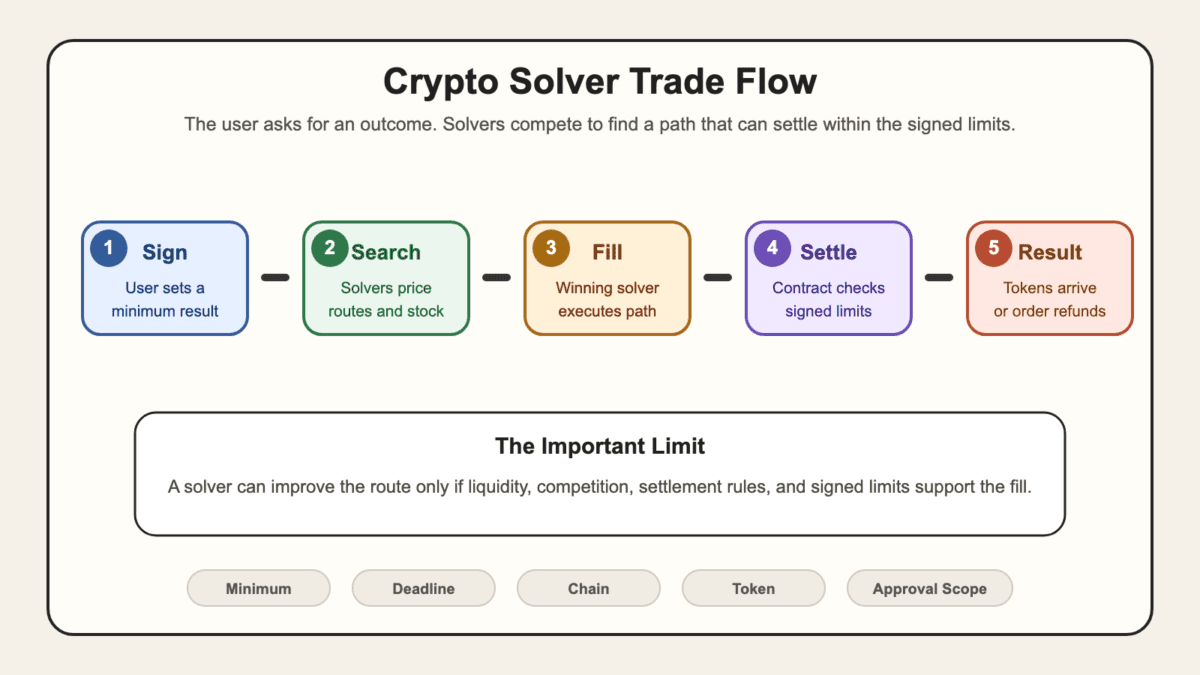
A crypto solver works by reading a user’s signed intent or order, searching for a fill that satisfies the constraints, then submitting the winning execution for settlement. The solver gets involved after the user defines the desired result.
The user starts by signing a request. That request may include the token sold, token received, minimum output, deadline, source chain, destination chain, recipient, and the contracts allowed to settle the trade.
A well-designed request is not a blank check. It should say what result counts as acceptable. If the result cannot meet those terms, the fill should fail, expire, or refund through the app’s rules.
Before a solver ever touches the route, the signed limits do most of the user protection. A vague approval or unclear deadline gives the user less defense when markets move.
Solvers then look for a way to satisfy the order and still earn something. They may compare DEX pools, use private inventory, batch orders, capture coincidence of wants, bridge assets, hedge elsewhere, or bid in an auction.
They participate because the trade creates an opportunity. A solver might earn a posted fee, keep a spread, capture surplus, or use inventory more efficiently than a simple router. If there is no profit, no inventory, or too much risk, the solver may ignore the order.
Solver competition shapes the final price and fill quality. One solver can become a new bottleneck. Several capable solvers can push fills closer to fair market execution.
The winning fill normally settles through a contract or protocol rule set. The settlement layer checks whether the submitted fill matches the signed order.
If the fill meets the constraints, tokens move according to the settlement rules. If it does not, the order should fail, expire, or return funds based on the app’s design. That final check is where the promise becomes a transaction, not just a quote.
Solver, filler, resolver, and router are related words with different jobs. Protocols name the execution role differently because their auctions, order formats, and settlement rules differ.
Ask what the actor actually does. Does it only choose a route? Does it provide liquidity? Does it take execution risk? Does it submit settlement? The answer affects price, failure modes, and who earns from the fill.
Use this table as a translation layer:
| Term | What It Usually Means In Crypto |
|---|---|
| Solver | Finds or executes a valid way to satisfy a user’s signed intent or auction order. |
| Filler | Provides execution for an order, often by filling it directly or routing it through available liquidity. |
| Resolver | Decodes or fulfills an order in systems that use resolver language for execution actors. |
| Router | Chooses a path through pools or venues, but may not take the same inventory or settlement risk. |
| Relayer | Passes messages or submits transactions, often in cross-chain or offchain-order flows. |
| Searcher | Looks for profitable onchain opportunities, which can overlap with solver work but is not identical. |
This vocabulary split is why beginner explanations get messy. A UniswapX-style filler, a CoW-style solver, and a 1inch-style resolver can all sit near the same job: deliver a valid result under protocol rules.
But the details still matter. A router may only point to a path. A solver may use its own inventory. A resolver may operate under a specific cross-chain settlement design. Those differences affect price, failure modes, and who profits from the fill.
Solver-based swaps differ from normal DEX swaps because the user defines the result, while solvers compete or decide whether to deliver that result. A normal DEX swap executes through pools directly.
That can help in some cases. It can also be unnecessary. If you swap a small amount of ETH for USDC in a deep pool, a normal AMM or DEX aggregator may already be good enough. Solver systems become more interesting when routing is hard, liquidity is fragmented, or the trade crosses chains.
Here is the practical comparison:
| Model | What The User Should Understand |
|---|---|
| AMM swap | The pool price and slippage rules drive execution. You trade against available pool liquidity. |
| DEX aggregator | The aggregator searches routes across venues, but execution usually still follows selected liquidity paths. |
| Solver-filled intent | Solvers can compete to fill the signed result using routes, inventory, auctions, or hedges. |
| Cross-chain solver fill | A solver or related actor may handle destination liquidity, gas, bridge path, and settlement timing. |
The biggest difference is risk location. In a normal swap, the route is more visible, but you may eat slippage. In a solver-based swap, the route may be abstracted away, but you need confidence in the signed minimum, deadline, settlement contract, and refund path.
Solver-based swaps also sit closer to order-flow competition. Professional actors may have better data, faster infrastructure, or inventory advantages. If you want a plain-language lens on adversarial execution, PvP trading helps explain why the counterparty side of a trade can matter even when the app looks friendly.
So do not ask only whether the quote looks better. Ask what guarantees it, what can fail, and whether the final received amount is clear before signing.
Crypto solvers can improve execution when they create competition for an order, find liquidity a simple route misses, or use inventory to deliver a better result. The upside depends on the market in front of them.
Solvers are useful because crypto liquidity is fragmented. Tokens trade across many DEXs, chains, pools, bridges, market makers, and private routes. A good solver can search that maze faster than a user clicking through tabs like it is a sad browser-based workout.
The main improvement paths are practical:
Those benefits depend on enough capable solvers showing up. If only one solver can fill a route, the auction pressure is weak. If liquidity is thin, routing cleverness has less to work with. If settlement rules are unclear, the cleaner UX may hide risk instead of reducing it.
The best solver systems make the hard parts less painful without pretending the hard parts disappeared. Better execution is the target. The spread still needs to come from somewhere. Magic execution is still not available, despite crypto’s long relationship with marketing smoke machines.
Crypto solver risk starts with trust boundaries. A solver may not custody your assets like a centralized exchange, but the trade can still depend on contracts, approvals, route choices, bridge paths, and offchain competition.
The first danger is weak competition. If only a few professional solvers can fill an order, they may keep more spread. If no solver wants the order, it may expire or fail. If market conditions change between signing and settlement, the route may break before it settles.
There are also approval and contract risks. A solver-based app may ask your wallet to approve token movement or interact with a settlement contract. Before using any new flow, review basic wallet setup hygiene: separate trading wallets, limited approvals, clean contract checks, and no casual signature spam.
The main risk checks are simple, but easy to skip:
MEV is another trap. Solver auctions can reduce some public-mempool problems, especially when trades are batched or settled through protected routes. But a solver is still a professional actor trying to earn money. It can profit through spread, inventory, timing, or order-flow advantages.
Partial leftovers can also confuse users. Failed cross-chain routes, refunds, gas changes, or odd token dust may leave tiny balances behind. If that happens, dust balances are not always worth chasing, especially when claiming or moving them costs more than they are worth.
The clean habit is boring and useful: read the signing screen, check the settlement rules, and never assume “solver-based” means safer by default.
Crypto solvers show up in DeFi wherever apps let users request outcomes instead of manually choosing every execution step. You will see the role around intents, DEX auctions, cross-chain swaps, and chain-abstraction products.
CoW Protocol uses solver language around batch auctions and order execution. UniswapX often uses filler language. 1inch Fusion uses resolver language. Across and other cross-chain systems may use relayers or filler-style actors. The labels differ, but the user-facing idea is close: someone or something competes to deliver the signed result.
Standards are trying to make this less fragmented. ERC-7683, published through Ethereum Improvement Proposals, gives cross-chain intents a common order interface and uses resolver-style language for fulfillment. Open Intents and related work point in a similar direction: more shared ways for apps, solvers, and settlement systems to talk to each other.
That does not mean every solver network works the same way. Some are open to many professional solvers. Some are more permissioned. Some focus on same-chain swaps. Others focus on cross-chain fulfillment, wallet UX, or institutional routing.
The product name is less useful than the execution promise. Ask what you are signing, who can fill it, how settlement is checked, and what happens when the fill fails. The standard or protocol can help answer those questions, but it should not replace them.
A crypto solver does not guarantee the best price, deep liquidity, safe bridges, instant settlement, or MEV-free execution. It can search and compete within the market that exists.
Thin tokens expose that limit fast. If there are few buyers, shallow pools, or heavy insider supply, a solver cannot create healthy exits from thin air. It may find a route, but the result can still be ugly. That is where exit liquidity becomes the real issue, not the routing label.
Solver-based flows also do not remove bridge or finality risk. A cross-chain fill may depend on inventory on the destination chain, settlement verification, refund logic, and the timing of the origin-chain transaction. If one part stalls, the app’s failure path decides whether you get a clean refund or a messy support ticket.
The same goes for MEV and spread. A solver may reduce some visible slippage, but it can still earn through private pricing, surplus, or route edge. A clean interface can hide complexity. It cannot repeal incentives.
Here is the sharper checklist of what a solver does not promise:
Use solver-based UX as a tool, not a trust substitute. If the quote, deadline, and failure path are vague, the nicer interface is doing the wrong kind of work.
Check a solver-based trade by reading the exact outcome, route assumptions, and permission request before signing. The goal is not perfect safety. The goal is to avoid signing blind.
Start with the trade result. Minimum received should be visible. Deadline should be clear. Token addresses should match the asset you intend to receive. The destination chain should be correct if the fill crosses chains.
Then check the parts that create hidden risk:
| Check | What The Check Protects |
|---|---|
| Minimum received | Sets the lowest acceptable output before the fill should fail. |
| Deadline or expiry | Limits how long market conditions can change after signing. |
| Token address | Prevents lookalike assets and wrong-chain surprises. |
| Approval scope | Controls how much a contract can move from your wallet. |
| Settlement contract | Shows which contract checks and finalizes the fill. |
| Bridge or route path | Reveals whether cross-chain timing or bridge risk is involved. |
| Refund rules | Explains what should happen if no solver fills the order. |
Big position sizing deserves extra caution. A solver does not rescue a reckless entry if the token is volatile, illiquid, or socially hyped. If a trade starts to look like one of those full-port trades where one signature carries the whole account, slow down before the wallet popup turns risk into muscle memory.
Also compare the solver quote against at least one familiar route when possible. If the solver result is much better, ask why. If it is worse, ask what convenience you are paying for. If the app cannot explain the fill, assume you are missing a risk, not discovering free money.
Good signing habits are not glamorous. They are how you keep a simple swap from becoming a small personal audit report.
No. A crypto solver and a searcher can overlap, but they are not the same role. A searcher looks for profitable onchain opportunities, often around MEV, arbitrage, liquidation, or ordering.
A solver is usually tied to a user’s order, auction, or intent. It tries to satisfy that request under protocol rules. Some firms may do both jobs, which is why the terms can blur in real markets.
No. A DEX aggregator usually searches routes across pools and venues, then helps the user execute through those routes. A solver may go further by taking execution risk, using inventory, bidding in an auction, or filling an intent directly.
The difference is not always visible in the wallet UI. Check whether the app is giving you a route to execute, or asking you to sign an outcome that a solver can later fill.
A solver should not be able to take funds outside the permissions and settlement rules you sign. But that does not mean every solver-based trade is safe.
The real risk often sits in approvals, malicious interfaces, bad settlement contracts, fake tokens, bridge routes, or unclear refund logic. Limit approvals and confirm the app, contract, token, and chain before signing.
A crypto solver fills an order because it can earn money from the fill. That profit may come from a fee, spread, surplus, arbitrage, private inventory, or an auction reward.
If the order is too risky or unprofitable, the solver may skip it. That is why some intents expire without a fill, especially during volatile markets or on thin routes.
If no solver accepts your intent, the order should expire, fail, or refund according to the app’s rules. The exact outcome depends on the protocol and the type of order you signed.
Check the deadline and refund path before signing. A good interface should make failed-fill behavior clear before you commit funds or approvals.
Crypto solvers can reduce some MEV exposure, especially when trades use auctions, batching, or protected settlement paths. They can also concentrate order flow among professional actors with strong infrastructure.
So the answer is mixed. A solver system can improve execution quality, but it does not make every fill fair, private, or immune to extraction.


