Physical Address
304 North Cardinal St.
Dorchester Center, MA 02124
Physical Address
304 North Cardinal St.
Dorchester Center, MA 02124


A practical guide to solver networks, intents, and execution risk.
A solver network is a group of DeFi execution specialists that compete to complete a user’s signed intent, such as swapping tokens or moving funds.
You usually see the term around intent-based swaps, cross-chain transfers, MEV-aware routing, and apps that promise a cleaner path than clicking through bridges, pools, and gas warnings by hand. The real issue is who handles the trade, what they can improve, and what risk still lands in your wallet.
A solver network in crypto is an execution layer where specialized actors compete to satisfy a user’s requested outcome. The user states the result they want. The solver network figures out who can deliver it under the app’s rules.
That requested outcome is usually called an intent. Instead of manually choosing every pool, bridge, chain, gas route, and timing detail, the user signs something closer to, “swap this token for at least that amount,” or “move this asset to this chain.”
A solver may be a market maker, router, filler, resolver, or specialized trading firm. The names change by protocol. The job is similar: find a path that meets the user’s conditions and still leaves enough room for the solver to make money.
Common solver network intents include:
For example, a user may want USDC on Arbitrum while holding ETH on Ethereum. A normal manual route might mean swapping, bridging, waiting, and checking gas twice. A solver-based app can let the user sign the desired end state, then let solvers compete to deliver the USDC on the destination chain.
That does not make the path risk-free. It means the route selection moves from the user’s hands to a competitive execution layer. Cleaner screen, more hidden machinery.
A solver network works by turning a user’s desired outcome into a fillable request. The app or protocol broadcasts that request to eligible solvers, then settlement rules decide whether the winning solver delivered what the user signed.
The flow can look simple from the wallet. Behind the screen, each step decides whether the user gets a better fill, a failed intent, or a fresh reason to mutter at DeFi.
| Step | What Can Go Right Or Wrong |
|---|---|
| User signs an intent | The intent can set a clear minimum output, deadline, and asset path. Loose terms can expose the user to a bad fill. |
| App shares it with solvers | A broad, competitive solver set can improve quotes. A narrow set can behave like a new middleman. |
| Solvers bid or quote | Solvers may use pools, private liquidity, inventory, hedging, or cross-chain liquidity. Weak liquidity limits what they can offer. |
| Winning solver executes | The solver may pay gas, route across venues, or front capital. Execution can fail if markets move or inventory runs out. |
| Settlement contract verifies | Strong settlement rules enforce the signed outcome. Bugs or vague rules create trust risk. |
| User receives output or expiry | The user gets the target asset, or the intent expires, cancels, or enters a refund path. Unclear refunds are a warning sign. |
The settlement contract is the guardrail. It should verify that the user’s conditions were met before assets move. If the output is below the minimum, the deadline passed, or the route fails, the intent should not settle as a worse trade.
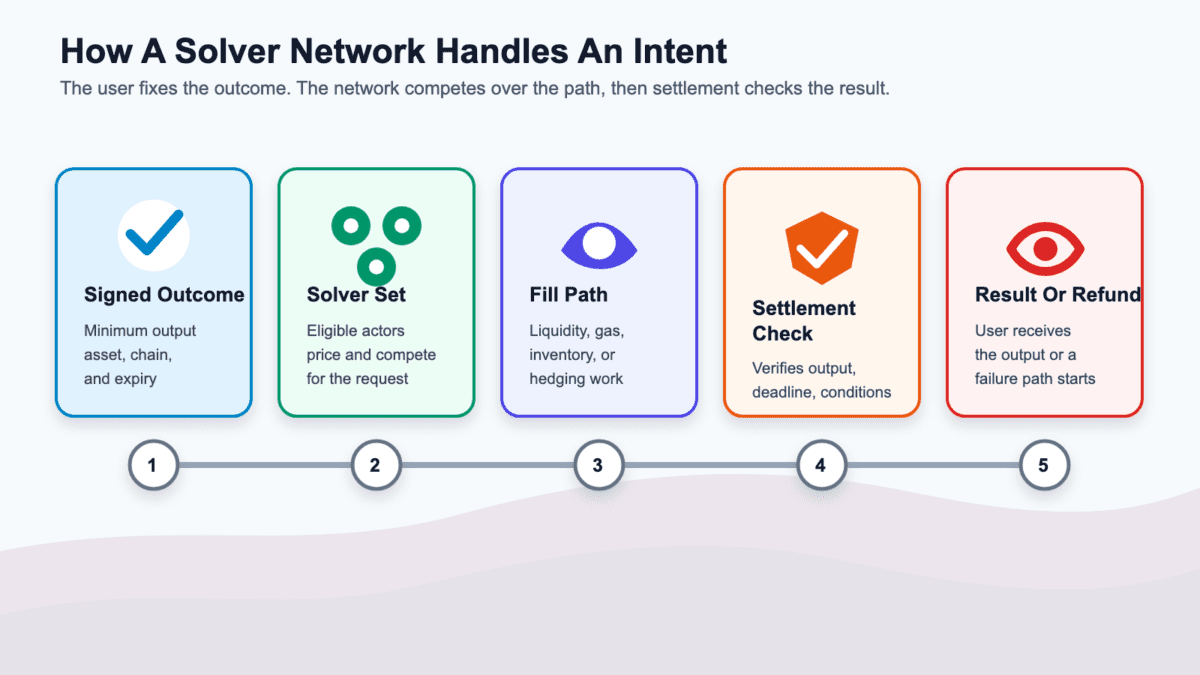
_A solver network adds competition between signing and settlement. The user still needs clear limits before approving the intent._
Cross-chain intents add more moving parts. A solver might deliver funds on the destination chain first, then settle or rebalance later. That can make the user experience faster, but it also raises questions about finality, refund handling, and hidden bridge exposure.
So the clean mental model is this: the user signs the outcome, solvers compete over the path, and settlement rules decide whether the result is good enough.
A solver network shows up in DeFi wherever an app wants users to request an outcome instead of micromanaging every execution step. That includes swaps, cross-chain transfers, quote systems, chain abstraction flows, and some large-order routes.
CoW Protocol and CoW Swap are common examples because they use solver competition around batch-style execution. UniswapX uses resolver-style filling for swap intents. Across is often discussed around cross-chain intents. LI.FI, NEAR Intents, Rango, Eco, and 1inch Fusion sit near the same vocabulary, even when their designs differ.
Keep that list separated. Some products focus on same-chain swaps. Some focus on cross-chain fills. Some expose integrator tools. Some use market makers or permissioned actors. The shared idea is that a user signs an outcome and another actor handles the route.
Wallet behavior still sits near the front of the flow. You may connect a wallet, approve token access, sign an intent, or review a destination chain before anything happens. That makes wallet setup part of solver network hygiene, not just a beginner chore.
The clearest user-facing case is a cross-chain move. Instead of selecting a bridge, checking routes, funding gas on another chain, and hoping the app explains the failure path, the user asks for a destination asset. The solver network competes to make that happen.
The best version feels boring. The bad version hides too much. If the interface cannot explain what you sign, what chain receives funds, and what happens on failure, the solver layer is adding fog instead of execution quality.
A solver network is not just a DEX aggregator with a new hat. Aggregators usually search existing routes, while solver networks can let actors compete to fill an outcome using liquidity, inventory, gas sponsorship, hedging, or cross-chain settlement.
The difference is about responsibility. A normal router points the user through available paths. A solver may take on more execution work and risk, then earn money for delivering the requested result.
| Model | What Changes For The User |
|---|---|
| AMM router | The trade routes through one or more pools with visible slippage and pool depth limits. |
| DEX aggregator | The app searches across venues and splits routes, but the user often still executes through onchain liquidity. |
| Bridge | The user moves assets or messages across chains and may wait for finality, liquidity, or relayer action. |
| Market maker | A professional counterparty quotes or fills using inventory, pricing models, and hedging. |
| Solver network | Competing actors try to satisfy a signed outcome and settle only if the user’s conditions are met. |
An aggregator can be excellent for a simple swap. It may split a route across pools and show the best quoted output at that moment. But if the trade needs private liquidity, cross-chain delivery, destination gas handling, or a market maker willing to warehouse risk, a solver model can offer more room to compete.
A bridge is also different. Bridges usually move assets or messages between chains. A cross-chain solver route may use bridge-like infrastructure, solver liquidity, or settlement contracts under the hood. The user may see fewer steps, but the underlying trust model still needs inspection.
Market makers are closer to solvers because both can use inventory and pricing judgment. In a solver network, that work is supposed to become a competitive marketplace around user intents, not just a single quote from one counterparty.
The practical takeaway is simple. Ask what the app is actually doing for you. If it only finds routes, it is acting like an aggregator. If actors compete to deliver your signed outcome, you are closer to solver network territory.
A solver network can help traders when execution complexity is the real problem. Cross-chain swaps, large orders, thin liquidity, destination-chain gas, and MEV-sensitive routes are better candidates than a tiny major-pair swap on one chain.
For a small ETH-to-USDC swap on a deep pool, a normal AMM or aggregator may already be good enough. The solver layer earns its keep when competition can produce a better final result after fees, gas, slippage, timing, and failure risk.
| Trade Situation | Solver Network Fit |
|---|---|
| Small same-chain major-pair swap | Often low. A normal aggregator may be enough. |
| Large swap across split liquidity | Better fit if solvers can source inventory or route across venues. |
| Thin token with ugly liquidity | Mixed. Solvers cannot create real demand from nowhere. |
| Cross-chain move | Strong fit when the app exposes limits, destination output, and refund rules. |
| MEV-sensitive trade | Good fit when private order flow and minimum output are enforced. |
| User lacks destination-chain gas | Useful if the solver can handle gas cleanly and disclose the cost. |
MEV pressure is one reason traders care. Public routes can become adversarial when bots, searchers, and fast actors compete around visible order flow. Someone else may profit from the way your trade reaches the market.
A solver network can reduce some of that exposure by moving execution into a controlled competition. It can also return surplus or improve a fill when solvers fight for the order. But those words need evidence in the quote, not just a glowing button.
The best fit is a trade where the solver has something useful to optimize. The weakest fit is a trade where the market itself is bad. A route can be clever and still fail when liquidity is thin, price impact is extreme, or the token is already a crowded exit door.
A solver network costs money even when the interface feels gasless. The cost may be explicit, hidden in spread, paid from surplus, or absorbed by the solver because the solver expects another edge.
Solvers are not charities with RPC endpoints. They may pay gas, front inventory, rebalance across chains, hedge exposure, maintain infrastructure, and risk failed fills. If they cannot earn enough to cover that, they stop bidding or quote worse prices.
Common solver revenue paths include:
Competition is what keeps those incentives honest. If many capable solvers compete, the user may see better quotes and tighter execution. If only one solver can fill a route, the user may simply be trusting a private middleman with better branding.
Failed bids change quotes too. A solver can spend time, gas, balance-sheet capacity, or operational effort and still lose. That cost gets priced into future quotes. Nothing about “intent” makes economic gravity take the afternoon off.
So when an app advertises better execution, compare the final output. Check minimum received, fee lines, spread, expiry, and whether the route can be compared with a normal aggregator. The number that lands in your wallet beats the word “optimized.”
Solver network risks start where the clean interface hides complexity. A solver network can reduce some execution pain, but it does not remove weak liquidity, bad settings, bridge exposure, contract risk, or concentrated execution power.
The biggest risk is weak competition. If only a few solvers can bid, the market may not discipline pricing. Permissioned access can reduce spam and improve reliability, but it can also make the network depend on a small group of actors.
Inventory limits create another failure point. A solver that can fill common routes may not handle a large, weird, or fast-moving trade. If the route touches a thin token, a user can still end up on the wrong side of a fancier execution path.
This is not a niche detail once a route crosses chains or relies on private liquidity. More moving parts mean more places for solver access, inventory, and settlement rules to decide the outcome.
> A solver network can make a route easier to use. It cannot make every route safe, liquid, private, or fairly priced.
Check these risks before signing:
MEV protection also deserves a narrow claim. Solver networks can reduce some sandwich risk or public order-flow exposure when they keep trades away from obvious public routes. They can also change who sees the order first. That is better only if the design enforces the user’s limits and keeps competition alive.
Refund handling is the quiet detail. If no solver fills, the user should know whether the intent expires, cancels, needs a new signature, or requires another transaction. If the app cannot explain that path, start smaller or step away.
Evaluate a solver-based app by checking what you receive, what you sign, who can fill it, and how failure is handled. The interface should make the route clearer, not turn risk into a loading spinner.
Start with minimum received. That number is the user’s hard boundary. If it is missing, unclear, or buried behind optimistic copy, the solver network is asking for trust before it earns it.
Use this checklist before approving a solver-based route:
Cross-chain routes can leave small residual balances after gas, rebalancing, or partial wallet activity. Those leftovers are the same basic idea as dust balances: tiny amounts that may be annoying, uneconomic to move, or easy to ignore until a wallet gets messy.
Route transparency is not all-or-nothing. Some apps cannot reveal every private liquidity source or solver strategy. But they should still show the final output, expiry, supported chains, failure behavior, and whether you are granting token approval or signing only an intent.
The clean habit is to test one small route first. If the app handles a tiny intent clearly, reports the result, and explains failure states, it earns more trust. If it hides basic details, the better execution claim has not done enough work.
Related solver network terms get messy because different protocols use different names for similar jobs. One system may say solver, another may say filler or resolver, and another may separate those roles more carefully.
Read the vocabulary by job, not label. Ask what the actor sees, what they can control, what risk they take, and how settlement limits their behavior.
| Term | What It Means Here |
|---|---|
| Solver | An actor that competes to satisfy a user’s signed intent. |
| Filler | A role that fills an intent or order, often by delivering the requested output. |
| Resolver | A solver-like actor name used in some intent and swap designs. |
| Relayer | An actor or service that forwards messages or transactions, usually without pricing the full trade. |
| Searcher | An actor that looks for MEV, arbitrage, backruns, or ordering opportunities. |
| Market maker | A counterparty that uses inventory and pricing models to quote or fill trades. |
| Intent | The user’s signed desired outcome, such as “receive at least this amount.” |
| Settlement contract | The onchain rule set that verifies whether the intent can finalize. |
| ERC-7683 | A draft ERC standard for cross-chain intent orders and solver-facing interfaces. |
For standards context, Ethereum Improvement Proposals identifies ERC-7683 as a Draft Standards Track ERC for cross-chain intents. That does not mean every solver network uses it, or that a standard removes app-specific risk.
Two adjacent CryptoProcent concepts help with the messy parts. PVP trading explains the adversarial execution pressure behind MEV concerns, while exit liquidity covers the bad-fill risk that can still appear when liquidity is thin.
The role labels are useful only after the user understands the flow. A solver can fill, route, hedge, or source liquidity depending on the protocol. A relayer may only move data. A market maker may be one solver in a wider set.
Keep the question grounded: who promises the output, who takes execution risk, and who gets paid if the route works?
Start with solver network apps by treating them as execution tools, not shortcuts around DeFi judgment. The route may reduce manual steps, but you still sign the outcome and live with the result.
The first use should be small and boring. Choose a familiar asset, a supported chain, and a route where you can compare the quote against a normal swap or bridge path. If the app cannot beat or clearly explain the alternative, there is no need to donate your trade to the experiment.
Use the next step that fits your goal:
Then read the signing prompt slowly. An intent signature, token approval, bridge action, and contract interaction are different things. They can appear close together in one flow.
The best solver network apps make that difference visible. They show what you give, what you get, when the quote expires, and what happens if no solver fills. If the screen hides those basics, the app is asking you to trust the machinery because it looks smooth. DeFi has sold worse ideas with nicer buttons.
No. A solver network is not the same as a DEX aggregator, although the two can overlap. A DEX aggregator usually searches routes through existing liquidity. A solver network lets actors compete to deliver a signed outcome, sometimes using inventory, private liquidity, hedging, gas sponsorship, or cross-chain settlement.
For simple swaps, an aggregator may be enough. Solver networks become more interesting when the route needs competition beyond normal pool routing.
A solver network can reduce some MEV exposure, but it does not stop all MEV. It may keep an order away from a public route, make solvers compete, or enforce a minimum output through settlement.
MEV can still appear through poor pricing, weak solver competition, opaque order flow, or thin liquidity. Check whether the app shows minimum received, route terms, expiry, and failure handling.
A solver network can make cross-chain swaps simpler, and sometimes safer, when settlement rules and refund paths are clear. It can reduce manual bridge steps and let solvers compete to deliver the destination asset.
But bridge and finality risk may be hidden rather than erased. The user still needs to know which chains are involved, what output is guaranteed, and what happens if the route stalls.
If no solver fills your intent in a solver network, the intent should expire, cancel, or move into a defined refund path. The exact result depends on the app and settlement design.
Good interfaces show the deadline, minimum output, and failure behavior before you sign. Weak interfaces leave users guessing whether they need a new signature, a cancellation transaction, or support.
Some protocols that use solver networks may have tokens, points, governance, or fee systems. But “solver network” itself is an execution architecture, not one specific token or investment category.
Keep that split clean. A token may capture governance, fees, incentives, or nothing important at all. Evaluate the protocol and token design separately from the solver concept.
A solver network in DeFi may be run by market makers, professional trading firms, protocol-approved solvers, infrastructure teams, or independent fillers. Access can be open, permissioned, or somewhere between.
The healthier setup usually has enough capable solvers, clear rules, and settlement checks that protect the user’s signed outcome. The label is secondary to competition, transparency, and failure handling.