Physical Address
304 North Cardinal St.
Dorchester Center, MA 02124
Physical Address
304 North Cardinal St.
Dorchester Center, MA 02124


Sovereign rollup risk without the modular fog.
A sovereign rollup is a crypto network that posts transaction data to another chain while its own nodes decide the valid state.
That design can give an app or chain more control over rules, upgrades, and execution. It can also move risk into places users often check too late: bridge design, liquidity depth, sequencer control, proof systems, and who gets to decide which chain is canonical after a fork.
A sovereign rollup is a rollup-style blockchain that publishes transaction data to another blockchain, usually for ordering and data availability. Its own nodes then verify execution and decide which state is valid.
Data availability means the transaction data is publicly retrievable. State means the current record of balances, contracts, and app activity. If the data is visible, a rollup node can replay the transactions and check whether the new state follows the rules.
Celestia’s introduction to sovereign rollups frames the core difference clearly: smart contract rollups have transactions verified by smart contracts on a settlement layer, while sovereign rollups have transactions verified by the rollup’s own nodes.
That is the job of the word “sovereign.” It points to control over rules, upgrades, and fork choice. The rollup can publish new software, and nodes can choose which version to follow.
But sovereign does not mean isolated. The rollup may still depend on a data availability layer, a sequencer, a bridge, wallet support, third-party liquidity, and a community willing to follow the same chain.
Use this plain split when the term appears in a pitch:
That final part is where many neat diagrams get shy. A sovereign rollup can be elegant architecture and still leave users with very human risks.
A sovereign rollup works by separating where data is published from where the chain’s state is accepted. Users send transactions, a block producer orders them, data gets posted elsewhere, and rollup nodes verify the result.
A sequencer is the actor that orders transactions into a batch. Some designs may call this a block producer. The name matters less than the job: someone decides the order in which user actions enter the rollup.
The basic flow looks like this:
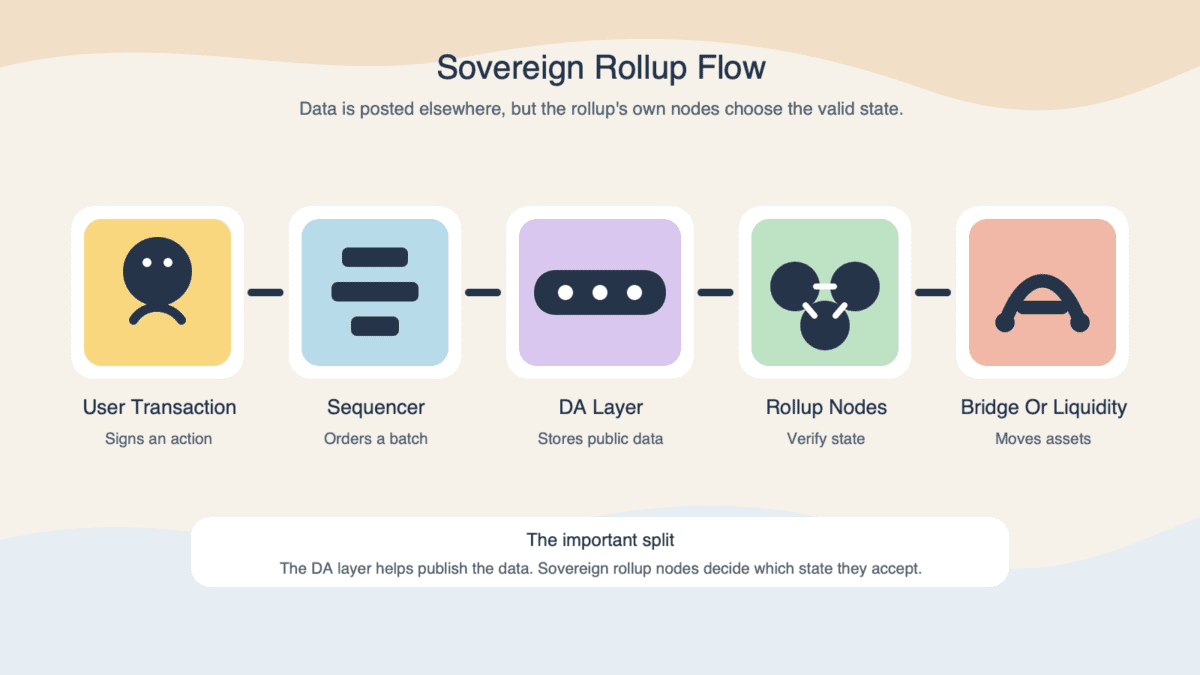
A proof system can add another check. A validity proof tries to show that a state update is correct. A fraud proof tries to prove a bad update happened. A zk sovereign rollup uses zero-knowledge proof technology to make verification more compact.
Those proofs do not remove the need to understand the rest of the stack. You still need to know who can sequence transactions, whether users have a forced-inclusion path, where data is posted, who runs nodes, and how assets move in or out.
The takeaway is simple. A sovereign rollup is more specific than a generic L2 pitch: the chain borrows data publication from another layer while keeping more authority over state and upgrades.
Sovereign rollup comparisons get messy because crypto uses similar words for different jobs. “Rollup” can describe data posting, settlement, proof systems, bridges, or a market narrative, depending on who is talking.
The clean question is this: who verifies the state, where does the data live, and what happens when users need to exit?
| Model | What Users Should Understand |
|---|---|
| Sovereign rollup | Transaction data is posted to another chain, but sovereign rollup nodes verify state and choose the canonical chain. |
| Smart contract rollup | A settlement-layer smart contract verifies proofs or challenges and usually anchors the native bridge. |
| Appchain | The chain is built for one app or narrow product. It may be sovereign, a rollup, a sidechain, or something else. |
| Validium | Execution happens off the base chain, but data may be kept offchain or on a separate DA layer, which changes exit assumptions. |
| Based rollup | The base chain helps sequence transactions. This can reduce some sequencing trust, but it is not the same as sovereign settlement. |
The table is not a ranking. It is a responsibility map. A smart contract rollup may offer stronger settlement-layer verification, but it can still have upgrade keys, sequencer risk, and withdrawal delays.
A sovereign rollup may offer cleaner rule control and easier forks, but users must inspect the bridge and liquidity path more carefully. If the base chain does not verify the rollup’s state, a bridge cannot be evaluated with the same assumptions as a standard settlement-layer bridge.
Appchain language adds another wrinkle. A sovereign rollup can be app-specific, but not every appchain is a sovereign rollup. Some appchains have their own validators. Some settle to a parent chain. Some use shared security. Some are mostly a token story wearing a hard hat.
So when a project uses several labels at once, slow down. Ask which label describes execution, which describes data availability, which describes settlement, and which describes marketing.
A sovereign rollup can inherit some security properties from the chain it posts data to. It does not inherit every protection that chain offers, and it does not magically make bridges safe.
The key split is data versus state. If transaction data is available and ordered, rollup nodes can verify the chain independently. But the DA layer may not verify that the rollup’s state transition is correct.
Here is the safer way to read security claims:
| Layer Or Role | What It Does For The User |
|---|---|
| Data availability layer | Makes transaction data retrievable so nodes can check the rollup. |
| Ordering or consensus | Helps establish the order in which published data appears. |
| Sovereign rollup nodes | Verify execution and reject invalid state updates. |
| Proof system | Can make correctness checks easier, faster, or harder to fake. |
| Settlement | Determines where disputes, exits, and final authority are resolved. |
| Bridge custody | Controls how assets move and what trust assumptions users inherit. |
| Social consensus | Decides which software version or fork the community treats as canonical. |
“Secured by Bitcoin” may only mean data is posted using Bitcoin-related blockspace or commitments. “Secured by Celestia” may mean data availability, not execution validation. “Settles to Solana” or another fast chain still needs a precise explanation of what settlement means in that design.
This is not hair-splitting. It changes user risk. A chain can make data public and still rely on its own nodes, bridge operators, upgrade governance, or liquidity providers for the parts users feel directly.
Strong sovereign rollup documentation should answer one sharp question: secured for what exactly? If the answer blends data availability, settlement, asset custody, and token value into one warm sentence, keep your wallet calm.
A sovereign rollup bridge changes user risk because funds may depend on bridge design rather than a settlement-layer smart contract that verifies every rollup state update. The bridge can become the most important part of the user experience.
Some sovereign rollups may have bridges to a DA layer or other chains. Some may use third-party bridges, liquidity networks, or wrapped assets. Some may rely on app-specific liquidity instead of a clean canonical exit.
That means users need to separate the chain from the asset path. A rollup can process transactions correctly while the bridge has upgrade keys, weak monitoring, limited liquidity, or a messy withdrawal route.
Bridge hygiene starts before the first signature. Use a separate wallet for experiments, review approvals, confirm the official bridge URL, and keep high-value storage away from fresh routes. CryptoProcent’s wallets hub is useful when the bridge section of a pitch sends you toward approvals, custom networks, or new wallet software.
Liquidity is the next problem. If most exits depend on a thin pool, leaving can cost more than entering. That is where exit liquidity stops being slang and becomes the price of getting out.
Check these points before you bridge:
Forks make the bridge question sharper. If the sovereign rollup community splits, each side may claim a valid history. Assets connected through external bridges may not follow both forks cleanly.
That does not make sovereign rollups unusable. It means “can bridge” is not enough. Ask what the bridge can prove, who controls it, and whether real liquidity exists when users want to leave.
For traders and investors, a sovereign rollup can change fees, speed, liquidity, and token demand. It can also make a mediocre trade sound more technical than it is.
The upside is easy to understand. A rollup with its own execution rules can tune for one app, one virtual machine, one fee market, or one high-throughput use case. That can help perps, games, privacy apps, custom DeFi, and trading products that dislike crowded shared blockspace.
But market relevance is not the same as token value. A sovereign rollup may use a DA token, its own gas token, a governance token, an app token, or no clean investable asset at all.
When sovereign rollups appear inside a modular-chain meta, separate the stack from the slogan. A useful architecture can still route value to sequencers, app operators, liquidity providers, the DA layer, or no public token in particular.
Use a short token claim check:
Trading UX can also be uneven. A chain may feel fast after deposits land, while exits remain slow or expensive. A sequencer can make activity feel smooth until censorship, downtime, or reordering enters the picture.
The investor lesson is deliberately boring. Sovereign-rollup architecture is one input, not a buy signal. The thesis still needs users, fees, liquidity, security discipline, and a token design that actually captures value.
Sovereign rollups show up around modular blockchain projects, DA layers, Bitcoin scaling experiments, app-specific networks, and custom execution environments. The term is often used in builder material before it becomes clear to everyday users.
Celestia is the most common reference point because it popularized the modular data-availability framing. Rollkit is often mentioned as a framework for building rollups that can post data to a DA layer. Avail, Nomos, and Sovereign SDK appear in similar infrastructure conversations.
You may also see the term in these categories:
Bitcoin sovereign rollup claims need careful reading. Posting data to Bitcoin, or using Bitcoin-related commitments, is not the same as getting a native BTC bridge, Bitcoin-style settlement for every state update, or automatic liquidity.
Solana-related rollup claims need the same caution. A high-throughput trading design may use fast infrastructure and still carry its own sequencer, bridge, and liquidity assumptions.
Zk sovereign rollup language means a proof system is involved. That can help verification, but it does not answer every bridge, upgrade, or liquidity question. A proof is one piece of the machine, not a receipt for the whole machine.
Read examples by category. Ask what role the named project plays: DA layer, framework, bridge, app, sequencer, prover, or token. Then decide whether that role helps the user risk you actually care about.
A sovereign rollup claim deserves a checklist because the label can hide very different systems. A real project should make the chain, data path, proof model, bridge, and upgrade controls easy to find.
Start with liveness. If the network is not live, the claim is mostly a roadmap. If it is live, find the explorer, node software, data-availability layer, sequencer model, bridge route, and withdrawal path.
Marketing language can also hide outright control risk. A project can talk about modular architecture while still carrying admin keys, malicious upgrade paths, fake bridges, or token-control patterns that look closer to a hard rug than infrastructure.
Use this checklist before trusting the claim:
Do not expect every early project to have perfect answers. But expect honest boundaries. “Not disclosed” is a warning when it applies to bridge keys, sequencer control, or withdrawals.
The best sovereign-rollup teams make boring details visible. The weakest ones bury those details under diagrams, acronyms, and a token chart that looks brave until liquidity checks the room.
Related sovereign rollup concepts are worth learning because the label sits inside a larger modular scaling map. You do not need to become a protocol engineer, but you should know which word points to which risk.
Data availability is the easiest starting point. It answers whether transaction data can be downloaded and checked. Settlement answers where disputes, exits, and final authority are resolved. Execution answers how transactions change balances and contract state.
Smart contract rollups use settlement-layer contracts to verify state updates or proof challenges. Based rollups use base-layer sequencing. Native rollups aim for tighter protocol-level integration with a base chain. Validiums move data availability away from the settlement layer, which changes user exit assumptions.
Appchains are chains built for one app or product. A sovereign rollup can be an appchain, but an appchain does not have to be a sovereign rollup.
Zk sovereign rollups add zero-knowledge proof machinery. The proof can make validation more efficient, but the normal questions remain. Who sequences, where is data posted, how does the bridge work, and what happens if users disagree on the valid chain?
Two CryptoProcent risk concepts help after the architecture map. A crypto meta guide is useful when sovereign rollup language turns into a market theme. A soft rug guide helps when delivery, liquidity, or governance clarity fades without an obvious one-day theft.
This vocabulary is useful because project pages rarely use only one term. They stack labels. Your job is to unstack them until each part has a job.
A sovereign rollup in crypto is a chain that posts transaction data to another blockchain while its own nodes verify execution and choose the valid state. It can use another network for data availability without handing every settlement decision to that network’s smart contracts.
A sovereign rollup works by batching user transactions, publishing the data to a data availability layer, and having rollup nodes verify the resulting state. A sequencer or block producer usually orders transactions, while proofs may help users check whether updates followed the rules.
A sovereign rollup can be described as an L2 in some contexts, but the label is imprecise. Many users call any scaling layer an L2, while sovereign rollups may not settle to the base chain the way smart contract rollups do.
A sovereign rollup may inherit data availability, ordering, or re-org resistance from the chain it posts to, depending on the design. It does not automatically inherit execution validation, bridge safety, asset custody, liquidity, or settlement guarantees from Ethereum, Bitcoin, or any other chain.
The main difference is where state is verified. A smart contract rollup uses smart contracts on a settlement layer to verify proofs or challenges, while a sovereign rollup relies on its own nodes to verify state and follow the canonical chain.
Yes, a sovereign rollup can have a bridge. The important question is what the bridge proves, who controls upgrades, which assets it moves, and whether the bridge is used for settlement or only for moving tokens and messages.
Start with the claim, not the logo. A useful sovereign rollup pitch should let you trace data, state, bridge, liquidity, and token value without guessing.
If one part is missing, the risk has not disappeared. It has moved into a place users cannot inspect. That gap can turn a routine signature, bridge, or token position into a blind bet.
Begin with the live system. Find the explorer, node software, data availability layer, sequencer model, proof model, bridge route, and withdrawal path. Then match those details to the action you are considering. Bridging funds, trading the token, and using the app each fail in different places.
Work through these checks before you bridge, trade, or buy the narrative:
Keep the first transaction boring. Use an amount you can afford to lose, wait for the deposit and withdrawal path to behave as described, and revoke broad approvals when the test is done. A chain that feels fast after deposit can still be slow, thin, or confusing when funds leave.
If a project cannot explain those basics, wait. Sovereignty is useful when it makes rules clearer. It is expensive decoration when it makes risk harder to see.