Physical Address
304 North Cardinal St.
Dorchester Center, MA 02124
Physical Address
304 North Cardinal St.
Dorchester Center, MA 02124

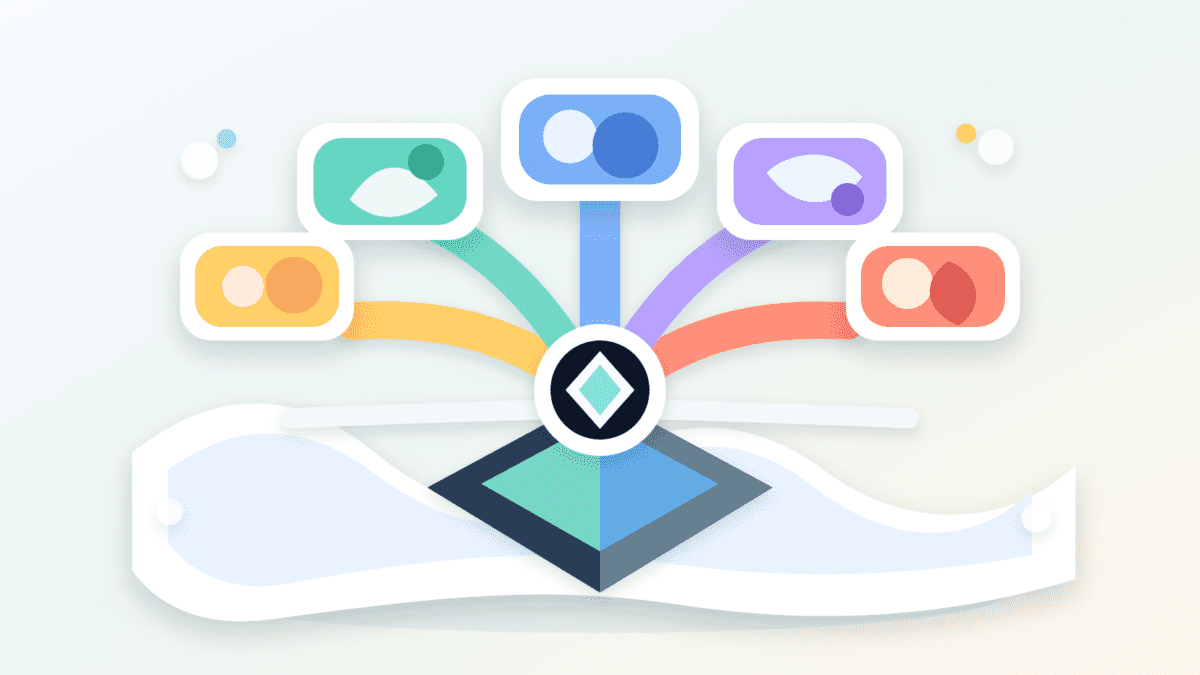
A practical guide to Superchain, OP Stack, Base, and bridge risk.
Superchain is Optimism’s coordinated network of OP Stack chains that share standards, upgrades, governance paths, and interoperability goals.
Most users meet Superchain through Base, OP Mainnet, Unichain, World Chain, Ink, Soneium, Zora, Mode, or Celo. It is not one giant blockchain swallowing everything. It is a group of Ethereum-aligned chains trying to feel less like separate islands over time.
That difference shows up before you bridge, trade, or buy a token tied to the story. Superchain can make the OP Stack world easier to follow. But each chain still carries its own bridge, liquidity, governance, and token risks.
Superchain in crypto means Optimism’s coordinated network of OP Stack-aligned chains. It is a shared framework for many chains, not a single blockchain that replaces Ethereum.
The label can sound bigger than the current product. That is where confusion starts. Superchain is not OP Mainnet renamed. It is not Base by itself. And it is not the OP token. It is a network thesis around OP Stack chains sharing standards, upgrade paths, governance alignment, bridge infrastructure, and eventually smoother cross-chain messaging.
Read the label this way:
For a normal user, the Superchain shows up as context around the chain you are already using. You might trade on Base, bridge to OP Mainnet, mint on Zora, use an app on World Chain, or follow a Celo migration. Those chains can share OP Stack standards and still have their own apps, liquidity, operators, and risk profiles.
So Superchain is useful as a map. It tells you which chains may share infrastructure and future interoperability goals. It does not tell you where to put funds without doing the boring checks first. Crypto loves a grand network label. The useful version is quieter: know the chain, the standards it follows, how assets move, and what still depends on future upgrades.
Superchain, OP Stack, Optimism, and Base are connected, but they are not interchangeable. Mixing them up can lead to bad assumptions about bridges, governance, token exposure, and chain risk.
The names sit at different layers of the same OP Stack world:
| Term | Plain-English Meaning |
|---|---|
| Optimism Collective | The governance community behind Optimism’s network, public goods funding, and protocol direction. |
| OP Mainnet | The original Optimism L2 chain, often what users mean when they say “Optimism” casually. |
| OP Stack | The open-source software stack used to build OP Stack chains and rollups. |
| OP Chain | A chain built with or aligned to the OP Stack model. |
| Superchain | The coordinated network of OP Stack-aligned chains with shared standards and interoperability goals. |
| Base | Coinbase’s L2 that launched on OP Stack and became the biggest attention magnet in the group. |
| OP token | The governance token tied to Optimism, not a direct ownership token for every Superchain chain. |
| Superchain Registry | A registry used to classify and track chains that meet Superchain-related standards. |
| Superchain bridge | Bridge infrastructure and roadmap work meant to make movement across aligned chains cleaner over time. |
The table leaves one important wrinkle: membership does not flatten risk. One chain may have deeper liquidity, better app support, stronger wallet integrations, or different upgrade controls than another. A chain can share OP Stack DNA and still behave differently when you bridge, withdraw, or chase incentives.
So the Superchain label should start a check, not end it. Ask which chain is involved, who operates its sequencer, which bridge route is official, what token version you are holding, and whether the app supports the destination chain. The label is useful, but it does not turn a messy multi-chain market into one neat button. We are still in crypto. There is usually another button.
The Superchain works by coordinating OP Stack-aligned chains around shared software standards, registry checks, upgrade paths, governance processes, bridges, and cross-chain messaging goals. It is meant to make many chains act more like one network over time.
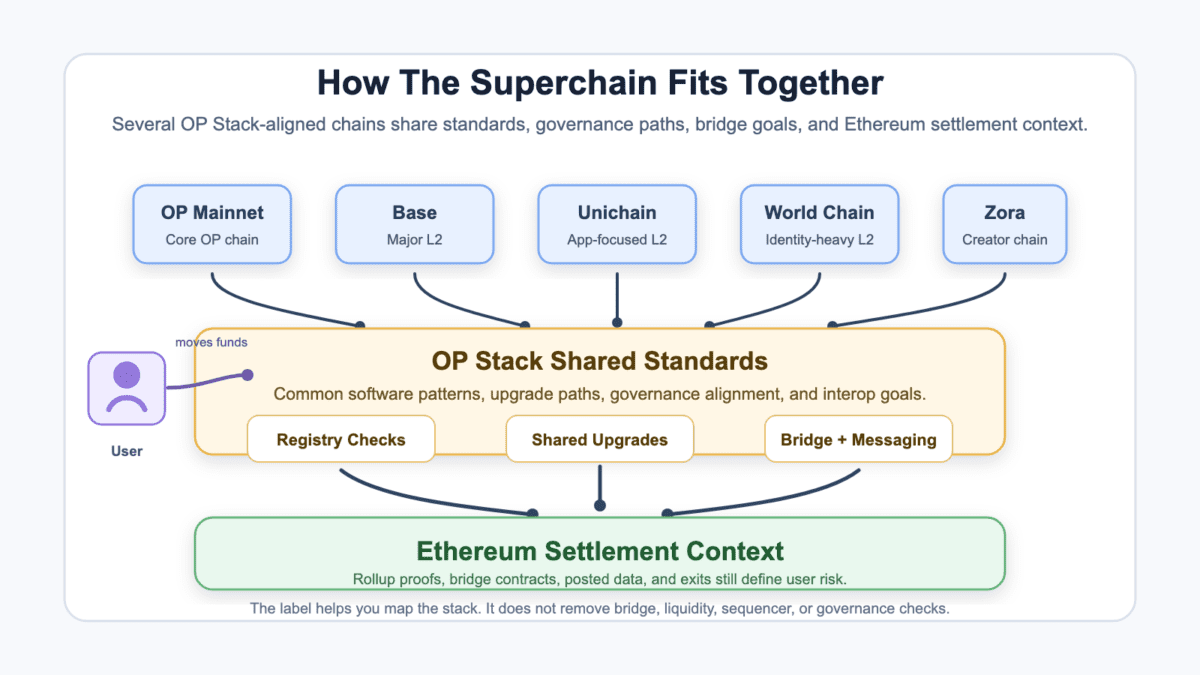
The OP Stack is the software foundation. Chains built with it can share design patterns, upgrade logic, bridge assumptions, and developer tooling. The Superchain adds the coordination layer. It tracks which chains meet standards, how upgrades move, how bridges and messages may work across chains, and how the network avoids becoming a pile of unrelated rollups with the same logo family.
Ethereum still sits in the risk picture. Superchain chains are Ethereum-aligned L2s, but using one is not the same as using Ethereum mainnet. Your transaction may execute on a rollup, depend on a sequencer, pass through a bridge contract, and later rely on posted data or an exit path. The moving parts are easier to follow once each job has a name:
Superchain interoperability is the ambition tying those parts together. The goal is not just “many chains exist.” The goal is that users and apps can move through those chains with less friction, fewer custom bridge paths, and clearer standards.
OP Stack infrastructure is Ethereum-like, but not identical to Ethereum mainnet infrastructure. A node operator, indexer, bridge builder, or data service may need OP Stack-aware software and chain-specific configuration.
That detail affects users because simplicity depends on hidden infrastructure. If a chain changes its client, upgrade process, proof system, RPC behavior, or bridge path, wallets and apps may need to adapt. A smooth interface can still sit on top of specialized moving parts.
For most users, the takeaway is simple: do not assume every OP Stack chain works exactly like every other one. Confirm chain support in your app or wallet before moving funds, especially when a bridge or incentive campaign points you toward a chain you have never used.
The Superchain has live OP Stack chains, shared standards, registry work, bridge routes, and active interoperability development. The unfinished part is the smooth “many chains, one experience” version people often imagine from the branding.
That live-versus-roadmap split is where many explanations get too glossy. A chain can be part of the broader Superchain story while a specific bridge, messaging feature, or shared upgrade path is still limited, staged, or dependent on app support. Use the split before you move funds:
| Live Or Usable Now | Still Staged Or Context-Dependent |
|---|---|
| OP Stack chains such as OP Mainnet, Base, Unichain, World Chain, Zora, and others are active. | A perfectly unified user experience across every Superchain chain is not the default today. |
| Users can bridge to supported chains through available bridge routes and app interfaces. | Bridge safety, speed, fees, and supported assets can differ by route and chain. |
| The Superchain Registry can help classify chain status and standards. | Registry status does not remove liquidity, sequencer, app, or token-contract risk. |
| Shared OP Stack standards make upgrades and tooling easier to coordinate. | Shared sequencing, atomic composability, and richer cross-chain UX depend on rollout details. |
| Cross-chain messaging and Superchain ETH work show the intended direction. | User-facing support may be limited by contracts, wallets, apps, and safety stages. |
The table should make one thing boringly clear: Superchain is both a live network and a roadmap. Some pieces are already useful. Others are promises with engineering, governance, and adoption work still attached.
That does not make the project fake. It means you should read “interoperability” as a direction, not a guarantee. Before sending funds, check the exact bridge, asset contract, chain support, and withdrawal path. A roadmap line cannot refund a bad approval.
For traders, Superchain changes the pre-trade checklist. Chain choice affects execution, liquidity, bridge routes, token versions, app support, gas, and withdrawal risk. The architecture shows up when a trade crosses chains or depends on one specific L2.
If you are only swapping a small token on one supported chain, Superchain may feel invisible. But it becomes very visible when a token exists on several OP Stack chains, liquidity is split, or an app pushes you through a bridge before the actual trade. Before signing, slow down and check the parts that can change the result:
The Superchain can make chain movement cleaner over time. It does not erase bridge risk today. You still need to know whether you are holding the right token version on the right chain with enough liquidity to exit.
Gas assets can also trip users. A chain may feel cheap until you need the correct gas token, a funded wallet, or a second transaction to claim funds. That is not a grand thesis problem. It is the tiny operations problem that makes a trade feel cursed at 2 a.m.
For traders, the practical win is better routing and clearer standards. The practical risk is over-trusting the label. Superchain tells you a chain belongs to a wider coordination effort. Your trade still settles through specific contracts, apps, pools, bridges, and wallets.
For investors, Superchain connects network usage, Optimism governance, OP token narratives, Base activity, Ethereum settlement, and competing L2 stacks. Those ideas overlap, but they are not the same bet.
Start by splitting utility from exposure. If more apps and chains use OP Stack standards, users may get better tooling, more consistent infrastructure, and less friction across chains. That can be real even when the token thesis stays uncertain. Separate the investment stories this way:
This is where investors often get sloppy. A useful chain network does not automatically mean every related token captures value. A token can pump because the story is hot, then become someone else’s exit liquidity when the story outruns the mechanics.
Capital can also move between ETH, OP, Base-adjacent tokens, and competing L2 ideas without validating one clean thesis. That kind of rotation is normal in crypto markets, especially when a new infrastructure theme starts pulling attention.
Useful investor questions are narrower: who governs upgrades, who earns fees, what revenue is actually routed where, how concentrated activity is, how sticky the apps are, and whether token holders have a clear claim on any upside.
> Superchain can be useful infrastructure while OP, ETH, and related-token trades remain risky. One label should not blur three different exposures.
That split keeps the article honest. You can believe the network design improves L2 coordination and still avoid pretending every Superchain-adjacent asset is a clean index on that future.
Base is the Superchain’s biggest test because it brings massive attention, liquidity, and distribution while raising hard questions about concentration, chain sovereignty, and shared economics.
Base launched as an OP Stack chain and became the example most users actually touch. That helps the Superchain story because real users matter more than diagrams. But it also creates tension. If one chain dominates activity, users start asking whether the network is becoming less fragmented or just more centered around one operator. The open questions are concrete:
Base has also become the current pressure point. A Base engineering update on February 18, 2026 described a move toward a unified Base-operated stack and a target of six smaller hard forks per year, up from three. Today’s user experience continues. OP Stack compatibility remains during the transition. Node operators will later follow Base releases. That is not a small footnote. It changes how people read the Superchain roadmap.
> None of that proves the Superchain fails. It proves the hard part has started: a real multi-chain network has to handle successful members that want more control.
This is also why Ethereum-aligned users argue so loudly about L2s. The ETH boomer concern is not only nostalgia for mainnet. It is a real question about whether L2 activity strengthens Ethereum settlement or pulls users, fees, and culture into separate venues.
Base can help the Superchain by bringing users, apps, and liquidity. It can also stress the model by showing how quickly chain operators want custom performance, governance, and economic control. Both can be true. Crypto is annoying like that.
Superchain differs from other multi-chain ecosystems because it focuses on OP Stack alignment, shared standards, Optimism governance context, and a future where related chains interoperate more cleanly. Other models solve the same fragmentation problem differently.
This comparison should not become a leaderboard. Arbitrum Orbit, Polygon AggLayer, ZK Stack, and Superchain all deal with the same pressure: apps want their own chains, users want less friction, and liquidity hates being chopped into tiny pieces. The useful comparison is the model, not the marketing:
| Model | What Makes It Different |
|---|---|
| Superchain | OP Stack-aligned chains coordinate around shared standards, upgrade paths, registry status, bridge goals, and Optimism governance context. |
| Arbitrum Orbit | Teams can launch chains around the Arbitrum stack with more app-chain flexibility and their own deployment choices. |
| Polygon AggLayer | The focus is aggregated liquidity and cross-chain coordination across connected chains rather than one OP Stack family. |
| ZK Stack | Chains use a ZK-oriented stack, where validity proofs and custom chain design shape the model. |
The tradeoff is familiar. More shared standards can make chains easier to coordinate. More sovereignty can let teams move faster or customize for a specific app. More interoperability can improve user experience. But it can also add new contracts, trust assumptions, and failure modes.
For users, the comparison should end with questions, not tribal flags. Which chain has the app you need? Where is the liquidity? How do withdrawals work? What happens if the operator pauses, upgrades, or changes direction? The best stack argument still has to survive your wallet screen.
Before using a Superchain chain, verify the chain, bridge, token, wallet, liquidity, and withdrawal path. The label is useful, but your transaction depends on the specific route you choose.
Verify chain identity first. The chain should appear in official materials, wallet network settings, bridge interfaces, and the Superchain Registry where relevant. Then confirm the app you are using supports that chain directly, not through a confusing lookalike route. Use this checklist before bridging, farming, trading, or chasing incentives:
Wallet hygiene deserves its own mention. Use good crypto wallets and keep risky approvals away from your main holdings. A new chain, new bridge, and new incentive campaign can be useful. They can also collect bad signatures from excited people.
Also check the token version. A ticker can look familiar while the contract is different, the liquidity is thin, or the bridge route creates a wrapped version that your target app does not accept. That is how a “quick move” becomes a small operations seminar nobody asked for.
The final check is intent. Are you using the chain because an app there is better, because liquidity is deeper, or because a rumor says points are coming? Those are different reasons with different risk levels. Superchain context helps, but your reason for moving funds still needs to be clear.
Superchain in crypto is Optimism’s coordinated network of OP Stack-aligned chains. It is designed to let multiple Ethereum L2s share standards, upgrades, governance paths, bridge infrastructure, and future interoperability goals.
Think of Superchain as a network framework for related chains, not a separate L1 or one single chain.
No, Superchain is not one blockchain. It is a coordinated group of chains connected by OP Stack standards and Optimism’s wider network design.
Individual chains, such as OP Mainnet, Base, or Unichain, are the environments where users transact. Superchain is the broader coordination layer around them.
No, Superchain and OP Stack are related but different. OP Stack is the software foundation, while Superchain is the coordinated network vision built around OP Stack-aligned chains.
A chain can use OP Stack technology, but users should still check whether it fits the Superchain standards, registry status, bridge support, and governance context they expect.
Base launched on OP Stack and remains central to the Superchain conversation because of its usage, liquidity, and Coinbase backing. It is also the current test case for how much chain sovereignty can fit inside a shared network.
Base’s move toward a unified Base-operated stack means users should watch compatibility, governance, upgrades, and bridge support instead of assuming the relationship never changes.
Superchain does not have a standalone Superchain token. The OP token is tied to Optimism governance and network economics, but it is not simple ownership of every chain in the Superchain.
That distinction keeps investor exposure clean. Using a Superchain chain, holding OP, holding ETH, and buying a Superchain-themed token basket are different exposures.
Superchain can reduce some L2 fragmentation by aligning chains around shared standards, bridges, messaging goals, and governance paths. It cannot remove fragmentation by itself today.
Users still face different chains, liquidity pools, bridge routes, wallets, sequencers, and app support. Compare the exact Superchain path you plan to use against the alternative: chain, bridge, liquidity, wallet support, and exit path.
Pin down the route before the slogan. Superchain is useful only when you know which chain, app, bridge, token, and wallet path you are actually using.
If you are trying to understand it before moving funds, take the checks in this order:
If you are only researching, the same order still helps. It keeps the topic grounded in chain mechanics instead of drifting into “Superchain coins” lists, airdrop rumors, or whatever chart is loudest that day.
If you are preparing to transact, a small test move can be dull and still cheaper than learning the wrong bridge route with the full bag.
That last point saves headaches. You can use Base without owning OP. You can like Ethereum settlement without buying every L2 token. You can think the Superchain is a serious coordination attempt and still wait for interop features to mature.
The Superchain is best understood as infrastructure in progress. It can make the OP Stack world easier to navigate, but it does not remove the need to check the route before you click. In crypto, the route is where the bill usually hides.