Physical Address
304 North Cardinal St.
Dorchester Center, MA 02124
Physical Address
304 North Cardinal St.
Dorchester Center, MA 02124


A practical guide to tap-to-earn points, tokens, and risk.
Tap-to-earn is a crypto rewards model where users complete simple app actions to earn points that may later qualify for tokens.
The tricky part is that points can look like crypto before they become crypto. A Telegram game may show coins, ranks, boosters, and referral bonuses, yet the balance may still sit inside an app database with no fixed claim, no wallet ownership, and no liquid market. Tap-to-earn can be a fun way to test a new crypto game or chase optional airdrop upside, but it can also become a time sink, a phishing trap, or a listed token that arrives after the easiest money has already left the room.
Tap-to-earn in crypto is a low-effort rewards model where users tap, complete tasks, invite friends, or play simple loops to build a points balance. That balance may later affect a token claim, airdrop allocation, leaderboard rank, or in-app reward.
The word “earn” needs caution. In many tap-to-earn crypto games, the user earns an internal score first. The project still decides whether that score becomes a token, how eligibility works, which users pass filters, and whether any token later has buyers. That puts tap-to-earn inside GameFi as a very light format, with a button, a task list, and a dream wearing a progress bar.
Tap-to-earn is not crypto mining because tapping does not secure a blockchain or produce blocks through proof-of-work. The app may use “mining” language, but the action usually records engagement inside the project system.
That distinction protects beginners from a common trap. If a Telegram bot says you are mining tokens on a phone, ask what chain is being secured, what consensus rule is being used, and where the mined asset appears. In most tap-to-earn apps, the honest answer is much simpler: you are farming points.
These labels overlap, but they point to different risk profiles. A tap-to-earn game can also be play-to-airdrop, and some eventually become part of a broader play-to-earn category.
| Model | Plain Meaning |
|---|---|
| Tap-to-earn | Simple taps, tasks, boosts, and referrals create points or eligibility. |
| Play-to-earn | Gameplay can create tokens, NFTs, or other tradable rewards. |
| Play-to-airdrop | Early activity may qualify users for a future token allocation. |
| Crypto mining | Computing power secures a network and earns protocol rewards. |
The label is less important than ownership. Ask what the user owns today, what has to happen next, and who controls the conversion from activity to reward. That keeps a shiny dashboard from doing all the thinking.
Tap-to-earn works by turning simple user actions into app-tracked points, then possibly using that activity in a later eligibility or token claim process. The path from tapping to trading has several gates.
Most games start with an account inside Telegram or another app. Users tap a button, spend energy, upgrade boosters, finish social tasks, join groups, invite friends, climb a leaderboard, or connect a wallet. The app records those actions, then the team may apply snapshots, anti-Sybil filters, region rules, and allocation formulas before any claim opens.
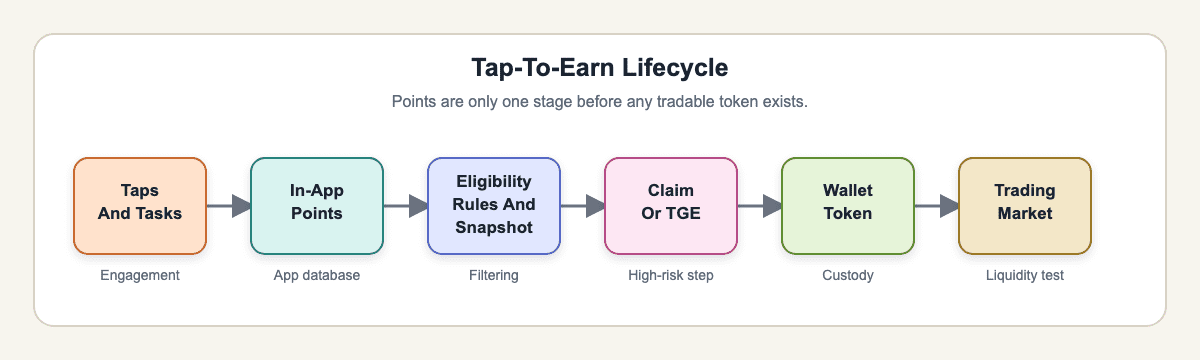
Deliberate reward chasing overlaps with airdrop farming because the user is trying to qualify before the token exists. But raw activity is rarely the whole story. A project may give more weight to referrals, wallet age, completed tasks, partner quests, anti-bot scores, or season ranks.
The riskiest moment often comes near the claim. Fake portals, cloned bots, paid allocation promises, and malicious wallet prompts tend to appear when users are most eager. That is when a harmless-looking points game can turn into a wallet-safety problem.
Use this split to avoid mixing the stages.
| Balance State | What It Means |
|---|---|
| In-game points | A score shown by the app. It may have no transfer path or fixed value. |
| Claimable tokens | An allocation becomes available through a claim page, wallet, or exchange process. |
| Exchange-traded tokens | The token has a market, liquidity, price risk, and possible sell pressure. |
The clean test is ownership. If you cannot verify the asset in a wallet, transfer it, claim it under published rules, or sell it into real liquidity, you probably have a points balance rather than crypto you control.
Tap-to-earn became popular on Telegram because the app made distribution almost frictionless. A game could spread through bot links, group chats, referrals, and mini-app flows without asking users to install a separate mobile game first.
Telegram Mini Apps let developers launch web interfaces inside Telegram, which helps explain why so many tap-to-earn games clustered there. A user can open a bot, tap through a mini-game, share a referral link, and return through the same chat environment.
That distribution is not theoretical. A June 2024 Telegram product update said more than 500 million users interact with mini apps monthly, including games, services, and purchase flows.
The Telegram fit comes from several small advantages working together:
That setup fits the attention economy in crypto. The reward is often not only about gameplay. It buys attention, daily check-ins, referrals, social posts, and a large pool of users who may later claim, trade, or promote a token.
That speed creates the whole opportunity and the whole mess. Telegram access does not guarantee token value. It only lowers the path from “someone shared this” to “I am tapping now,” which also attracts bots, low-quality referrals, copycat apps, and users who vanish once rewards slow down.
Some users can make money with tap-to-earn, but the realistic answer is conditional. Rewards may be small, delayed, filtered, diluted, region-limited, or dependent on a later token generation event.
The player is usually trading time and attention for uncertain upside. The app may be free in cash terms, but “free” can still cost ad views, referrals, personal data, wallet exposure, and hours of repetitive action. Tiny payouts after weeks of tapping are not a bug in the model. Sometimes they are the model.
Before you farm a tap-to-earn app, separate these possible outcomes:
Tap-to-earn rewards can become real when a project publishes a claim process, opens eligibility, and lets users receive tokens in a wallet or supported venue. The token then needs enough liquidity for users to sell or use it.
That chain has many moving parts. A snapshot may decide who qualifies. Anti-Sybil checks may remove bot-like accounts. Referral abuse may reduce rewards. Some users may need a wallet on a specific chain. Others may face regional limits or missed deadlines.
Tap-to-earn payouts often disappoint because the visible effort does not always map cleanly to final allocation. Ten thousand taps may be less valuable than one completed eligibility task, a clean wallet history, or early participation before a snapshot.
Late users also face dilution. By the time a game becomes famous, the user base may already be crowded with farmers, referral groups, and automated accounts. If a fixed reward pool has to stretch across many users, the average payout can shrink fast.
Free tap-to-earn apps can still extract value from users through attention, ads, referrals, social tasks, and wallet risk. A game does not need to charge a fee to benefit from your activity.
That does not make every app bad. It means the user should set a cap. If the game is fun and the time cost is tiny, optional upside can be fine. If the game needs daily chores, paid boosts, aggressive referrals, or wallet signatures before rules are clear, the trade starts looking expensive.
Tap-to-earn risks split into two buckets: player safety and token market risk. Players face fake bots, bad claim links, wallet prompts, and unclear reward rules. Investors face supply, liquidity, and sell-pressure problems after listing.
The dangerous moments are predictable. A game gains hype, users expect a token, and scammers create fake claim portals or support accounts. Then, after listing, traders may mistake a large player count for durable demand. Those are different mistakes, but both come from the same shiny number problem.
Use this check before connecting anything or buying anything.
| Risk | What To Check |
|---|---|
| Fake bot or clone | Use only links from the official website and verified social channels. |
| Seed phrase theft | Never enter a seed phrase, private key, or recovery phrase into a bot or claim page. |
| Malicious wallet prompt | Read the action, use a fresh wallet, and avoid broad approvals. |
| Paid allocation scam | Ignore anyone selling guaranteed airdrop access or boosted claims. |
| Bot-farm competition | Check whether anti-Sybil rules exist and whether criteria are public. |
| Weak token market | Check liquidity, supply releases, exchange support, and actual demand. |
Wallet hygiene deserves its own mention. Use a separate wallet for unfamiliar games, keep your main funds away from claim experiments, and learn basic crypto wallets safety before signing prompts around a token launch.
Investor risk starts after the app phase. A token can list with social hype and still struggle if most holders are farmers waiting to sell. If the game has no demand beyond rewards, a big user count can become a queue for the exit.
Evaluate a tap-to-earn project by checking official access, reward rules, wallet safety, and token design before you spend serious time or buy the listed token. A good screen separates player risk from trader risk.
Start with the route into the app. The official website, Telegram bot, social channels, and any claim portal should match each other. If links conflict, support accounts pressure you, or a claim page asks for a seed phrase, stop there. Then check whether the reward logic is clear enough to respect your time, especially when the project asks for daily chores, paid boosts, aggressive referrals, or wallet connections.
For a player, the first screen is access hygiene. Use the same bot link from the website and verified social accounts, then check whether the app explains seasons, snapshots, and disqualifying behavior. Vague rules are a time-cost warning because the project can still decide that raw tapping counts less than referrals, wallet activity, or partner tasks.
Use this checklist before you commit.
For a trader, the same project needs a market check. A public token plan should explain allocation, supply releases, utility, and how rewards avoid becoming instant sell pressure. If the project gives polished referral copy but almost nothing about token design, buying after listing carries a different risk from playing for free.
The last item is underrated. If the only reason to open the app is a future payout, you are farming a probability, not playing a game. That can still be a choice, but it should be a small and deliberate one.
Tap-to-earn examples are useful when they show how the model behaves, not when they become a stale ranking list. The names change faster than the mechanics.
Notcoin is the hopeful example many users remember. It showed why a simple Telegram game could create a massive points-to-token story. Hamster Kombat became the caution example for scale, expectations, and post-hype disappointment. TapSwap, Catizen, Blum, DOGS, MemeFi, Yescoin, X Empire, and similar projects show how the format can mix tapping, quests, referrals, social tasks, and token anticipation.
That is why these examples belong inside the broader GameFi category, but only loosely. Tap-to-earn is often less about deep gameplay and more about distribution, habits, and a possible airdrop. A tiny loop can still pull in huge attention when the app is easy to share and the reward story is simple.
Use the examples as lessons, not promises.
The common thread is not that every project pays well. It is that tap-to-earn compresses user acquisition, social sharing, reward farming, and token speculation into one very easy habit loop.
That habit loop can be powerful. It can also make users overvalue whatever number the app shows. The stronger question is always the same: what happens after the points phase ends?
Traders should analyze tap-to-earn tokens like risky GameFi or meme-adjacent assets after listing. Playing the game and buying the token are separate decisions.
A listed token has different risks from an app balance. Now supply, float, liquidity depth, exchange support, holder behavior, token sinks, and airdrop sell pressure drive the trade. A large pre-launch player base can help attention, but it can also create a large group of users waiting to cash out.
Use these signals before buying a tap-to-earn token.
| Signal | What It Shows |
|---|---|
| Circulating supply | Low float can make early price moves misleading. |
| Supply releases | Future emissions can pressure the market. |
| Liquidity depth | Thin books make entries and exits harsher. |
| Active users after rewards | Demand should survive after farming slows. |
| Token sinks | Real uses can reduce pure sell pressure. |
| Exchange support | More venues can help access, but they do not remove risk. |
That is where exit liquidity risk enters. If late buyers are mostly absorbing tokens from earlier reward farmers, the chart can punish anyone who confuses app popularity with sustainable demand.
The cleanest trade filter is demand after rewards. If users only appeared for points and leave after the claim, the token has to find a new reason to exist. That is a hard job for any asset, especially one born from a button.
Tap-to-earn can be legit, but the label does not prove the project is safe or valuable. Real projects may use points, tasks, and token claims, while scams may copy the same language.
Check official links, wallet prompts, reward rules, and claim timing. If a bot asks for your seed phrase or sells guaranteed allocation, walk away.
No, tap-to-earn is not the same as crypto mining. Tapping usually records app engagement or points, while mining secures a blockchain through consensus work.
Some apps use “mining” as marketing. If there is no proof-of-work network, no mining hardware, and no protocol reward process, the safer description is reward farming.
Tap-to-earn points can become real crypto if the project opens a claim, allocates tokens, and lets eligible users receive those tokens in a wallet or supported venue.
That outcome is not automatic. Points may be filtered, capped, delayed, region-limited, or left as app-only scores.
Some tap-to-earn games may require a TON wallet for claims or token custody, especially if they are built around Telegram and TON rails. Others may only use Telegram for access and social sharing.
Check the official claim instructions before connecting a wallet. Use a fresh wallet when risk is unclear.
Tap-to-earn games can make money through ads, partnerships, referrals, in-app boosts, premium features, token launches, or later trading activity around their tokens.
That is why a free app can still be valuable to the project. Your time, attention, social sharing, and wallet activity may be the product input.
Only consider buying tap-to-earn tokens after checking supply, liquidity, airdrop sell pressure, token utility, and whether users stay after rewards slow down.
A popular game can still produce a weak token. If most holders joined for the airdrop, the first liquid market may be more about exits than belief.
Start with small exposure, verified links, and realistic expectations. Tap-to-earn works best when it stays optional, low-cost, and separate from your main wallet.
The aim is not to catch every game. It is to avoid turning a possible airdrop into a daily chore, a wallet mistake, or a bad post-listing trade.
If you are testing one app, decide the limit before the streak starts. Set a time cap, avoid paid boosts until the rules are public, and keep claim experiments away from your main funds. That makes the upside small but controlled, which is the right size for an uncertain points game.
Use these steps before you tap, claim, or buy.
If a project passes those checks, keep the experiment small. A tap-to-earn app can be worth a few spare minutes without deserving your main wallet, paid boosts, or daily schedule. The cleaner setup is simple: verified link, separate wallet, clear time cap, and no panic if the points never become much.
Tap-to-earn can be useful as a tiny optional bet on attention turning into tokens. It becomes dangerous when the app balance starts feeling like money before any claim, market, or real buyer exists. Keep that line clear, and the game stays a game instead of quietly becoming a bad trade.