Physical Address
304 North Cardinal St.
Dorchester Center, MA 02124
Physical Address
304 North Cardinal St.
Dorchester Center, MA 02124


Check pool migration risks before you sign a new liquidity move.
Pool migration is the process of moving crypto liquidity from one pool to another, either when LPs relocate funds between DeFi pools or when a token graduates into a DEX pool.
That can sound like boring plumbing. Then your wallet asks for a new approval, your LP position changes shape, or a meme coin chart suddenly shows a fresh pool. A pool migration can be routine, profitable, expensive, or fake. The label alone does not tell you which version is in front of you.
Start by separating the actors. LPs care about fees, ratios, approvals, and new receipts. Token holders care about whether they must act at all. Traders care about timing, depth, slippage, and whether the new pool is real.
Pool migration in crypto means liquidity leaves one trading pool and ends up in another pool. The reason may be a protocol upgrade, a new fee tier, a token-contract change, a better rewards program, or a launchpad token moving from a bonding curve into a DEX pool.
The same phrase can ask different users to do very different things:
The new pool may return standard LP tokens, a concentrated-liquidity position, or another receipt that proves ownership. Charts may also show a new pool creation time that does not match the token mint time or the first trade.
That role split blocks a common scam angle. Fake migration pages often target holders who were never supposed to connect a wallet. It also keeps the wallet prompt honest. An LP migration usually asks for liquidity movement. A holder-only notice should not ask for custody-level permissions.
So pool migration is not one single wallet instruction. It is a liquidity move with different consequences for LPs, holders, and traders. Start the check by asking which role you have in the migration.
Pool migration works by unwinding the old liquidity position, moving the assets through the wallet or a migration contract, and adding them to the new destination pool. A direct migration button may hide some steps, but the same economic move still happens underneath.
The official Uniswap Labs v3-to-v4 support flow, updated August 19, 2025, is a useful example. It lists 10 migration steps, including a wallet approval and a separate wallet confirmation after liquidity and fees leave the v3 position. That example is protocol-specific, but the pattern explains what most LP migrations are trying to do.
Manual pool migration is more exposed. You remove liquidity, receive the underlying assets, approve a new contract if needed, then add liquidity to the destination pool. If the move crosses chains, a bridge adds another transaction, another fee, and another trust assumption.
Direct migration tools can reduce clicks, but they do not remove risk. You still need to know the old pool, new pool, token addresses, fee tier, price range, bridge route, and approval scope.
Use the sequence below to read what your wallet is asking for.
| Step | What To Check |
|---|---|
| Claim rewards or fees | Make sure rewards are included or intentionally left behind. |
| Remove old liquidity | Confirm the old pool address and expected token amounts. |
| Hold underlying assets | Check the wallet receives the right tokens on the right chain. |
| Approve or bridge | Confirm the spender, amount, chain, and bridge route. |
| Add to new pool | Check price range, fee tier, token ratio, and destination pool. |
| Receive new receipt | Confirm the new LP token, position NFT, or vault receipt appears. |
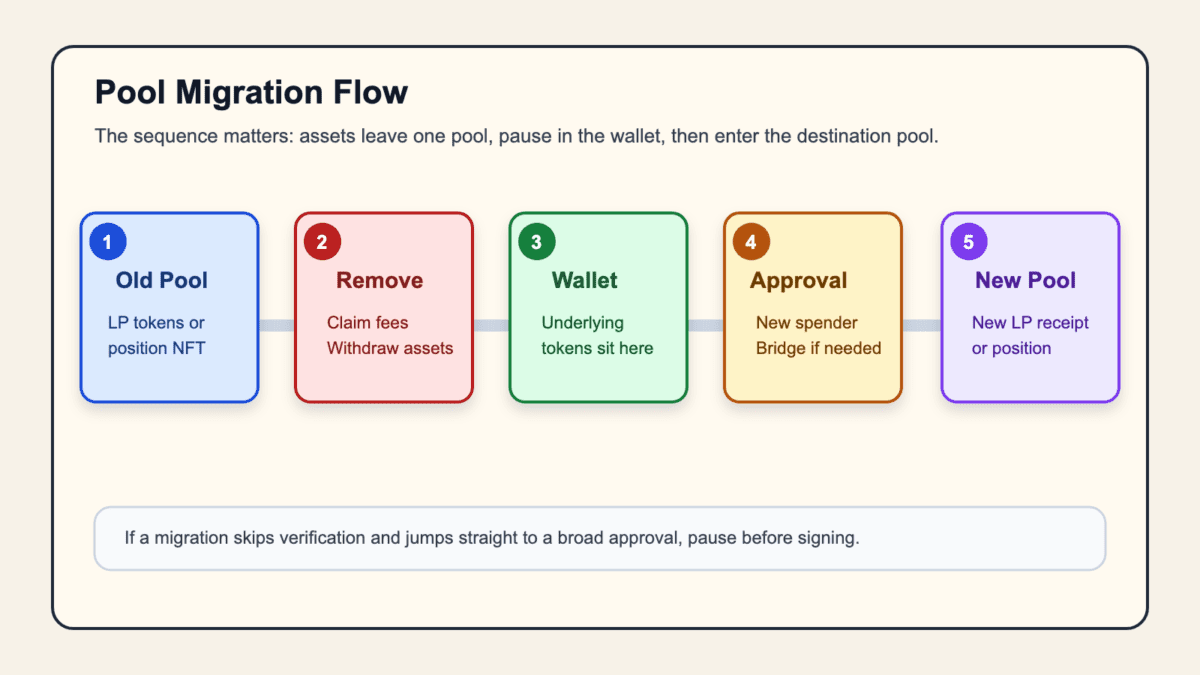
A pool migration is not just one click. It is a chain of custody changes. Each step can be legitimate. Each step can also be copied by a scam page with a different spender address.
Pool migration happens in DeFi when the old pool no longer gives the best mix of safety, liquidity, fees, incentives, or protocol support. Sometimes the move is healthy maintenance. Sometimes capital is chasing the next reward program. Sometimes it is a warning sign.
Protocol upgrades are a common reason. A DEX may launch a new version with different fee tiers, concentrated-liquidity tools, hooks, or better routing. LPs may migrate because the new pool gives them a tighter range, better fee capture, or access to new incentives.
Reward programs also move liquidity. New farms can attract deposits fast, especially when yield farming incentives make the new pool look richer than the old one. That does not make the move free money. Higher rewards can hide thinner depth, weaker contracts, or a crowd that plans to leave as soon as emissions slow.
Common pool migration triggers include:
Capital also migrates for narrative reasons. When attention shifts, liquidity follows fees, volume, and incentives. That kind of liquidity rotation can be rational. It can also leave old pools thin enough that exits become painful.
The reason changes what you check. A planned protocol upgrade calls for contract and fee-tier verification. A farm-driven migration calls for reward math and exit timing. A rushed token-contract replacement calls for extra caution around approvals and official channels.
Pool migration in meme coin launches often means a token has moved from a launchpad or bonding-curve phase into a DEX pool. On Solana, users often use migration language around Pump.fun, Raydium, PumpSwap, and similar launch flows.
This meaning is different from an LP moving a mature Uniswap position. A launchpad token may trade against a bonding curve first. When that phase completes, liquidity may be placed into a DEX pool where normal AMM trading begins. Traders then watch for the new pool address, liquidity depth, launch timing, and whether the pool is locked or burned.
A typical sequence looks like this:
That sequence creates timestamp confusion. Token mint time, bonding-curve completion, migration event time, DEX pool creation time, and chart listing time can all differ. A bot that filters only by pool creation may miss older mints that just migrated. A trader who assumes the pool was live from mint time can read the chart backward.
Pool migration also creates refund and excess-buy questions. The correct answer depends on the specific launchpad rules, not a universal crypto rule. Some platforms define how final fills, failed transactions, or excess input are handled. Others change mechanics over time. Do not assume Pump.fun, Raydium, PumpSwap, or another venue handles every edge case the same way.
For traders, the check starts with the pool address and liquidity state. A real migration should point to a verifiable pool and token mint. A fake one may point to a lookalike token, a copied pool page, or a wallet approval that token holders never needed.
Pool migration can lose money even when every link is official. The main risks are price movement, poor execution, wrong settings, weak new-pool depth, and approvals that do more than expected.
LPs face the first risk when they remove liquidity. Exiting a pool can realize impermanent loss that was previously only visible inside the position. If token prices move while the funds sit in the wallet, the new position can start from a worse ratio than expected.
Traders face a different problem. The old pool can become thin before the new pool has enough depth. That can raise slippage, break routes, or leave late buyers acting as exit liquidity for faster sellers. The label “migration” does not protect anyone from a shallow market.
The risk table below keeps the checks concrete.
| Risk | What It Looks Like |
|---|---|
| Realized impermanent loss | Removing liquidity returns a token mix worth less than the original deposit. |
| Slippage | A trade or add-liquidity step executes at a worse price than expected. |
| Gas or bridge cost | Moving funds costs enough to offset the expected benefit. |
| Wrong token ratio | The new pool requires a different balance than the wallet currently holds. |
| Shallow destination pool | The new pool opens with limited depth and jumpy prices. |
| Unsupported token behavior | Fee-on-transfer or rebase mechanics break assumptions in the new pool. |
| Dry old pool | Liquidity leaves faster than traders can exit cleanly. |
| Broad approval | A wallet grants more access than the migration requires. |
Automated managers can add another layer. A tool may reposition liquidity faster than a user could. It can also lock in losses, churn fees, or move into a range that no longer fits the market. Automation is useful only when you understand its rules.
Cross-chain migration deserves extra caution. The bridge route can add delay, fees, and another failure point. Same-chain migration is already enough work. Cross-chain migration adds another checklist.
Pool migration safety starts with verifying the source, destination pool, token addresses, and wallet approval before you sign anything. A migration announcement is not proof that a link is safe.
Scammers like migration language because real migrations already create urgency. Users expect deadlines, new pools, and unfamiliar transactions. A fake page can copy the look of an official portal, then ask for a broad token approval or a signature that gives away control.
This is where scam checks overlap with wallet safety. Your wallet can show the spender, chain, and permission request, but it cannot always tell you whether the social post or search result that sent you there was real. Verification has to start before the wallet opens.
Run these checks before signing:
A malicious migration can become a hard rug if the approval drains funds or the team uses the move to yank liquidity. A softer version can still hurt users through vague rules, dry liquidity, or a destination pool that insiders exit first.
Do not confuse safety signals. A liquidity burn can limit one type of rug risk, but it does not prove the token contract is clean. A lock can expire. A renounced contract can still trade in a weak pool. One green check does not cancel the rest of the checklist.
If the official process is real but confusing, wait for a clean source path. Search ads, Discord DMs, and copied replies are not source paths. They are where expensive mistakes often begin.
Pool migration is often mixed up with similar terms because they all involve liquidity, tokens, or movement. The difference comes down to who acts and what changes.
Sort the terms by asking what moves. If liquidity moves between pools, it is pool migration. If token balances convert from an old contract to a new contract, it is token migration. If liquidity is raised or priced through a launch mechanism, the better term may be liquidity bootstrapping.
Use this table when a project announcement uses several terms at once.
| Term | What It Means |
|---|---|
| Pool migration | Liquidity moves from one trading pool to another. |
| Token migration | Holders move or receive a new token contract, ticker, or chain version. |
| Liquidity removal | LPs exit a pool and receive the underlying assets. |
| Liquidity bootstrapping | A project uses a launch design to distribute or price early liquidity. |
| Pool hopping | LPs move between pools to chase fees, rewards, or better ranges. |
| Rebalancing | A position changes token weights or price ranges without necessarily changing pools. |
| Bridge migration | Assets move across chains before entering a new pool or market. |
| Liquidity burn | LP tokens or control rights are burned to reduce future withdrawal control. |
These terms can overlap in one event. A token can migrate contracts. Then the team can migrate pool liquidity. Then LPs can rebalance their own positions. That is why vague “migration soon” posts are not enough. You need the object of the migration, the actor, and the action.
For most users, the difference is simple. Token holders should not sign LP transactions. LPs should not assume holder-only notices cover their positions. Traders should not confuse a new pool with a safer pool.
Pool migration means crypto liquidity moves from one trading pool to another. It can happen when LPs relocate funds, a protocol upgrades, incentives move, or a token graduates from a launchpad into a DEX pool.
The key question is who must act. LPs may need to remove and re-add liquidity. Token holders may only need to verify where the token trades.
Pool migration includes removing liquidity, but it is not the same thing. Removing liquidity exits the old pool. Migration adds the next step: placing those assets into a new pool or route.
That extra step changes the risk. You need to check the new pool address, token ratio, fee tier, approval, and receipt before calling the migration complete.
Yes, pool migration can make you lose money through realized impermanent loss, slippage, gas, bridge fees, wrong settings, or a shallow destination pool. A legitimate migration does not remove those market risks.
Calculate the exit, transfer, and re-entry costs before moving the full position. A tiny test can help when the official process allows partial moves.
Pool migration on Pump.fun or Raydium usually refers to a launch token moving from an earlier trading phase into a DEX liquidity pool. Users often call this graduation or migration.
The details depend on the platform rules. Check the token mint, pool address, liquidity state, and official launchpad guidance before assuming how final buys, refunds, or pool creation timing work.
A pool migration link is safer only when it is reached from an official project site, verified support channel, or trusted app route. A copied reply, DM, or search ad is not enough.
Before signing, match the pool address, token contract, chain, and spender. If a site asks for your seed phrase or private key, leave immediately.
Pool migration can affect token price when liquidity depth, routing, fees, or trader attention changes. A deep new pool may improve execution. A shallow or confusing migration can make prices jumpier.
The effect is not automatic. Watch liquidity, volume, slippage, and whether the old pool is drying up before assuming the migration is bullish or bearish.
Start by identifying your role before opening a wallet prompt. If you are an LP, inspect the old position and the destination pool. If you only hold the token, confirm whether holders need to do anything. If you are trading the launch, verify the pool address and liquidity before chasing the chart.
Next, collect the facts in one place. You want the old pool address, destination pool address, token contract or mint, chain, fee tier, deadline, and approval path. If those details are scattered across social replies, the migration still needs verification.
Then work through the practical steps:
If any step feels unclear, pause. Pool migration is normal DeFi plumbing, but plumbing can still flood the room. Speed helps bots. Verification helps humans.
The safest user is not the fastest signer. It is the one who knows exactly what is moving, where it is going, and what permission the wallet is granting. If the migration is real, that clarity should be available before you sign. If it is not available, the delay is doing its job.