Physical Address
304 North Cardinal St.
Dorchester Center, MA 02124
Physical Address
304 North Cardinal St.
Dorchester Center, MA 02124


Private orderflow hides trades before execution, not forever.
Private orderflow is crypto transaction routing that sends orders outside the public mempool before settlement to reduce visibility, MEV, or execution risk.
The idea shows up in wallet settings, private RPCs, MEV protection tools, trading bots, solver systems, and order flow auctions. The pitch sounds simple: stop public bots from seeing your order before it lands.
The catch is just as important. Private orderflow hides the pre-trade route, not the final on-chain result. Another path now decides who sees the order first, who can act on it, and whether any value comes back to you.
Private orderflow means crypto orders or transactions go through a private path instead of being broadcast straight into the public mempool. That path may be a private RPC, private mempool, order flow auction, solver network, relay, block builder, or direct app integration.
The word to watch is “before.” Private order flow usually means the order is hidden before it is included in a block. Once the transaction settles, the result is still visible on a public chain.
Picture a DEX swap from a wallet. A public route sends the signed transaction where network participants can see it before inclusion. A private route sends it to a selected endpoint, auction, solver, or builder first, trying to keep public searchers from reacting.
That switch changes three parts of the transaction supply chain:
It does not remove every risk. A private route can still fail, delay inclusion, leak hints, route poorly, or give one provider a stronger view of order demand.
In plain English, private orderflow hides order details from the open pre-trade crowd and gives a narrower set of actors first look instead.
That trade can be worth making. It can also be a nicer label on a new middleman. The easiest mistake is to confuse private with permissionless, because a narrower audience still means trusting someone’s routing rules.
So private orderflow belongs in market-structure language, not only wallet-security language. It changes who gets order information before the chain records the final result.
Private orderflow moves a crypto transaction by changing its first audience before chain inclusion. The user still signs a transaction or intent, but the first stop is no longer the public mempool.
The public path is easy to picture. Your wallet or DEX frontend sends the transaction to an RPC endpoint. The transaction reaches a public mempool. Searchers and bots can inspect it, simulate it, and race to place their own transactions around it.
In a private route, the first stop may be a private RPC, private mempool, order flow auction, solver, or direct builder connection. This is where wallet routing defaults can matter, because many users meet private routing through a wallet toggle, swap interface, or custom RPC setting.
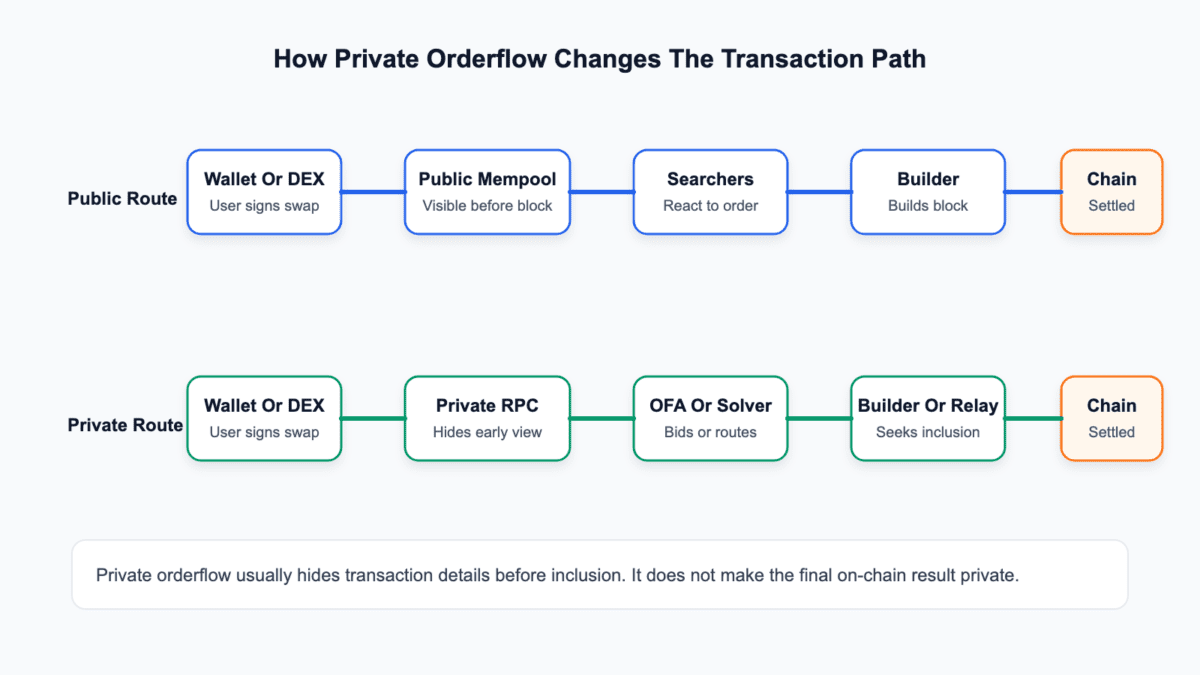
Private routes vary. One design may show the full order to a limited provider. Another may share hints with searchers or solvers. Another may ask solvers to compete for execution, then pass bundles to builders or relays for inclusion.
| Route | What Happens Before Settlement |
|---|---|
| Public Route | The order enters a public mempool where searchers can inspect and react before block inclusion. |
| Private Route | The order goes to a private RPC, OFA, solver, relay, or builder before reaching the chain. |
The final state is still public once the transaction is included. Private orderflow mainly controls pre-inclusion visibility, routing, and competition over the order.
That is why route details matter. A private route that shares refunds, discloses failure behavior, and routes to competitive builders is different from a route that quietly sells exclusive access to one actor.
Private orderflow exists in DeFi because public transaction visibility gives bots time to act before, around, or after user orders. Public mempools make markets transparent, but they also make pending trades easy to target.
The best-known risk is a sandwich attack. A bot sees a pending swap, buys before it, lets the user move the price, then sells after it. The user gets a worse fill, while the bot captures the spread.
That is the user-level reason private orderflow grew. Users and apps wanted fewer public attack surfaces, especially in these cases:
Not all MEV is theft. Backrunning can close arbitrage gaps, liquidations can keep lending markets solvent, and block builders compete to assemble profitable blocks. But for normal users, public pre-trade visibility can feel like walking into a poker game with your cards taped to your forehead.
That last case is where PVP trading helps as a mental shortcut. In adversarial venues, users are trading against price movement, bots, insiders, and faster routing. Private orderflow tries to limit that early visibility, but it cannot make a shallow market deep or a bad quote good.
Private orderflow is the umbrella category. Public mempools, private RPCs, private mempools, OFAs, solver routes, encrypted mempools, and ZK order books are different designs inside or around the transaction-routing problem.
Product pages often bundle those terms under “MEV protection.” Under the hood, the route can be very different. A private RPC is not the same as an order flow auction, and an encrypted mempool is not the same as giving one builder exclusive access.
Use this comparison to separate the labels before you trust the pitch:
| Route | What The User Should Understand |
|---|---|
| Public Mempool | Pending transactions are visible before inclusion, so searchers can simulate and react. |
| Private RPC | A wallet or app sends the transaction to a private endpoint before public broadcast. |
| Private Mempool | Transactions sit in a non-public pool until a route submits them for inclusion. |
| Order Flow Auction | Searchers or solvers compete for access or execution rights, often with possible refunds. |
| Solver Or Intent System | The user expresses an outcome, and solvers compete to fill it under agreed limits. |
| Encrypted Mempool | Transaction contents are hidden until a later reveal point, often still emerging or chain-specific. |
| ZK Order Book | Privacy or validity proofs can hide parts of the order while preserving execution rules. |
The benefit depends on the route. A private RPC may reduce public sandwich risk. An order flow auction may return some backrun value. A solver route may improve execution if solvers compete honestly and enough liquidity is available.
The trust cost also changes. With a public mempool, everyone can see the pending order. With private orderflow, fewer actors see it, but those actors may gain more power. Privacy from the crowd can become dependence on the gate.
Private orderflow changes the odds around pre-trade visibility, especially for traders whose orders are large, obvious, or routed through crowded venues. It helps most when a pending order creates a clear target.
A small swap on a deep ETH-stablecoin pair may not feel different. The pool is thick, the price impact is small, and the value available to an attacker may be limited. The bigger problem might be the DEX route, fees, or slippage setting.
Now compare that with a larger swap in a thin pool. The order moves the price more. Bots can estimate the likely impact. A public mempool route gives them time to react before the user settles.
For a quick check, split the problem like this:
That is why private orderflow shows up in meme-coin trading, especially in the trenches where tokens launch fast and bots watch everything. Private routing still cannot rescue every trade. If the pool is shallow, the quote is weak, or the token is mostly hype, the user can still get a poor fill.
The same problem appears around exit liquidity in hype-driven markets. When many users are trying to leave or enter the same thin pool, poor execution can come from market structure, not only from MEV.
For traders, the useful split is simple:
Private orderflow is one tool. It is not a force field, and crypto already has enough capes.
The central private orderflow tradeoff is simple: MEV protection can reduce public exposure while concentrating visibility with private actors. The crowd sees less, but the chosen route may see more.
That route can include private relays, builders, solvers, searchers, trusted execution environments, apps, or order-flow providers. Some designs spread access across competing actors. Others make the order exclusive to one partner.
Private orderflow and exclusive orderflow are different. Private can mean the order is hidden from the public mempool but still available to several solvers or builders. Exclusive orderflow means one actor gets privileged access, often creating a stronger edge.
Watch these private orderflow tradeoffs:
At the network level, the risk becomes easier to see. A 2025 Ethereum builder-market paper, Private Order Flows and Builder Bidding Dynamics, estimated that private order flows contributed 54.59% of block value in its studied Ethereum sample and affected builder bidding dynamics. That is not just a wallet setting. It is market structure.
The same debates often spread through CT before they reach beginner guides, which is why the language can feel messy. POF, XOF, MEV protection, builder centralization, and refunds all point at one question: who gets first look at valuable flow?
> Private orderflow is useful only when the route’s incentives are better than the public exposure it replaces.
The takeaway is to separate protection from trust. A route can protect you from public searchers while exposing you to a smaller set of private actors with better information.
Check private orderflow by asking what risk it removes, what actor it adds, and whether the final execution improves. A private label alone tells you almost nothing.
Start with the chain and app. Ethereum mainnet, L2s, appchains, Solana-style routing, and off-chain intent systems can use different transaction paths. Then check the route. A wallet toggle, DEX setting, Telegram bot, intent auction, or private RPC can all claim protection.
Use these checks before changing settings or relying on a private path:
The best check comes after execution. Look at the transaction, the received amount, the route used by the app, and whether the result matched the quoted protection. If you cannot verify everything, at least compare outcomes over similar trades.
Private orderflow does not replace trade hygiene. You still need sane slippage, deep enough liquidity, clear approvals, and a reason to trust the app handling your order.
For small swaps, the friction may not be worth the attention. For larger trades, thin pools, bot-heavy launches, or automated strategies, the routing path deserves a real look before you click confirm.
Private orderflow sits near several other crypto routing ideas, but they do not all solve the same problem. Some are live tools. Some are research-heavy designs. Some are product labels wrapped around older market plumbing.
Keep the related terms selective so the labels do not blur together:
The overlap can be real. A solver system may use auctions. A private RPC may feed builders. A future encrypted design may reduce the need for some private routing.
Ask a simpler routing question before learning every label. Does the route hide the order, improve execution, share value, reduce attack surface, and give you enough visibility after settlement?
If not, the label is mostly packaging. Also separate live tools from research direction. Private RPCs, OFAs, and solver routes are already visible in user products, while encrypted mempools and some ZK order-book designs are more chain-specific or still developing.
> Exclusive orderflow deserves extra caution because it can let one actor learn more about demand than everyone else.
That can be fine when the rules are clear and competition exists elsewhere. It becomes risky when users cannot tell who benefits from the private lane.
Private orderflow in crypto is the routing of orders or transactions outside the public mempool before settlement. It aims to reduce early visibility, MEV exposure, or sandwich risk. The final transaction still appears on-chain.
Private orderflow can reduce some MEV, especially public mempool sandwich attacks. It does not stop all MEV. It may also move value capture to private searchers, solvers, builders, or route operators.
Private orderflow is broader than a private mempool. A private mempool is one place where transactions can wait outside public view, while private orderflow can also use private RPCs, OFAs, solvers, relays, builders, or direct integrations.
Private orderflow hides the order from the public mempool. Exclusive orderflow gives privileged access to one actor or a very narrow set of actors. That can create a stronger information edge and more centralization risk.
Private orderflow can be censored or delayed if the route operator, builder, relay, solver, or app refuses to pass the transaction along. The risk depends on the route design, fallback behavior, and how quickly users can resubmit elsewhere.
Retail traders should consider private orderflow when using larger swaps, thin pools, bot-heavy markets, or MEV protection tools. For small liquid swaps, slippage settings, route quality, and basic wallet hygiene may matter more.
Use private orderflow as a routing check, not a personality test for your wallet. The goal is to understand where the order goes before settlement and whether that path improves your actual execution.
You do not need to rebuild Ethereum’s transaction supply chain before making a swap. You do need to know whether your app sends orders publicly, privately, through solvers, or through a route that can fall back to public submission.
Before changing settings, take a few practical steps:
After the trade, inspect the transaction result. Did the received amount match expectations? Was there a refund? Did the order route through the provider you expected?
Private orderflow helps when it reduces a real visibility problem. It becomes weak protection when it only hides complexity behind a cleaner button.
For everyday use, keep the habit simple. Use public routes when the risk is low and execution is fine. Use private routes when order visibility is the clear problem. Step back when a route promises protection but cannot explain who sees the order, how inclusion works, or what happens when the trade fails.