Physical Address
304 North Cardinal St.
Dorchester Center, MA 02124
Physical Address
304 North Cardinal St.
Dorchester Center, MA 02124


A beginner guide to crypto quest platforms, rewards, wallet safety, and airdrop risk.
A quest platform is a crypto campaign hub where users complete tasks and may earn points, badges, tokens, NFTs, or airdrop eligibility.
You will usually meet one through a project announcement, a wallet app, an airdrop thread, or a dashboard full of “complete this” buttons. Some quests teach useful skills. Others buy attention with points that may never become liquid.
The trick is knowing which is which before your wallet gets dragged into a small obstacle course.
A quest platform in crypto gives projects a place to publish tasks and gives users a dashboard for completing them. The tasks may be social, educational, wallet-based, or fully on-chain.
A project might ask you to follow an account, join Discord, answer a quiz, mint a badge, bridge funds, swap tokens, hold an NFT, or use a new app. The platform checks the task and records progress. It may then award points, XP, badges, NFTs, tokens, allowlist access, or a future reward claim.
The basic roles are easy to separate:
That makes a crypto quest platform different from a single game, exchange promo, or airdrop claim page. It is the campaign layer between projects and users. One dashboard can host quests from many teams, while one project can run several campaigns across seasons.
The word “quest” makes it sound playful. The money part makes it less cute. A quest platform turns attention into trackable behavior. Then it turns that behavior into a possible reward, if the campaign terms hold up.
So a quest platform is not free money with a progress bar. It is an incentive machine. Sometimes that machine teaches you how a protocol works. Sometimes it feeds you points and hopes you do not ask when dinner arrives.
A quest platform verifies tasks by checking whether a user completed the required action. The check can happen through a social account, a wallet address, an API, a screenshot, or on-chain data. Most flows start with an account or wallet connection.
Some platforms ask for an email, X account, Discord account, Telegram account, or wallet signature. Then each task has its own proof. A quiz answer is easy to check. A swap, mint, bridge, or stake action can be checked against blockchain data.
Off-chain and on-chain tasks carry different tradeoffs. The platform may check both, but the proof quality and user risk are not the same.
| Task Type | What the Quest Platform Checks |
|---|---|
| Off-chain task | Social follows, Discord joins, forms, quizzes, screenshots, or content submissions. Easier to fake and often easier to complete. |
| On-chain task | Wallet transactions, contract events, token holdings, NFT mints, swaps, bridges, or claims. Harder to fake, but often costs gas. |
| Hybrid task | A social or education task tied to a wallet action, such as joining a campaign then minting a badge. |
| Manual review | A team reviews a submission, meme, thread, bug report, or community contribution before approving it. |
The check does not always mean the reward is instant. A campaign may have a claim window, a snapshot date, a raffle, a leaderboard, region limits, Sybil filters, or manual exclusions. Some rewards appear as points first, then become useful only if a later token or claim event happens.
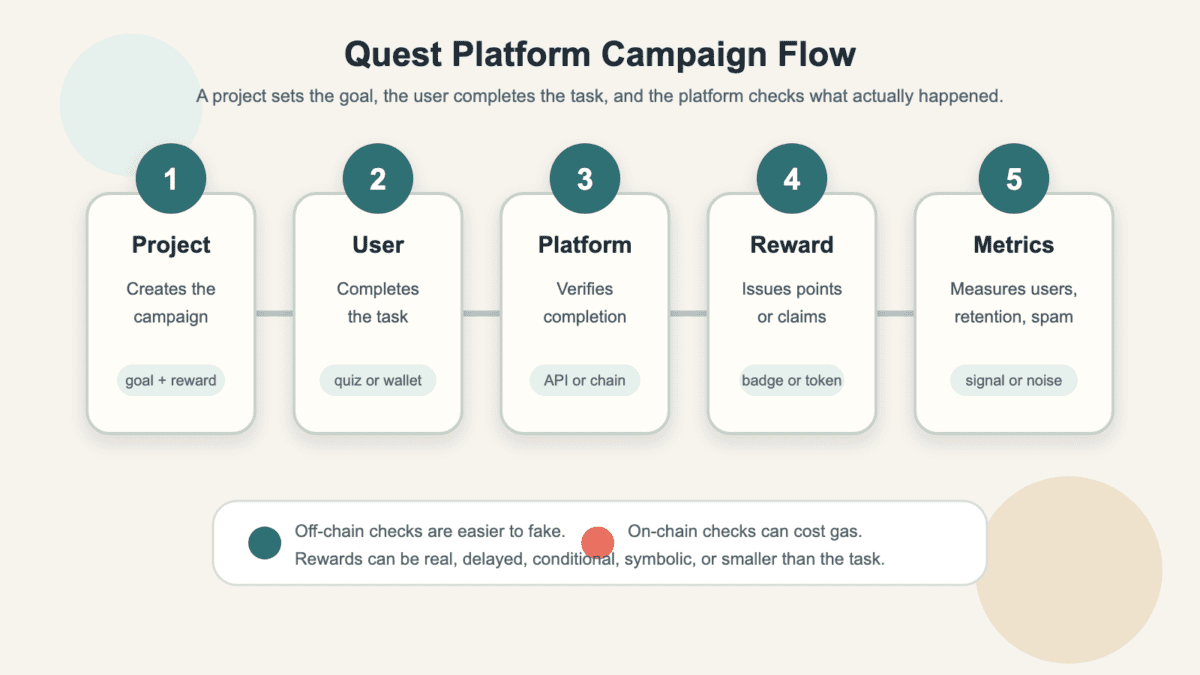
_A quest platform connects project goals, user tasks, verification, rewards, and activity metrics. Each step can add friction or risk._
Good platforms make those rules readable before the user spends gas. Weak campaigns hide the hard part until the final claim button. That is usually where “quick quest” turns into “why did I bridge for this?”
Projects use a quest platform because it turns vague interest into measurable action. A project can track who joined, learned, bridged, swapped, minted, voted, tested, or returned after the first task.
That data helps teams shape campaigns. They can teach users how a product works, push activity to a new chain, reward early contributors, test wallet flows, support partner launches, or build lists for future airdrop filters.
Common project goals include:
The March 2025 arXiv paper Quest Love studied one deployed quest system with 43 unique quests over 10 months and 80M completions, then noted that quests are used for user education, market share, leaderboards, investor-facing activity, and airdrop recipient selection. It also studied how rewards, difficulty, cost, farming, and bots shape completions.
That lines up with the crypto attention economy. A project is not handing out rewards because the internet became generous. It is buying attention, behavior, and data.
That setup can lead to two different outcomes:
The hard part is quality. Quests can produce real learning and real activity. They can also produce fake wallets, copied answers, low-retention users, and leaderboards full of people who vanish when rewards dry up.
That is why a quest platform can be useful and noisy at the same time. It gives projects a structured way to grow, but it cannot turn mercenary clicks into loyal users by itself.
Users on a quest platform may earn rewards, but the word “reward” does a lot of work. A token payout is different from a badge, and points are not the same as cash.
Some campaigns pay directly. They may distribute tokens, stablecoins, NFTs, allowlist spots, or raffle prizes. Others track XP, badges, levels, or points that may only matter inside the platform. Airdrop quests sit in the middle: you complete tasks now and hope those tasks count later.
Use this table before assuming every reward has a market price.
| Reward Type | What It Really Means |
|---|---|
| Token reward | A claimable crypto asset, but value depends on liquidity, supply, and selling pressure. |
| Stablecoin prize | A clearer payout, often limited by caps, raffles, eligibility, and region rules. |
| NFT or badge | Proof of participation, access, status, or campaign history. It may have no resale value. |
| XP or leaderboard rank | Progress inside the platform or campaign. Useful only if rules give it weight. |
| Points | A score that may influence future rewards, but may never convert into tokens. |
| Whitelist access | A chance to join a mint, sale, beta, or community tier. It is not a guaranteed profit. |
| Airdrop eligibility | A possible future claim, usually subject to snapshots, filters, and final team rules. |
This is where many users confuse quest-to-earn with income. A real reward can still be small, locked, delayed, illiquid, or expensive to claim. A points season can look valuable for months, then settle into a token allocation that barely covers gas.
Questing overlaps with airdrop farming because users repeat tasks across campaigns to improve eligibility. That can make sense when costs are low and rules are clear. It gets ugly when users bridge funds, pay gas, and chase unclear points without knowing the reward source.
Separate four questions before doing the task:
If those answers are fuzzy, the reward is speculation wearing a checklist.
Quest platform risk starts with the link, then moves to the wallet. A real-looking quest page can still lead to bad signatures, expensive actions, weak rewards, or copied campaigns.
Fake links are the obvious danger. A scammer can imitate a campaign page, reply under an official announcement, or send a Discord message that looks urgent. The user thinks they are claiming a reward. The wallet prompt may ask for a harmful approval, a malicious signature, or a connection to the wrong contract.
> A quest platform can be legitimate while a specific campaign, claim link, or follow-up message is still dangerous.
Wallet hygiene should come before reward chasing. Quests often ask users to connect, sign, claim, mint, swap, or bridge. If you are new to wallet prompts, slow down and review basic wallet setup before using a campaign wallet with real funds.
Gas and bridge costs are the quieter trap. An on-chain task may cost more than the reward is worth. A bridge may add delay, slippage, withdrawal friction, or extra network risk. If the reward is points, you may be paying today for a promise that never becomes liquid.
Watch for these prompt-level red flags:
Token rewards can add a different problem. A low-quality reward token may have thin trading, heavy selling pressure, or poor support after the campaign. That can turn late participants into exit liquidity for earlier users who claimed first.
Bots and Sybil farmers make the whole system noisier. When rewards are attached to tasks, people create many wallets, scripts, and repeated patterns to look active. Platforms and projects respond with filters, identity checks, behavior scores, or manual reviews.
That fight creates several user headaches:
That can help protect campaigns. It can also hit real users who look suspicious because they use fresh wallets, shared funding paths, VPNs, or repeated task patterns. The result is awkward but important: completing a quest does not always mean qualifying for the reward.
KYC and privacy requests deserve a separate pause. Some campaigns may ask for stronger identity checks, email links, account connections, or region information. Those requests may be normal for a specific campaign, but they are still data trades. Do not hand over more than the reward justifies.
A quest platform campaign is worth doing only when the source, cost, reward, and wallet action all make sense. Start with the campaign, not the points counter. First, confirm that it came from an official project channel.
Use the project website, verified social account, official Discord announcements, or the platform’s verified project page. A forwarded link from a replies tab is not a source. It is a phishing audition.
Then check the task cost against the reward. Social tasks may cost time and privacy. On-chain tasks may cost gas, bridge fees, token approvals, and cleanup work later. If the reward is vague points, keep the spend tiny.
Run this checklist before you connect:
The project itself needs a scam check too. If the campaign pushes users toward a weak token, anonymous team, rushed mint, or aggressive funding ask, review hard rug warning signs before signing anything.
The best filter is boring but effective: would you still do the task if the reward ended up being symbolic? If the answer is no, keep the cost near zero. You do not need to win every campaign. Most campaigns are not grading your soul.
Quest platform examples help users recognize the category, but they should not turn the guide into a ranking list. The major names often serve different campaign styles.
Galxe is known for large Web3 campaigns, credentials, Passport-style identity tools, and reward discovery. Zealy is often used for community quest boards, XP, roles, and leaderboards. Layer3 focuses on on-chain discovery, learning, quests, and credentials.
Wallet-native quest products sit beside those platforms, but the comparison is still about use case. Coinbase Wallet Quests and Robinhood Wallet Quests are closer to guided learn-and-do flows inside a wallet product.
| Platform Type | Best-Known Use |
|---|---|
| Galxe-style campaign hub | Large campaigns, credentials, rewards, identity checks, and partner activity. |
| Zealy-style community board | XP, roles, social tasks, Discord activity, and leaderboard participation. |
| Layer3-style on-chain discovery | Guided protocol actions, credentials, quests, and crypto learning paths. |
| Intract-style campaign layer | Quests with stronger quality filters, user segmentation, and Sybil resistance. |
| QuestN or TaskOn-style host | Broad task hosting for projects that want quick campaign setup. |
| Wallet-native quests | Learning tasks inside a wallet flow, often with simpler onboarding. |
The best quest platform for beginners is usually the one with clear tasks, official project links, low gas, readable reward terms, and harmless wallet prompts. Brand recognition helps, but it does not replace checking the campaign.
Use examples as labels, not endorsements. A strong platform can host a dull campaign. A smaller platform can host a useful one. The campaign rules decide the user experience.
Quest platform users quickly run into related crypto concepts. The most common are airdrop farming, Sybil attacks, points, badges, NFT credentials, wallet approvals, and on-chain reputation.
Two CryptoProcent guides are useful next stops when a campaign starts to look expensive or overhyped:
Sybil attacks are the fake-user side of the same incentive loop. Points and XP track progress before payouts. Badges and NFT credentials record participation. None of those labels tells you whether the final reward will be useful.
Wallet approvals deserve extra care because a quest may ask you to interact with a contract. A harmless signature can prove wallet ownership. A dangerous approval can let a contract move tokens. The prompt text and contract address matter more than the quest graphic.
On-chain reputation is the broader idea behind many campaigns. A wallet history can show past actions, holdings, claims, and behavior patterns. That can help projects filter bots, but it can also link your activity across apps.
A quest platform is not isolated. It sits at the intersection of incentives, identity, wallets, and data. When a campaign asks for action, check which of those layers you are touching.
Start with a quest platform by choosing a small official campaign and limiting what it can cost you. The goal is to learn the flow without turning a beginner task into a wallet incident.
Pick a campaign from the project’s official link, read the rules, and use a wallet that does not hold your main funds. Favor social, quiz, or low-cost educational tasks before bridging, depositing, swapping, or approving tokens.
If the first task asks for a bridge, deposit, mint, or token approval, pause before treating it like beginner onboarding. On-chain tasks can be useful practice, but they also create public wallet history and real costs. A low-stakes quest should still feel low-stakes after gas, time, and cleanup are counted.
Use these next actions:
After the first quest, review what changed. Did you create approvals? Did you connect accounts? Did you spend gas? Did the reward appear, or only a promise? Those answers tell you whether the next campaign deserves more effort.
Also check whether the campaign taught you anything useful about the product. If the only thing you learned was how many buttons a rewards page can fit on one screen, the next campaign needs a better reason.
Good questing is boring on purpose. Official links, small wallets, clear rules, no heroic gas spend, and no panic clicking. The rewards can wait. Your wallet cannot always say the same.
A quest platform in crypto is a site or app where projects publish tasks and users complete them for possible rewards. Tasks can include quizzes, social actions, wallet connections, swaps, mints, bridges, or product use. The platform tracks completion and may issue points, XP, badges, NFTs, tokens, allowlist access, or airdrop eligibility.
A quest platform verifies tasks by checking the proof tied to each requirement. Social tasks may be checked through account links, APIs, forms, screenshots, or manual review. On-chain tasks are usually checked through wallet addresses, transaction history, token holdings, smart-contract events, or claim records. Verification proves the task was detected. It does not always prove the reward is guaranteed.
Yes, a quest platform can lead to real rewards, but the payout is not automatic. Some campaigns distribute tokens, stablecoins, NFTs, or prizes. Others only award points, badges, XP, or leaderboard rank. A future airdrop may never happen, and a token reward may be worth less than the gas, time, or bridge cost needed to claim it.
A quest platform can be safe to use when the link is official, the wallet prompt is harmless, and the campaign rules are clear. The risk comes from fake links, malicious approvals, unclear signatures, expensive on-chain tasks, and scam follow-up messages. Use a low-balance wallet, read prompts carefully, and never enter a seed phrase for a quest.
A quest platform hosts and verifies tasks. An airdrop is a reward distribution. A project may use a quest platform to decide who qualifies for an airdrop, but the two are not the same. Completing quests can improve eligibility in some campaigns. It does not create a guaranteed right to tokens unless the campaign terms say so.
The best quest platform for beginners is one with official links, clear tasks, low costs, readable reward terms, and simple wallet prompts. Galxe, Zealy, Layer3, Intract, QuestN, TaskOn, and wallet-native quest products all appear in beginner flows. The platform name helps, but the campaign rules and wallet request matter more.