Physical Address
304 North Cardinal St.
Dorchester Center, MA 02124
Physical Address
304 North Cardinal St.
Dorchester Center, MA 02124


Understand redemption queue waits before exiting.
A redemption queue is an ordered waiting line for converting a crypto token, receipt, vault share, or staking position back into the underlying asset when instant liquidity is not available.
You may see one when unstaking ETH, redeeming a liquid staking token, leaving a yield vault, or exiting a tokenized real-world asset product. The queue is the product saying: your request is valid, but the exit route has timing rules.
That does not automatically mean funds are gone or frozen. But it does mean the exit is no longer just a click. You need to understand the wait, the claim step, the market alternative, and the conditions that could turn a normal queue into a warning sign.
A redemption queue in crypto is a formal waitlist for exit requests. It appears when a product cannot redeem every user at once without breaking its rules, draining liquidity, or giving early exits better treatment than later ones.
The word “redemption” matters. You are not merely selling a token to another buyer. You are asking the protocol, issuer, vault, or staking service to turn your claim back into the asset it represents.
That underlying asset may be ETH from staking, a reserve asset behind a stablecoin, or value returned from a vault position.
Most redemption queues use an order rule. FIFO, short for first in, first out, means earlier requests are handled before later requests. Some products use batches, epochs, or status buckets instead, but the idea is similar.
Keep the split simple:
That difference explains why a token can still trade while redemption takes days. A liquid staking token may sell instantly on a DEX, while protocol redemption waits for validator exits. A vault share may have buyers today, while the vault waits to unwind loans or settle assets.
So a redemption queue is not the same thing as panic. It is a timing mechanism. You need to see a clear, fair wait backed by enough liquidity to finish the exit.
A redemption queue works by turning an exit request into a tracked position. The product records who asked to leave, what they should receive, and when the underlying asset may be ready to claim.
The exact process varies, but most queues follow a similar path:
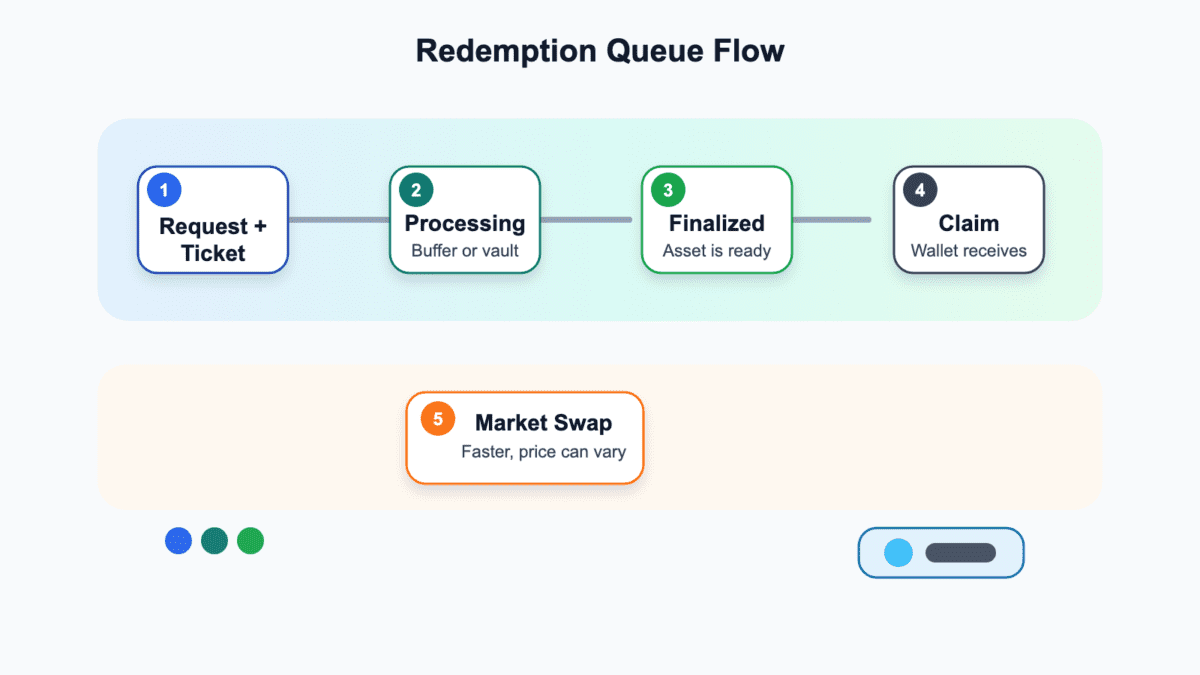
Some products lock the original token immediately. Others burn it and give you a claim ticket. Lido, for example, has used an unstETH withdrawal NFT model, where the ticket represents the claim while the request waits.
Ethereum staking adds another useful distinction. In Ethereum, a validator can leave active duty before the withdrawn ETH reaches a withdrawable address. Ethereum.org separates validator exit from withdrawal processing. For scale, that withdrawal sweep can include up to 16 eligible withdrawals per block. That equals 115,200 validator withdrawals per day if slots are not missed.
That is why users may hear about an exit queue, a withdrawal sweep, and a provider redemption queue in the same conversation.
The claim step is easy to miss. A request can be processed while the user still needs to return and claim funds. If the wallet changes, the ticket is lost, or gas is unavailable, the exit can feel stuck after the queue has done its part.
A redemption queue exists because instant exits can hurt the system or other users. Crypto products often hold assets that cannot be unwound at full value on demand.
Staking is the clearest case. A proof-of-stake network limits how fast validators enter or leave so the validator set does not swing wildly. That protects network security, but it also means unstaking can take time when many validators exit.
Vaults and yield products have a different problem. They may hold loans, LP positions, tokenized bills, or other assets that need settlement. If every user exits at once, instant redemption could force bad sales or favor early users over later ones.
Queues can solve several problems at once:
Stablecoins and RWA-style products may also use queues during reserve settlement. The product may need bank rails, asset sales, custodian movement, or administrator approval before cash-equivalent assets can return to users.
> A redemption queue is normal only when the terms, status, and claim path are clear. If the product cannot explain what happens next, the queue is no longer just plumbing.
The beginner mistake is assuming every queue is a freeze. The opposite mistake is assuming every queue is harmless. Read it more narrowly: a queue shows that redemption has constraints, and those constraints now matter to your exit.
Redemption queue times change because each product sits on a different exit route. A wallet, exchange, liquid staking protocol, direct validator, vault, or stablecoin issuer may all show different waits for the same broad action.
Provider estimates are especially easy to misread. A provider may have a buffer that pays small exits quickly. It may batch requests once a day. It may also route through the base chain’s exit rules, then add its own processing time.
Several drivers can change the wait:
| Driver | How It Changes The Wait |
|---|---|
| Protocol exit capacity | The base chain may limit how many validators can leave per period. |
| Provider buffer | A service with available liquidity can satisfy requests before deeper exits finish. |
| Internal batching | Requests may wait for daily, weekly, or epoch-based processing. |
| Oracle or report cadence | Some systems need accounting updates before claims finalize. |
| Secondary liquidity | Deep markets can offer a faster sale, while thin markets widen discounts. |
| Operational pause | Security reviews, upgrades, or incidents can slow processing. |
| Asset type | Validator exits, stablecoin reserves, and vault loans all settle differently. |
This is why two users can redeem similar exposure and see different clocks. One may use a direct staking route. Another may hold an LST. A third may be on an exchange with its own liquidity buffer and internal queue.
Long waits also cluster during stress. If many users exit at once, the queue grows. If buyers demand a discount for taking the token immediately, the secondary-market price can move before the native queue finishes.
Do not ask only “how long does redemption take?” Ask whose queue you are in, what asset must be freed, and whether the estimate comes from the base protocol or a service layered on top.
A redemption queue means your funds are in a transition state. You may no longer control the original token, but you may not yet have the underlying asset either.
That transition can affect rewards. If a validator is still active, rewards may continue under the product’s rules. Once the position has exited, rewards may stop while the claim waits. Some products account for this cleanly. Others make users read the fine print with a magnifying glass and a strong coffee.
Slashing exposure can also depend on timing. A staking position may still carry validator risk until it fully exits. A vault share may still carry strategy risk until the underlying position is satisfied. A stablecoin redemption may still carry issuer, bank, or reserve-route risk.
Check these items before you submit:
Wallet control matters here. If the claim ticket, NFT, or receiving address depends on your wallet, basic wallet setup becomes part of the exit plan, not a separate chore.
Small leftovers can matter too. Partial claims, gas costs, and rounding can leave small leftover balances that are annoying or uneconomic to move. That is not usually the main risk, but users feel it at claim time.
The best habit is to screenshot or save the request status, ticket ID, expected claim route, and official link. Then keep the wallet funded enough to claim when the queue clears.
Redemption queue, withdrawal queue, exit queue, cooldown, and instant swap describe related but different exits. Mixing them up can make a normal wait look like failure, or make a costly shortcut look free.
Native redemption usually aims to return the underlying asset under the product’s rules. A market swap aims to find a buyer now. The swap can be faster, but the price may include spread, slippage, pool imbalance, or a discount.
Here is the plain comparison:
| Path | What The User Is Really Choosing |
|---|---|
| Redemption queue | Wait for the product to return the underlying asset through its own rules. |
| Withdrawal queue | Wait for a platform, vault, or protocol to process withdrawal requests. |
| Ethereum exit queue | Wait for validators to leave active duty under Ethereum’s validator rules. |
| Cooldown or delay | Wait through a fixed delay before withdrawal becomes available. |
| Instant swap | Exit through market liquidity now, accepting price and slippage risk. |
| Provider queue | Wait for an exchange, wallet, or staking service to process its own batch. |
The terms can overlap. A staking provider may call its user-facing process a withdrawal queue while the base chain has an exit queue underneath. An LST protocol may call the whole user journey redemption, even when part of it depends on validator exits.
The shortcut has a cost curve. Selling an LST on a DEX can avoid the native redemption queue, but the discount may be larger than the value of waiting. During quiet markets, the trade-off may be tiny. During stress, it can become the whole story.
So compare time against price. If the queue is clear and the discount is large, waiting may make sense. If you need funds now, the market exit may be worth the cost. That is a liquidity choice, not a victory lap.
Checking a redemption queue before you redeem means confirming the route, the wait, and the claim requirements before the request becomes hard to reverse. Do it before your balance enters limbo.
Start with the product’s official interface, then cross-check where possible. For Ethereum staking, users often compare provider estimates with explorer-style tools such as Beaconcha.in or queue trackers such as ValidatorQueue.com. Use any outside estimate as a clue, not a promise, unless the product itself makes that promise in its terms.
Run this checklist before submitting:
Then decide whether the wait still fits your need. A 24-hour queue for a long-term holder may be fine. A 40-day queue for funds needed next week is a different problem.
Also check wording around “estimated”, “expected”, and “subject to”. Those words do real work. If the request creates a ticket, check whether that ticket can transfer, expire, or be claimed only by the original wallet.
Finally, compare the native redemption value with the live market exit. If the market discount is small and you need speed, selling may be reasonable. If the discount is wide and the queue is moving, waiting may be the cleaner exit.
If the product has vague status labels, no visible claim path, or no way to verify the request, slow down before submitting more funds.
Redemption queue risk starts when the wait becomes a market signal. If many users want out and buyers demand a discount, the queue length can show up in the token’s trading price.
This is common with liquid staking and liquid restaking tokens. Native redemption may target the underlying asset, but the market may price the token below that value if the wait is long, trust is weak, or sellers need instant cash.
That is where exit liquidity stops being theory. A queue can be orderly while the market around it gets ugly. If the pool is thin, a few large sellers can push the token below expected redemption value.
Watch for these red flags:
> A queue is not automatically a rug. But a vague queue plus a widening discount is not comforting either.
Stablecoin and RWA queues deserve extra attention because the underlying assets may be offchain. Settlement can depend on banks, custodians, legal claims, fund administrators, or asset sales. That does not make the product bad, but it makes the exit route more dependent on people and paperwork.
The real signal is change. A known seven-day queue with clear claims is very different from a growing backlog, unclear status, and a token slipping below expected value. The first is timing. The second may be liquidity stress.
Redemption queues show up anywhere crypto turns a claim into an underlying asset. Ethereum staking is the most visible example, but it is not the only one.
Liquid staking protocols use queues when users redeem LSTs for the base asset. Validator providers use queues when many validators exit. Stablecoin products can use redemption processes when reserves need settlement. Vaults and RWA products may need time to unwind positions or return cash-equivalent assets.
The product type tells you what the queue is protecting:
| Product Type | What The Redemption Queue Protects |
|---|---|
| Liquid staking token | Validator exits, protocol accounting, and fair claim order. |
| Validator staking service | Network churn limits and provider processing. |
| Yield-bearing stablecoin | Reserve settlement, liquidity buffers, and wrapper accounting. |
| DeFi vault | Loan repayment, asset sales, or strategy unwinds. |
| Tokenized RWA product | Offchain settlement, administrator processing, and cash movement. |
| Queue ticket or NFT | A user’s claim position and transfer record. |
This is why the same term can appear in very different products. A vault tied to yield farming may queue exits because the strategy needs time to unwind. A staking product may queue exits because validators cannot all leave at once.
The common thread is not the asset. It is the promise. If a token represents something underneath, redemption asks for that thing back. The queue is the wait between that promise and the payout.
A redemption queue in crypto is an ordered waitlist for converting a token, receipt, vault share, or staking position back into the underlying asset. It appears when the product cannot redeem every request instantly.
The queue may use FIFO order, batches, epochs, tickets, or claim NFTs. The important point is that redemption follows product rules, not just market selling.
A redemption queue and a withdrawal queue can overlap, but they are not always the same. A redemption queue focuses on turning a claim back into the underlying asset. A withdrawal queue focuses on processing funds out of a product, platform, or account.
Some services use the terms loosely. Read the local rules to see whether you are waiting on validator exits, provider processing, vault liquidity, or final claim availability.
A redemption queue can take minutes, hours, days, or longer depending on the product. The wait can change with validator exits, provider buffers, reserve settlement, vault liquidity, queue size, and operational reviews.
The estimate is only useful when you know whose queue it describes. A base protocol queue, an exchange queue, and an LST redemption queue may all show different timings.
You can sometimes skip a redemption queue by selling the token on a DEX, CEX, or OTC route. That does not make the exit free. You accept the market price, spread, slippage, fees, and available liquidity.
This can be sensible when you need a faster exit. It can be expensive when the token trades at a discount because many users are trying to leave at once.
A redemption queue is not automatically a red flag. Many staking, vault, and tokenized products use queues as normal exit plumbing.
It becomes a warning sign when the queue grows quickly, status updates are vague, claims pause, rules change mid-process, or the token trades at a widening discount. Clear queues deserve patience. Opaque queues deserve smaller assumptions.