Physical Address
304 North Cardinal St.
Dorchester Center, MA 02124
Physical Address
304 North Cardinal St.
Dorchester Center, MA 02124


Renounced authority explained without the fake safety halo.
Renounced authority in crypto means a project has given up a specific admin control, such as minting, freezing, metadata updates, or ownership, through its normal path.
Once properly revoked or renounced, that control should no longer work through its usual path. But the phrase does not mean the token is audited, liquid, fairly held, or impossible to rug. It is a useful signal, not a full safety verdict.
Renounced authority in crypto means one privileged action has been removed from normal use. The key word is one. A token can renounce mint authority, freeze authority, metadata authority, contract ownership, or another role, while other controls remain active.
That is why the phrase appears so often on launch pages, token scanners, contract explorers, and meme-coin checklists. It sounds broad. The chain state is usually narrow.
Think of a token creator with active mint authority. If that power remains, the authorized signer may be able to create more supply. If the mint authority is revoked, that specific supply-creation path should be closed. The token may still have weak liquidity, concentrated holders, or a freeze control sitting somewhere else.
So the useful question is not “is authority renounced?” It is “which authority was renounced, on which chain, and what can still change?”
Scanner dashboards often compress several checks into friendly labels. A green label can feel final when it only answers one field. On Solana, one authority may be gone while another remains. On EVM chains, an owner role may be gone while proxy control or role-based access can still steer the contract.
Renounced authority is best read as a control map. It tells you which lever was removed. Then you still need to inspect the rest of the machine, because crypto has never met a half-truth it did not try to chart.
Renounced authority, revoked authority, renounced ownership, and renounced contract all point toward the same family of claims: a project gave up a privileged control. The terms are not identical, though. They depend on the chain, token standard, and scanner language.
Solana tools often talk about separate authorities. Mint authority, freeze authority, update authority, and close authority can be checked separately. EVM tools, including Ethereum, BNB Smart Chain, Base, and similar networks, often talk about contract ownership, owner roles, admin roles, and zero-address ownership.
Use the wording as a clue, then verify the actual field.
| Phrase | What It Usually Means |
|---|---|
| Renounced authority | A broad claim that a specific admin role has been given up. |
| Revoked authority | Solana-style wording for removing a selected authority role. |
| Renounced ownership | EVM-style wording for giving up the contract owner role. |
| Renounced contract | Retail shorthand for a contract whose ownership was renounced. |
| Owner set to zero address | An EVM owner field points to an unusable burn-style address. |
| Authority set to None | A Solana authority field has no active authority. |
The distinction is most important when a token mixes scanner labels and marketing claims. A Solana token may say “ownership renounced” even though the useful question is whether mint authority and freeze authority are set to None. An EVM token may say “renounced contract” even though another admin role, upgrade path, or transfer restriction still deserves attention.
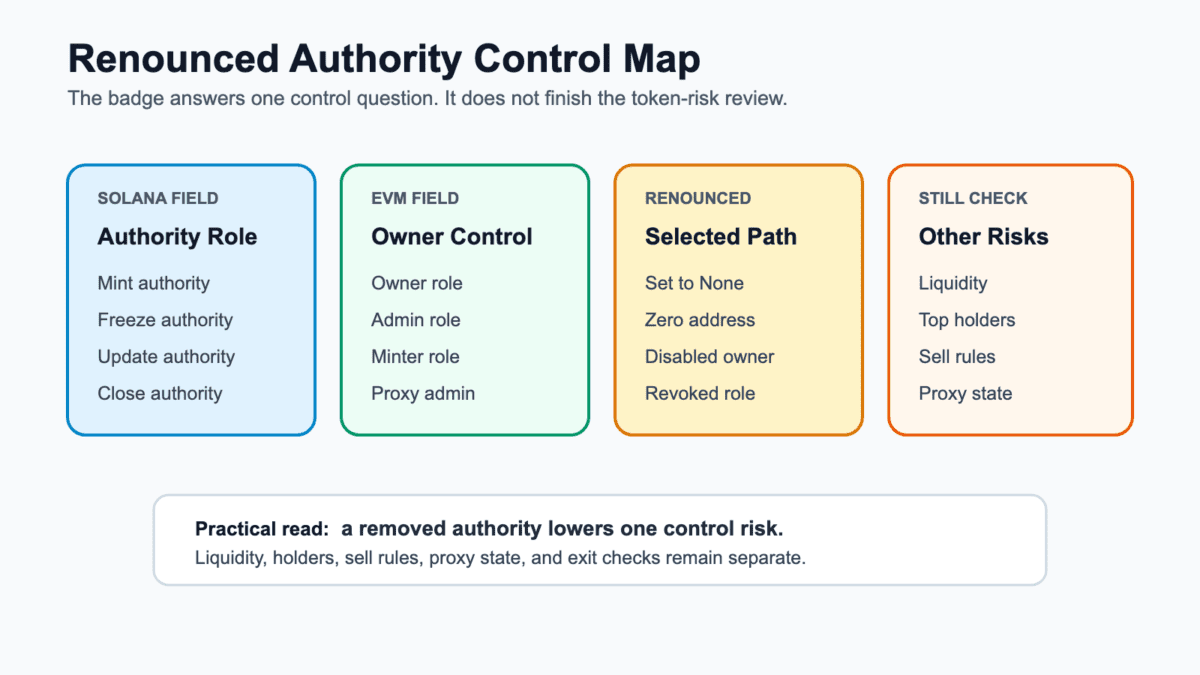
_Renounced authority removes a selected control path. Liquidity, holders, sell rules, and proxy risk still need separate checks._
The clean read is simple. Language gets you to the right door, but chain state answers the question. Do not make a scanner label do more work than it was built to do.
Renounced authority works on Solana by changing or removing one authority role tied to a mint or token account. The role is specific. Removing mint authority does not automatically remove freeze authority, and removing freeze authority does not prove metadata is locked.
Solana’s SetAuthority flow can change one selected role on a mint or token account, and setting that selected role to None permanently removes that role through the normal token program path. The protocol-level reference is the Solana documentation.
That is the reason Solana checks can feel more detailed than a simple “owner renounced” badge. You are not only asking whether a team has control. You are asking which control was attached to which account.
Mint authority is the supply lever. If active, the authority can create more units of the token. If mint authority is revoked, the token should no longer be mintable through that role.
This is the check traders care about when a token claims fixed supply. A meme coin can say “no more supply” all day, but the mint authority field is the receipt. If the field is still active, the claim needs an explanation.
Freeze authority controls movement from token accounts. If active, the authority may freeze selected token accounts for that mint. The wallet still exists, and the balance may still show, but movement can be blocked.
That makes active freeze authority a serious issue on speculative tokens. It can be legitimate for regulated assets or controlled products, but it is ugly on a fresh anonymous token promoted as trustless.
Update authority affects token metadata, such as name, symbol, image, or related display data. It does not create more supply or freeze accounts, but it can still change how the token appears.
Mutable metadata can be harmless during setup. It can also be abused after buyers trust the brand. Buyers should look for a clear reason metadata remains changeable and for the key that controls it.
Each Solana authority answers a different question. A clean token check looks at the fields together, not one badge alone.
| Authority | What Revocation Removes |
|---|---|
| Mint authority | The selected path for creating more token supply. |
| Freeze authority | The selected path for freezing token accounts. |
| Update authority | The selected path for changing token metadata. |
| Close authority | The selected path for closing a token account where applicable. |
The table is a map, not a verdict machine. A token with mint authority revoked can still have freeze authority active. A token with both removed can still have weak liquidity, clustered holders, or a misleading launch story.
So on Solana, “renounced authority” should always become a follow-up question: which authority, and what still remains active?
Renounced authority works differently in EVM smart contracts because the common language is usually ownership. Traders often see “renounced ownership,” “owner set to zero address,” or “contract renounced” on explorers and scanners.
Those labels usually point to an owner role inside the contract. If the owner is renounced, functions protected by that owner role should no longer be callable by the old owner. That can remove powers such as changing fees, enabling trading, excluding wallets, or updating certain settings, depending on how the contract was written.
Many EVM contracts store an owner address. Renouncing ownership often means setting that owner to the zero address or another unusable address. The old owner can no longer sign as the owner because the owner field no longer points to that wallet.
That sounds final, and sometimes it is. But it only covers the owner role. It does not prove every privileged function is gone, and it does not prove the contract has no other control paths.
Owner-only functions are common in EVM contracts. Developers often use patterns where certain functions can run only if the caller is the owner. If ownership is renounced, those functions may become unusable.
That can help users when owner-only functions include dangerous powers. It can also create a maintenance problem if the project later needs to fix a bug, update a setting, or respond to a real issue.
Proxy contracts make the ownership check more complicated. A proxy can point user calls to another implementation contract. If a separate proxy admin can upgrade that implementation, the visible token owner may not tell the whole story.
Role-based access adds another wrinkle. A contract may have admin, minter, pauser, blacklist, tax, or router roles that are not the same as the owner field. That is why “smart contract ownership renounced” is useful, but never enough by itself.
The EVM version of the check is plain: confirm the owner state, then look for proxy control, admin roles, transfer restrictions, verified code, and sell behavior. The badge starts the review. It does not finish it.
Renounced authority proves that one named control has been removed through its normal path. It may close minting through mint authority. It may close freezing through freeze authority. It may stop a contract owner from calling owner-only functions.
That is valuable. It reduces one kind of trust. It can also make a token easier to evaluate because a specific lever is gone.
But it does not prove the token is safe. A token can still have bad liquidity, concentrated holders, hidden transfer restrictions, proxy admin control, mutable metadata, or dev wallets waiting to sell. A green authority badge can sit beside a terrible market setup.
The remaining risks usually fall into clear buckets:
This is where authority checks meet rug-pull literacy. A token can still be exposed to a hard rug if another direct abuse route remains, such as liquidity control, transfer traps, or upgrade power.
It can also fade into a soft rug after authority is gone. No one has to mint more tokens for a project to die slowly through silence, insider selling, weak delivery, or empty demand.
Keep the conclusion narrow and useful. Renounced authority lowers one control risk. It does not replace checking liquidity, holders, code, ownership, proxy state, and whether normal wallets can actually sell.
Check renounced authority before you buy by starting with the exact token address. Then verify the chain-specific fields in an explorer and compare them with scanner labels. Do not start from screenshots, Telegram claims, or a random checker that asks for wallet approvals.
The address is critical because fake tokens copy names, symbols, images, and social accounts. A correct-sounding token name is not enough. Copy the token address from the project’s official source, then cross-check it against the pool, chart, and explorer you plan to use.
Use the token address, not the ticker. On Solana, that usually means the mint address. On EVM chains, that means the token contract address.
Then check that the trading pair, scanner page, and explorer page all point to the same address. If the addresses differ, stop. You may be checking a decoy while buying something else.
On Solana, look for mint authority, freeze authority, update authority, and any other visible authority fields. The useful clean state is usually None, revoked, null, or a clearly disabled equivalent, depending on the tool.
On EVM chains, look for owner state, ownership-renounced labels, verified source code, proxy notices, and admin roles. If the owner is the zero address, that helps with owner-only controls. It does not settle proxy or role-based access.
Scanners are good dashboards, but they are not law. Use them to find warnings, then check the explorer when a warning could change the trade.
A simple workflow helps:
That last point deserves attention. You should not need to approve a random site just to read public token state. If a page asks you to connect and sign before showing a basic authority field, close it and use a safer route.
Authority checks do not answer whether you can exit. After the badge looks clean, inspect liquidity depth, locked or burned LP claims, top holders, wallet clusters, recent sells, and the size of your trade relative to the pool.
This is where late buyers can become exit liquidity even when authority was truly renounced. If early wallets control supply and the pool is thin, the contract can be clean while the trade is still terrible.
The goal is not to make every token look suspicious forever. It is to avoid treating one green check as permission to ignore the rest of the chart, pool, and holder map.
Renounced authority does not always happen immediately because some projects still need a controlled window for setup, upgrades, testing, metadata fixes, migrations, rewards, or compliance. Retained authority is not automatically bad. Hidden retained authority is the real problem.
A serious team should explain which powers remain, who controls them, how changes are approved, and when control will be reduced or removed. That explanation should match the chain state. Marketing language and explorer fields need to agree.
| Reason To Keep Authority | What Users Should See |
|---|---|
| Launch testing | A short timeline and clear post-launch revocation plan. |
| Metadata fixes | Narrow control over display data, not supply or freezing. |
| Upgrades or migration | Multisig, timelock, governance, or published process. |
| Compliance controls | Plain disclosure of freeze, blacklist, or transfer limits. |
| Rewards or emissions | Supply schedule and controller identity. |
The difference between a reasonable retained power and a red flag is disclosure plus limits. A multisig is better than one unknown wallet. A timelock is better than instant changes. A published policy is better than “trust us bro,” which remains undefeated as the worst audit category.
Renouncing too early can also create problems. If a bug is found after a team has removed every control, there may be no clean way to fix it. Users should not demand instant renouncement as a ritual. They should demand clarity about what remains possible.
Renounced authority red flags still deserve attention because the badge only answers one control question. The riskiest tokens often combine one clean field with several ugly ones.
A common pattern is revoked mint authority with active freeze authority. Supply may be capped, but selected token accounts can still be frozen. Another pattern is EVM ownership renounced while a proxy admin can still change implementation logic. That can make the owner badge look calmer than the contract really is.
Watch for these signals after the authority check:
Anonymous teams need extra care when control paths are unclear. An anon dev can still build honestly, but anonymity plus retained authority puts more weight on on-chain proof and market structure.
Public identity helps only when it matches the controls. A doxxed team can still ship risky contracts, and public faces do not stop a bad proxy, weak pool, or concentrated supply from doing damage.
The useful habit is boring, which is why it works. Keep renounced authority to one line in the checklist, then keep checking until the sell path, holder map, and control map make sense together.
Renounced authority examples usually show up as scanner labels, launch-site promises, or explorer fields. The trick is to translate the label into the next check.
Use hypothetical cases rather than trusting a token name because conditions change fast. The same label can mean different things on Solana, Ethereum, Base, or BNB Smart Chain.
| What The Scanner Says | What To Check Next |
|---|---|
| Mint authority revoked | Check freeze authority, update authority, liquidity, and holders. |
| Freeze authority revoked | Check mint authority and whether sells work for normal wallets. |
| Ownership renounced | Check proxy notices, admin roles, transfer rules, and verified code. |
| LP burned | Check holder concentration and whether liquidity is deep enough. |
| Metadata locked | Check supply controls, freeze controls, and market depth. |
| Honeypot warning clear | Check taxes, failed sells, proxy risk, and recent transfer behavior. |
A scanner might say mint authority is revoked while freeze authority remains active. That means future supply risk may be lower, but selected accounts could still face movement risk.
Another scanner might say ownership is renounced on an EVM token. That helps only after you check whether the contract is proxied, whether other roles exist, and whether normal wallets can sell without surprise taxes or blocks.
The bigger lesson is that scanner labels are shortcuts. Shortcuts save time when you know where they lead. They get expensive when you mistake them for the destination.
Renounced authority sits inside a wider token-risk checklist. It connects most directly to rug-pull mechanics, liquidity quality, holder concentration, developer identity, and scanner interpretation.
Use the related concepts as follow-up checks, not as a reading pile. Rug-pull mechanics explain why one removed control does not protect every exit path. Liquidity and holder checks explain why a clean contract can still trade badly. Identity checks explain why public accountability helps only when the on-chain controls match the claim.
If you are checking a new token, pair the authority read with three plain questions. Can the team still change important rules? Can large holders crush the pool? Can normal wallets sell without hidden restrictions?
For team risk, the anon dev guide helps separate normal pseudonymity from unclear signer access, hidden control, and market-trust gaps. That is the useful next step when renounced authority looks clean but the project still depends on unknown wallets.
The doxxed team guide helps with the opposite claim. Public identity can raise accountability, but it does not cancel proxy control, active freeze authority, weak liquidity, or concentrated supply.
Those questions keep the badge in its proper place. Renounced authority narrows one risk. Trouble starts when a green icon gets promoted into an audit, a liquidity review, and a team background check.
Renounced authority in crypto means a project has removed a specific admin control, such as minting, freezing, metadata updates, or contract ownership. It proves that selected role should no longer work through its normal path.
Renounced authority is broader than renounced ownership. Renounced ownership usually describes an EVM contract owner role, while renounced or revoked authority can also describe Solana mint, freeze, update, or close authority fields.
No. Renounced authority lowers one control risk, but it does not prove liquidity, holder distribution, sell rules, proxy state, code quality, or market demand are safe.
Use the exact token address, open the correct explorer, check the authority or owner fields, then compare scanner labels with explorer data. Do not rely on screenshots or random approval-seeking checker sites.
Yes. A token can still be rugged through weak liquidity, concentrated holders, hidden transfer restrictions, proxy control, insider selling, or market abandonment after a specific authority is gone.
Usually, a properly revoked or renounced selected role is not reversible through that same role. The caveat is that other admin roles, proxy controls, or separate authorities may still exist elsewhere.


