Physical Address
304 North Cardinal St.
Dorchester Center, MA 02124
Physical Address
304 North Cardinal St.
Dorchester Center, MA 02124


A clear guide to retroactive airdrops, eligibility, and claim safety.
A retroactive airdrop is a token distribution that rewards wallets for past activity before users knew the final eligibility rules.
That is the clean version. In practice, a project reviews wallet history, chooses a rule set after the activity happened, then lets eligible users claim tokens or receive them automatically. It can feel like free crypto, but the real cost may include gas, time, wallet exposure, tax records, and a few suspicious links trying to separate you from your funds.
A retroactive airdrop is an after-the-fact crypto reward. A project looks at earlier wallet behavior, decides which addresses qualified, and distributes tokens to those wallets later.
Retroactive is the key part. Users did not know the final criteria while they were using the app, bridge, exchange, testnet, domain service, or community tool. They may have known a token was possible. They did not know the exact scoring rules.
That makes a retroactive airdrop different from a simple giveaway. A giveaway asks users to do something after an announcement. A retroactive airdrop rewards activity that already happened.
Projects use this model to reward early users, distribute governance power, create attention, and turn active wallets into token holders. The reward might be a governance token, a network token, a claimable allocation, or a distribution sent straight to the wallet.
Most retroactive airdrops come down to three moving parts:
The same setup creates confusion. A wallet can be active and still miss the criteria. Another wallet can qualify from one specific action. A points dashboard can hint at future rewards without promising any token.
So the clean definition is simple. The user experience is not.
A retroactive airdrop sits between reward, marketing, governance, and luck. It can be a nice surprise, but “free” is too lazy a word for something that may require careful claiming, tax records, wallet hygiene, and a post-claim plan.
A retroactive airdrop works by turning past wallet data into an eligibility list. The project checks historical activity, applies criteria, calculates an allocation, then opens a claim page or sends tokens to eligible wallets.
The timeline usually starts before anyone sees the rules. A user swaps on a DEX, bridges assets, trades on a protocol, votes in governance, registers a domain, tests an app, or joins a campaign. Later, the project takes a snapshot or scores wallet history from a chosen period.
That delay creates most of the confusion. Users may think current activity can still qualify after the eligibility period already closed. Others assume any past use counts. In reality, the project decides which signals match its goals and which activity looks like noise.
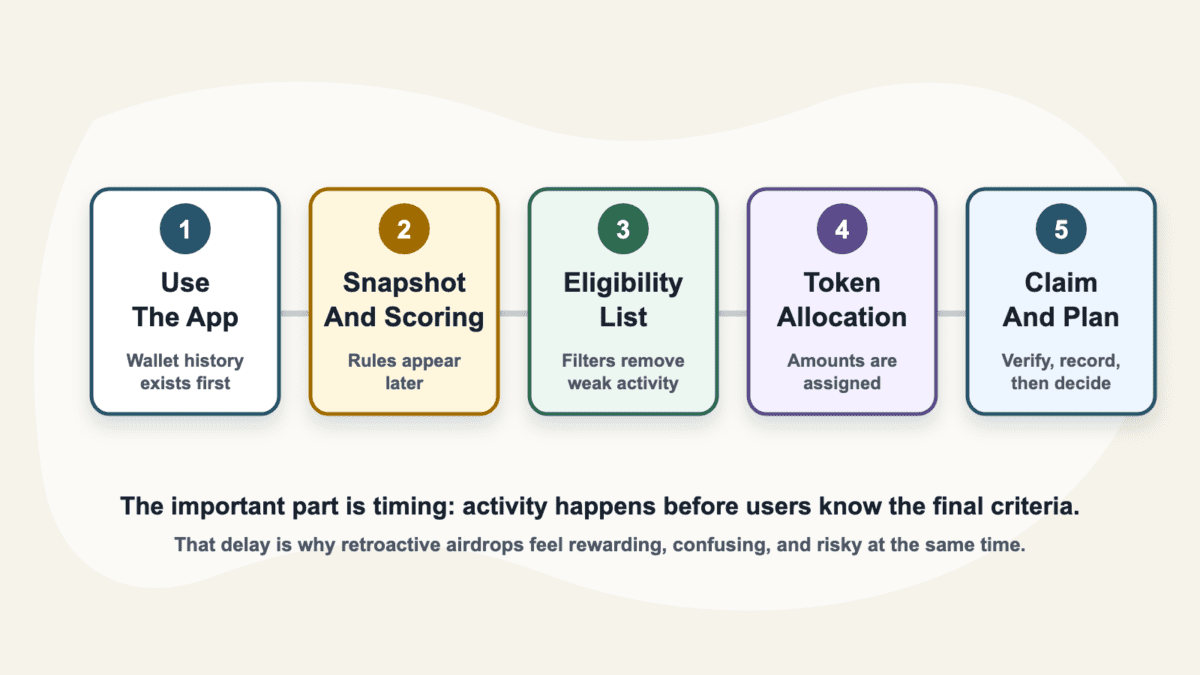
Here is the common flow, simplified:
| Step | What It Means For The User |
|---|---|
| User Activity | The wallet uses a protocol, bridge, app, testnet, domain service, or governance tool. |
| Snapshot Or Scoring | The project records balances, actions, dates, points, volume, or contribution history. |
| Eligibility List | Wallets that match the criteria become eligible, often after anti-bot filtering. |
| Allocation | The project assigns token amounts or tiers to eligible wallets. |
| Claim Or Send | Users either claim from an official portal or receive tokens automatically. |
| Post-Claim Choice | The user keeps, sells, delegates, records taxes, or ignores a small allocation. |
Some retroactive airdrops use a visible snapshot date. Others keep the scoring method hidden until the claim starts. That can reduce manipulation, but users often learn too late which actions counted.
Projects also use drops strategically. A retroactive airdrop can reward loyal users and generate crypto attention at the same time. The risk is that the same attention pulls in farming, spam, fake claim sites, and people acting on rumors.
And one more caveat belongs here: a project may never launch a token. Activity on a popular tokenless app can lead to a drop, but it can also lead nowhere. Wallet history is a possibility, not a receipt.
A retroactive airdrop rewards the behavior a project wants to recognize. That can mean real protocol use, long-term participation, liquidity, trading volume, governance work, testnet feedback, developer contributions, or ownership of a related asset.
The hard part is that different projects value different signals. A DEX may care about swap history. A bridge may care about cross-chain transfers. A derivatives protocol may care about trading activity. A domain project may care about registered names or ownership duration.
Generic farming threads often overpromise here. They turn “this might count” into “do this and get paid.” Projects can score anything they can measure, but they are not required to reward every visible action.
Common reward signals look like this:
| Signal | Why A Project Might Count It |
|---|---|
| Protocol Usage | Shows the wallet used the product before token incentives existed. |
| Trading Volume | Rewards users who created measurable activity and fees. |
| Liquidity Provision | Recognizes users who supplied assets and took pool risk. |
| Bridging | Helps a network prove cross-chain demand. |
| Governance Participation | Points to users who voted, delegated, or joined proposals. |
| Testnet Work | Rewards users who found bugs or stress-tested features. |
| NFT Or Domain Ownership | Ties eligibility to a specific community or access credential. |
| Duration | Separates short spam bursts from longer participation. |
| Community Or Developer Work | Covers useful contributions that wallet data alone may miss. |
The table is not a checklist. It is a map of possible signals. A project can reward one of them, combine several, cap allocations, exclude wallets, or apply rules that never become fully public.
Wallet history can help only when the project chooses to score it. A “good” wallet does not carry a universal reputation badge across crypto. There is no secret airdrop passport hiding under your MetaMask fox.
Keep the question narrower: what does the project actually need? If your activity helped that product, network, or community before the token plan was public, it may fit a retroactive airdrop. If the activity exists only because a farming spreadsheet said “click weekly,” expect weaker odds.
Retroactive airdrop farming means using likely tokenless protocols in the hope that future eligibility rules will reward your activity. It is speculative work, not yield, wages, or a guaranteed claim path.
Farming can be reasonable when you already want to test a protocol. It gets expensive when users bridge funds across chains, pay repeated gas fees, spam low-value actions, and manage many wallets only because social feeds expect a token.
Points programs add another layer. A project may award points before any token exists. The score can become eligibility input, but it can also remain reputation, access, badges, or marketing fuel. Points are not tokens unless the project makes that conversion real.
Use this filter before spending time or gas:
Some activity looks like real use. Swapping when you need liquidity, bridging for an app, voting on proposals, testing features, or providing feedback can create useful wallet history. It also teaches you how the protocol works.
Other behavior looks weak. Repeating tiny swaps, splitting one user across dozens of wallets, recycling funds through scripted routes, and copying every influencer checklist can trigger Sybil filters. It can also turn your wallet history into expensive noise.
This is where farming in crypto needs context. Retrodrop farming is not just “do tasks, get tokens.” It is a bet that opaque future criteria will value your past activity more than the costs and risks you took.
The plain takeaway is blunt. Act like a real user, or admit you are gambling on hidden rules. Both choices exist. Only one sounds honest.
Retroactive airdrop examples are useful when they teach patterns, not when they become a greatest-hits list. Old success stories can make future farming feel cleaner than it deserves.
The useful examples split by what they show:
Together, these examples point to one lesson: retroactive airdrops reward patterns selected by the project. They do not prove that copying old activity will create the next result.
That is the trap. A huge airdrop story can make farming feel like a lottery-ticket bet where the ticket price is gas, time, and wallet risk. Sometimes the ticket pays. Often it just teaches budget discipline the expensive way.
Retroactive airdrop risks start before the claim and continue after tokens land. The biggest mistakes are connecting a valuable wallet to a fake page, farming in a way that gets filtered, ignoring gas costs, and treating tax records as a later problem.
Fake claim pages are the obvious danger. Scammers copy project branding, buy ads, reply under official posts, send support DMs, and create urgency around “eligibility.” They do not need to hack the real project. They need one rushed signature.
> Never enter a seed phrase, private key, or recovery phrase to claim a retroactive airdrop. A real claim does not need it.
Wallet-drainer flows often hide behind approvals or signatures. A page may ask for broad token spending rights, route you to the wrong chain, or prepare a transaction that does more than claim. If the wallet prompt does not match the action, reject it.
Identity can help, but it is only one signal. A visible doxxed team can make official communication easier to verify. It does not make every link, reply, or cloned claim portal safe.
Sybil risk sits on the eligibility side. A project may exclude wallet clusters that look like one person pretending to be many users. Wash activity, repetitive dust transactions, obvious fund recycling, and scripted interactions can all look weak.
Costs come next. Farming can burn gas across chains. Failed claims can waste fees. Small allocations can be worth less than the transaction needed to receive them. A token can also drop hard after claimants rush to sell.
Taxes are the quieter risk. For U.S. users, the IRS treats digital assets under property-tax principles. Its public guidance is split into Part I FAQs 1-46 and Part II FAQs 47-111, with the second part applying to digital-asset transactions completed on or after January 1, 2025. Other countries use different rules, so save records and get local advice for serious amounts.
Useful records include the claim date, token amount, wallet address, transaction hash, market value when received, sale date, sale proceeds, and fees. That sounds dull because it is. It is also easier than reconstructing twelve wallets during tax season.
The goal is not paranoia. The goal is slower clicking. A legitimate retroactive airdrop can still be worth claiming, but only after the link, wallet action, eligibility, fees, and recordkeeping make sense.
Check a retroactive airdrop safely by proving the announcement, domain, contract, wallet action, and claim value before you sign anything. The claim page should earn your trust one step at a time.
Start from official sources. Use the project’s main domain, verified social profile, documentation, governance forum, app dashboard, or wallet-native notice. Do not start from a sponsored result, reply account, random Telegram link, or “support” DM.
Then separate reading from signing. Checking whether an address is eligible can be low risk if the page only reads a public address. The risk changes when it asks for a signature, transaction, approval, or network switch.
Use this checklist before connecting:
| Check | What To Look For |
|---|---|
| Official Source | The claim link appears on the project site, verified social profile, docs, or governance post. |
| Domain | The spelling, subdomain, and redirects match the project. |
| Contract Address | Any published address matches the explorer and wallet prompt. |
| Wallet Request | The prompt describes the expected claim, not broad spending approval. |
| Eligible Wallet | You control the wallet that actually qualified. |
| Claim Value | The expected token amount is worth the gas and wallet exposure. |
| Deadline | The claim window and later phases are clear. |
If a claim needs wallet interaction, use careful wallet setup habits. Keep long-term holdings away from experimental claim pages. A separate low-balance wallet can limit damage when you are checking unfamiliar flows.
Also review old approvals. A wallet used for farming may have touched many apps across many chains. Revoking stale approvals will not fix every risk, but it reduces loose permissions that should not stay open forever.
Block explorers help too. They can show contract addresses, verified source labels, transaction history, and whether other users are interacting with the same contract. Explorers do not prove a project is honest, but they can catch obvious mismatches.
The final check is human. If the page pushes urgency, asks for secrets, hides addresses, or makes the wallet prompt hard to understand, pause. A real allocation should survive a few minutes of verification.
Retroactive airdrop terminology gets messy because crypto uses several reward words loosely. A retrodrop is usually the same idea as a retroactive airdrop: tokens for past activity.
A standard airdrop can be broader. It may reward holders, campaign participants, early signups, testnet users, NFT owners, community members, or wallets from a partner list. Some are retroactive. Some are not.
A retroactive airdrop is narrower because the important action happened before the final rules were known. That is the part users should remember when judging rumors.
The common labels split like this:
The points distinction deserves care. Points can be a useful signal because they show a project is measuring behavior. They can also be a distraction if users assume every point has a future token value.
Project wording carries weight. “Points,” “XP,” “season,” “rewards,” “credits,” and “allocation” do not mean the same thing. If a project has not announced a token, do not rewrite the announcement in your head because social media wants a cleaner story.
Retroactive airdrops reward history. Points may track current activity. A claim page asks for wallet action. A market listing creates sell or hold choices. Keeping those stages separate prevents a lot of avoidable clicking.
Start with retroactive airdrops by learning the protocol before you farm it, protecting your wallet before you connect it, and planning what you will do if tokens actually arrive.
The best airdrop strategy is boring in the right places. Use products that make sense to you. Track costs. Keep wallet risk contained. Verify claims from official channels. Save records before you forget why a wallet moved funds at 1:13 a.m.
Use these next steps:
The post-claim plan is especially important. Fresh airdrop tokens can face heavy selling when many wallets claim at once. If buyers arrive late into thin liquidity, they can become exit liquidity for faster claimants.
None of that means every retroactive airdrop should be sold instantly. It means the token deserves a fresh decision after the claim. Eligibility is not a thesis. A dashboard balance is not a plan.
If you do farm, keep it measured. Spend time where the product, network, or community would still interest you without a token rumor. That one filter cuts out a lot of nonsense.
A retroactive airdrop in crypto is a token distribution that rewards wallets for activity they completed before the final eligibility rules were known. It is often used by protocols, networks, or apps to reward early users and turn them into token holders.
The important detail is timing. The activity happened first, then the project later decided which wallets qualified. That is why a retroactive airdrop can feel like a surprise, even when users suspected a token might arrive.
The claim may still require action. Some drops open a portal, while others send tokens automatically. Either way, the wallet history is what earned the allocation.
Retroactive airdrops are based on criteria chosen by the project. Common inputs include wallet activity, volume, bridge use, liquidity, governance, testnet work, domain or NFT ownership, points, duration, and anti-Sybil filtering.
No outside checklist can confirm the final rules before the project publishes them. A wallet can look active and still miss the cut if the scoring model values different signals.
Projects may also cap rewards, exclude obvious farms, or apply hidden filters. That is why “I used the app” and “I qualified” are not the same sentence.
You qualify for a retroactive airdrop only if your wallet matches the project’s final eligibility rules. Real usage can help, but no outside farming guide can guarantee that a project will reward a specific action.
The safer approach is to use products you understand, track your costs, and avoid spammy wallet behavior. If the activity only exists to chase a rumor, the risk-to-reward math can get ugly fast.
Qualification also depends on custody. If you used an exchange wallet or a partner app, you may not control the address that appears in the snapshot.
Yes, a retrodrop is usually shorthand for a retroactive airdrop. Both terms mean a project rewards past activity after the fact, though some users use “retrodrop” more casually in farming discussions.
The term does not create a separate reward category by itself. When someone says “retrodrop,” check whether they mean an official claim, a rumored future reward, or just another farming thread with confidence problems.
That difference changes your next move. An official retrodrop needs safety checks. A rumored retrodrop needs patience, cost control, and fewer dramatic wallet experiments.
Retroactive airdrops can be taxable, but the answer depends on your country, the token, and when you control the asset. U.S. users should keep claim records and ask a qualified tax professional for meaningful amounts.
Keep the boring details early: claim date, token amount, wallet address, transaction hash, fees, and any later sale. That record is much easier to save at claim time than rebuild months later.
Small allocations can still create paperwork. Before claiming dust, check whether the token value, gas cost, and recordkeeping burden are worth the interaction.