Physical Address
304 North Cardinal St.
Dorchester Center, MA 02124
Physical Address
304 North Cardinal St.
Dorchester Center, MA 02124


A plain-English keyshare wallet guide for MPC, recovery, provider risk, and safer first steps.
A keyshare wallet is a crypto wallet that splits private-key control into separate cryptographic shares so a single share usually cannot move funds alone.
That can ease seed phrase panic, but it shifts the work. A keyshare wallet lowers one-secret risk and raises new questions about wallet design, recovery, provider control, and your own signing habits.
A keyshare wallet is a wallet design where signing authority is split across multiple cryptographic shares. The crypto does not sit inside the app. The assets stay on-chain, and the wallet controls whether a transaction can be signed.
In a normal seed phrase wallet, one recovery phrase can recreate the private key. That is simple and powerful. It is also why a stolen, copied, burned, or misplaced seed phrase can become a very expensive paper problem.
A keyshare wallet changes that control model. Instead of asking one secret to carry the whole account, it spreads signing power across separate shares. Those shares may live on your phone, a backup factor, a second device, a provider server, a hardware enclave, or approved team members.
The labels can be messy. Many consumer products call this a keyless wallet, seedless wallet, MPC wallet, or self-custodial MPC wallet. Those labels overlap, but they are not identical.
Use the labels as clues, then ask better questions:
Plain version: a keyshare wallet tries to remove the old single seed phrase bottleneck. In return, you must understand the share setup. If that sounds like trading one custody headache for a newer one, yes. That is crypto security with nicer UI.
A keyshare wallet works by creating and storing pieces of signing authority separately, then using enough shares to produce one valid blockchain signature. During normal signing, the full private key should not need to appear in one place.
Most keyshare wallets use multi-party computation, or MPC, often with threshold signature schemes. The shares cooperate during signing. The blockchain still receives a normal-looking signature at the end.
The basic flow has a few moving parts:
Fireblocks describes MPC wallet signing as a process where key shares are generated and used independently, while a complete transaction signature is produced through distributed computation. Its current MPC-CMP example also shows why implementation details matter. It uses one signing round instead of nine in the older GG18 setup. Read that as a product-specific speed clue, not a promise that every keyshare wallet will feel faster.
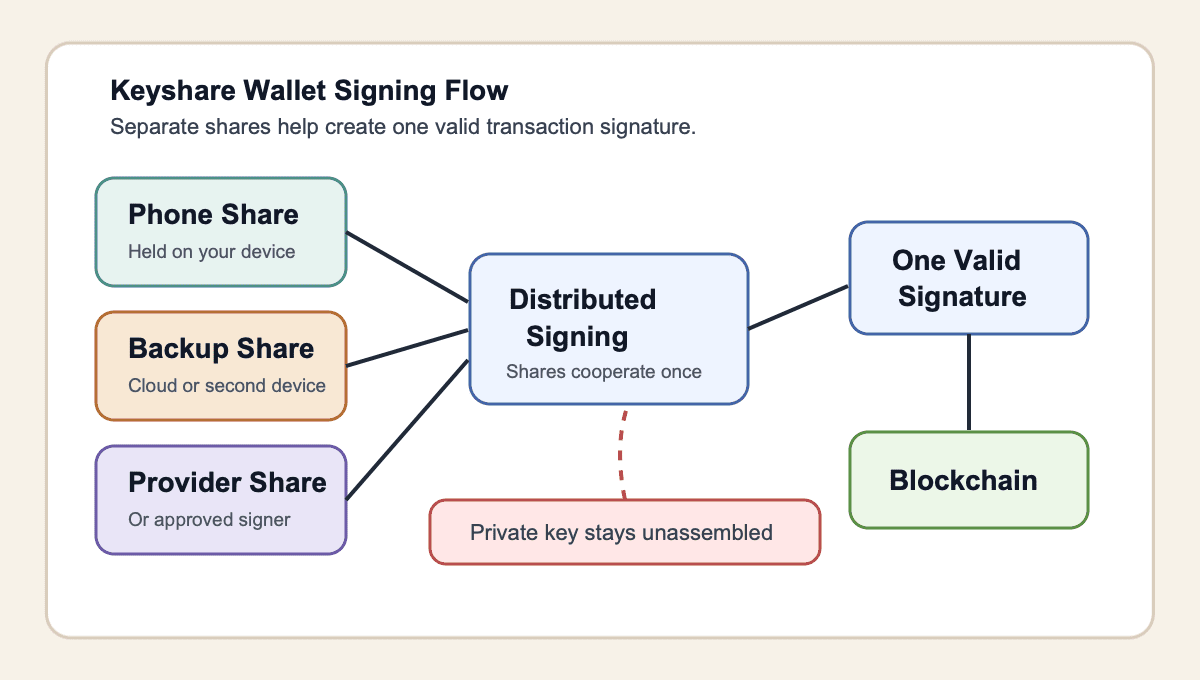
“Keyless” is the phrase that causes the most confusion. It usually means you do not hold a traditional seed phrase. It does not mean the wallet has no cryptographic key material. If a blockchain transaction happens, some valid signing process still exists.
This distinction shows up at the approval screen. MPC can reduce the risk of one stolen seed phrase. It cannot tell a safe transaction from a malicious one unless the wallet also gives clear prompts, simulations, limits, or policy checks. A bad approval is still a bad approval, even if the signing ceremony looks fancy backstage.
A keyshare wallet reduces reliance on one recovery phrase, while a seed phrase wallet usually puts full recovery power into one set of words. That single difference changes backup, recovery, inheritance, and everyday security.
Seed phrases are brutally honest. If you store the words well, you can recover without a company. If you expose them, someone else may recover without asking nicely. If you lose them, the blockchain will not admire your intentions.
Here is the practical split:
| Wallet Model | What The User Must Protect |
|---|---|
| Seed Phrase Wallet | One recovery phrase that can usually recreate the wallet. |
| Metal Backup | The same seed phrase, stored in a more durable physical form. |
| Shamir Backup | Backup shares that can reconstruct a seed when enough pieces combine. |
| Keyshare Wallet | Active signing shares, recovery factors, devices, and provider rules. |
A keyshare wallet does not remove responsibility. It changes the checklist. Instead of guarding one phrase, you may need to protect a phone, cloud backup, biometric login, second device, recovery contact, provider account, or team policy.
For normal humans, that can be better. Many people will lose paper, photograph a seed phrase, type it into fake support, or leave heirs with a treasure map written in panic. A keyshare wallet can make recovery more usable if the design is clear.
But the replacement duties are real. You need to know what happens after a lost phone, deleted cloud account, provider outage, or account lock. You also need a way to test recovery before the wallet holds anything you would hate to lose.
So the seedless pitch deserves a slower read. Less seed phrase risk is useful. Hidden recovery risk is just the same circus in better lighting.
A keyshare wallet distributes signing control, while a hardware wallet keeps a signing secret on a separate physical device. Both can improve safety, but they solve different problems.
Hardware wallets are strongest when the goal is long-term storage with limited movement. The private key stays offline until you sign. That makes them attractive for cold storage, especially when paired with careful seed backup and a clean transaction process.
The trade-off looks like this:
| Setup | Best Fit |
|---|---|
| Keyshare Wallet | Active use, mobile recovery, team approvals, policy controls, and smoother signing. |
| Hardware Wallet | Long-term storage, lower transaction frequency, and users who want a physical signing boundary. |
| Keyshare Wallet Weak Spot | Provider dependence, recovery design, device security, and unclear approval prompts. |
| Hardware Wallet Weak Spot | Seed backup risk, firmware trust, supply-chain trust, and blind signing during dApp use. |
| Large-Balance Fit | Often both: hardware for deep storage, keyshare for active funds. |
Calling every hardware wallet “safe” and every keyshare wallet “convenient” is too tidy. A hardware wallet connected to risky dApps every day is no longer behaving like deep cold storage. A keyshare wallet with strong policy limits and tested recovery can be safer for active funds than a seed phrase sitting in a phone photo album.
Some users split roles. They keep long-term holdings on a hardware wallet and use a keyshare wallet for smaller active balances, DeFi actions, or family-friendly recovery. That is not glamorous. It is just good compartmentalization, which is usually where crypto safety stops sounding cool and starts working.
A keyshare wallet usually signs off-chain with shares of one wallet key, while a multisig wallet requires multiple full keys or signatures under explicit approval rules. Both can require more than one participant, but the enforcement layer is different.
In multisig, approval rules are usually visible on-chain or inside a smart contract design. In MPC or threshold signing, the blockchain often sees one final signature. The share coordination happens before the transaction reaches the chain.
The distinction shows up in daily use:
| Comparison Point | What Changes |
|---|---|
| Approval Location | Multisig approval is often enforced on-chain. Keyshare approval happens before one signature is broadcast. |
| Chain Support | Keyshare signing can work across chains that accept the signature type. Multisig support varies by chain. |
| On-Chain Visibility | Multisig can be easier to inspect publicly. Keyshare signing may look like one normal wallet. |
| Signer Rotation | Keyshare systems may rotate shares without changing the address. Multisig changes can require contract updates. |
| Team Governance | Multisig can be clearer for public treasury rules. Keyshare wallets can be smoother for policy-heavy operations. |
That creates two clean use cases:
Multisig shines when visible governance and auditability are important. A DAO treasury, foundation wallet, or public team fund may prefer a structure that outsiders can inspect. The friction can be worth it.
For solo users, multisig can be overbuilt. For teams, a casual keyshare setup can be under-documented. The right model depends on who must approve, who can recover, and who needs to verify the rules later.
A keyshare wallet is self-custodial only if the user can control signing and recovery without giving a provider unilateral power over funds. The label alone does not prove that.
Some keyshare wallets are built so the user controls enough shares or recovery factors to regain access. Others require a provider server to co-sign. Some are closer to custodial accounts with nicer language around key management.
Common setups include:
This is where marketing can get slippery. “Self-custodial MPC wallet” should mean the user is not depending on a company to move funds. But if the provider can block signing, close the account, disable recovery, or refuse export, the setup may still be semi-custodial in practice.
Before trusting a keyshare wallet with serious funds, check the custody model directly:
“Not disclosed” is an answer too. It is not a comforting answer, but it is better than filling gaps with vibes. If a wallet does not explain who controls the shares, you do not yet understand your custody risk.
A keyshare wallet makes sense when recovery, active signing, or shared control is more important than the purity of one offline seed. It is often a practical tool for people who use crypto rather than just store it.
The best fit is usually a wallet that sees real activity. That could mean swaps, DeFi positions, NFT actions, business payments, team treasury flows, or a mobile-first user who will mishandle a paper backup. Be honest. Some people should not be trusted with a seed phrase and a drawer.
Useful cases include:
If you are still comparing custody categories, CryptoProcent’s wallet options page can help place keyshare wallets beside broader wallet choices. Use that only as a category map, not as a reason to rush into a product.
The best keyshare wallet setup is boring before it is funded. You know who holds the shares, how recovery works, which chains are supported, where dApp limits sit, and how to exit. Then you test it with a small amount. If that feels slow, remember that moving fast is exactly how people donate to attackers with excellent branding.
A keyshare wallet may be the wrong choice when you cannot verify recovery, dislike provider dependence, or need long-term cold storage with minimal moving parts. Seedless does not automatically mean safer.
Some users want a setup that can sit untouched for years. A well-backed-up hardware wallet may fit that better than a mobile MPC wallet tied to accounts, devices, cloud factors, or vendor infrastructure.
This is especially true when the wallet’s daily convenience is not useful to you. If you rarely sign transactions, a faster mobile approval flow may only add more accounts to maintain. Every phone login, cloud backup, recovery email, or provider dashboard becomes another place that must stay secure and understandable.
Be careful in these cases:
This is also where portfolio discipline enters. Do not go full port into a keyshare wallet just because seedless sounds cleaner than a metal backup. Move a small amount first. Test recovery, test a send, and test the exact dApps you plan to use.
A keyshare wallet reduces one classic failure mode: one exposed seed phrase. It may add others, including account lockouts, provider downtime, weak recovery factors, unclear export paths, and overconfident approvals.
So run the wrong-choice check before the marketing pitch starts sounding comfortable. If you cannot explain the recovery path to another trusted person, the wallet is not ready for serious funds. If you cannot leave the provider cleanly, the custody trade-off is still unresolved. And if the app makes approvals hard to read, better key management will not save a bad click.
Keyshare wallet risk starts where the shares, recovery path, and approval screen meet. The biggest danger is assuming MPC solves every wallet problem because it sounds more technical than a seed phrase.
One stolen share should usually be useless by itself. But that does not mean every share setup is safe. Attackers may target the device, cloud backup, provider account, fake support channel, recovery flow, or the transaction approval itself.
Use this checklist before adding real funds:
| Risk | What To Check |
|---|---|
| Share Compromise | Whether one stolen device, account, or backup factor can start recovery or signing. |
| Provider Outage | Whether signing, recovery, or export works if the provider is offline. |
| Bad Recovery Design | Whether recovery can be tested with a tiny balance before larger deposits. |
| Cloud Backup Weakness | Whether email, cloud storage, or SIM recovery becomes the soft target. |
| Device Malware | Whether the wallet shows clear transaction details before signing. |
| Blind Signing | Whether the app explains approvals, contract calls, and spending permissions. |
| Unsupported Chains | Whether your chains and dApps are fully supported before transfer. |
| Emergency Access | Whether heirs, teammates, or backup signers have a documented path. |
Two limits are easy to miss after a wallet passes the signing test:
The strongest check is a rehearsal. Fund the wallet with a tiny amount. Send out. Revoke an approval. Recover on a new device. Disable a recovery factor if the wallet allows it. If the product gets vague during the drill, do not wait for a real emergency to learn the ending.
Keyshare wallet terms get confused because several systems split control, backup, or approval in different ways. The words sound related, but the user consequences are not the same.
The main trap is mixing active signing shares with backup fragments. An MPC key share may help create a signature. A Shamir backup share may help rebuild a seed. Those are different jobs.
Keep the terms separate:
| Term | Plain Meaning |
|---|---|
| Key Share | A cryptographic piece used with other shares to support signing or control. |
| Seed Phrase | A set of words that can usually recreate a wallet’s private keys. |
| Shamir Share | A backup fragment that can help reconstruct a secret when enough shares combine. |
| Multisig Key | One of several full keys used in a multi-signature approval setup. |
| Social Recovery Guardian | A person or account that can help recover access under wallet rules. |
| Smart Contract Wallet | A wallet controlled by contract rules, often with recovery or spending logic. |
| Custodial Account | An account where a platform controls the wallet infrastructure for the user. |
A keyshare wallet may use MPC and still feel like a normal app. A smart contract wallet may use social recovery and not be MPC at all. A multisig may require several visible signers. A custodial exchange wallet may hide the whole key system from you.
A useful habit is to ask what the term changes for control. Can one person sign? Can one company block? Can you recover alone? Can shares rotate? Can an outsider verify the rules? If the label does not answer those questions, keep reading before funding.
Start with small, reversible checks before moving meaningful crypto into a keyshare wallet. The first goal is not perfect security. The first goal is proving you understand the setup before it controls anything painful.
Read the custody model first. Look for plain answers about share locations, recovery factors, provider role, supported chains, audits, export paths, and emergency access. If the wallet only says “keyless” and moves on, that is marketing, not custody documentation.
Take notes while you test. They do not need to be elegant. They need to tell future you which accounts, devices, recovery factors, and backup people are involved. A recovery plan that lives only in your head is just another fragile secret with better branding.
Run these checks in order:
If one step fails, stop before adding more funds. A failed test is useful information, not an inconvenience to power through. It tells you which part of the setup needs a clearer answer, a different device, or a different wallet model.
Keep large cold storage separate until the wallet earns trust. A keyshare wallet can be excellent for active funds, but it does not need to hold every coin you own. The old rule still works: the more painful the loss, the slower the migration.
Once the tests pass, size the wallet for its job. Daily DeFi, team spending, and mobile funds may belong there. Long-term savings may stay elsewhere. Boring separation beats a heroic all-in custody migration almost every time.
A keyshare wallet splits control of a crypto wallet key into separate shares. Enough shares can help sign a transaction, but one share usually cannot move funds alone.
A keyshare wallet is often an MPC wallet, but the terms are not always identical. MPC describes one common method for splitting signing work across shares.
Yes, a keyshare wallet still relies on cryptographic key control. The difference is that normal signing should not require one full private key to sit in one place.
One keyshare wallet share should usually be useless by itself, but the real answer depends on the threshold, recovery rules, and wallet implementation. A stolen device or account can still create risk.
The answer depends on the recovery design. A good keyshare wallet should explain how a lost phone is replaced, which factors are required, and whether the provider must help.
A keyshare wallet is not automatically safer than a hardware wallet. It may be better for recovery and active use, while a hardware wallet may be cleaner for long-term cold storage.