Physical Address
304 North Cardinal St.
Dorchester Center, MA 02124
Physical Address
304 North Cardinal St.
Dorchester Center, MA 02124


How low-cap crypto hunting really works.
Market cap hunting is the practice of screening crypto assets by market capitalization to find smaller coins with possible upside.
In crypto, the phrase usually overlaps with hunting low cap crypto gems, small cap crypto, micro caps, and early narrative tokens. The trap is that a smaller market cap can also mean thinner liquidity, weaker data, more whale control, and exits that vanish when everyone reaches for the door.
Good market cap hunting is a rejection process first. You are not asking, “Can this 10x?” before asking, “Can I sell, can supply dilute me, and is the story stronger than a noisy group chat?”
Market cap hunting in crypto means using market capitalization as an early filter for smaller coins. Traders use it to find assets that may move faster than large caps if new demand arrives. Crypto market cap is usually calculated as token price multiplied by circulating supply.
CoinMarketCap’s methodology, updated on January 6, 2026, lists four market-cap-style valuation metrics: fully diluted valuation, minted market cap, unlocked market cap, and circulating market cap. So two cap figures can tell very different stories. Use these rough labels as context, not law:
| Common Label | Practical Meaning |
|---|---|
| Large cap | Usually deeper liquidity, broader awareness, and slower percentage moves. |
| Mid cap | Often established enough to trade, but still sensitive to sector rotations. |
| Small cap | Can move on smaller inflows, but information quality often drops. |
| Micro cap | High volatility, thin markets, and more room for manipulation. |
| Nano cap | Usually a survival test before it becomes an investment case. |
Those ranges shift with the wider market. A cap that looks tiny during a bull market may look ambitious when liquidity dries up. That is the useful part: market cap gives a rough size label.
So market cap hunting is better understood as low-cap screening. It narrows the list, then other checks decide whether the token deserves more attention.
That keeps the phrase grounded. A small cap can be interesting, but it still needs a market, a supply story, and an exit path. Without those checks, the hunt becomes a prettier way to chase whatever looks early.
Traders use market cap hunting because smaller markets can react sharply to new attention. A little fresh demand can move a small token more than it would move Bitcoin, Ethereum, or a major exchange-listed alt. That upside logic is real, and it is also the bait.
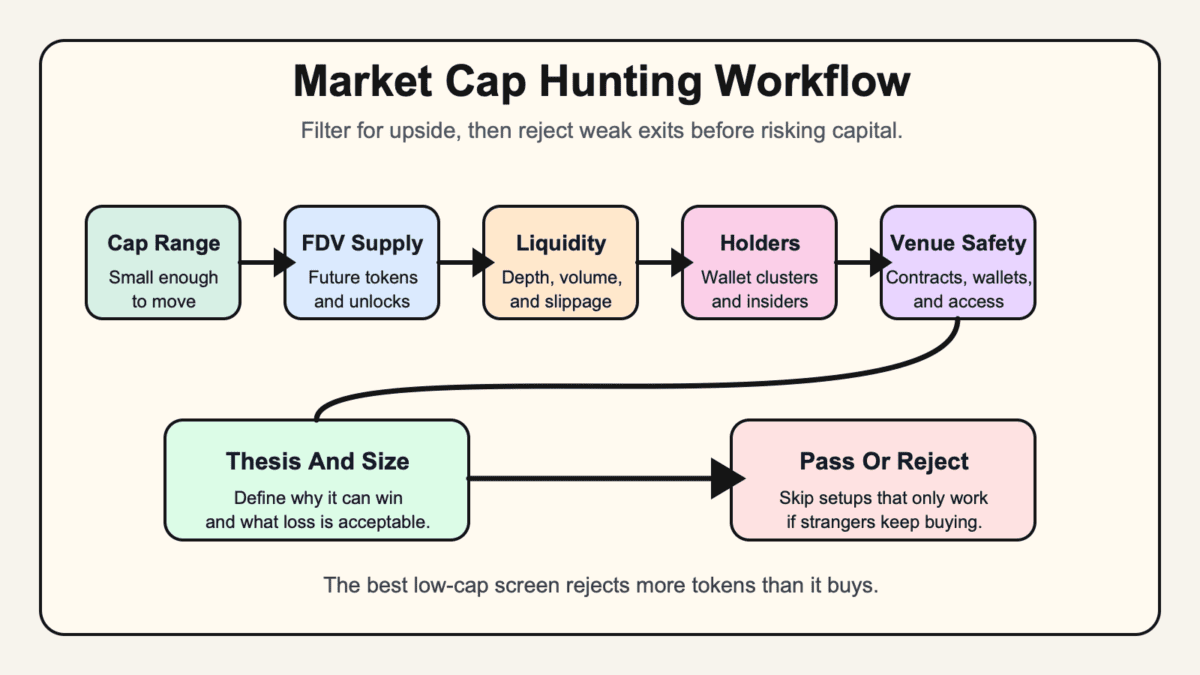
Low cap crypto gems usually start with a story: AI, DeFi, RWA, gaming, DePIN, Base tokens, Solana memes, or whatever the timeline is shouting about that week. A narrative coin can draw attention fast when traders believe the sector is next in line for rotation. A cleaner workflow looks like this:
Market cap helps traders estimate how much attention the asset may need to reprice. A small-cap token can double with less new money than a large-cap token, if liquidity and sell pressure allow it. Still, market cap is the filter, not the thesis.
Exchange access can add another layer. Early DEX-only tokens may offer more upside if they later reach better venues, but listing rumors are also classic shill fuel. Leave those rumors outside the thesis until an official venue confirms them.
Market cap hunting does not mean buying coins with the lowest unit price. A token under one cent can still be expensive if it has a huge supply. This is the beginner trap called unit bias.
A coin priced at $0.0005 can feel cheap because the number is tiny. But if trillions of tokens exist, the market cap may already be large. A higher-priced token can have a smaller cap if the circulating supply is low. Use the numbers for different jobs:
| What The Number Shows | What It Can Hide |
|---|---|
| Price shows the cost of one token. | It can hide a huge supply and an already-large valuation. |
| Circulating market cap shows the counted public float. | It can hide locked supply, insider allocations, and future emissions. |
| FDV shows a full-supply valuation. | It can overstate pressure if some supply never becomes sellable soon. |
| Volume shows recent trading activity. | It can be temporary, wash-like, or concentrated on one venue. |
| Liquidity shows how much can trade near the current price. | It can disappear when incentives end or holders rush out. |
The important comparison is not “cheap coin versus expensive coin.” It is “current valuation versus future supply, real demand, and exit depth.”
That is why market cap hunting needs more than a low-price filter. Cheap-looking coins are easy to market. Tradable coins are harder to fake.
The market cap hunting checklist starts with one blunt question: can the trade exit without breaking itself? If the answer is unclear, upside math is decoration.
A useful screen moves from valuation to tradability, then to supply risk, holder risk, venue risk, and position size. This order stops a tiny cap from looking attractive before you know whether the market can absorb a normal sale.
Market cap versus fully diluted value tells you whether the visible cap is only a small slice of the full token supply. This is one of the fastest ways to spot a low-float trap.
Circulating market cap counts the supply treated as circulating now. FDV estimates the valuation if total or maximum supply is priced at the current token price. Check these details before trusting a low cap:
A token can show a $15 million market cap and a $300 million FDV. That does not automatically make it bad, but it means today’s price already implies a much larger full-supply valuation.
If future supply belongs to insiders, early investors, or aggressive emissions, the low cap may be a temporary window. The question becomes whether demand grows before those tokens become sellable.
Volume, liquidity, and slippage decide whether market cap hunting profits are real or just screenshot wealth. High 24-hour volume can look comforting, but it does not always mean deep exit liquidity.
Read the terms separately:
Here is the painful version. A token may display a $25 million market cap and $2 million of daily volume, but its main pool may only handle a $5,000 sale before price impact gets ugly.
That is where exit liquidity becomes more than a meme. If your profit depends on later buyers absorbing your sell order, market cap alone does not protect you. Check liquidity on the venue you will actually use.
Holders, unlocks, and supply overhang show who can sell into the same upside you want. Small caps are often fragile because a few wallets control too much supply.
Start with top-holder concentration. If a handful of wallets can move the market, your chart is partly a social contract with strangers. That is not exactly a bank vault.
Then check the supply schedule:
None of these signals is automatically fatal. Serious projects can have unlocks and treasury budgets. The risk is mismatch: weak liquidity, high FDV, concentrated holders, and a loud claim that “supply is fine.”
When those signals stack, the market cap is often telling you less than the wallet map.
Exchange access, contracts, and wallet safety decide whether the hunt adds operational risk before the trade even starts. Many low caps begin on DEXs, where you may need a wallet, exact contract address, and token approvals.
That means the asset risk sits beside signing risk. Fake contracts, malicious approvals, bad bridges, and rushed wallets can cost more than the token ever could. Before touching a DEX-only low cap, run the safety checks first:
CEX access can reduce some wallet friction, but it may arrive after much of the early move. DEX access can be early, but early sometimes means you are volunteering for every operational problem at once.
Market cap hunting changes when the target is a low-cap altcoin versus a memecoin. Both can trade by cap levels, but the evidence quality is different.
That difference changes the research job. A small-cap altcoin may have a roadmap, token role, active users, revenue claims, audits, governance, and unlock data to test. A memecoin may have none of that, so the work shifts toward launch history, liquidity, wallet behavior, and whether attention is still growing or already exhausted.
With low-cap altcoins, you can often inspect product, users, token role, team history, revenue, integrations, audits, governance, and unlock schedules. The thesis can still fail, but at least there is something to test.
The split looks like this:
| Low-Cap Altcoins | Memecoins |
|---|---|
| Product, users, and token role can support the thesis. | Attention, liquidity, and holder behavior often drive the trade. |
| FDV, unlocks, and revenue quality matter more. | Launch fairness, whale wallets, and pool depth matter more. |
| Slower research can still be useful. | Speed and execution can dominate. |
| Weak products can still pump briefly. | Strong memes can still collapse brutally. |
With memecoins, the market cap often becomes a social scoreboard. Traders watch round levels, holder count, liquidity, whale wallets, launch mechanics, and whether attention keeps refreshing. A jump from one cap level to the next can pull in new buyers, but it can also give earlier wallets a clean place to sell.
Market cap hunting can work in both categories, but the job changes. Altcoin hunting asks whether the project can earn a larger valuation. Memecoin hunting asks whether attention, pool depth, and holder behavior can survive the next wave of selling.
The late-entry problem is the same. If you buy because the crowd already looks rich, you may be funding someone else’s exit and inheriting bagholder risk.
Market cap hunting works best when risk appetite is broad, liquidity is improving, and traders are willing to move beyond the largest assets. Small caps need attention and fresh bids, not just good slides.
Risk-on markets can help. When Bitcoin and large caps have already moved, traders often look down the size curve for more upside. That can send money toward mid caps, small caps, micro caps, and then the more chaotic corners.
But a friendly cycle does not make a weak token good. It only makes mistakes easier to hide for a while. Watch these cycle signals before leaning hard into market cap hunting:
Low caps punish traders when liquidity dries up. In those periods, spreads widen, order books thin, DEX pools shrink, and small holders learn that a market cap on a screen is not the same as demand. Late-cycle behavior can also create a top signal when everyone suddenly believes every micro cap deserves a major-exchange valuation.
Patience becomes part of the trade here. If the wider market is rotating away from risk, a good-looking low cap may still struggle because no new buyers are arriving. If the market is euphoric, the same screen may produce too many candidates, which makes discipline more important, not less.
Timing does not replace due diligence. It only changes how forgiving the market may be when your checks are incomplete.
How you size a market cap hunting portfolio matters more than any single low-cap idea. The position should be built for total-loss risk before the chart gives you a reason to get emotional.
Core holdings and speculative hunting should not share the same job. Bitcoin, Ethereum, stablecoins, or other long-term positions may anchor a plan. Low caps belong in a smaller sleeve where failure does not damage the whole portfolio.
Decide the rules before entry:
This is where a real conviction play differs from borrowed hype. Conviction means you know the thesis, risk, invalidation point, and position size. It does not mean holding harder because a stranger posts diamond emojis.
Recordkeeping also belongs in the sizing plan. Frequent DEX swaps, bridges, and small exits can create messy cost-basis trails. If the position is too small to track carefully, it may also be too small to justify the operational mess.
Small-cap exposure can be rational when it is limited, researched, and tracked. It becomes dangerous when every new ticker gets promoted to “early opportunity” without a sell plan. Write the sell plan while you are calm.
Market cap hunting red flags are signals that the upside case depends on trust, urgency, or fake depth. If several appear together, walking away is usually the cleanest trade.
The biggest red flag is a tiny cap paired with extreme confidence from people who cannot show their work. Low cap plus high certainty is often a sales pitch, not analysis. End the hunt when you see these patterns:
Read the pattern, not one isolated item. One messy signal may deserve more checking. Several messy signals pointing in the same direction usually mean the trade needs your liquidity more than it needs your insight.
Low cap, low liquidity, and high confidence from strangers is a very expensive education package. The brochure is usually free. The tuition is not.
Some red flags need context. Anonymous builders can be legitimate. New tokens can start with one pool. Early communities can look messy. But market cap hunting is not charity work. If the project cannot explain supply, liquidity, controls, and venue access clearly, the burden stays on the setup, not on your optimism.
A market cap hunting example works best with a fictional token because real tickers turn the lesson into a recommendation. Call this one TOKEN A. It has a small circulating market cap, a loud AI story, and fast social growth.
Run the setup through the screen:
| Check | What The Fictional Token Shows |
|---|---|
| Market cap | Small enough to move if real demand arrives. |
| FDV | Much larger than circulating cap, with several future unlocks. |
| Volume | Busy for two days, but mostly on one venue. |
| Liquidity | A moderate buy is easy, but a larger sell creates heavy slippage. |
| Holders | Top wallets control a large share of supply. |
| Contract | Verified, but owner controls need more review. |
| Venue | DEX-only, so wallet and approval risk are part of the trade. |
| Thesis | AI narrative is hot, but product proof is thin. |
| Position size | Only a tiny speculative position would fit the risk. |
The pass or reject decision should not depend on whether TOKEN A can pump. Almost anything can pump for a while when attention is loud enough. The better question is whether the setup survives normal pressure.
That does not mean TOKEN A cannot rise. It means the clean decision is reject, watch, or size so small that a full loss is boring. This is the point of market cap hunting: find the rare small cap where upside, liquidity, supply, holders, access, and position size all fit.
Market cap hunting in crypto is the practice of using market capitalization to screen for smaller crypto assets that may have higher upside. It is informal trader language, not a formal investment method.
The useful version does not stop at cap size. It checks FDV, liquidity, volume quality, holders, unlocks, venue access, wallet safety, and whether the thesis still makes sense without hype.
Market cap hunting is closely related to finding low cap crypto gems, but it should be more disciplined. Gem hunting often starts with excitement about a small coin. Market cap hunting should start with filtering and rejection.
The cap can point you toward smaller opportunities. It cannot prove the coin is undervalued, liquid, safe, or early.
There is no universal low-cap cutoff in crypto. Many traders use rough bands, then adjust them based on the wider market, sector, venue quality, and liquidity.
A token can be called low cap at one point in the cycle and look expensive later if demand fades. The better question is whether the cap is small relative to real traction, FDV, liquidity, and sell pressure.
Liquidity matters more than market cap in market cap hunting because liquidity decides whether you can enter and exit near the displayed price. Market cap shows valuation. Liquidity shows trading depth.
A token can have a large displayed cap and still have a shallow pool or thin order book. If your sell order moves the price hard, the market cap did not protect your profit.
Market cap hunting can work with memecoins, but the signals are different. Memecoins often trade on attention, liquidity, holder behavior, launch mechanics, and social speed more than product fundamentals.
That makes exits even more important. Round market-cap levels can attract buyers, but they can also become sell zones for earlier wallets.
The biggest mistake in market cap hunting is confusing a small market cap with a good opportunity. Small only means small. It does not mean undervalued, liquid, safe, or early.
The fix is to reject weak setups fast. Check FDV, liquidity, holders, unlocks, contract safety, venue quality, and position size before letting upside math do the talking.
Start market cap hunting by choosing the cap range you want to study, then write down why that range fits your risk. If the answer is “because it can 100x,” keep working.
The first useful step is to narrow the universe before the chart gets loud. Decide whether you are looking at small-cap projects, micro caps, or memecoins, then match the research to that category. A product altcoin and a two-day meme launch should not pass through the same mental filter.
Then test the exit before the entry. Check the venue you would actually use. Estimate the trade size that fits the available liquidity. Decide what would make you walk away. If those answers feel vague, the setup is not ready yet.
Use a short workflow:
After that, write the rejection rule. Maybe you skip any token with unclear supply. Maybe you skip one-pair liquidity. Maybe you skip every setup where the only catalyst is a listing rumor. The exact rule matters less than having one before the timeline starts chanting.
Then give yourself one final rule: skip any token where the thesis depends on a stranger sounding certain.
There will always be another low cap. There will not always be another clean exit.