Physical Address
304 North Cardinal St.
Dorchester Center, MA 02124
Physical Address
304 North Cardinal St.
Dorchester Center, MA 02124


Mainnet farming without the airdrop fog.
Mainnet farming means using real assets and live blockchain transactions to pursue crypto yield, points, launch incentives, or possible airdrops.
That sounds cleaner than it feels. A mainnet farm can include gas fees, bridge routes, wallet approvals, smart contracts, lockups, and reward rules that change after users have paid to play.
Before chasing the upside, ask the uglier question: what am I spending, signing, and exposing before anything becomes claimable?
Mainnet farming in crypto is live-chain reward seeking. A user makes real transactions on a production blockchain to chase yield, points, incentives, or possible airdrop eligibility.
The phrase is informal. It is not a protocol standard, a product category, or a promise that a token will arrive. People use it because the action happens on mainnet, where wallets hold real assets and transactions settle on live networks.
That separates it from a testnet quest. On a testnet, the assets are usually trial tokens with no normal market value. On mainnet, a swap, bridge, deposit, liquidity position, or claim can cost money and expose a wallet to smart contract risk.
Mainnet farming shows up in a few common forms:
The trap is mixing those forms into one clean story. Yield can be real but risky. Points can be visible but worthless. Airdrop eligibility can be possible but unpublished. Launch incentives can exist and still leave smaller users diluted after whales and sybil filters arrive.
The chain label can confuse things too. “Mainnet” can mean Ethereum mainnet, an L2 that is live for users, or a project-specific mainnet after testing ends. The common thread is not the brand of chain. It is that transactions now affect real balances.
That makes mainnet farming a cost and permission problem before it becomes a reward problem. Users need to know which chain holds the assets, which app receives approvals, and which action could count.
So the first rule is simple: mainnet farming starts with real cost, not guaranteed reward. If the campaign cannot explain the activity, cost, permissions, and exit path in plain language, the shiny points dashboard is doing too much of the sales work.
Mainnet farming differs from testnet farming because mainnet uses real funds. It also differs from ordinary yield farming because the target reward may be a future signal, not a current yield.
That difference is not academic. A user testing a new app on testnet may waste time. A user farming on Ethereum mainnet, Base, Arbitrum, Optimism, or a project mainnet may also pay gas, bridge funds, approve contracts, accept slippage, and manage a live position.
The broad idea overlaps with crypto farming, but the mainnet version adds production-chain exposure. You are not just “doing tasks.” You are using a wallet with assets in an environment where transactions can settle, fail, or be exploited.
Use this split before you compare opportunities:
| Term | What Changes For The User |
|---|---|
| Mainnet Farming | Uses real assets, real fees, live contracts, and uncertain rewards. |
| Testnet Farming | Uses trial assets and may help test an app before launch. |
| Yield Farming | Seeks fees, interest, or token incentives from DeFi deposits. |
| Points Farming | Builds a score that may or may not convert into value. |
| Airdrop Farming | Uses activity to improve possible future eligibility. |
| L2 Farming | Uses an L2 where fees may be lower, but bridge and app risk remain. |
The same wallet action can fit more than one bucket. Providing liquidity on an L2 may be yield farming if the pool pays fees. It may be points farming if the app tracks usage. It may be airdrop farming if users believe activity could matter later.
But each reward source needs its own check. Current yield asks whether the return covers risk. Points ask whether the rules are clear. Airdrop farming asks whether the cost still works if no allocation arrives.
Mainnet farming works by turning live-chain usage into a possible reward path. The user connects a wallet, performs relevant actions, pays real costs, then waits for yield, points, eligibility, or a claim.
That flow should stay boring. The more a campaign sounds like secret knowledge, the more important it is to slow down. Good farming starts with verifying the official app, not copying a thread from someone who may earn from your referral.
A basic flow looks like this:
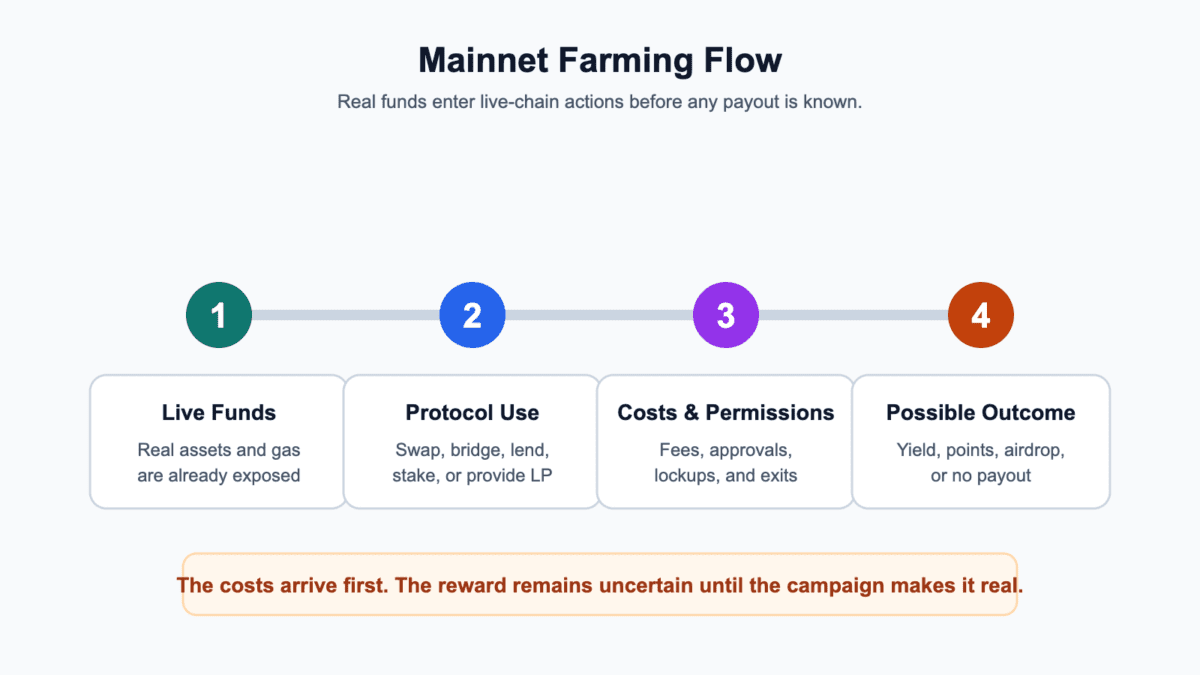
Some community playbooks talk about “authentic use.” That usually means sustained, relevant activity looks more credible than random wallet noise. It can be a useful pattern, but it is not a rule every campaign must follow.
For example, a lending app may value deposits, borrows, repayments, and repeat use. A bridge campaign may care about routes and volume. A new L2 may track app diversity. Another project may ignore all of that and use a private filter.
Blind transaction spam is weak farming. It creates cost, noise, and approval risk without proving that the activity will count. If you cannot explain why an action is relevant to the protocol, it may be busywork with gas fees.
Mainnet farming can cost more than it looks because the visible task is only one line item. Gas, bridges, slippage, failed transactions, lockups, and time can quietly eat the expected reward.
Small wallets feel this first. A few dollars in fees can be acceptable on a large position, but brutal on a tiny one. A bridge fee, a failed transaction, and a bad swap price can turn a “free airdrop hunt” into paid volunteer work with extra wallet risk.
The cost stack usually includes more than the app shows:
Here is the small-stack problem in plain language. If a user spends $25 in gas and bridge costs to farm a possible future reward, the campaign must pay more than that after claim and exit costs. If the user also spends hours managing the route, the invisible cost is higher.
The same logic applies to yield. A pool can show a healthy APY while the reward token falls, deposits crowd in, or fees drop. A points farm can show a rising score while the project never publishes a conversion formula.
Mainnet farming is easier to evaluate when the cost comes before the dream number. If the farm only works under generous reward assumptions, it is not a strategy. It is a spreadsheet wearing party shoes.
Mainnet farming may make sense when the activity is useful even without a bonus. The cleanest farms are usually protocols you would use anyway, with costs low enough to survive a zero-reward outcome.
That does not mean every good opportunity has guaranteed rules. Some campaigns stay partly private to reduce sybil abuse. But users still need enough public information to understand what they are signing, where funds go, and how to exit.
Stronger setups usually share these traits:
This is where L2s can help, but they do not remove risk. Lower fees can make experimentation cheaper, yet bridge routes, app contracts, oracle design, and token rules still shape the downside.
Mainnet farming also suits users who can separate product use from reward hope. If you already need to swap, lend, bridge, or test a protocol, a points campaign can be a bonus signal. If the only reason to act is a vague hint of future tokens, the bar should be much higher.
The best version is selective. Pick fewer farms, understand the rules, cap the downside, and keep records. A routine built around twenty tabs, ten wallets, and one lucky screenshot usually breaks before the reward shows up.
Avoid mainnet farming when the campaign asks for trust before it gives clarity. Fake urgency, vague rewards, cloned websites, and broad wallet permissions are not quirks. They are warning signs.
Referral-heavy posts deserve extra skepticism. A guide can be useful and still be incentivized. But when the whole pitch is “connect now before the snapshot” with no official source, the user may be the crop.
Red flags usually look like this:
Team transparency changes the risk math. A doxxed team is not an automatic pass, and an anonymous team is not an automatic scam. But thin docs plus unknown operators plus aggressive wallet prompts should raise the cost of trust.
The most dangerous farms make risk feel like admin work. Approve this token. Sign this claim. Bridge here. Verify there. Do it before the window closes. Each step can feel normal because real campaigns also use steps.
So break the spell. Check the URL from official channels, search for contract warnings, limit approvals, and make a small test transaction before adding size. If the process punishes basic verification, it is not early. It is expensive.
Mainnet farming and airdrops connect because live-chain activity can sometimes become an eligibility signal. A project may reward users who supplied liquidity, bridged, swapped, voted, tested apps, or stayed active before a token launch.
The key word is sometimes. Activity can help in some campaigns, but points are not a claim unless the project makes them redeemable, transferable, or part of an official allocation. A dashboard score is not money just because it puts a neat number beside your wallet.
A Coinbase points farming explainer frames points farming as doing protocol actions that may lead to future rewards. That framing is useful because it keeps “may” in the sentence, where it belongs.
Airdrop outcomes can change through several filters:
That is why mainnet farming can feel like a lottery ticket when users chase a large upside with uncertain odds. The analogy works only if you remember that this ticket can also ask for gas, approvals, and opportunity cost.
A mainnet launch does not guarantee an airdrop. A token hint does not guarantee fair allocation. A points season does not guarantee points become tokens. And a token claim does not guarantee the reward is worth more than the grind.
Still, airdrop farming is not automatically foolish. It becomes more reasonable when the user already values the product, costs are low, activity is natural, and the downside is capped. Anything beyond that needs a clear reason, not just a screenshot of someone else’s points.
The mainnet farming safety checklist starts before the wallet connects. Once real funds and live contracts are involved, prevention is cheaper than cleanup.
Use a separate wallet when possible. Keep long-term holdings away from experimental farms, especially when a campaign uses new contracts, bridges, or claim pages. A burner wallet is not magic, but it limits the damage.
Run these checks before signing:
Anonymous teams need tighter checks, not instant dismissal. An anon dev can still build useful software, but users should demand stronger evidence from contracts, audits, liquidity, permissions, and withdrawal paths.
Record keeping is part of safety. If a farm pays tokens later, you may need wallet addresses, claim dates, values, transfers, and sale records. Tax treatment depends on your jurisdiction, so keep clean data and get local professional help when needed.
Finally, revoke stale approvals after you exit. Many farming losses start long after the first deposit, when an old permission remains open and a user forgets it exists. The best farm is not the one with the prettiest dashboard. It is the one you can leave without surprises.
Mainnet farming is worth it only when the expected learning, product use, or reward chance justifies the real cost. For many users, the honest answer is “maybe, but smaller than you think.”
The yes case is narrow. It fits users who already use the protocol, understand the chain, can cap position size, and would accept no reward. They are not betting the rent on a hidden snapshot. They are adding a possible bonus to activity they can explain.
The maybe case is a low-fee experiment. A user might test a small L2 campaign, keep approvals limited, record costs, and stop if the rules get vague. That can be useful learning, as long as the budget is treated as spent from day one.
The no case is clearer:
Mainnet farming often looks attractive because the upside is easy to imagine and the costs arrive in small pieces. Gas here, bridge there, one more task, one more wallet. The result can be a lot of work for a reward that never gets named.
So use a hard cap. Decide the maximum capital, fees, and time you are willing to lose before you start. If the farm still looks sensible under that cap, it may be worth a measured try. If it only works with a heroic airdrop, the farm is farming you.
Related mainnet farming terms help separate the language before it turns into wallet action. Many mistakes start when users hear “farm” and assume every reward path works the same way.
Start with the two broadest terms:
The next layer is reward type. Yield farming usually means depositing assets into DeFi for fees, interest, or incentives. Points farming means building a score that may or may not become valuable. Airdrop farming means trying to improve eligibility for a future token distribution.
Then come the safety terms. Testnet farming uses trial assets before a network or app goes live. Sybil filtering tries to remove repetitive or fake-looking wallet behavior. Wallet approvals give contracts permission to move tokens, sometimes more than users expect.
Two nearby phrases need extra care. Pre-mainnet farming usually means activity before a network or product is fully live, so the risk may sit in deposits, waitlists, or off-chain points rather than normal live-chain activity. L2 farming usually means using a live scaling network where fees can be lower, but bridges and app contracts still create real exposure.
Mainnet itself is not a quality stamp. It only tells you the environment is live enough for transactions to matter. A weak app on a live chain can still be weak.
The clean habit is to name the reward source before you act. Fees, emissions, points, and possible airdrops are different incentives. They also fail in different ways.
If a campaign cannot answer which bucket it belongs in, keep the wallet closed until it can.
Mainnet farming in crypto means using real assets and live-chain transactions to pursue yield, points, launch incentives, or possible airdrops. It is informal market language, not a guaranteed reward model.
Mainnet farming is not always the same as yield farming. Yield farming seeks current DeFi returns, while mainnet farming can also include points, airdrop eligibility, and launch campaigns on a live chain.
Mainnet farming is usually riskier than testnet farming because real assets, fees, approvals, and contracts are involved. Testnet tasks can waste time, but mainnet mistakes can cost funds.
Mainnet farming can qualify a wallet for an airdrop only if the project uses that activity in its allocation rules. Activity can be a signal, but it is never a guarantee.
The amount needed for mainnet farming depends on chain fees, bridge costs, position size, slippage, and campaign rules. Start small enough that a zero-reward outcome would not hurt.
The biggest mainnet farming risks are smart contract failure, bridge risk, fake claim pages, broad wallet approvals, gas and slippage costs, lockups, sybil filtering, and rewards that never arrive.