Physical Address
304 North Cardinal St.
Dorchester Center, MA 02124
Physical Address
304 North Cardinal St.
Dorchester Center, MA 02124


A plain-English guide to modular blockchain layers, risks, and rollups.
A modular blockchain is a blockchain design that splits core jobs like execution, settlement, consensus, and data availability across specialized layers.
That split can make crypto networks more flexible, but it also moves risk around. A modular stack may lower fees, support rollups, or help apps launch faster. It can also push users toward bridges, sequencers, withdrawal routes, and token stories that may not age well.
A modular blockchain is a layered crypto design. Instead of one chain handling transaction execution, settlement, consensus, and data availability together, the stack splits those jobs across purpose-built layers.
A monolithic blockchain bundles those jobs into one main system. Bitcoin and many older Layer 1 designs are easier to picture this way. One network orders transactions, checks them, stores the needed data, and finalizes the result. A modular blockchain changes that layout:
You will usually see the phrase near Ethereum rollups, data availability networks, appchains, and infrastructure tokens. In those settings, “modular” means the chain stack is split by function. It does not mean a project has random plug-ins.
The term often appears in a few places:
That is architecture, not magic. A modular blockchain can be fast and useful. It can also be confusing, fragile, or overhyped when the pieces depend on weak bridges, thin liquidity, or unclear token economics.
The clean read is simple. Modular design changes where blockchain work happens and where risk sits. It does not automatically make a network safer, cheaper, or more valuable.
A modular blockchain splits the chain into jobs that different layers can handle. The four jobs are execution, settlement, consensus, and data availability.
Specialization is the point. A rollup might run transactions quickly, while another layer publishes transaction data or helps secure final outcomes. That split lets each part optimize for a narrower task.
This model also makes hidden assumptions easier to spot. If one layer runs the trade, another stores the data, and another settles the result, the user needs to know which layer carries each trust assumption.
| Core Job | What It Does In Plain English |
|---|---|
| Execution | Runs transactions and smart contracts. |
| Settlement | Confirms final outcomes or handles disputes. |
| Consensus | Gets validators or nodes to agree on the order and validity of data. |
| Data availability | Publishes the data others need to verify what happened. |
Picture a swap inside a rollup app. Your wallet signs the action. The rollup executes the transaction. The transaction data is published where others can inspect it. The result later settles or becomes final through the chosen security path.
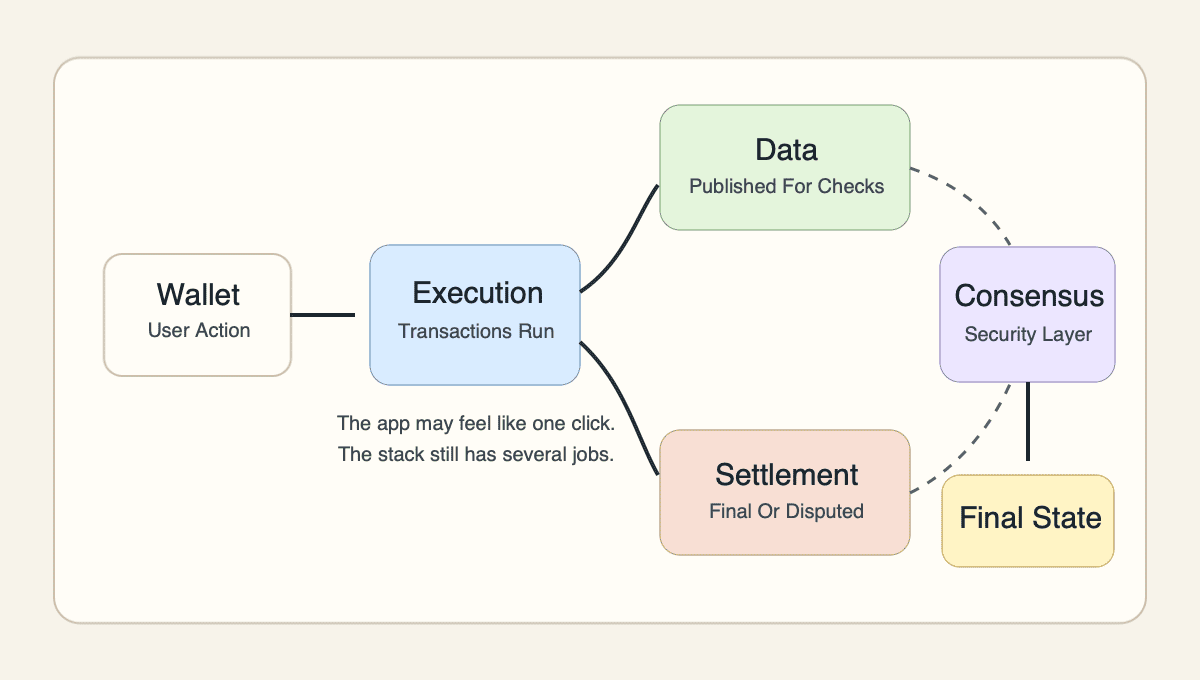
The diagram is tidy because diagrams are polite. Real routes can include bridges, sequencers, relayers, proof systems, RPC providers, wallet support, and withdrawal delays.
The four-job model keeps the app screen honest. It lets you ask which layer is doing which job before you assume one clean interface equals one simple chain.
Modular blockchain vs monolithic blockchain is not a beauty contest. It is a trade-off between simplicity, specialization, coordination, and hidden dependencies.
A monolithic chain can feel simpler because the main jobs live in one place. A modular stack can scale and adapt by letting different layers specialize, but the user may touch more routes and assumptions.
| Question | How The Designs Differ |
|---|---|
| Where do transactions run? | Monolithic chains usually run them on the main chain. Modular stacks may run them on rollups or app-specific layers. |
| Where does finality happen? | Monolithic chains settle inside one system. Modular stacks may settle through another layer. |
| What is simpler for users? | Monolithic chains can be easier to reason about. Modular stacks can hide more moving parts. |
| What can scale more flexibly? | Modular stacks can add specialized execution or data layers. Monolithic chains must change the main network more directly. |
| What can go wrong? | Monolithic chains concentrate risk in one system. Modular stacks can add bridge, sequencer, data, and route risk. |
For users, the difference shows up through fees, speed, withdrawals, wallet support, and whether liquidity sits on the route they need. A modular blockchain can make a swap cheaper while making the exit path harder to read.
For builders, modular design can be attractive because they can choose components. They may use a rollup stack, a separate data availability layer, or an appchain design that fits their app.
That flexibility is useful, but every chosen component becomes part of the trust map. Before you deposit funds, bridge assets, or buy the token, ask what the design makes you rely on.
Rollups show modular blockchain design in action. A rollup usually handles execution away from the base chain, then relies on another layer for security, settlement, or data publication.
Ethereum says today’s rollups are roughly 5-20x cheaper than Ethereum Layer 1, and describes rollups as batching transactions offchain before sending output back to Ethereum. That is the modular idea in motion. Data availability keeps the transaction data accessible enough for others to verify the state.
Here is the plain version:
If the needed data is unavailable, outside observers may not be able to verify the chain state properly. That does not make every data availability layer unsafe. It means the chosen data layer becomes part of the safety path.
This is why Celestia, EigenDA, Avail, Ethereum blobs, and similar terms appear near modular blockchain discussions. They are not all the same thing, but they all sit near the question of where rollups publish or rely on data.
> If a modular blockchain route depends on outside data publication, ask what happens when that data is delayed, withheld, or hard to retrieve.
Cheaper execution earns trust only when the route can still be verified, settled, and exited under stress.
Modular blockchain design can improve scale by giving each layer a narrower job. Instead of making one chain optimize everything at once, a stack can push high-throughput execution, data publication, or app-specific logic into the layer built for that job.
That can show up as lower fees, faster app launches, more flexible rollup stacks, and apps that tune the chain around their own needs. A derivatives app may care about speed and liquidation handling. A game may care about cheap transactions. A DeFi app may care about execution quality and liquidity routing.
The useful improvements are usually concrete:
Builders like modular blockchain design because it can reduce the pressure to fit every app into the same blockspace. Users feel the benefit only when the route they use is faster, cheaper, or less congested.
But the improvement is not automatic. A modular app with thin liquidity, bad wallet support, or a fragile bridge can still feel worse than a slower but simpler chain. The upside is real when specialization removes a bottleneck without making the rest of the path harder to trust.
Modular blockchain design can make risk harder to see because the app may look simple while several layers sit underneath it. A clean front end can still depend on a bridge, sequencer, proof system, data layer, wallet route, and settlement path.
That is the trap. A modular stack can have excellent parts, while the full route still depends on several assumptions working together.
Common failure paths include:
Bridge and wallet details deserve special attention. If your funds move across several networks, check approvals, supported routes, and custody hygiene before trusting the interface. Start with wallet support basics when you need to check network selection, approvals, and where assets actually sit.
> A modular blockchain is not safer just because the diagram has more specialist boxes. More boxes can also mean more places to trip.
Liquidity fragmentation is another quiet risk. More rollups, appchains, and token versions can split depth across routes. A token may trade somewhere, but not where your funds are or where your exit needs to happen.
So risk checking must follow the route, not the brand name. Ask what executes the transaction, where data is published, how the result settles, and how you leave if one layer slows down.
A modular blockchain token can lag even when the architecture sounds strong. Good infrastructure can exist beside weak token value, heavy supply pressure, poor liquidity, or a market story that already ran too hot.
Modular blockchain narratives can attract traders before the token mechanics are clear. The technology may be real, while the token mostly carries governance rights, emissions, or narrative heat.
Check what the token actually does:
If the answer is mostly market attention, you may be looking at a narrative coin rather than a clean infrastructure claim. That can still trade well for a while, but it is a different bet.
The darker version is exit timing. Late buyers can become exit liquidity when early holders, insiders, or supply schedules meet a crowded narrative.
> Good architecture is not the same as a good token.
That does not mean every modular blockchain token is bad. It means the token thesis needs its own work. A serious case should survive questions about supply, demand, fee capture, liquidity, and what the token controls.
The phrase “modular blockchain” can also become a market theme when traders chase the latest infrastructure story. Architecture is the starting point. Token design decides whether that theme has durable value.
Examples of modular blockchain stacks make more sense by role than by token ticker. The same project can touch more than one category, but grouping the stack keeps the article from turning into a shill list with nicer shoes.
Ethereum rollups, dedicated data availability networks, rollup frameworks, and appchains all show different parts of the modular idea. The point is to see what job each example helps with.
| Role In The Stack | Example To Understand |
|---|---|
| Settlement and security base | Ethereum can serve as a base layer for many rollups. |
| Execution-heavy rollup | Arbitrum, Optimism, and Base process user activity away from Ethereum Layer 1. |
| Data availability layer | Celestia, EigenDA, and Avail focus on publishing or serving data for other systems. |
| Rollup-building stack | OP Stack, Arbitrum Orbit, and Polygon CDK help teams launch new chains or rollups. |
| Appchain model | Cosmos SDK-style appchains can give one app more control over its chain environment. |
| Sovereign rollup | A rollup can handle settlement differently instead of relying on the usual base-layer dispute path. |
None of these examples should be read as price calls. They are architecture examples. Some may have tokens, some may not, and some tokens may capture less value than the infrastructure story suggests.
Celestia is often used as the clean data availability example. Ethereum is often used as the rollup-centric settlement and security example. OP Stack and Arbitrum Orbit show how chain-building kits can turn modular design into something teams can actually deploy.
The practical lesson is not to memorize the names. Learn the role. Once you know the role, you can ask the right risk question instead of treating every infrastructure logo as the same bet.
Evaluate a modular blockchain by mapping the route before funds move. The interface may show one deposit button, but the transaction can involve several layers that handle different jobs.
Start with the flow. Then check what happens if one part slows, pauses, upgrades, or fails. Use this checklist before bridging, trading, or depositing size:
Small tests are not paranoia. They are the entry fee for using a layered stack without donating tuition to the market.
For app users, withdrawal paths matter as much as entry paths. A low-fee deposit is not a win if the exit depends on a slow challenge period, thin wrapped asset, unsupported wallet route, or bridge that cannot move your size.
> If you cannot explain the exit route, the entry route is not clear enough.
For token buyers, the same map helps separate usage from value. If the app is useful but the token does not capture fees, secure the layer, or have clear demand, the investment case may be weaker than the architecture story.
One more check helps during hype cycles. Ask whether normal users can use the stack without reading three support threads, changing RPC settings, or guessing which wrapped asset is the real one.
For larger positions, write the route down before signing. Note the source chain, destination chain, bridge, token version, withdrawal path, and the layer that publishes data. If that map still looks fuzzy, reduce size or wait.
Related modular blockchain terms help because the same few words appear in rollup, appchain, and data availability discussions. You do not need to become a protocol engineer, but you do need to know which term changes the risk map.
A rollup is an execution-focused system that batches activity and relies on another layer for security, settlement, or data publication. A validium also uses validity proofs, but keeps data off the main settlement layer, which changes data availability assumptions.
For a narrower custom-chain version of the idea, the appchain guide shows how one app can get its own execution path, gas rules, bridge route, and security model. That is useful when a modular blockchain discussion turns into “why does this app need its own chain?”
For Ethereum rollup data costs, Ethereum blobspace is the next useful stop. Blobspace explains why temporary rollup data can lower L2 costs while still leaving users with bridge, sequencing, and exit-route checks.
Other nearby terms still belong on the map. A sovereign rollup handles settlement differently. A sequencer orders transactions for many rollups. Shared security means one system borrows security from another. Liquidity fragmentation means trading depth splits across routes, chains, pools, or token versions.
Those terms point to different failure points. A sequencer problem is not the same as a data availability problem. A bridge issue is not the same as a thin-liquidity issue.
If a project uses all these terms at once, slow down. The vocabulary may be accurate, but your job is still to find the layer that touches your funds.
Start with modular blockchain basics, then map the route you are about to use. The goal is not to avoid every modular stack. The goal is to stop treating every layer as invisible because the interface looks clean.
Use five practical actions:
That last step is boring in the best way. Boring checks save money when the market starts dancing around your risk limits. If you are only learning the topic, start by drawing the four jobs on paper.
If you are about to use an app, start smaller. Run a test transaction, confirm the token version, check the withdrawal route, and make sure your wallet shows the right network before adding real size.
> Modular design rewards users who check routes before they chase speed.
If the route uses a bridge, look for the refund path and finality delay. If it uses a rollup, check whether withdrawals are native, liquidity-provider based, or routed through another app. Those details decide whether a small problem stays small.
If you are using a modular blockchain app, follow the transaction. If you are buying a modular infrastructure token, follow the value capture. If you cannot explain either one in plain English, the stack is not ready for your serious size yet.
No, a modular blockchain is not automatically safer than a monolithic blockchain. It can improve some parts of the stack, but it can also add bridge, sequencer, data availability, and liquidity risks.
Safety depends on the whole route. A strong execution layer does not remove weak withdrawal paths, thin liquidity, or unclear upgrade controls.
Ethereum is often described as moving toward a modular blockchain model because its roadmap relies heavily on rollups for execution. Ethereum Layer 1 still provides settlement, consensus, and security context for many rollups.
That does not mean Ethereum is only one thing. A clearer description is that Ethereum has become a major base layer for modular scaling.
Celestia is a modular blockchain project focused on data availability. It is often used as an example of a layer built to help other chains or rollups publish data.
That role is different from a general smart contract chain. Celestia is mainly discussed as a specialized data layer inside modular blockchain architecture.
A data availability layer in a modular blockchain publishes the transaction data others need to verify what happened. Without available data, outside parties may struggle to check state or challenge bad updates.
The point is not storage for convenience. The point is verification. Data availability helps make the rest of the stack inspectable.
Yes, modular blockchain tokens can still lose value. A strong architecture thesis does not guarantee fee capture, token demand, liquidity, or protection from supply releases.
Before buying, check what the token does. Then check supply, usage, liquidity, governance power, and whether the market has already priced in the story.
Modular blockchains do not always need rollups, but rollups are a common way to separate execution from other chain jobs. They can run transactions away from the base layer while relying on another layer for security, settlement, or data publication.
That split can improve throughput and fees. It can also add sequencer, bridge, withdrawal, and data availability assumptions.