Physical Address
304 North Cardinal St.
Dorchester Center, MA 02124
Physical Address
304 North Cardinal St.
Dorchester Center, MA 02124


How PSMs support stablecoin pegs, and where the risk hides.
A peg stability module is a crypto facility that swaps a protocol stablecoin and a reserve asset near a fixed price.
It is best known from MakerDAO, Sky, and DAI, but the idea now appears across DeFi under names like PSM, GSM, and protocol-specific stability modules. The first question is whether the stablecoin has one. The better follow-up is what asset backs the route, who can change the rules, and whether the module still works when everyone wants the same exit.
A PSM can make a stablecoin feel boring in normal markets. That is the point. But boring plumbing can become the loudest part of the room when a reserve stablecoin depegs, a cap fills, or governance pauses swaps.
A peg stability module in crypto is usually a smart contract or protocol facility that lets users swap a protocol stablecoin and an approved reserve asset at a set ratio. The ratio is often close to one dollar for one dollar, but the exact path depends on the protocol.
The short version is simple enough. If a stablecoin like DAI, USDS, GHO, DOLA, VAI, or MAI starts trading away from its target, a PSM can give arbitrage traders a cleaner route back toward the peg.
That does not make it a magic dollar machine. A peg stability module is one tool inside a larger stablecoin design. It is not the full reserve, not every peg-defense tool, and not the same thing as an AMM pool.
Use this quick split to keep the term straight:
So when a protocol says it has a PSM, ask what sits on the other side. USDC, USDT, tokenized bills, yield-bearing vault shares, and protocol reserves all create different risk. The acronym may be tidy. The backing is where the mess lives.
That framing keeps the term from getting too broad. A protocol can defend a peg with rates, collateral rules, auctions, market makers, or governance votes. A peg stability module is the direct conversion route inside that larger toolkit.
A peg stability module keeps a stablecoin near $1 by making the arbitrage trade easier. When the stablecoin trades above target, traders can bring more supply into the market. When it trades below target, traders can buy the discounted stablecoin and use the module as an exit, if the reserve side has room.
The loop works only when the PSM route is cheaper, faster, and more reliable than the market gap. If fees eat the spread, the reserve asset looks shaky, or the module is capped, arbitrage becomes theory with a wallet connected.
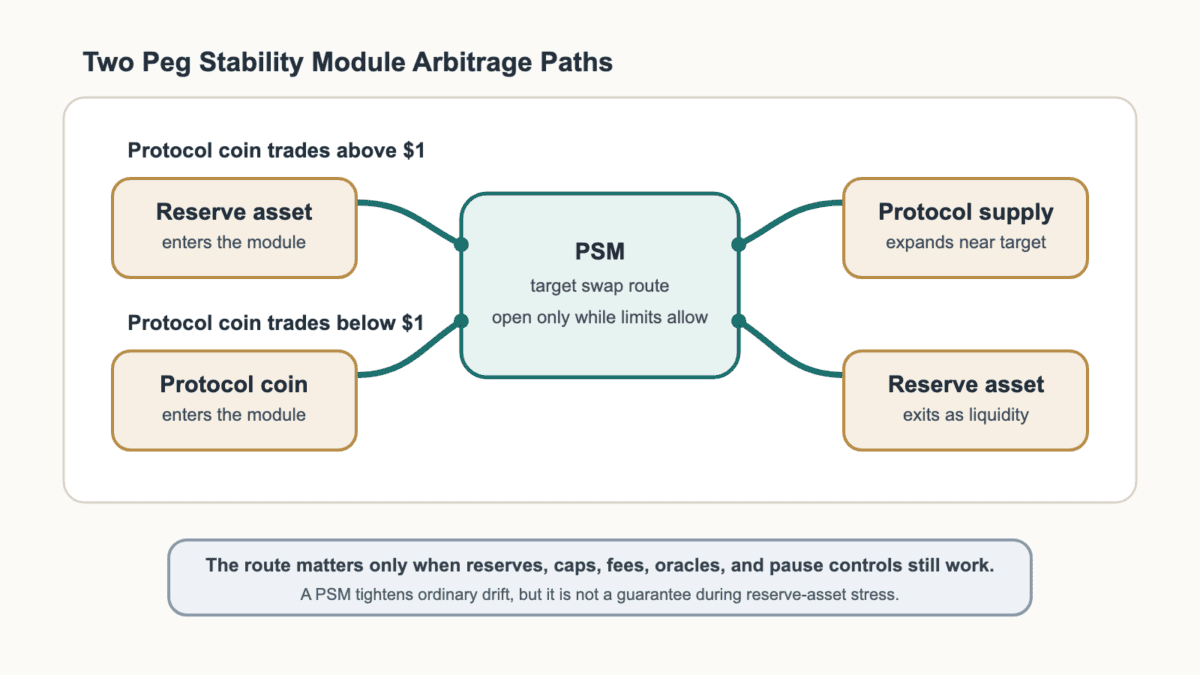
The two main PSM trades look like this:
| Market Situation | How The PSM Pulls The Price |
|---|---|
| Stablecoin above $1 | A trader brings reserve stablecoin into the module, receives protocol stablecoin near $1, then sells it into the higher market price. More supply can push the premium down. |
| Stablecoin below $1 | A trader buys discounted protocol stablecoin, sends it into the module, and receives reserve stablecoin if capacity is available. That demand can lift the discount. |
This is why PSMs show up during stablecoin stress and crypto rotation. Traders may rotate between dollar assets when one stablecoin trades rich, one trades cheap, or one route looks safer.
The cleaner the route, the tighter the peg can feel. But the route still rests on assumptions. The reserve asset must be credible, the contract must function, and enough traders must believe the spread is worth taking.
Protocols use a peg stability module because AMM liquidity can be slow, shallow, or expensive during stress. A PSM gives the market a direct route between the protocol stablecoin and a chosen reserve asset, rather than making every trader push through a DEX pool.
AMMs are useful, but they price trades from pool balance. If sellers flood one side, the pool can tilt fast. A PSM can create a harder arbitrage boundary when it has enough reserve assets and minting or redemption capacity.
That difference shows up in several design choices:
Other peg tools still matter. Protocols may use vault minting, stability fees, savings rates, credit facilities, market-maker agreements, or debt ceilings to influence supply and demand. A PSM does not replace those tools. It gives one very visible pressure valve.
The trade-off is control. AMM liquidity is messy, but it can be broad and market-driven. A PSM is cleaner, but cleaner means someone picked the asset, the caps, the fees, and the emergency rules.
Serious users should read a PSM as infrastructure, not a guarantee. It can tighten normal drift. It can also make one reserve asset far more important than the stablecoin brand suggests.
The peg stability module trade-off is blunt: the stablecoin may hold $1 better in calm markets, but it can inherit risk from the reserve asset. If the module relies heavily on USDC, USDT, or another external stablecoin, that asset becomes part of the real peg story.
This is the objection many users have with DAI, USDS, GHO, and other protocol stablecoins. If a supposedly decentralized stablecoin can be swapped directly against a centralized reserve asset, then banking access, issuer controls, freezes, and reserve quality can all leak into the protocol.
A PSM can add several reserve-side risks:
The Silicon Valley Bank weekend made this risk easier to see. A December 2025 Federal Reserve FEDS Notes paper describes how Circle announced that $3.3 billion of USDC reserves, around 8% of total reserves at the time, was stuck at SVB during the March 2023 crisis. Dai had one-to-one PSM routes against USDC and other stablecoins, and those routes became a channel for stress when USDC depegged.
That does not mean every USDC-backed or USDT-backed module is doomed. It means the module can move risk from one ticker to another. The stronger the PSM route, the more important the reserve asset becomes.
During a crowded exit, exit liquidity is not an abstract meme. It is the question of who can actually leave through the module before reserves, caps, or confidence run thin.
Some newer designs try to soften this trade-off with multiple reserves, yield-bearing reserves, tokenized assets, or stricter caps. Those choices can improve protocol economics. They can also add vault risk, oracle risk, redemption delays, and more governance work. The bill always lands somewhere.
A peg stability module can break, fill up, pause, or become too expensive to use. It can also work exactly as designed and still fail to protect the market price if the reserve asset is distressed.
“Swap near $1” is a rule inside conditions. Those conditions include reserve balances, exposure caps, debt ceilings, buffers, fee-in, fee-out, oracle bounds, chain liquidity, bridge access, and emergency controls. If one condition binds, the arbitrage route can narrow or close.
Check these failure modes before you trust a PSM as a clean exit:
| PSM Failure Mode | What To Check |
|---|---|
| Reserve asset depegs | See whether the module still treats the reserve asset as money-good or blocks swaps through price bounds. |
| Module hits cap | Check exposure caps, debt ceilings, buffers, and whether new swaps are allowed. |
| Fees block arbitrage | Compare fee-in and fee-out with the live market discount or premium. |
| Oracle freezes swaps | Find whether price bounds or stale oracle rules can halt conversion. |
| Governance pauses the module | Look for emergency roles, pause authority, and restart conditions. |
| Reserve liquidity sits on the wrong chain | Check whether liquidity, bridges, and app routes match the chain you use. |
| Smart contract bug appears | Review audits, bug history, upgrade keys, and emergency shutdown paths. |
Capacity is usually the overlooked part. A PSM with a great design and a tiny usable buffer will not absorb a large wave of redemptions. The protocol may need keepers, allocators, or governance actions to refill the route.
Fees create another quiet limit. A small fee can prevent toxic flow or pay for risk. But if the fee is larger than the market spread, arbitrage traders may skip the trade. The peg then has to recover through slower routes.
Pause controls can be good or bad. They can stop bad collateral from entering during a reserve-asset shock. They can also leave holders staring at a closed door while the secondary market reprices the stablecoin. Crypto does enjoy finding the door after it closes.
Here is the check. Do not ask only whether the module exists. Ask what would stop it today, on your chain, at the size you care about.
Peg stability module examples across DeFi show one shared idea with many local rules. Maker and Sky made the PSM language familiar, but other protocols use related modules with different reserve assets, caps, prices, and pause controls.
That variety is useful. It proves a PSM is not one universal contract. It is a design pattern: a controlled route between a protocol stablecoin and selected assets that can help the market arbitrage toward the peg.
Here are the common examples to understand:
| Example | What Makes The PSM Different |
|---|---|
| Maker or Sky PSM and LitePSM | Anchor examples for DAI and USDS routes, with newer lighter routing and parameter controls around reserve flow. |
| Aave GHO Stability Module | Uses the GSM name and adds controls around price strategy, fees, exposure, and conversion freezes. |
| Spark PSM3 | Extends the PSM idea into newer app and chain routing around Sky-linked stablecoin liquidity. |
| Inverse DOLA PSM | Shows how a PSM can support protocol stablecoin liquidity and reserve movement, not only a simple retail swap. |
| Venus VAI PSM | Highlights oracle-price rules and limits around conversion with a paired stablecoin. |
| Mai PSM | Shows that some PSM-style routes can include redemption queues rather than instant exits. |
The examples are not endorsements. They are reminders to read the local rulebook. A PSM can be symmetric or asymmetric, instant or queued, cheap or fee-heavy, open or paused.
Reserve assets can also behave differently. A plain USDC route has one set of risks. A yield-bearing reserve has another. A cross-chain route adds bridge and chain liquidity assumptions. Same acronym, different stress points.
So compare the design before comparing the ticker. A stablecoin with a PSM can still be riskier than a stablecoin without one if the reserve side is weak, capped, opaque, or slow to redeem.
A peg stability module affects most stablecoin users indirectly. You may never touch the contract, but you can still feel it through DEX prices, app routes, lending assumptions, liquidations, and yield positions.
For normal holders, the PSM can make the price look steadier. That is useful when you are parking funds, paying in stablecoins, or moving between protocols. But it also means you should check what asset sits behind the swap route before assuming the ticker is cash.
Different users should read the PSM differently:
Stablecoin yield is where the hidden assumptions often pile up. A vault may quote a neat return while its underlying pool quietly assumes the PSM stays open, liquid, and trusted. That is why farming in crypto needs peg-risk checks, not just APR screenshots.
Traders may use the PSM directly when the spread is large enough. They are not doing charity work. They are paid by the gap between the module price and the market price, minus fees, gas, slippage, and the risk that the route changes before the trade clears.
LPs get a different problem. If the market loses trust in the protocol stablecoin, pools can become imbalanced. The PSM may help pull price back, but LPs can still end up holding more of the weaker asset during the ugly part.
Borrowers and lending users should pay attention too. A stablecoin that trades below $1 can affect collateral values, liquidation paths, and repayment behavior. The PSM may reduce the move, but it does not erase lending-market risk.
Evaluate a peg stability module by checking the reserve asset, capacity, fees, controls, and live routes before you rely on the stablecoin. The goal is not to become a protocol engineer. It is to avoid trusting a $1 price without knowing what keeps it there.
Start with the asset on the other side of the module. If the PSM swaps against USDC, USDT, tokenized bills, or a yield-bearing vault token, each choice changes the risk. Then check whether the module has enough usable capacity for the size of stress you care about.
Use this checklist before holding, farming, borrowing, or routing through a PSM-backed stablecoin:
Do not confuse wallet safety with peg safety. Strong private-key control protects access to your tokens, but it does not protect the reserve asset, oracle, fee settings, or module capacity. A wallet setup checklist helps with key control. The stablecoin still needs its own peg-risk check.
Current utilization is useful when you can verify it from a live dashboard or official interface. If you cannot verify it, do not invent comfort from old screenshots. Stablecoin stress is usually about today’s exit door, not last month’s diagram.
The cleanest answer is rarely “safe” or “unsafe.” A PSM can be useful for small routine swaps and still fragile under a large reserve-asset shock. Size your trust to the route, not the acronym.
Related concepts help because a peg stability module sits at the intersection of stablecoins, liquidity, custody, and DeFi risk. You do not need every term before using a stablecoin, but a few ideas make the PSM easier to evaluate.
Stablecoin arbitrage is the core mechanism. It explains why traders care about tiny price gaps, and why the PSM must leave enough profit after fees and gas.
Exit liquidity is the stress concept. It explains why a route can look fine in calm markets, then become crowded, capped, or politically messy during a depeg.
Custody is separate from peg design. You can hold your own keys and still hold a weak stablecoin. You can also use a protocol with strong peg controls and still lose funds through poor wallet hygiene. Different risks, different checks.
Farming and lending add another layer. A stablecoin may look safe in a wallet, but its use inside pools, vaults, and lending markets can amplify small peg moves. PSMs reduce some drift. They do not cancel DeFi reflexes.
The useful habit is to connect the concepts. Ask how the PSM changes arbitrage, how it affects exits, what custody cannot fix, and where a yield strategy assumes the peg will behave.
A dust-sized test is useful when you need to prove a route before moving serious money. It will not prove the peg is safe, but it can expose the chain, wallet, approval, and routing problems that make exits harder during stress.
Derivatives are another useful next step if the stablecoin backs margin, perps, or lending positions. A small peg move can become a larger problem when collateral values, liquidation rules, and funding markets lean on the same dollar asset.
Then look back at the stablecoin you actually plan to use. If the PSM route is capped, opaque, or tied to a fragile reserve asset, the related concept is no longer trivia. It is part of the trade.
No. A peg stability module is a swap or mint-redeem route, while a reserve is the asset base or collateral stack behind the stablecoin. The PSM may hold or route reserve assets, but it is not the whole backing model.
A peg stability module can help stop ordinary drift, but it cannot guarantee the peg during severe stress. It needs credible reserves, usable capacity, working contracts, low enough fees, and traders willing to take the arbitrage.
Peg stability modules often use USDC or USDT because those stablecoins have deep liquidity and broad routing across DeFi. The trade-off is reserve exposure. If the paired stablecoin has issuer, banking, freeze, or depeg risk, the PSM-backed stablecoin can inherit some of it.
Arbitrage traders profit when the market price differs from the module price by more than fees, gas, slippage, and risk. They are paid for moving supply or demand back toward the peg. The protocol benefits if that activity tightens the stablecoin price.
If the reserve stablecoin in a PSM depegs, the module can transmit stress instead of absorbing it. Governance may pause swaps, cap exposure, change fees, or rely on oracle bounds. Holders may then face weaker secondary-market prices and slower exits.
Most normal users do not need to interact with a peg stability module directly. They usually feel it through DEX prices, aggregator routes, lending markets, liquidations, and stablecoin yield products. Direct PSM use is more common for bots, large traders, and protocol operators.