Physical Address
304 North Cardinal St.
Dorchester Center, MA 02124
Physical Address
304 North Cardinal St.
Dorchester Center, MA 02124


Paid alpha explained, with the risks to check before joining a private group.
Paid alpha is paid access to supposed crypto market edge, usually early information, trade setups, token leads, research, or private calls.
The hard part is not the phrase. It is knowing whether the person selling the edge still has one by the time you receive it. In crypto, timing, liquidity, and incentives can turn “early access” into a late entry with better branding.
Paid alpha in crypto means someone is charging for access to information, research, tools, trade ideas, token leads, or private community calls that claim to give members an edge. The promise is simple: pay to see something useful before the wider market sees it.
In traditional finance, alpha usually means returns above a benchmark. In crypto slang, alpha is looser. It can mean an early lead, a useful wallet, a token setup, an airdrop clue, a market read, or a call that spreads through private rooms before it lands on public social feeds.
That looser meaning is why paid alpha needs quick disambiguation:
Most paid alpha spreads through private chats, Discord rooms, Telegram channels, newsletters, dashboards, creator memberships, and paid caller groups. Public Crypto Twitter often sees the same ideas later, after screenshots, summaries, or victory laps begin moving through X.
The useful question is not “is paid alpha real?” Sometimes it is just research, tooling, or community filtering. The sharper question is whether the information is still early, whether it can be checked, and whether the seller benefits if members buy after them.
Paid alpha usually works through gated access. A user pays for a Telegram, Discord, private chat, NFT pass, Whop-style membership, newsletter, scanner, bot, dashboard, or smaller VIP room that promises earlier calls and better filtering.
The flow often looks cleaner in the sales pitch than in the actual trade. A caller finds a token, hears about a presale, watches wallets, tracks a launch, or receives a lead. Then the idea moves through tiers: inner circle, VIP room, main paid group, free channel, public X, and late buyers.
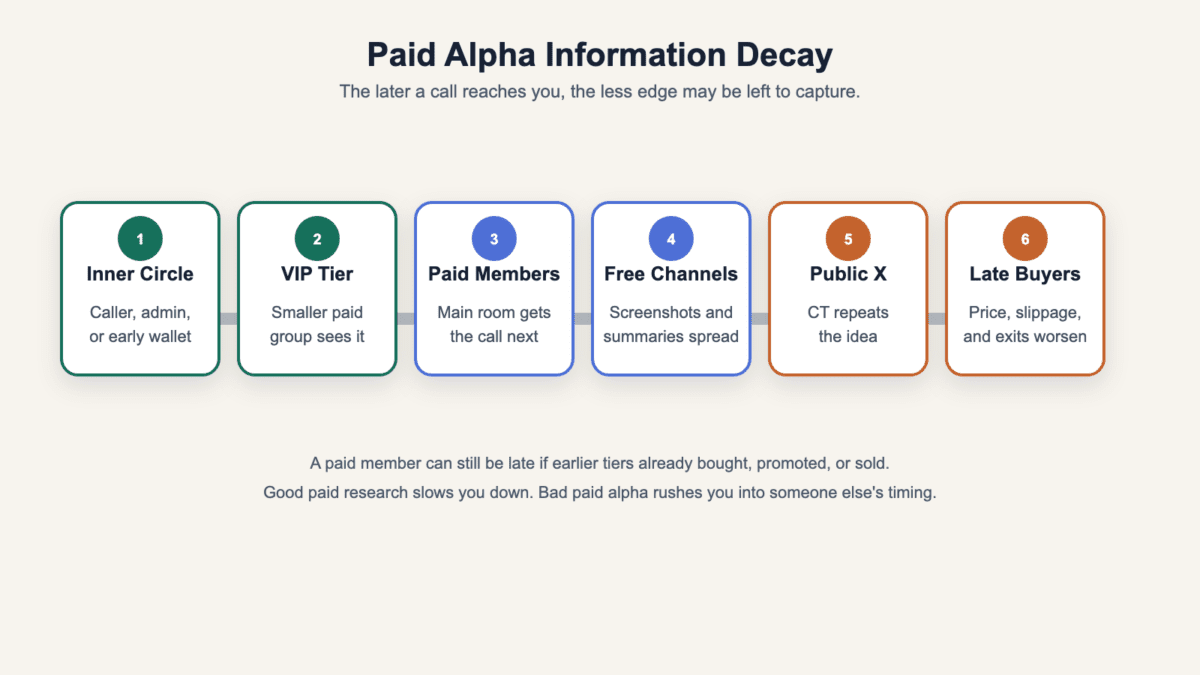
This timing gap creates the central risk. A paid member may think they are early because the room is private, while earlier wallets already bought. If enough members chase the same thin token, their demand can become exit liquidity for holders with better timing.
A simple example makes the problem obvious. A caller buys a low-liquidity token, posts it first to a small paid tier, then posts a cleaner version to a larger group. By the time the main room sees it, price is up, slippage is worse, and the early buyer has a much easier exit path.
The group format changes the wrapper, not the core checks:
Good paid alpha explains the method, the risk, and the evidence. Bad paid alpha rushes members toward action before they can ask basic questions.
Traders pay for paid alpha because crypto moves quickly and attention is exhausting. A private group promises filtering, speed, community, and the feeling that someone else is watching the market while you sleep.
The appeal is strongest in memecoins, new launches, NFTs, airdrops, and low-cap tokens. In the trenches, a few minutes can change the entry, the available liquidity, and the odds that a trade has already become crowded.
The better sales pages know that fear. They sell relief from noise, not just a list of coins. For a busy trader, a curated feed can feel cheaper than spending every evening chasing wallets, Discord rumors, DEX screens, and X replies.
There are fair reasons to pay for a private group:
There are weaker reasons too:
The first set can be useful if the group shows its work. The second set is how paid alpha turns into expensive comfort. It feels like buying certainty, but crypto charges extra for that illusion.
So the honest question is not whether paying is always foolish. It is whether the group improves your process after the excitement wears off. If the subscription only makes you click faster, it has replaced research with social pressure.
Paid alpha risks come from three places: the call may be late, the market may be too thin, and the seller may profit from behavior that hurts members. Those risks can stack quickly in small tokens.
Start with the risk stack:
If a trade reaches you after insiders, admins, VIP members, or earlier wallets already entered, the edge may be partly gone. A call can still sound early because the public has not seen it, while the useful entry already passed inside a smaller room.
Thin pools and weak order books can make a “great call” hard to enter or exit at the quoted price. A small group might move a tiny token. A larger group can move it against itself.
The person selling paid alpha may earn from subscriptions, referrals, presale allocations, paid promotions, token holdings, or member demand. That does not prove bad intent. It does mean you need to know where the seller makes money.
FINRA warns that fraudulent investment groups can move users from social media into encrypted chats and pitch lesser-known crypto assets. Its December 2025 alert also cites an FBI public service announcement about at least a 300 percent increase in victim complaints referencing ramp-and-dump stock fraud compared with 2024. The crypto version often rhymes with paid-alpha pressure: urgency, private rooms, confident instructions, and weak exits.
Watch especially for these red flags:
Rug risk deserves its own check when paid alpha points to new tokens. A clean call can still lead into a hard rug if liquidity disappears, selling breaks, or insiders drain value. A heavily promoted paid call can also become a top signal when everyone sees the same “secret” trade at once.
> Paid alpha is most dangerous when urgency replaces verification and the seller never explains how they benefit.
The fix is not cynicism. It is slower execution. If a call cannot survive questions about timing, liquidity, seller incentives, and exit path, it is not alpha. It is pressure wearing a private-room badge.
Evaluate paid alpha before joining by asking for evidence that includes losses, timestamps, risk rules, and seller incentives. A win collage is marketing. A complete record is closer to evidence.
Use this checklist before paying for access, connecting a wallet, or copying a call:
| Check | What It Reveals |
|---|---|
| Complete call history | Shows losers, quiet periods, and repeated mistakes |
| Timestamps | Proves whether members saw the call before the move |
| Entry and exit rules | Separates a trade plan from a vague shout |
| Preserved losses | Reduces cherry-picked performance claims |
| Wallet disclosure | Helps expose front-running or hidden positions |
| Paid-promotion policy | Shows whether calls may be sponsored |
| Risk limits | Prevents “full send” culture from replacing sizing |
| Public sample calls | Lets you test quality before paying |
| Refund terms | Reveals how the seller handles unhappy members |
| Bot permissions | Protects wallets from unclear automation access |
The table is not a guarantee filter. It is a friction filter. Honest research groups can answer most of these questions without turning defensive.
Screenshots of winners should carry the least weight. They often hide the entry time, position size, missed calls, deleted posts, and exits. A group that only shows green candles is asking you to evaluate a movie from the trailer.
Then check the room itself:
If asking “who bought before this call?” gets you attacked, you already learned something useful.
Paid alpha overlaps with crypto signals, research tools, scanners, bots, and private chats, but those products do different jobs. Confusing them is how users buy a tool and expect a trading system.
The clean split is simple: research helps you think, signals tell you what someone else wants to do, and tools surface data faster. None of them can prove that a caller is honest or that a thin market can absorb your trade.
| Format | What To Verify Before Trusting It |
|---|---|
| Paid research | Method, assumptions, conflicts, and update quality |
| Signal group | Full track record, risk rules, entries, and exits |
| Alpha call | Caller position, timing, liquidity, and disclosure |
| Wallet tracker | Whether copied wallets are still holding or already exiting |
| On-chain scanner | Contract risk, liquidity, holders, and false positives |
| AI feed | Data sources, hallucination risk, and stale summaries |
| Sniper bot | Permissions, slippage settings, fees, and failure modes |
| Private chat | Moderator incentives, pressure, and loss transparency |
| Creator membership | Education value versus trade-command culture |
The safest products slow you down. They explain what to check and where the uncertainty sits. The riskiest products speed you up before you understand the trade.
Automating trades from an unaudited source is especially fragile. A bot can execute faster than you can think, which is useful only if the rule is sound. Bad input at high speed is still bad input, just with fewer seconds to regret it.
Paid alpha can be useful when it improves your research process instead of replacing it. A good group helps you find leads, understand context, compare sources, and learn how stronger traders think.
That value often looks less exciting than the sales page. It may be a clean watchlist, a good airdrop calendar, a useful wallet monitor, a patient analyst, or a community that notices when a trade thesis breaks. None of that requires pretending every call will hit.
The useful version usually feels slower than the hype version. Members get context, risk notes, and follow-up when conditions change. They are not just told to buy, hold, pray, and clap whenever the caller posts a green screenshot.
Better signs include:
The boundary is clear. Paid alpha can help with discovery and discipline. It cannot remove market risk, execution risk, or the seller’s incentive to package uncertainty as confidence.
If a group teaches you to ask better questions, it may have value. If it trains you to ask fewer questions, the subscription fee is only the first cost.
The strongest paid groups also make leaving easy. They let the results speak for themselves, keep records visible, and do not turn every cancellation into a loyalty drama. A group that needs pressure to keep members probably has weaker proof than its marketing suggests.
Instead of blindly following paid alpha, turn every call into a small research task. The call can point at a token, wallet, launch, or narrative, but your own checks decide whether it deserves attention.
Start with a watchlist. Add the asset, the caller, the timestamp, the entry range, the stated reason, and what would prove the idea wrong. That simple record turns a private call into something you can review later, not just feel in the moment.
Then separate discovery from execution. A call can introduce a token or wallet worth studying. It should not decide your size, entry, exit, and risk limit for you. Those choices depend on your account, not the caller’s confidence.
Before acting, run a short check:
Writing a thesis before entry is not fancy. It is a basic defense against borrowed conviction. A real conviction play has a reason, a risk limit, and a plan that survives more than one loud message.
Also compare multiple sources. If the same call appears everywhere, the edge may already be public. If only one private room mentions it, the idea may still be early or may simply lack confirmation. Discovery can come from paid alpha. Execution should come from your own risk checks.
Keep ignored calls in the record too. Skipped trades teach you whether the source is early, late, reckless, or just noisy. Without that log, memory will keep the wins and quietly misplace the mess.
Related paid alpha terms help you read private-group language without getting pulled into every phrase. The words often point to timing, status, or incentive risk.
Keep the basics close. An alpha call is a trade idea or lead presented as early information. The caller is the person posting it. A KOL is an influencer with market reach. A signal group is a channel built around alerts. In paid rooms, status can make ordinary claims sound more proven than they are.
Several terms point straight at timing risk:
Other terms fill in the social layer. CT is Crypto Twitter, the public crypto crowd on X. Trenches means fast, risky low-cap trading culture. Exit liquidity means demand that lets earlier holders sell. A bagholder is the person still holding after demand fades. A rug is an abusive or scam-like collapse in sellability, value, or liquidity.
These terms are useful because paid alpha rarely appears alone. A seller may frame a call as “early,” “VIP,” “trenches alpha,” or “before CT catches it.” Translate the phrase into plain risk: who saw it first, who benefits now, and what can still be verified?
Paid alpha and crypto signals overlap, but they are not always the same. A signal is usually a buy, sell, entry, or exit alert. Paid alpha can also include research, tools, private discussions, wallet tracking, airdrop leads, or market context.
The risk is similar when either format tells you to act before you can verify the setup.
Paid alpha groups can be worth it when they provide education, useful tools, complete records, and a calmer research process. They are weak value when they mainly sell urgency and screenshots.
Before paying, ask what you can test for free and what proof the group shows when trades go wrong.
Yes, paid alpha groups can be scams or scam-adjacent. Some groups use private access, urgent calls, fake records, hidden promotions, or thin tokens to push members into bad trades.
Not every paid group is fake. But the burden of proof is high because the seller controls the room, the marketing, and often the timing.
People sell paid alpha for many reasons: subscription revenue, community building, tooling fees, education, referrals, paid promotions, or because the edge is weaker than the pitch suggests.
A seller can have useful knowledge and still have conflicts. That is why disclosures, timestamps, and full records matter more than confidence.
No, Binance Alpha is not the same thing as paid alpha. Binance Alpha is an exchange product phrase, while paid alpha usually means paid access to private crypto edge, calls, research, or community leads.
The shared word “alpha” creates confusion. Check whether the page or post is talking about a product, a token, a trading metric, or a private paid group.
Check paid alpha by reviewing the full call history, timestamps, losses, entry and exit rules, seller incentives, paid-promotion policy, and community behavior. Then test the source without risking meaningful money.
Credible groups make verification easier. Weak groups make simple questions feel like disloyalty.
Start with paid alpha by deciding what you actually need. If you need education, buy education. If you need tools, test tools. If you want someone to remove uncertainty from crypto, pause before paying.
Write that need down before you open the sales page. “Find cleaner airdrop leads” is testable. “Stop missing pumps” is a feeling, and feelings are easy to invoice.
Use this order before joining or acting:
Track the group for several weeks. Record calls you took, calls you skipped, and calls you only saw after price moved. Include losers. The missing-loss column is where many paid-alpha stories get less glamorous.
Also track behavior, not only prices. Notice whether moderators explain failed calls, whether members can ask plain questions, and whether the seller discloses promotions before the trade gets crowded.
Set a review date before you pay for another month. If the group has not saved time, improved entries, exposed better checks, or helped you avoid bad trades, the value is thin. Entertainment is allowed. Just do not confuse it with edge.
Then decide from evidence, not FOMO. A good paid group should improve your process. It should not make your process disappear.
If the record is mixed, do the boring thing: wait longer, trade smaller, or leave. Paid alpha should earn trust over time, not borrow it from urgency.