Physical Address
304 North Cardinal St.
Dorchester Center, MA 02124
Physical Address
304 North Cardinal St.
Dorchester Center, MA 02124


A plain guide to data availability, rollup safety, L2 fees, and DA-layer risk.
Data availability is the assurance that transaction data behind a block or rollup batch was published so others can verify state changes.
In crypto, that small phrase separates a fast chain outsiders can check from a cheap chain with a footnote. Ask whether the chain published enough data for outsiders to check balances, challenge bad updates, and leave safely if an operator goes quiet.
Data availability in crypto means network participants can access the data needed to verify a block, transaction batch, or rollup state update. It is not a data feed, a storage app, or a nicer name for uptime.
The term appears most often around rollups. A rollup batches many user transactions, publishes a summary or commitment, and needs the underlying transaction data available so others can check the new state. Without that data, a clean-looking update can be hard to verify.
You will usually see data availability near these parts of the stack:
A simple example helps. A rollup sequencer batches swaps, transfers, and app actions. It posts the batch data to Ethereum blobs, calldata, a separate DA layer, or a committee-backed route. Watchers then use that data to rebuild state or challenge an invalid update.
That is why data availability shows up in Ethereum scaling, modular blockchain, and L2 fee debates. It sits behind the wallet quote, but it also sits behind the safety model. The basic test is plain: can independent parties see enough data to verify what happened?
Rollups need data availability because verification depends on other participants seeing the batch data. If the data is missing, fraud proofs, state reconstruction, and safe exits can fail or become much harder.
Rollups are not just fast databases with a crypto logo. They move execution away from a base chain, then rely on proofs, watchers, sequencers, bridges, and published data to keep the system accountable. For optimistic rollups, challengers need transaction data to dispute a bad state transition.
For ZK rollups, validity proofs can prove computation, but users and infrastructure still need data to understand balances and exits. Proofs help, but hidden state still leaves users guessing.
The risk becomes obvious during stress. If a sequencer posts a commitment but withholds the data behind it, outsiders may not be able to reconstruct the correct state. If a DA provider or committee stops serving data, users may depend on fallback rules they never read.
That is where funds enter the story:
> Data availability is not a wallet-safety guarantee. It is a verification condition that helps others prove what the rollup state should be when things go wrong.
The practical consequence is simple. Before you bridge serious value to an L2 or modular chain, you want to know where the data goes, who can check it, and how exits work if the normal operator path stalls.
Cheap transactions are useful. Cheap transactions with unclear exits are less charming.
Data availability is different from storage, oracles, and uptime because it answers a narrower question: was the data needed for verification published when the network needed it?
This distinction solves a lot of beginner confusion. People hear “data” and think of price feeds, web APIs, archive history, block explorers, or a site staying online. Blockchain data availability is about verification of state, not every data-related service in crypto.
Use this table when the terms start blending together:
| Concept | What It Actually Means |
|---|---|
| Data Availability | The transaction or block data was published so others can verify state changes. |
| Data Retrievability | Historical data can still be fetched later by users, nodes, indexers, or providers. |
| Blockchain Storage | Data kept by nodes, archive services, explorers, or infrastructure providers over time. |
| Oracle Data | External information, such as prices or events, brought into smart contracts. |
| Uptime | A chain, app, RPC, explorer, or website is online and responding. |
The overlap is real, but the promises differ. A rollup can have data availability for a batch while an explorer is down. A chain can have a working app frontend while historical data is hard to fetch. An oracle can deliver price data while saying nothing about rollup batch verification.
Celestia’s retrievability guide separates publication from later historical access. The split is important because a DA guarantee can be time-bound, while users may still want records months later. So don’t read data availability as “the data lives forever in a convenient place.”
Data availability sampling lets many participants check small random pieces of data instead of forcing every node to download every byte. That makes large blocks or rollup batches easier to verify without turning every user into a data center.
The data availability problem starts with scale. Bigger batches can lower costs and support more activity, but full downloads become heavier. If only a few powerful machines can check the data, the system asks for more trust and offers less verification.
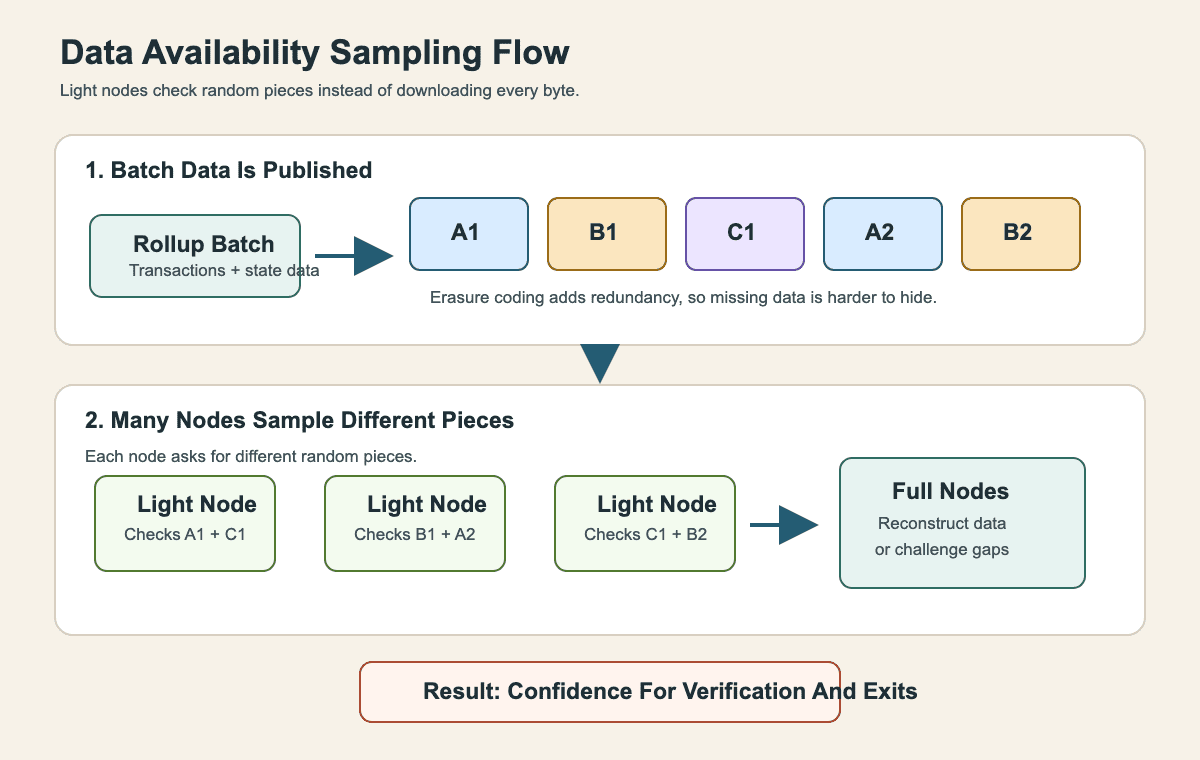
Data availability sampling uses a clever shortcut. The data is expanded with redundancy through erasure coding. Then light nodes randomly sample pieces. If enough independent checks succeed, the network gains confidence that the full data is available.
One tiny sample does not prove everything. Many random samples, across many participants, make hiding missing data much harder because a dishonest publisher cannot know exactly which pieces everyone will request.
The basic flow looks like this:
This is why sampling usually appears with erasure coding. Random checks need structure behind them. If the data is coded well, missing chunks become easier to detect because the publisher has to hide enough pieces to break reconstruction.
The broader problem is proving data is available without forcing every node to download all of it. That is the heart of the scaling tradeoff.
For users, the takeaway is practical. Data availability sampling can make verification lighter, but it still depends on correct implementation, honest participation, and a clear bridge between the DA system and the chain using it.
Data availability on Ethereum now centers on blobs, which give rollups a purpose-built way to publish temporary data for verification. That changed the economics behind many L2 fee quotes.
Before blobs, rollups often relied more heavily on calldata. Calldata is posted through Ethereum’s execution layer and is more expensive for large rollup data loads. Ethereum’s EIP-4844 introduced blob-carrying transactions, which created a separate data lane for rollup batches.
Ethereum.org describes the blob availability period as 4096 epochs, roughly 18 days. After that, normal Ethereum nodes can prune the blob data, while rollup operators, archive services, indexers, and other infrastructure may keep copies.
That limited window is not a bug. It is part of the design. Rollups need data available long enough for checks and challenges. They do not always need Ethereum nodes to store every rollup byte forever.
For users, blobs explain part of the L2 fee story:
PeerDAS changes Ethereum data availability by letting nodes sample blob data from peers instead of requiring every node to download every blob fully. The goal is more blob capacity while keeping verification practical.
The user-facing version is simple. More efficient sampling can support more rollup data, which can help L2 throughput and cost pressure. But it still needs careful engineering because data availability is a security assumption, not only a bandwidth upgrade. PeerDAS is one reason Ethereum roadmap discussions often pair blobs, rollups, ZK-EVM work, and modular scaling.
Data availability layers publish transaction data for other chains or rollups to verify. Ethereum, Celestia, EigenDA, Avail, and data availability committees all answer the DA question with different trust and cost assumptions.
Ethereum blobs keep data availability close to Ethereum. Celestia and Avail are modular DA networks. EigenDA is tied to EigenLayer and restaking assumptions. DACs are smaller committees that attest that data was available.
The key question is what trust moved where. A high-throughput game, social app, or appchain may care about cheaper data capacity. A DeFi rollup holding large deposits may care more about settlement, exits, and conservative assumptions.
Use this comparison before accepting any DA-layer pitch:
| DA Option | What The User Should Check |
|---|---|
| Ethereum Blobs | Whether the rollup posts data to Ethereum and how exits work after the blob window. |
| Celestia | How the rollup connects Celestia DA to settlement and what the DA bridge assumes. |
| EigenDA | How restaking, operators, slashing, and the bridge support the availability claim. |
| Avail | How sampling, validator assumptions, and app-specific integration affect verification. |
| DACs | Who sits on the committee, what they sign, and what happens if members disappear. |
No option makes every chain safe by default. Ethereum blobs can still sit under a rollup with sequencer, proof-system, or upgrade-key risks. A modular DA layer can be technically serious while still adding bridge and provider assumptions.
That is why GameFi is a natural example. Games can generate many low-value actions, so cheaper data capacity may matter. But a game still needs clear custody, bridge, and asset-withdrawal rules if tokens or NFTs carry value.
The label starts the risk check. It does not finish it.
Rollups and validiums can both use proofs, but they differ in where transaction data lives. That difference changes how users verify balances and exit during stress.
A rollup usually posts the data needed for verification to the base chain or a public DA route tied into its security model. A validium keeps some transaction data off-chain while using validity proofs for state transitions. That can lower costs and raise throughput, but it shifts part of the data trust elsewhere.
The risk sits in the exit story, not in the validium label itself. Off-chain data availability changes what users depend on when the normal operator path breaks.
That changes three checks:
A cheap appchain might choose off-chain DA because it handles many small actions. A high-throughput trading venue might choose a design that favors speed and cost. Those choices can be reasonable, but they should be visible.
The distinction also helps avoid false alarms. A data availability failure is not the same as a hard rug, where a project deliberately steals or blocks funds. It is also not the same as a soft rug, where a team slowly abandons operations or lets risks pile up.
Still, technical risk can hurt real users. A system does not need cartoon-villain intent to create painful exits.
> If a project markets “Ethereum security,” check whether it means settlement, proofs, data availability, bridge guarantees, or just a convenient logo.
That sentence can save you from a lot of mushy marketing. Data location is not a footnote when your exit depends on it.
Data availability does not promise permanent storage, reliable explorers, private data, safe apps, or a working frontend. It promises that data was available for verification under a specific design and time window.
This is where many users overread the term. If data was available for a rollup challenge window, that does not mean every historical record will remain free, indexed, fast, and easy to fetch forever.
Archive nodes, rollup operators, indexers, explorers, paid infrastructure providers, and researchers may store copies later.
Here is the cleaner split:
The wallet line is easy to underrate. A rollup can have a sound DA setup while a user still signs a bad approval, uses a fake bridge, or trusts a broken app. DA is one layer in the stack, not a force field.
So when a project says its data is available, ask the next question. Available where, for whom, for how long, and what happens after that period ends?
You can check data availability before bridging or investing by identifying where the chain posts data, how that DA claim reaches settlement, and what exit path exists if data is withheld.
Start with the project’s risk page, documentation, and dashboard entries. On June 5, 2026, L2BEAT listed 32 DA entries across public and custom designs. That snapshot shows why “uses a DA layer” is not one uniform security model. Use live dashboards for current checks, not evergreen facts.
Then move from labels to consequences. A rollup using Ethereum blobs has a different data path than one using Celestia, EigenDA, Avail, or a custom committee. The bridge between those systems can be as important as the DA layer itself.
Use this checklist before moving serious funds:
Also separate DA risk from custody risk. A good wallet can help you manage keys and approvals, but it cannot fix a rollup’s hidden data assumptions. Custody is a separate lane from verification.
For investing, add one more check. If a token thesis depends on DA usage, find out who pays fees, what asset captures them, whether incentives are subsidizing activity, and whether supply releases can swamp demand. You do not need to become a protocol auditor overnight. You just need to avoid trusting a cheap bridge before you know what the cheapness moved.
Data availability can create fees, demand, and market attention, but it does not automatically create token value. Useful infrastructure and good token economics are related, not identical. DA demand may flow to Ethereum, a modular DA network, a restaking system, a rollup, a sequencer, or an app.
That split is why DA often becomes a market meta. Markets like clean stories, and “rollups need data” is very clean. But clean stories can still leave messy cap tables, token emissions, and weak fee capture.
Before turning data availability into a trade, ask the boring questions:
A narrative coin can rise because the market likes the story, not because the token captures durable value. That can still create tradable momentum. It just should not be confused with proof of long-term economics.
The harsher version is also worth saying. If you buy late because a DA chart looks impressive, you may become exit liquidity for someone who checked the vesting calendar first. Data availability can be important infrastructure. Importance is not a price target.
Data availability connects to several crypto ideas that often appear in the same conversation. Rollups need DA so others can verify batches. Validiums change the data location. Blobspace gives Ethereum rollups a temporary data lane. Data retrievability handles later access to history.
Modular blockchain design separates execution, settlement, consensus, and data availability. That split can make chains cheaper or more specialized, but it also makes risk harder to read. A user may see one app and one bridge while several infrastructure layers sit underneath.
Use these related concepts to separate technical risk, custody risk, and market-story risk:
Token narratives sit nearby, too. DA layers can attract attention because they sound like core infrastructure. But the article’s main thread still applies: check what is verifiable, what is trusted, and who captures value.
Start with data availability as a verification question, not a brand category. The useful first move is to ask where the data is posted and who can inspect it.
Then look at exits. A chain can feel smooth while deposits are easy and still become awkward when users need to leave during stress. The exit path should be understandable before the bridge transaction, not after the group chat panics.
If the project cannot answer that plainly, slow down. A vague DA claim is not fatal by itself, but it is a poor place to park serious funds without more context.
Use these actions before you trust a rollup, validium, or modular-chain pitch:
That is enough for a first pass. You do not need every proof detail to spot a vague DA claim. You just need to ask what data is visible, who can verify it, and what happens when the normal path breaks.
Then keep the token story separate. Data availability can explain why a stack is useful, but it cannot tell you whether the token captures fees, survives dilution, or keeps demand after incentives fade.
Data availability in crypto means the transaction data behind a block or rollup batch was published so others can verify the resulting state.
The reason is simple: blockchains and rollups should be checkable by outside participants. If the data behind an update is missing, verification becomes trust by default.
Rollups need data availability because fraud proofs, validity checks, state reconstruction, and exits all depend on visible batch data.
An L2 can process transactions away from the base chain, but outsiders still need enough data to confirm balances and challenge bad updates. Without that data, a rollup can become harder to verify during stress.
Data availability is not the same as blockchain storage because DA concerns publication for verification, while storage concerns keeping data accessible over time.
A network can make data available for a challenge or verification window without promising that every historical byte stays easy to fetch forever. Archive nodes, indexers, explorers, and rollup operators may handle later access.
Data availability sampling is a method where light nodes check random pieces of data instead of downloading the whole block or batch.
When sampling is paired with erasure coding, many small checks can give strong confidence that the full data was available. It helps scale verification without forcing every participant to download everything.
Data availability can fail if required data is withheld, a DA bridge reports availability incorrectly, a committee stops serving data, or the implementation has a serious flaw.
The user impact depends on the design. In the worst cases, watchers may struggle to verify state, challengers may be blocked, and exits may become slower or more trust-heavy.
Data availability does not automatically make DA tokens valuable because protocol usefulness and token value capture are separate questions.
Demand may accrue to ETH, a DA-layer token, a restaking system, a rollup, sequencers, apps, or users through cheaper fees. Token supply, incentives, competition, and switching costs still matter.