Physical Address
304 North Cardinal St.
Dorchester Center, MA 02124
Physical Address
304 North Cardinal St.
Dorchester Center, MA 02124

DePIN explained without the hardware-income fog.
A decentralized physical infrastructure network (DePIN) is a crypto-coordinated network where independent contributors provide real resources and earn tokens for verified work.
The resources can be wireless coverage, maps, storage, compute, bandwidth, vehicle data, sensors, or energy data. That real-world link is only the start. The harder question is whether useful demand can support rewards after early token excitement cools.
A decentralized physical infrastructure network (DePIN) is a network that uses crypto incentives to build or run infrastructure through many independent contributors. Instead of one company owning every tower, drive, sensor, or server, DePIN uses software rules and token rewards to coordinate distributed supply.
The name sounds purely physical, but the category is wider than routers and sensors. Physical Resource Networks cover place-specific resources like wireless coverage, mapping, mobility, weather, or energy data. Digital Resource Networks cover resources like storage, compute, rendering, and bandwidth.
That split changes the failure points:
| Term | How It Differs From DePIN |
|---|---|
| Internet Of Things | IoT connects devices, while DePIN adds token rewards, verification, and market rules around contributed resources. |
| DeFi | DeFi handles financial activity, while DePIN connects tokens to real services such as coverage, storage, maps, or compute. |
| RWA | RWA usually tokenizes claims on existing assets, while DePIN coordinates active supply for a service. |
| Cloud Or Telecom | Traditional providers own and operate infrastructure directly, while DePIN tries to source supply from independent operators. |
So DePIN is not every hardware project with a token. A useful DePIN needs a real resource, proof that useful work happened, customers who need the service, and token rules that can survive lower rewards.
That last part is where the marketing gets noisy. A dashcam, hotspot, GPU, or hard drive can be part of a DePIN network. It is not automatically a money printer with a warranty sticker.
A decentralized physical infrastructure network (DePIN) works by connecting resource supply, verification, user demand, and token incentives. The loop sounds simple, but each step can make or break the network.
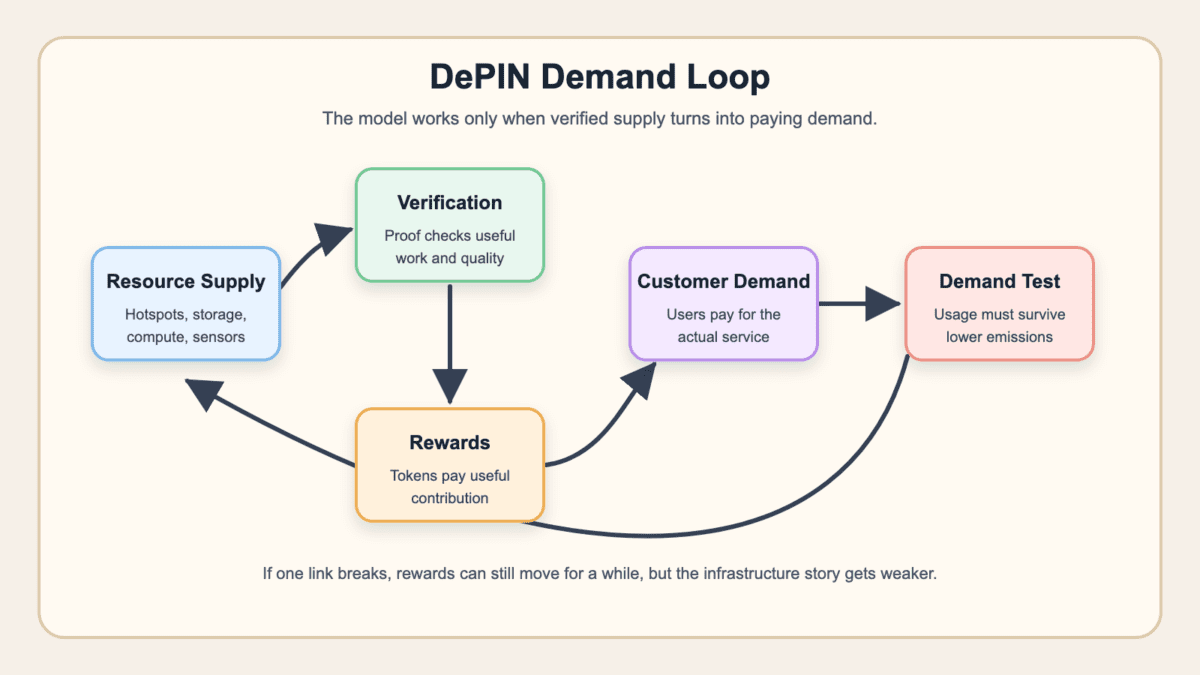
Contributors provide the thing the network wants to sell or use. That might be a wireless hotspot, a dashcam, spare storage, GPU capacity, bandwidth, vehicle telemetry, or sensor data.
The useful unit changes by category. Wireless needs coverage where people need signal. Mapping needs fresh, accurate imagery. Compute needs availability, pricing, and performance. Storage needs uptime and proof that data remains available.
Verification is the trust engine. The network has to check that a contributor supplied the resource, supplied it in the right place, and supplied it at useful quality.
Some proofs are technical, such as storage proofs. Others rely on signals, location checks, oracle data, device telemetry, or customer usage. “Proof of Physical Work” is best understood as a verification idea, not a universal consensus system like Bitcoin mining.
Verification failures usually show up in plain ways:
Bad proof creates bad rewards. When that happens, honest contributors subsidize noise.
The user side is where a DePIN network leaves the white paper and meets reality. Someone must need the coverage, storage, compute, data, or bandwidth enough to pay for it.
Demand may arrive slowly. That is normal for infrastructure. But it cannot stay imaginary forever. If the network keeps paying contributors while customers barely show up, rewards become a subsidy loop.
Tokens can pay early contributors, set governance rights, create staking or collateral rules, or connect user payments to the network economy. They are coordination tools, not proof that the service has durable demand.
A healthy loop looks like this:
If those pieces do not connect, DePIN can still produce dashboards, devices, and lively chats. It just may not produce lasting infrastructure.
A decentralized physical infrastructure network (DePIN) uses tokens to solve the cold-start problem. Infrastructure is expensive before users arrive, so tokens can reward early contributors while the network is still building supply. That works only when rewards create useful coverage, storage, compute, or data that later attracts paying customers.
A 2026 Frontiers in Blockchain review synthesized 46 DePIN tokenomics sources and describes the category around useful-work verification, demand monetization, issuance rules, collateral, and governance. Plain English: the token must help coordinate the service, not just decorate it.
Token mechanics deserve separate checks:
| Token Mechanic | Question To Ask |
|---|---|
| Contributor rewards | Are rewards tied to useful work, customer usage, or mostly emissions? |
| Demand-side credits | Do users buy the service in a way that creates token demand? |
| Burns Or Sinks | Does usage remove tokens or create clear value flow, or is the link vague? |
| Staking Or Collateral | Does stake improve service quality, or only lock supply for optics? |
| Governance | Who can change rewards, proofs, fees, and provider rules? |
The token can also trade ahead of the service. When DePIN becomes a hot crypto meta, capital may rotate into anything with the right label. A DePIN token can then become a narrative coin before the business case is proven.
So the token question is not “does this project have utility?” Ask whether useful demand creates durable pressure that supports the token rules. That answer is often less tidy than the pitch deck.
Types of decentralized physical infrastructure network (DePIN) projects are best sorted by the resource being supplied. Categories teach more than ticker lists because the economics change by resource.
Wireless and mapping depend heavily on place. Compute and storage depend more on quality, uptime, pricing, and utilization. Sensor and vehicle-data networks add privacy and data-rights questions.
The main categories look like this:
| Resource Supplied | What Users Buy Or Need |
|---|---|
| Wireless Coverage | Connectivity, local network reach, mobile offload, or niche signal coverage. |
| Mapping And Geospatial Data | Fresh road imagery, location data, map updates, or machine-readable physical-world data. |
| Storage | Distributed file storage, retrieval, redundancy, or archival capacity. |
| Compute And Rendering | GPU time, rendering capacity, AI-related compute, or general cloud-style workloads. |
| Bandwidth | Network routing, proxy capacity, data transfer, or connectivity services. |
| Sensors And Energy Data | Environmental readings, device telemetry, grid data, mobility data, or local measurements. |
The category changes the research path:
Use the category as the first filter. Then ask whether the project can prove useful supply and sell it to real users. Without both, DePIN starts looking like hardware cosplay with token rewards.
Decentralized physical infrastructure network (DePIN) examples help when they explain the model, not when they become a disguised investment list. Use them to see how the resource, proof, customer, and token fit together before any ticker starts looking clever.
Use these names as category examples, not endorsements:
The pattern matters more than the brand list. A strong DePIN example should make the useful work easy to name, the verification method easy to inspect, and customer demand harder to hand-wave.
These examples are not endorsements. Use them as working models for the questions that decide the risk: what resource is supplied, how work is verified, who pays, what can fail, and how much token exposure you are taking.
Decentralized physical infrastructure network (DePIN) risks differ by role. A token buyer and a hardware contributor may share the same project name, but they do not share the same risk profile.
The contributor worries about device cost, location, electricity, uptime, maintenance, reward changes, data exposure, and whether the token can be sold. The investor worries about emissions, liquidity, vesting releases, exchange access, governance, custody, and whether usage creates token demand.
That split is worth making before money leaves your account:
| Contributor Risk | Investor Risk |
|---|---|
| Hardware or setup costs arrive before rewards are proven. | Token price can fall even while network usage grows. |
| A poor location can make a useful device barely earn. | Emissions and vesting releases can dilute late buyers. |
| Uptime, maintenance, power, and bandwidth cut into rewards. | Thin liquidity can turn a small sell order into a bad exit. |
| Reward rules can change after equipment is purchased. | Governance can alter fees, emissions, proofs, or collateral. |
| Device data can reveal location, movement, or usage patterns. | Custody mistakes and wallet approvals can create direct losses. |
Custody is not a side quest. Testing a DePIN app may involve a new wallet, hardware reward address, token approvals, or small-chain tooling. Use crypto wallets as part of the safety check when you plan to earn, claim, bridge, or hold rewards.
Privacy is the risk many token pitches underplay. A mapping app may touch location and imagery. A vehicle-data network may touch driving behavior. A bandwidth app may create traffic questions. A sensor network may expose home, device, or movement patterns.
Then comes market risk. If a DePIN project sells a strong hardware story after insiders, early operators, and reward farmers are already positioned, late buyers can become exit liquidity for a story that peaked before demand caught up.
Red flags deserve their own checklist:
A malicious app, fake preorder, or wallet-draining setup can become a hard rug quickly. A weaker project can fail slowly, with rewards shrinking while the token limps along.
“Real-world” is not a safety label. It is a claim that still needs proof, demand, and boring operational math.
Evaluate a decentralized physical infrastructure network (DePIN) by starting with the service, not the chart. If you cannot explain what the network sells and who pays for it, the token thesis is not ready.
Good DePIN research keeps three ideas separate. The service may be useful. The contributor economics may still be poor. The token may still fail to capture value. Check each one, even when the marketing blends them together.
If a DePIN token becomes a high-conviction token bet, the thesis should still survive this split. “The network is real” is a start, not a full reason to buy.
Use these questions before buying a token or hardware:
The answers do not need to be perfect. Early networks are messy. But a weak answer should show up before you commit capital, not after the first reward period disappoints. Also compare DePIN against the normal alternative, such as a cloud provider, map vendor, telecom company, or data broker.
The strongest signal is boring: paying demand that still exists when rewards fall. If all evidence points to emissions, referrals, and token excitement, keep your wallet colder than the marketing.
Decentralized physical infrastructure network (DePIN) terms help investors read project claims without getting buried in jargon. The main terms explain resource type, proof design, and token demand.
Keep this list close when a project pitch starts mixing hardware rewards, AI, data, and governance in one breath:
| Term | Plain Meaning |
|---|---|
| Physical Resource Network | A DePIN category where the supplied resource depends on place, such as wireless, mapping, mobility, sensors, or energy data. |
| Digital Resource Network | A DePIN category where the supplied resource is digital, such as storage, compute, rendering, or bandwidth. |
| Proof Of Physical Work | A verification method for useful offchain contribution, not a universal mining system. |
| Data Credits | Usage credits that let customers pay for a network service without directly handling volatile reward tokens. |
| Oracles | Systems that bring offchain data into crypto rules, often useful for checking location, service, price, or activity. |
| Token Emissions | New token rewards distributed over time, often used to attract early contributors. |
| Demand-Side Payments | Money or credits paid by users who actually need the service. |
Two terms deserve extra care:
The useful habit is simple. Translate every DePIN term back into resource, proof, demand, and reward. If the translation breaks, the pitch may be doing more work than the network.
Decentralized physical infrastructure network (DePIN) means a crypto network that rewards independent contributors for supplying real resources. Those resources can include wireless coverage, storage, compute, mapping, bandwidth, sensors, or vehicle data.
The phrase points to active resource contribution, not just tokenized ownership. A DePIN network should prove useful work and connect it to demand.
A decentralized physical infrastructure network (DePIN) makes money when users, apps, or businesses pay for the service it provides. That service might be connectivity, map data, storage, compute, bandwidth, or device data.
Some networks use credits, burns, native-token payments, stablecoin payments, or mixed models. The key check is whether customer demand supports rewards over time.
A DePIN token is not the same as owning infrastructure. It may give access, rewards, governance rights, staking utility, or exposure to network activity, but it usually does not give legal ownership of hotspots, servers, cars, sensors, or storage devices.
That distinction changes the risk. A useful network can still have a weak token if value capture, liquidity, emissions, or governance are poor.
Decentralized physical infrastructure network (DePIN) projects can create rewards, but “passive income” is often too clean a phrase. Hardware, location, setup, maintenance, power, bandwidth, token price, and withdrawal friction all change the result.
If a project leads with guaranteed earnings, slow down. Real contributor economics include costs and uncertainty.
DePIN coordinates real resources, while DeFi coordinates financial activity. A DePIN network might pay contributors for coverage, storage, compute, or data. A DeFi protocol might handle lending, trading, liquidity, or collateral.
They can overlap through tokens, governance, and smart contracts. But the user need is different: DePIN sells a service outside the chart.
The biggest decentralized physical infrastructure network (DePIN) risks are weak demand, poor verification, unprofitable hardware, privacy exposure, token emissions, thin liquidity, custody mistakes, and scams.
The trap is assuming real-world activity makes the token valuable. Useful supply still needs paying demand and careful token design.
Start with DePIN by picking the resource category first. Wireless, mapping, storage, compute, bandwidth, vehicle data, and sensors all have different costs and proof problems.
Then study one network without buying anything. The boring checks will tell you more than the loudest thread, especially when rewards are changing, liquidity is thin, or hardware sellers sound unusually excited.
Use this order:
If you want to contribute, start small enough that a bad reward cycle is tuition, not a crisis. Test the app, payout path, wallet setup, and support process before you buy more devices or commit sensitive data.
If you want token exposure, keep the token thesis separate from the infrastructure thesis. Ask what demand can support the token when early rewards slow down, and what happens if supply keeps growing while paying users do not.
Keep the first move boring. Use a separate wallet, avoid rushed approvals, and write down the costs before the rewards start looking smooth. A DePIN setup can feel small at first, but repeated devices, bridges, claims, and token swaps can turn a test into a real position.
DePIN has one of crypto’s better real-world stories. That still does not make every hotspot, GPU marketplace, dashcam, or bandwidth app a good deal. Useful networks can be built slowly. Bad token stories can move very fast.