Physical Address
304 North Cardinal St.
Dorchester Center, MA 02124
Physical Address
304 North Cardinal St.
Dorchester Center, MA 02124


A practical guide to decentralized sequencer risk.
A decentralized sequencer is a rollup transaction-ordering system run by multiple independent participants instead of one operator.
That sounds like plumbing, because it is. But it is the part of the L2 plumbing that decides which transactions enter the fast lane, what order they take, and when users see a quick confirmation before Ethereum settlement catches up. Ethereum may secure a rollup later, while the sequencer still shapes the first few seconds or minutes of the user experience.
A decentralized sequencer in crypto is a multi-participant system for ordering rollup transactions before those transactions settle to a base chain such as Ethereum. It replaces, or tries to replace, one operator with a set of sequencer participants. The basic job comes first: a rollup needs someone, or some mechanism, to receive transactions, order them, update the L2 state, and prepare data or batches for the base chain.
Decentralization changes who controls that role. The design may use a permissioned operator set, a rotating leader, stake-based selection, a committee, a shared network, or Ethereum validators in a based sequencing design.
These parts are easy to mix up, so keep the boundaries clean:
A simple swap shows the difference. You submit a trade on an L2 DEX. The sequencer receives it, places it in order, and the app quickly shows a result. Later, the rollup posts data or a batch to Ethereum, where stronger settlement follows.
With a single sequencer, one operator controls that fast ordering path. With a decentralized sequencer, multiple participants share that control through rules. That does not mean every decentralized sequencer is equally open. Some are live and permissioned. Some are partially decentralized. Some are still mostly roadmap language with better lighting.
A decentralized sequencer changes the normal L2 flow by adding more participants and coordination to the ordering layer. The user still wants fast transactions, but the system now has to agree on order without relying on one operator.
In a typical rollup flow, you send a transaction to the L2. The sequencer orders it, the L2 state updates quickly, and the rollup later posts data or batches to Ethereum. That fast first response is useful, but it is not the same thing as final settlement.
The normal path has a few moving parts:
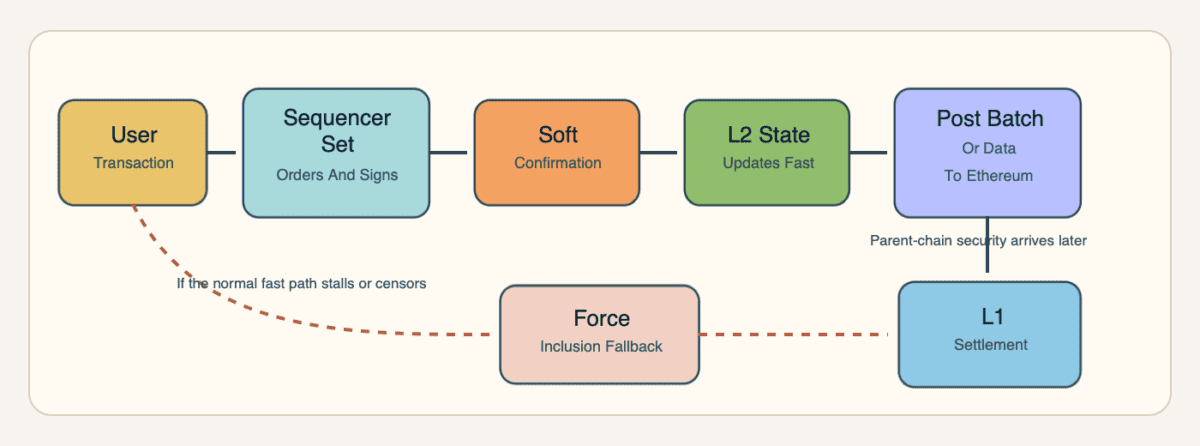
Soft confirmations are quick signals that the sequencer has accepted and ordered a transaction. They are useful because nobody wants every L2 action to feel like waiting for luggage after a delayed flight. But soft confirmations rely on the sequencing path.
Arbitrum’s sequencer documentation separates fast feed-based confirmations from parent-chain finality. Its Censorship Timeout details also list a 30-minute threshold for Arbitrum One when measuring delayed messages. Fast ordering can feel final before the base chain has done its heavier work.
For small app interactions, that tradeoff is usually fine. For large swaps, bridge moves, liquidations, or treasury transfers, the difference between fast feedback and final settlement can affect risk.
The sequencer is important, but it is not the entire rollup. A rollup also depends on execution rules, proofs or fraud challenges, data availability, bridge contracts, governance, and upgrade controls. That distinction prevents a common mistake.
So the right question is not “is the rollup decentralized?” as one giant label. Ask which layer is decentralized, who can operate it, and what happens when that layer fails.
A decentralized sequencer fixes one specific problem for L2 users: one operator should not have unchecked control over the fast transaction-ordering path. It can reduce censorship, liveness, and ordering risks tied to a single sequencer.
The risk is usually not that a sequencer reaches into your wallet and steals funds. The sharper risk is delay, exclusion, reordering, or a stalled transaction while the market keeps moving.
That can show up in ordinary ways:
A decentralized sequencer can make those failures harder to cause from one control point. If one operator goes down or tries to censor, other participants may keep the system moving. But it does not guarantee perfect fairness.
The gain is resilience, not perfection. Users get a better shot at inclusion when one participant fails, stalls, or behaves badly. They still need to understand the fallback route and the final settlement path.
So the benefit is narrower and more useful than the marketing line. A stronger sequencer design can improve inclusion, uptime, and neutrality. It cannot make latency, bridge risk, liquidity risk, or bad trade sizing disappear.
Centralized and decentralized sequencers differ in who controls ordering, how fast the system can coordinate, and who captures the economic upside. The tradeoff is not “bad versus good.” Many rollups launch with a centralized sequencer because it is simpler.
That simplicity has a cost. One operator can become the bottleneck for liveness, censorship policy, fee capture, MEV policy, and roadmap trust. Users may still settle to Ethereum later, but the first transaction path runs through one narrow gate.
| Sequencer Model | What Changes For Users |
|---|---|
| Centralized sequencer | Fast and simple UX, but one operator controls ordering, inclusion, and short-term availability. |
| Decentralized sequencer | More participants share ordering control, but consensus, leader selection, and incentives add complexity. |
| Permissioned operator set | Better than one operator, yet still limited if entry is controlled by governance or one foundation. |
| Permissionless operator set | Stronger openness, but users must still check stake rules, hardware needs, and operator concentration. |
| Based sequencing | Ordering leans on the L1 validator path, which can improve alignment but may need extra preconfirmation design. |
The table hides one ugly detail because tables are polite. Decentralization is hard to add after users, apps, and revenue already depend on the centralized path. A centralized sequencer may collect fees, direct order flow, control upgrades, and set expectations around transaction speed.
That is why roadmap language deserves a raised eyebrow. A serious decentralization plan should say who runs the sequencer, how leaders are chosen, what can be slashed, what users can verify, and what still depends on one upgrade key.
Shared sequencers, based sequencing, and decentralized sequencer pools are three different ways to reduce one-operator sequencing risk. They all deal with ordering, but they do not make the same design choice.
The terms appear together because rollups are still searching for a better fast path. Some want a sequencer set for one rollup. Some want one shared ordering layer across many rollups. Some want Ethereum itself to drive ordering.
Use this map before reading project claims:
| Model | Plain Meaning |
|---|---|
| Centralized sequencer | One main operator orders the rollup’s transactions. |
| Rollup-specific decentralized pool | Multiple participants order transactions for one rollup. |
| Shared sequencer | One ordering network serves multiple rollups. |
| Based sequencing | The rollup uses the base L1 validator path for ordering. |
Shared sequencers are ordering networks used by more than one rollup. Instead of every L2 building its own sequencer set, multiple rollups connect to a shared layer that orders transactions across them. The appeal is cross-rollup coordination.
The tradeoff is shared dependence. A shared sequencer can reduce isolated one-operator control, but it can also become important infrastructure that many rollups depend on at once.
Based sequencing routes ordering through the base layer’s validator path. On Ethereum, that means the rollup’s ordering leans more directly on Ethereum’s validator and proposer system. This is technical rollup language.
If you also see based in crypto used as slang, keep that separate from based sequencing. Coinbase’s Base chain is also not the same thing as based sequencing, which is a naming gift only a protocol researcher could love.
The upside is stronger Ethereum alignment and fewer separate sequencer assumptions. The hard parts are latency, preconfirmations, MEV allocation, implementation complexity, and whether users still get the fast UX they expect from an L2.
A rollup-specific pool uses multiple sequencer participants for one rollup. The design may rotate leaders, require stake, use a committee, or ask participants to sign ordered batches. This model is easier to explain than it is to evaluate.
So read the words carefully. “Decentralized sequencer” can describe a live mechanism, a staged launch, a selected committee, or a planned design. The label alone does very little work.
A decentralized sequencer changes the risk surface for traders and investors because ordering power sits close to money. Swaps, liquidations, auctions, bridge timing, and L2 token stories can all run through the sequencer layer.
For traders, the sequencer affects timing. A transaction that gets delayed, reordered, or soft-confirmed without final settlement can change the outcome of a DEX trade or liquidation defense.
The risk is sharpest when seconds matter:
A decentralized sequencer can reduce the chance that one operator controls those moments. It may also change how MEV is handled, who receives ordering value, and whether users can verify the ordering policy. But decentralized sequencing does not delete MEV. It can move MEV from one operator to an auction, a committee, a validator path, or another market structure.
For investors, sequencers are also business model infrastructure. A centralized sequencer can produce fees, control flow, and support a cleaner launch experience. Decentralizing it can improve credibility, but it can also change fee capture and token incentives. A token can become a narrative coin when the market prices a story faster than the system delivers working infrastructure.
For investors, the strongest check is also the least flashy. Look for live operator data, public rules, real fallback paths, and measurable progress. If all you have is a roadmap slide and a ticker, you have a story.
You check decentralized sequencer risk by verifying who orders transactions today, how users can bypass failures, and which parts still depend on governance promises. Do this before bridging serious funds, farming rewards, or buying an L2 token.
Start with the current system, not the future one. A rollup may plan a permissionless sequencer later while running a centralized sequencer now. That difference affects outage risk, censorship risk, and how much you should trust fast confirmations.
Use this checklist before you move from curiosity to exposure:
Money management still counts. Test small first. A user who goes full port into a new L2 before testing exits, fallback paths, and fees is not doing infrastructure research. Force inclusion can let users route transactions through the base chain or delayed inbox when the sequencer refuses or fails.
Use fallback paths as safety valves, not normal UX. If the route exists only in dense documentation, ask whether you could actually use it during stress.
Decentralized sequencer claims need proof because the same words can describe very different launch states. “Decentralized” can mean live permissionless participation, a permissioned committee, a testnet, a shared network integration, or a future milestone.
Do not repeat exact status claims, revenue claims, TVL claims, outage-duration claims, or “first” claims unless you can verify them from current official or high-quality sources. This topic moves fast, and project pages often move faster than reality.
Use this table to separate useful claims from slogan fog:
| Claim | What To Verify |
|---|---|
| Decentralized sequencer is live | Mainnet proof, operator list, and transaction ordering data. |
| Permissionless participation | Public join process, stake rules, hardware needs, and active operators. |
| Shared sequencer integration | Which rollups use it in production, not just in a demo. |
| Based sequencing | Whether L1 ordering is live, partial, or only planned. |
| MEV protection | Exact policy, auction design, privacy design, and known limits. |
| Censorship resistance | Force-inclusion route, timeout rules, and user-facing instructions. |
| Sequencer revenue | Official fee data, distribution rules, and who captures value. |
| Fully decentralized | Upgrade keys, governance powers, operator concentration, and fallback controls. |
This is not a case for reflexive cynicism. Real sequencing work is valuable. The risk is buying a label while missing the control path behind it. Weak proof can turn infrastructure hype into exit liquidity risk for late buyers.
Good proof looks dull. It gives you operator details, contract references, failure behavior, participation rules, and a clear split between live code and planned upgrades.
Related decentralized sequencer terms help you see which part of the rollup stack is being discussed. Most confusion comes from using one word, “decentralized,” to describe several layers at once.
Start with the ordering terms. A sequencer orders L2 transactions before settlement. An L2 sequencer does that job for a layer 2 rollup. A rollup executes activity away from the base chain, then settles back to it through its own proof, data, bridge, and governance design.
Then split ordering from verification and data. A prover helps verify state claims. A validator can matter when based sequencing leans on the base chain’s validator path. Data availability asks whether transaction data can be accessed and checked. Blobspace is one Ethereum-specific data lane rollups may use for that separate job.
Timing terms sit in their own lane. A soft confirmation is a fast but provisional signal from the sequencing path. L1 finality is stronger settlement from the base chain. Force inclusion is the fallback route when the normal sequencer path fails or censors.
Finally, keep market structure and slang from muddying the definition. MEV is value created by ordering, inclusion, or exclusion. A shared sequencer is an ordering layer used by multiple rollups. Based sequencing means ordering that leans on the base L1 validator path. If you need the slang or Base-chain naming confusion, based in crypto is the cleaner detour.
Start with decentralized sequencer risk by checking the live ordering path before you trust fast L2 confirmations. You do not need to become a rollup engineer. You need to know where control sits when your transaction enters the system.
Use a simple routine before meaningful exposure:
Then adjust your behavior to the risk. Small app interactions may be fine with soft confirmations. Large swaps, bridge moves, and liquidation-sensitive activity deserve more caution. The main mistake is reading “settles to Ethereum” as a blanket answer.
Run the same check on exits. A fast deposit tells you little if the withdrawal path, delayed inbox, or force-inclusion route is hard to find when the sequencer is stressed. If the docs hide that path behind dense operator language, assume normal users will struggle during a live incident.
For token exposure, separate infrastructure progress from market pricing. A decentralized sequencer can improve the lane, but it can also arrive in stages, with permissioned operators first and broader participation later. Before you trust the claim, make the project show its work: live operators, public rules, clear fallback behavior, and fewer promises doing the job of shipped code.
A decentralized sequencer in crypto is a multi-participant system that orders rollup transactions before they settle to a base chain. It replaces a single sequencing operator with a set of participants, a shared ordering network, or an L1-driven ordering design. The goal is to reduce one team’s control over transaction inclusion, ordering, and uptime.
Many L2s use centralized sequencers because they are simpler to launch and easier to operate. One operator can give fast confirmations, manage upgrades, and debug incidents with less coordination overhead. The tradeoff is that users depend on one control point for short-term ordering, inclusion, and availability.
A decentralized sequencer can reduce one-operator MEV control, but it cannot stop MEV by itself. Ordering value can move to auctions, validators, shared networks, committees, or other routing systems. To evaluate the claim, look for the MEV policy, ordering rules, privacy design, and who captures the value.
A decentralized sequencer usually cannot steal funds from your wallet by itself. The bigger sequencer risks are delayed inclusion, censorship, reordering, soft-confirmation trust, downtime, and poor fallback UX. Funds can still be at risk through bridge bugs, contract upgrades, app issues, or bad trades, so do not reduce rollup risk to one role.
If a decentralized sequencer goes offline, the result depends on the design. Another operator may take over, the network may pause, or users may need a fallback route such as force inclusion through the base chain. The important check is whether the outage path is documented, tested, and realistic for normal users.
Based sequencing is one possible decentralized sequencer design, not a synonym for every decentralized sequencer. It routes ordering through the base L1 validator path, usually discussed in Ethereum rollup context. A shared sequencer or rollup-specific sequencer pool can decentralize ordering in different ways.