Physical Address
304 North Cardinal St.
Dorchester Center, MA 02124
Physical Address
304 North Cardinal St.
Dorchester Center, MA 02124


Understand a dynamic fee before a transfer, swap, or withdrawal costs more than expected.
A dynamic fee is a crypto transaction or withdrawal cost that changes with network demand, route choice, platform policy, or urgency.
You may see one before sending funds from a wallet, withdrawing from an exchange, swapping on a DEX, or bridging between chains. The number matters, but the source matters more. A blockchain network fee, exchange withdrawal fee, wallet service fee, route fee, and trading cost are different layers.
A dynamic fee in crypto is a live fee estimate tied to the conditions around a transaction. Those conditions can include congestion, transaction complexity, priority settings, withdrawal policy, bridge routing, and the chain selected for a token.
The word “dynamic” does not make the fee good, bad, fair, or suspicious by itself. It only means the cost is not fixed. A wallet might update a network fee every few seconds. An exchange might update a withdrawal fee before you confirm. A DEX route might get more expensive when liquidity moves.
That can be fairer than stale flat pricing when the fee tracks real network costs. It can also surprise you when a platform adds its own policy layer, or when the transfer is too small for the fee to make sense. Use the label to decide what to check next:
Then look for the input that moved:
Peak-hour pricing is a useful analogy. But crypto adds a twist. The fee is not only about demand. It can also pay for scarce blockspace, validator incentives, route execution, platform processing, or priority during a crowded trade.
So ask two things: what changed, and who controlled that part of the fee?
A dynamic fee can describe several fee layers, so the first job is sorting the charge. One screen may show “network fee,” “withdrawal fee,” “gas,” “priority fee,” “route fee,” or just “fee.” That is not helpful when your transfer suddenly looks expensive.
Use this table to separate the usual layers before you assume the wallet is at fault.
| Fee Layer | Who Sets It Or Why It Changes |
|---|---|
| Blockchain network fee | The chain, validators, miners, and wallet estimator react to congestion, transaction size, computation, and urgency. |
| Exchange withdrawal fee | The exchange controls how the fee is displayed and may update it with current network costs, asset choice, and withdrawal policy. |
| Trading cost | The venue, liquidity, spread, slippage, route, and order type change the final execution cost. |
| Wallet or app fee | A wallet, bridge, aggregator, or paymaster may add a route fee, service fee, sponsored-gas limit, or retry cost. |
The same action can touch more than one row. A stablecoin withdrawal might involve an exchange withdrawal fee, a network fee, a minimum withdrawal amount, and the chain you selected. A DEX swap might involve gas, slippage, pool fees, priority settings, and a route fee.
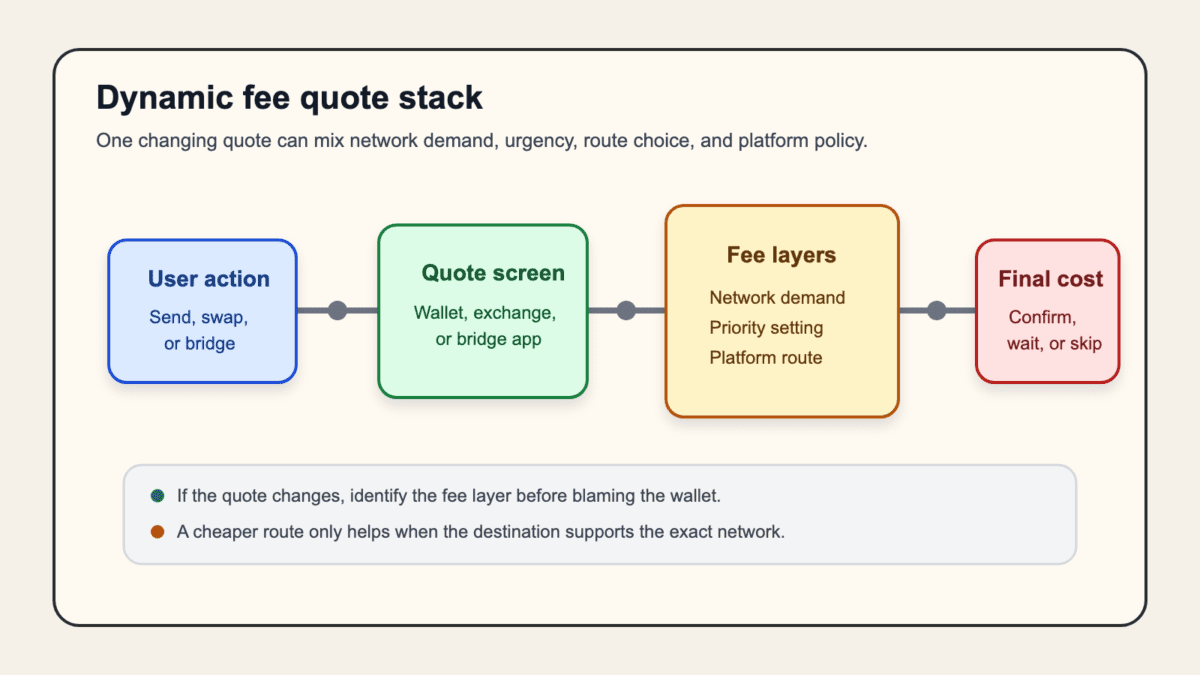
That is why “exchange withdrawal fee versus network fee” is such a common point of confusion. The blockchain may set the cost of inclusion, while the platform controls the withdrawal product and its screen. Both can be honest. Both can still hurt.
A dynamic fee changes before confirmation because the estimate is being refreshed against live conditions. If demand rises, the wallet may quote a higher network fee. If you change speed, route, chain, token, or transaction type, the app may rebuild the quote.
The estimate can also move because your transaction needs different resources. A simple transfer is not the same as a smart contract swap. A bridge route is not the same as sending a token on one chain. And a crowded mint is not the same as a quiet Sunday transfer.
These inputs tend to move the quote before you confirm:
Native gas-token balances matter here. You may hold USDC, but still need ETH, SOL, MATIC, or another native token to pay the chain fee. Sponsored gas and paymasters can hide that step in some apps, but they do not make execution free. They only move who pays, how much is covered, and what limits apply.
> Normal dynamic fees appear inside the wallet, exchange, bridge, or app confirmation flow. A separate message demanding an off-platform “tax,” “release fee,” or extra payment is a different risk and should be treated as suspicious.
The quote is not always final until the transaction is sent or the withdrawal is confirmed. If you wait, refresh, or change the priority slider, the number can move again. That is annoying, but not automatically shady.
Dynamic fee mechanics look different across chains. The shared idea is scarcity. A network has limited room, users want timely execution, and the fee system decides who gets included now, later, or not at all.
Ethereum, Bitcoin, and Solana show three useful versions of the same problem. Ethereum explains gas settings. Bitcoin explains mempool competition. Solana explains why a fast, low-fee chain can still have priority costs during crowded trading.
Ethereum dynamic fees revolve around gas. Gas measures the work a transaction needs, while the fee pays for that work and for inclusion. A simple ETH transfer uses less gas than a complicated smart contract call.
The main wallet terms are easy to separate:
The Ethereum gas documentation separates total gas price into a protocol-set base fee and a user-added priority fee. It also notes that the base fee can move by up to 12.5% per block based on how full the previous block was. The base fee is burned. The priority fee is the tip that can make a transaction more attractive to validators.
Your wallet may also show a max fee. That is the cap you are willing to pay per unit of gas. If the final base fee plus tip lands below that cap, unused ETH can be refunded. If the cap is too low, the transaction may wait or fail to get included. Dynamic does not mean cheap. It means Ethereum adjusts pricing as demand changes. During token launches, NFT mints, liquidations, or busy market moves, the same action can get expensive fast.
Bitcoin dynamic fees come from mempool competition and transaction size. The mempool is where unconfirmed transactions wait before miners include them in blocks.
When many users want blockspace, higher-fee transactions are more attractive to miners. If you pay too little, your transaction may wait. If you need fast confirmation, you may need to pay more. Peak-hour pricing is not a perfect analogy, but it gets the mood right.
Two variables usually explain surprise Bitcoin fees:
Bitcoin fees can also surprise users because not every transaction has the same data size. A payment that spends many small prior outputs can be larger than one that spends a cleaner output set. That can make the fee feel strange if you only compare the dollar amount being sent.
This is where small payments get awkward. A fee that is fine for a larger move can make a small purchase or wallet cleanup uneconomic. The chain is doing what it does. Your transfer may still be a bad use of blockspace at that moment.
Solana dynamic fee language often shows up around priority fees and congested apps. Base transaction costs are usually low, but users can still pay extra to improve scheduling when demand crowds a route.
That does not mean every Solana transaction needs a high priority fee. Routine transfers may not. Busy swaps, token launches, bot-heavy markets, and liquidation-style actions are different. In those moments, users are competing for execution, not admiring a fee chart.
Common screen labels can include:
Solana traders may also see Jito tips, compute-unit settings, platform charges, or bot route costs. Those settings can improve a route in specific conditions, but they can also turn a tiny trade into fee confetti. Your wallet balance sees every cost, even when the app highlights only the entry.
Failed or retried transactions matter too. A failed attempt may still leave some costs behind depending on the chain and app path. So a cheap-looking priority setting is not the whole story if the route keeps missing.
A dynamic fee is worth paying when speed or priority changes the outcome enough to justify the cost. If the transaction is not urgent, paying more may only buy a faster version of the same result.
Good reasons can exist. An urgent withdrawal, liquidation defense, bridge timing issue, crowded mint, or volatile DEX trade may reward faster execution. But “the fee went up” is not a strategy. It is a cost signal.
Use this split before accepting the quote:
Then run the quick version of the math:
The trader version is especially unforgiving. In PVP trading, everyone is competing against other wallets, bots, and thin liquidity. A higher priority cost can help a transaction land, but it cannot create liquidity or fix a bad setup.
For slower portfolio moves, set a fee ceiling before opening the app. If the quote crosses that ceiling, wait or resize the transfer. If the fee is larger than the expected edge, skipping the transaction may be the cleanest move. No wallet popup will say that out loud. Very rude, but useful.
A dynamic fee on an exchange withdrawal is platform-controlled and may track current network costs. The exchange may show the fee before confirmation, update it by asset, and change it by the network you choose.
This is not the same as using a self-custody wallet. A wallet quote usually estimates the onchain transaction cost. An exchange withdrawal quote can include network costs, batching policy, custody processing, minimum withdrawal rules, asset support, and the platform’s own display choices.
The screen can combine several decisions:
When you move funds to self-custody, crypto wallets with clear fee previews and native-token warnings can make the workflow easier. The wallet still cannot make an unsupported chain safe, and it cannot remove an exchange withdrawal policy.
Stablecoins make this clearer. USDC on Ethereum, Solana, Base, Arbitrum, or another network is not one interchangeable rail. The destination must support the exact network. A cheaper withdrawal route is useless if the receiving platform or wallet cannot handle it.
Minimum withdrawals and small balances add another squeeze. An exchange may require a minimum send, then subtract a dynamic withdrawal fee, while the destination network has its own gas needs later.
You can reduce a dynamic fee by waiting, choosing a supported cheaper network, using an appropriate Layer 2, avoiding tiny transfers, or lowering priority when urgency is low. The trick is not turning a fee problem into a funds problem.
Waiting is often underrated. If the transaction is routine, a quieter network period can lower the estimate. Lowering priority can also help, as long as you can tolerate slower confirmation or a pending transaction.
Layer 2s and cheaper chains can help when the token, app, and destination already support that route. They stop helping when you must add bridges, swaps, risky approvals, or a network the recipient cannot use.
Use this checklist before chasing the cheapest route:
Network choice can help, especially for stablecoins and exchange withdrawals. But the receiving address, chain, and asset must match. Wrong-network transfers are not a discount. They are a customer-support adventure with no guaranteed happy ending.
Small dust balances are where dynamic fees look most absurd. If the fee is near the value of the asset, moving it may not be worth the attempt. Cheapest is not always safest. Aim for a fee you understand, on a route you can recover from, for a transaction that still makes sense after costs.
Dynamic fees can tell investors something about demand, but they do not hand out clean buy or sell signals. High fees can show that blockspace, app routes, or withdrawal rails are crowded. They can also show that the user experience is getting painful.
That creates a tradeoff. A high-fee network may capture more value from users during busy periods. It may also push activity toward Layer 2s, cheaper Layer 1s, custodial transfers, or offchain routes. Fee pressure can be a strength, a weakness, or both. The same fee spike can point to real demand on one chain and product friction on another.
When looking at fee charts, separate the signals:
Different protocols handle fee value differently. Some burn part of the fee. Some pay validators or miners. Some route value through sequencers, apps, MEV infrastructure, or service providers. The path changes who captures the value users pay, so one fee spike is not a full investment thesis.
Crowded trades add another layer. If people are paying high dynamic fees to chase a launch, the market may already be crowded. That can turn late buyers into exit liquidity faster than the fee screen can refresh. For investors, the useful signal is the pattern, not the screenshot. Watch whether fees reflect durable demand, temporary hype, poor UX, or a migration to cheaper rails.
No, a dynamic fee is not always the same as a gas fee. Gas is one kind of network fee, mostly associated with Ethereum and EVM chains.
A dynamic fee can also be an exchange withdrawal fee, bridge route fee, wallet estimate, priority cost, or app service charge. The label depends on where you see it.
Your dynamic fee changed because the estimate refreshed against new conditions. Network activity, priority settings, route choice, token type, and platform quote timing can all change the number.
That does not automatically mean the fee is fake. It means you should check the fee layer before confirming.
Dynamic fees are usually not a scam when they appear inside a legitimate wallet, exchange, bridge, or app confirmation flow. They are common in systems where cost changes with demand.
Be careful with separate messages asking you to pay a tax, release charge, or off-platform fee before funds can move. That is a different warning sign.
You should use a cheaper network only when the destination supports that exact network and asset. The receiving address, platform, and wallet must all match the route.
Also check liquidity, custody, bridge risk, and future gas needs. A cheaper quote is not useful if it creates a recovery problem.
Yes, a dynamic fee can make a trade unprofitable. Fees, priority costs, slippage, spread, platform charges, and failed attempts can erase a small edge.
This is most common in tiny trades, crowded launches, volatile DEX routes, and bot-heavy markets. The trade has to beat the whole cost stack, not only the chart move.
Start with the confirmation screen, not the headline number. Identify whether the dynamic fee is a network fee, exchange withdrawal fee, trading cost, route fee, wallet fee, or priority setting. That tells you whether to wait, resize, switch routes, or stop.
Do not start with the dollar amount alone. The same fee can be normal, wasteful, or risky depending on the asset, chain, and reason for moving funds. A $20 fee on a large urgent transfer is different from the same fee on a small stablecoin move.
Before you confirm, work through these checks:
For withdrawals, pause on the network selector. The token ticker is not enough. USDC on one chain and USDC on another can land in different places, with different recovery odds. A cheaper rail helps only when the recipient can actually receive it.
For trades, include costs the quote may not highlight. Slippage, spread, route fees, priority settings, and failed attempts all pull from the same expected edge. If the app keeps retrying, the math can change while you are watching.
Save enough detail to reconstruct the move later:
If the route still makes sense after those checks, the dynamic fee is a cost of execution. If it does not, wait, resize, or cancel rather than paying a fee you cannot explain. The cheapest transaction is often the one you do not send.