Physical Address
304 North Cardinal St.
Dorchester Center, MA 02124
Physical Address
304 North Cardinal St.
Dorchester Center, MA 02124


Eigen points explained without airdrop fog.
Eigen points are restaking participation scores that track EigenLayer activity, not wallet tokens, EIGEN, or guaranteed future payouts.
That distinction saves a lot of expensive confusion. A user can have Eigen points without holding a tradable point token, and a user can hold EIGEN without having a direct restaking position. The score may help explain past or possible reward logic, but it does not remove route rules, eligibility filters, or the usual DeFi habit of turning simple curiosity into a wallet prompt.
Eigen points sit in the same neighborhood as restaking, liquid restaking tokens, AVS rewards, and airdrop hunting. They are useful to understand if you already have exposure. They are a weak reason, by themselves, to add risk you cannot explain.
Eigen points are a protocol-style record of participation in EigenLayer restaking. They measure activity over time, usually by connecting the amount restaked with how long that position stayed active.
The tricky part is the word “points.” In everyday life, points sound redeemable. In crypto, they can mean a scoreboard, campaign metric, eligibility signal, marketing hook, or future reward hint. That range is where users get trapped.
For Eigen points, the clean definition is narrow: they are a participation score. They are not EIGEN. They are not an ERC-20 token. They are not a receipt that promises a fixed amount of future value.
That does not make them useless. A points score can still affect how a protocol, foundation, LRT provider, or vault describes activity and rewards. But the score is only one input. Eligibility can still depend on snapshots, route rules, geography, wallet status, provider terms, and official claim windows.
The score also may not sit where you expect. Some users look for Eigen points inside a wallet balance, then assume something is missing. Often the relevant record lives in an app, provider dashboard, eligibility checker, or campaign page instead.
The useful habit is to ask one question first: “Who is tracking this score?” If the answer is EigenLayer, a liquid restaking protocol, a vault, or a third-party dashboard, the next steps and risks can change quickly.
Eigen points still deserve attention because many users used them to judge restaking rewards, airdrops, and eligibility. That is why old dashboards and new strategy posts still mention points long after the first EIGEN distribution cycle.
Eigen Foundation announced the Season 1 stakedrop on April 29, 2024, with the Phase 1 claims window planned for May 10, 2024. Later, Eigen Foundation said Season 2 allocated about 70 million EIGEN to stakers and operators. Points history can matter without turning every score into a live promise.
The history helps, but it is not a promise. Points helped users understand why they might be included in a past distribution. They did not turn into a universal right to claim future EIGEN.
Here is the safer timeline.
| Date Or Phase | What Changed For Eigen Points |
|---|---|
| Restaking campaign period | Points became a visible way to track restaking participation. |
| Season 1 announcement | Points became tied to stakedrop expectations and eligibility questions. |
| Claims window | Users had to check official rules, route treatment, and claim status. |
| After the first cycle | Points became more of a risk and rewards signal than a simple airdrop bet. |
People still remember the chase. That behavior sits close to points farming: users do activity mainly because a future reward may appear.
Eigen points also became part of the restaking crypto meta. Once a market narrative gets hot, users often confuse “this protocol has points” with “this protocol owes me money.” That is the exact mistake to avoid.
Eigen points are usually calculated from restaked exposure over time. The common shorthand is an ETH-hour style score: more eligible stake over more time means more points.
For a concrete historic formula, Bedrock uses the example of 1 ETH restaked for 1 hour equaling 1 restaked point. That makes the idea easy to understand, but it should not be stretched into a universal live rule for every route.
A simple example works like this.
The caveat is more useful than the arithmetic. Eigen points can look simple at the base layer and messy at the user layer. The mess appears when the user is not restaking directly.
Liquid staking tokens, liquid restaking tokens, vaults, custodial accounts, and Pendle-style positions can each change who tracks the points and who may receive a future reward. If a dashboard shows points, ask whether those are Eigen points, LRT points, vault points, or a blended campaign score.
So the formula tells you the basic idea. The route tells you whether the displayed number means anything useful to you.
Eigen points, EIGEN, AVS rewards, and LRT points are separate things. They can appear in the same restaking story, but they do not give the user the same claim.
The comparison below separates the score from the assets and rewards around it.
| Term | What It Means For The User |
|---|---|
| Eigen points | A restaking participation score tied to eligible activity over time. |
| EIGEN | A token, with market price risk and its own protocol role. |
| AVS rewards | Rewards tied to services that operators help secure through restaking. |
| LRT points | A third-party protocol score from a liquid restaking provider. |
| Vault points | A score tracked by a vault, strategy, or yield route. |
| Airdrop eligibility | A rule-based status that may use points but can include other filters. |
The table helps prevent a wallet-screen mistake. A token balance feels concrete. A points number feels promising. A claim page feels urgent. None of those feelings prove ownership.
EIGEN can trade like a token. AVS rewards can depend on service rules, reward budgets, operator behavior, and provider choices. LRT and vault points can depend on a third party that sits between the user and EigenLayer.
The confusion usually starts when several labels appear on one dashboard. One page may show restaked assets, Eigen points, a provider campaign, and an expected reward. That does not mean each item has the same issuer, claim path, or liquidity.
The best check is boring but effective: name what you actually hold. If you hold EIGEN, you have token exposure. If you hold an LRT, you have wrapper exposure. If a dashboard shows Eigen points, you have a score whose meaning depends on official or provider rules.
People earn Eigen points by taking an eligible restaking route that tracks activity. The route changes the answer because direct restaking, LST restaking, LRTs, vaults, and custodial products can handle scoring differently.
Start with the asset. ETH, stETH, rETH, cbETH, weETH, ezETH, rsETH, or another wrapper can all sit near restaking conversations. But similar exposure does not mean identical eligibility.
Then identify who controls the route. A wallet user, LRT provider, vault manager, operator, and custodial platform can all sit between the asset and the points record. That distance changes what you can verify yourself.
This route check comes before any assumption that points count.
| Route | What To Check Before Assuming Points Count |
|---|---|
| Native restaking | Whether the EigenPod, operator delegation, and wallet activity are eligible. |
| LST restaking | Whether the supported LST route earns points directly or through a provider. |
| LRT protocol | Whether the LRT provider tracks Eigen points, its own points, or both. |
| Vault strategy | Whether the vault owns the route and how it allocates any rewards. |
| Pendle-style route | Whether points follow the principal token, yield token, or campaign terms. |
| Custodial route | Whether the platform passes points, rewards, or eligibility to the user. |
A route can turn Eigen points into a custody and accounting question. A direct restaker may see one type of activity record. An LRT holder may rely on the provider to display, allocate, or pass through points. A vault user may hold exposure to a strategy, not the raw restaking position.
That is why route-based crypto farming can be confusing. Users may think they are farming one thing, while the actual score sits one wrapper deeper.
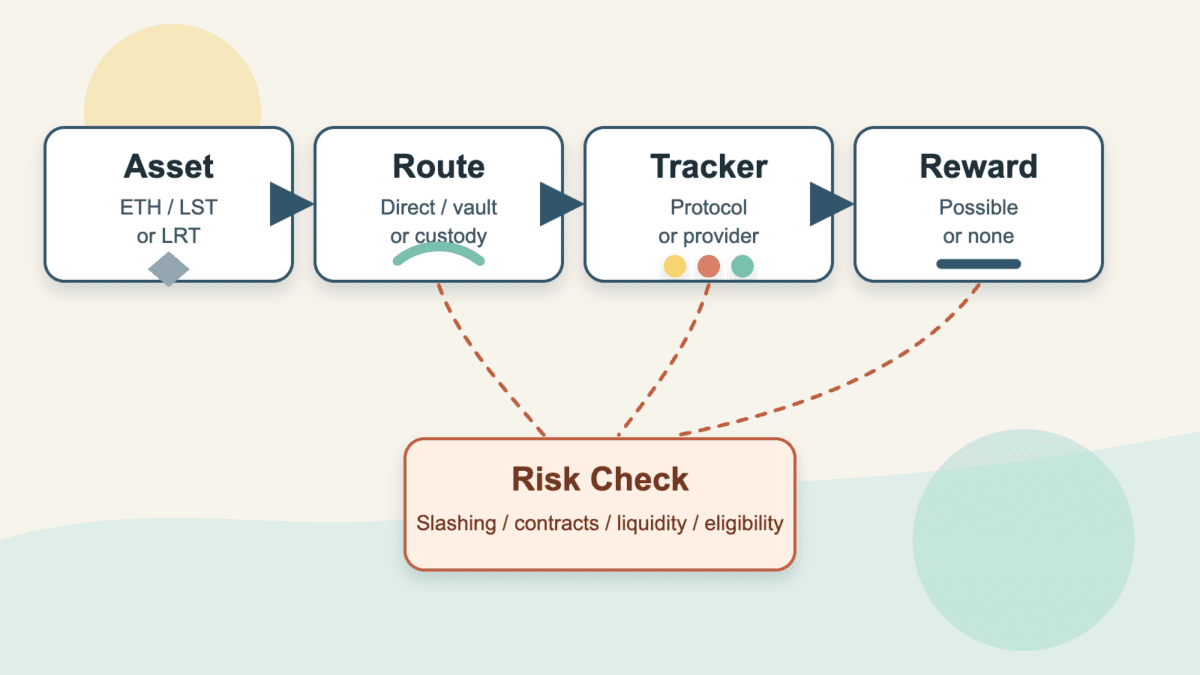
Wrappers are not automatically bad. They can add liquidity, convenience, and strategy access. But they also add rules. If a provider controls the route, the provider’s terms control what the points mean to you.
The main risk before chasing Eigen points is adding real financial exposure for a score that may never become a payout. Points are the carrot. The risk stack is the bill.
Restaking can add slashing exposure, operator selection risk, AVS exposure, smart contract risk, LST or LRT depeg risk, withdrawal delays, gas costs, tax records, and eligibility uncertainty. None of those disappear because a dashboard shows a neat points number.
Slashing is the scary word, but it is not the only one. A depeg can hurt before any AVS penalty appears. A vault can change withdrawal timing. A provider can show points that later depend on its own allocation rules. Gas can eat the edge on small positions.
Run these checks before you chase the score.
The social layer can be dangerous here. A hot Crypto Twitter thread can make points feel like a countdown to free money, even when the official rules say less.
Position size belongs in the risk check too. Going full port into a restaking route because of vague reward hopes is not research. It is a scoreboard with wallet risk attached.
The sneakiest risk is value speculation. Users often ask what Eigen points are worth, but a point only has value if a credible rule gives it value. Without that rule, the number is useful as a record, not as a balance.
Jurisdiction can also change the outcome. A past or future reward program may apply regional restrictions, identity checks, claim windows, or provider-specific handling. If a strategy only works when every later rule breaks in your favor, the strategy is thinner than it looks.
Checking Eigen points safely means verifying the official source before connecting a wallet or trusting a claim link. Any topic with points and airdrops attracts fake pages because users expect a reward.
Do not turn a score check into an approval spree. A fake link can do more damage than a bad yield thesis.
This is especially true after a stakedrop cycle. Old claim links, copied screenshots, and lookalike domains can keep circulating long after the real window changed. Urgency is a risk signal, not proof that rewards are waiting.
Use this safety checklist.
Wallet hygiene belongs in the core process. If you need a custody refresher, CryptoProcent’s wallets category is the more relevant place to think about approvals, storage, and account setup.
The safe path is not a click-by-click claim tutorial. Those age badly. The durable rule is simpler: official source first, minimal permissions second, and no random claim links in between.
If you are checking through a provider, confirm whether the provider names EigenLayer, its own campaign, or both. A dashboard can be useful and still be incomplete.
Eigen points are worth paying attention to if you already restake, hold LRT exposure, use vaults, track airdrops, or hold EIGEN. They are not enough reason by themselves to add risk.
That is the balanced read. Points can help you understand activity, provider routing, and possible reward history. They can also become a shiny distraction from liquidity, exits, and eligibility.
The answer changes by wallet. Someone already restaking may need the points record for tracking and tax notes. Someone with no exposure should not use points as a reason to enter a complex route cold.
Pay attention if these describe you.
Be careful if these describe the pitch.
There is a difference between a researched conviction play and blind points chasing. The first starts with a thesis and risk limits. The second starts with “maybe free tokens” and hopes the exit is kind.
That does not mean ignoring points completely. It means reading them as a clue, then checking the route, source, and risk before doing anything with money.
Eigen points make more sense when you understand the behaviors around them. Most confusion comes from treating a score like a token, then treating a possible reward like a claim.
These related concepts help sharpen the risk side without turning Eigen points into a shopping path.
Airdrop eligibility is still a rule, not a vibe. A dashboard score is not enough. Wallet approvals decide what a claim page can do, so safety checks belong before reward checks. Route ownership decides who can see, allocate, or pass through a future reward.
That is the useful lens for Eigen points. They are a record to interpret, not a trophy to worship. Track the score, but keep the route, risks, and claim rules in separate boxes.
No. Eigen points are a restaking participation score, not a token that normally appears in your wallet as a transferable asset. EIGEN is the token. Eigen points are the activity record.
That difference is useful when you check balances. A wallet may show EIGEN or an LRT, while a dashboard shows points. Do not assume the missing wallet token means you lost anything.
No. Eigen points do not guarantee an EIGEN airdrop or any future payout. A past or future distribution can use points as one input, but eligibility can also depend on snapshots, geography, route rules, claim windows, and official terms.
That is why old points history should not be read as a live promise. Always check the current official rule set before treating any score as claimable.
Eigen points are not designed like a normal transferable token. Some markets or private arrangements may try to price points exposure, but that is not the same as selling an official wallet asset. Treat any points marketplace with heavy caution.
If someone offers a simple points sale, ask what is actually being transferred. It may be a claim, account access, derivative exposure, or just a very creative way to create regret.
The basic historic idea is ETH-hours: one eligible ETH restaked for one hour can equal one point under simple provider examples. But the number you see can change by route, delay, wrapper, provider, and current official rules.
For direct routes, the score may look straightforward. For LRTs, vaults, and Pendle-style positions, the provider may control how points are tracked and displayed.
They may, but you need to check the provider’s current route and terms. An LRT can track Eigen points, its own protocol points, or both. The provider may also control how any future reward is allocated.
Do not assume two LRTs handle points the same way. Similar restaking exposure can still produce different dashboards, eligibility rules, withdrawal paths, and reward handling.
Check Eigen points only through official sources or trusted read-only tools. Avoid random claim links, inspect wallet approvals, and do not sign transactions just because a page says rewards are waiting.
If a claim page appears in a social post, verify it from an official domain before connecting. A real reward can wait for verification. A fake approval usually cannot be undone cleanly.
Start with your route, not the reward story. Eigen points only become useful when you know which asset, wrapper, wallet, and provider produced the score.
Then write the answer down. That sounds dull, but it prevents the classic mistake: mixing a token position, an LRT position, and a points dashboard into one imaginary claim.
Use these next actions.
The final answer is plain: Eigen points are worth understanding, especially if you already have restaking exposure. They are not worth chasing blindly. A score can be useful. A score with unclear risk is just a spreadsheet wearing a cape.
If you cannot explain the route in one sentence, stop before adding size. Points should clarify your exposure, not pressure you into signing the next wallet prompt.