Physical Address
304 North Cardinal St.
Dorchester Center, MA 02124
Physical Address
304 North Cardinal St.
Dorchester Center, MA 02124


EigenLayer explained without the yield-button fog.
EigenLayer is an Ethereum restaking protocol that lets staked ETH, supported LSTs, EIGEN, and eligible assets secure extra verifiable services for possible rewards and added risk.
The efficiency is real. So are the added dependencies: smart contracts, operators, AVSs, reward rules, withdrawal paths, and sometimes third-party liquid restaking tokens. Before judging an EigenLayer route, narrow the question: which layer are you using, and what can fail?
EigenLayer is a restaking protocol built on Ethereum. It lets stakers commit assets to support services beyond ordinary Ethereum validation, while accepting extra rules that can include rewards and penalties.
EigenLayer’s protocol overview maps the main loop as a market that connects restakers, operators, and Autonomous Verifiable Services, usually shortened to AVSs. The idea is simple enough: a new service can use restaked security instead of building a separate validator market from scratch.
The word to watch is “extra.” EigenLayer sits on top of Ethereum staking exposure. It does not replace Ethereum, and it does not make ordinary staking risk disappear.
That is also separate from buying EIGEN on an exchange. Buying the token gives market exposure to the token. Restaking ETH or an LST through EigenLayer gives protocol and operator exposure. Holding a liquid restaking token adds another wrapper.
So it helps to think of EigenLayer as a shared-security layer. It can make staked assets work harder, but busier collateral has more failure paths.
EigenLayer restaking works by connecting four roles: a restaker supplies assets, an operator performs work, an AVS defines tasks and penalties, and EigenLayer contracts coordinate delegation, rewards, and slashing.
The loop is straightforward. You restake an eligible asset and delegate it to an operator. That operator runs AVS software, and the AVS may pay rewards if the work is done properly. If the work breaks AVS rules, the operator’s allocated stake can face penalties.
The role map keeps the jargon in order.
| Role | What It Does |
|---|---|
| Restaker | Supplies eligible assets and delegates security to an operator. |
| Operator | Runs software for AVSs and accepts AVS-specific obligations. |
| AVS | Defines the service, task rules, reward logic, and penalty design. |
| EigenLayer contracts | Coordinate restaking, delegation, reward claims, withdrawals, and slashing paths. |
The important point is that delegation does not mean the operator can simply take the tokens. It means the operator can put delegated stake to work in ways that may earn rewards or become slashable under AVS rules.
Restakers are users who commit eligible assets into the EigenLayer system. That can include native ETH routes, supported liquid staking tokens, EIGEN, or other eligible assets depending on the current route.
The restaker chooses how much exposure to add and where to delegate it. That choice changes the real risk because the operator and AVS list shape the outcome.
Operators run the infrastructure for AVSs. They are the working layer between the restaker’s delegated stake and the services that need verification.
An operator can support multiple AVSs. That can make the operator more useful, but it can also make the risk harder to read if each AVS has different rules.
AVS now usually means Autonomous Verifiable Service. Older pages may use Actively Validated Service, so seeing both is normal.
An AVS is a service that wants verifiable work, such as data availability, oracle support, bridge checks, sequencer work, prover tasks, or other offchain computation tied back to Ethereum-style security.
EigenLayer contracts manage the protocol side of restaking. They do not make every AVS safe, and they do not make every reward durable.
They coordinate the route. Users still need to check the operator, the AVS, and the exit process before putting funds at risk.
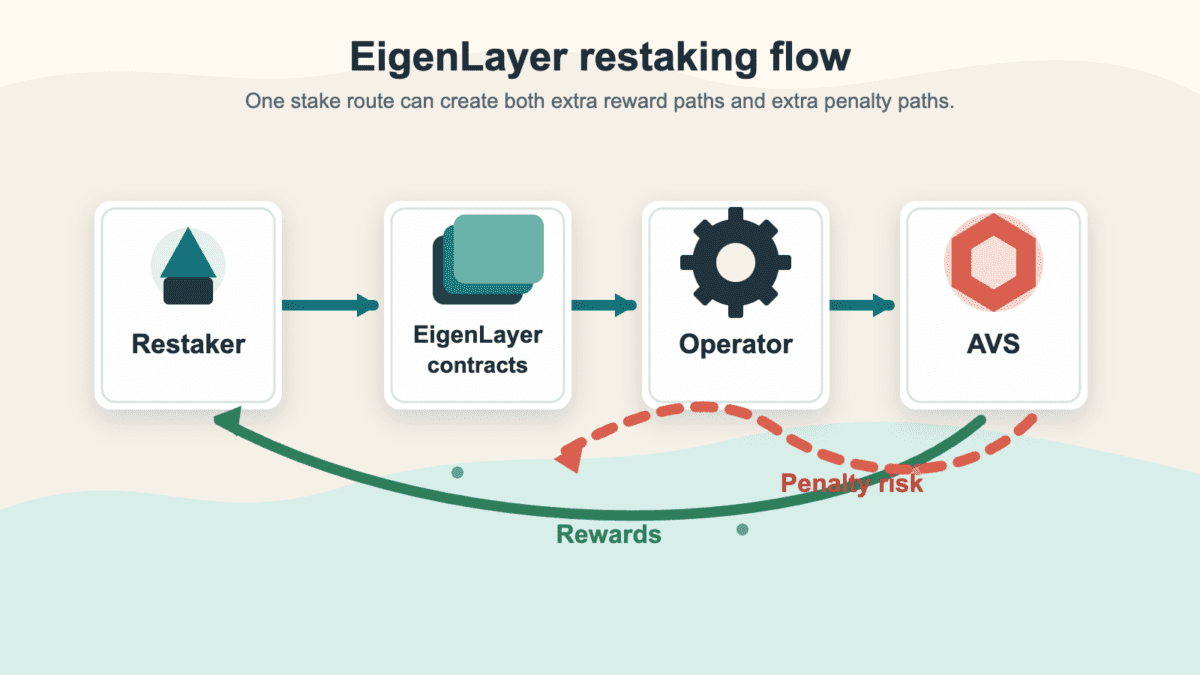
The flow is useful because it separates the moving parts. A reward can come from one part of the loop, while a failure can arrive from another.
EigenLayer, restaking, liquid restaking tokens, CEX restaking products, and EIGEN spot exposure are different routes. They can share the same story without giving you the same claim.
That distinction prevents a common mistake. A shiny exchange page about EIGEN is not a restaking tutorial. A high-yield LRT dashboard is not direct EigenLayer delegation. A wallet route is not a custodial product.
Here is the route-by-route comparison.
| Route | What Changes |
|---|---|
| Direct ETH staking | You take ordinary Ethereum staking exposure, including validator and staking-service risk. |
| LST staking | You hold a liquid staking token, so issuer quality, redemption, and market liquidity matter. |
| Direct EigenLayer restaking | You add EigenLayer contracts, operator choice, AVS rules, and possible slashing exposure. |
| LRT exposure | You hold a tokenized restaking position, so wrapper transparency, depeg risk, and route opacity matter. |
| CEX restaking product | You depend on the platform’s custody, terms, eligible assets, reward handling, and exit process. |
| EIGEN token | You hold spot token exposure, so price volatility and token-specific demand drive the position. |
The useful habit is to name what you actually hold. ETH in a validator, an LST, an LRT, a CEX balance, and EIGEN each answer to a different failure path.
LRTs add another practical concern: exits may depend on market depth, not just the calm withdrawal story in a dashboard. That is where exit liquidity becomes more than slang.
Do not let one route prove another. EigenLayer may be the parent protocol, but your real risk comes from the exact path your funds take.
EigenLayer rewards can come from more than one source, and that is why APY screenshots can mislead. A displayed number may blend staking yield, AVS rewards, token incentives, points, operator fees, and platform deductions.
EigenLayer rewards documentation separates AVS rewards, operator-directed rewards, operator fee splits, and programmatic incentives. That helps explain why two users can see different results even if both are “using EigenLayer.”
For a practical fee example, that same documentation lists the default operator fee split at 10%, so the fee path is not a rounding error.
Use this table as a reward sanity check.
| Source | What To Check |
|---|---|
| Base ETH staking rewards | Whether the route keeps ordinary staking yield separate from extra restaking rewards. |
| AVS rewards | Which AVS pays them, in what token, and under what eligibility rules. |
| EIGEN or AVS incentives | Whether incentives are active, claimable, vested, or only expected. |
| Points campaigns | Whether points have any stated conversion, or are just a leaderboard. |
| Operator fees | Whether the operator takes a cut before rewards reach restakers. |
| LRT deductions | Whether a liquid restaking protocol takes protocol fees or changes reward timing. |
| CEX service fees | Whether a platform keeps part of the reward or changes the exit terms. |
This is why “extra yield” is too blunt. Extra compared with what? Paid by whom? In which token? After which fees? With which slashing rules?
Some routes can start to look like crypto farming when users chase points, emissions, and campaign rewards without checking the underlying AVS demand. That does not make the route fake. It does mean the reward source deserves a raised eyebrow.
The clean read is simple: EigenLayer rewards are possible, variable, and route-specific. A screenshot is not a contract.
EigenLayer exposure can lose money. The loss may come from ordinary staking issues, smart contract risk, operator behavior, AVS rules, slashing, LRT depegs, liquidity problems, wallet mistakes, fake links, or EIGEN token volatility.
Slashing is the sharpest term in the stack. Under EigenLayer’s slashing rules, an AVS can penalize an operator’s allocated Unique Stake when the operator breaks AVS-defined commitments and the required conditions are met.
That does not mean every bad headline instantly slashes every restaker. It means the AVS, operator set, allocated stake, safety delays, and rule design matter.
Warning: slashing risk depends on the full path: which operator, which AVS, which operator set, which allocated stake, and which penalty process.
Use this risk map before you deposit or delegate.
| Risk | What To Check |
|---|---|
| Ethereum staking risk | Whether the base staking route is native, pooled, liquid, or custodial. |
| EigenLayer contract risk | Whether you understand the contracts and route you are using. |
| Operator risk | Operator reputation, concentration, AVS list, and incident history. |
| AVS rule risk | What commitments the AVS requires and how penalties work. |
| Slashing risk | Which stake is slashable and what process must happen first. |
| Redistribution or burn | Whether slashed funds are burned, redistributed, or otherwise handled by the protocol path. |
| LST or LRT depeg | Whether the wrapper can trade below the underlying exposure. |
| Exit friction | Withdrawal queues, unstaking delays, market liquidity, and route-specific terms. |
| Wallet and phishing risk | Approvals, fake airdrops, fake support pages, and copied URLs. |
| EIGEN market risk | Price swings that have little to do with your restaking mechanics. |
Layered exposure also creates position-sizing risk. A high-yield claim is a weak reason to full port into a route you cannot explain.
The most overlooked risk is mismatch. A user thinks they are earning simple staking yield, but they actually hold an LRT. Or they think buying EIGEN gives restaking rewards, when it mainly gives token-price exposure.
EigenLayer is not automatically unsafe. It is just not simple staking with a free coupon taped on top. The coupon has terms.
An EigenLayer opportunity is worth checking by route first, not by headline APY. Start with the asset, the operator, the AVS list, the reward source, the fees, and the exit path.
A boring checklist beats a clever thesis here. Most avoidable mistakes show up in the route details.
Run through these checks before you connect a wallet or accept a custodial product.
Wallet safety is not a side quest here. Restaking topics attract fake front ends because users expect to connect wallets, check rewards, and claim something. A practical wallet-safety routine is part of the risk work.
Fake pages can also turn a complex opportunity into a simple theft. If a claim link drains funds or a copied support page captures approvals, the result can feel like a hard rug before the real EigenLayer risk even begins.
The final check is source quality. If a reward claim only appears in a social post, a screenshot, or a referral thread, slow down. Real protocol exposure should survive basic verification.
EigenLayer examples help because AVS sounds abstract until the service has a job. Services such as data availability, infrastructure, or verification work can use restaked security instead of bootstrapping a separate security market.
EigenDA is a clear example. It is a data availability service connected to EigenLayer, built for rollups and other systems that need data to be published, available, and verifiable.
EigenDA is not “another staking app.” It is an AVS connected to operators and restaked security for data availability work.
Other possible AVS categories include oracle networks, bridge checks, RPC infrastructure, sequencer support, prover networks, and verifiable compute. The common thread is the need for outside verification backed by economic risk.
A useful AVS can still have opaque rules, weak disclosure, poor operator distribution, or reward economics that do not justify the added risk.
So use examples as a map, not as a green light. The same EigenLayer model can support serious infrastructure and still produce routes that are too opaque, too crowded, or too hard to exit.
Examples show that the model has real uses. They do not prove that every restaking route is worth using.
EigenLayer and EIGEN are separate exposures. EigenLayer is the protocol and restaking layer, while EIGEN is token exposure tied to the project’s token market and eligible protocol roles.
Buying EIGEN can make sense for a trader with a token thesis. It does not mean that trader is restaking ETH, earning AVS rewards, or accepting the same slashing route as a direct restaker.
Keep these decisions separate.
This split is especially useful when restaking becomes a market theme. Narratives can lift token prices before rewards, usage, and AVS demand are easy to measure.
The risk is ending up as a bagholder in a token story you mistook for protocol revenue. The protocol may be interesting, and the token may still trade badly. Crypto allows both at once.
Related EigenLayer concepts are useful when they expose the exact layer you are using. They should map failure paths, not become a link pile or a shopping path.
Restaking is the parent action: using already staked or eligible assets to support more services. Liquid staking is different because it starts with a token that represents staked ETH. Liquid restaking adds another wrapper on top of the restaking route.
AVS means the service receiving the verification work. Operator means the entity running that work. Slashing means the penalty path if AVS-defined commitments are broken. If those three terms are fuzzy, the rest of the stack turns into yield soup.
Market language changes how EIGEN trades. EIGEN can move like a restaking theme before the protocol mechanics are easy to measure.
If you are tracking LRT exits, start with exit liquidity. It asks the right question: can you leave at the value you think you have? If points and incentives drive the thesis, crypto farming gives better language than “free yield.”
Wallet approvals belong in the same mental folder as wallets, because custody mistakes often happen before protocol risk begins. Market timing belongs in a different folder: a restaking market rotation can make a careful thesis look obvious after the move.
EIGEN can also trade as a narrative coin when restaking becomes the theme of the month. That does not make the protocol mechanics irrelevant, but it can make price action noisier than usage.
With LRTs and DeFi wrappers, exits can depend on markets, not only protocol withdrawal screens. That is why related terms matter here: each one should clarify what you hold, who you trust, or how you leave.
If a term does not help with one of those questions, it can wait.
Start with EigenLayer by mapping the route before touching the yield. You need to know the asset, wrapper, operator, AVS exposure, fees, reward source, and exit path.
Use this as a practical first pass.
That last point is not timid. It is clean accounting. A small test position can teach route mechanics without turning every unknown into a portfolio event.
If the route still feels unclear after those checks, the answer is usually to pause. A protocol can be real, useful, and still wrong for a user who cannot explain the exit path.
If EIGEN is a token thesis, call it a token thesis. If restaking is a researched protocol thesis, call it that. A real conviction play should survive more than an APY screenshot and a loud thread.
EigenLayer is a protocol that lets eligible staked assets support extra services beyond normal Ethereum staking. In return, users may receive extra rewards, but they also accept extra contract, operator, AVS, and slashing risk.
EigenLayer is a restaking protocol, but restaking is the broader action. You can restake through different routes, and each route changes what you hold, who you trust, and how you exit.
Yes, EigenLayer restaking can lose money. Losses can come from slashing, contract issues, LST or LRT depegs, poor liquidity, platform terms, wallet mistakes, scams, or EIGEN price volatility.
No, EigenLayer does not make yield guaranteed. Rewards can depend on the AVS, operator, route, eligibility rules, token incentives, claim timing, fees, and whether a campaign is still active.
An AVS in EigenLayer is an Autonomous Verifiable Service that uses operators and restaked security for verifiable work. Older explainers may call it an Actively Validated Service.
No, buying EIGEN is token exposure. Using EigenLayer means choosing a restaking route, operator, and AVS exposure, which creates a different risk and reward profile.


