Physical Address
304 North Cardinal St.
Dorchester Center, MA 02124
Physical Address
304 North Cardinal St.
Dorchester Center, MA 02124


A plain-English guide to fixed yield token mechanics and risks.
A fixed yield token is a crypto tokenized position designed to produce a known or pre-priced return over a set term.
That does not mean the return is guaranteed. It means the rate or redemption math can be clearer at entry, usually because the token trades at a discount and can be redeemed at maturity if the underlying system works.
The messy part is that people use the phrase for a few nearby things. It can mean an older fixed-rate lending token, a modern Principal Token in a PT/YT market, or a loose label for fixed-term crypto yield. The useful move is to separate the payout structure from the risks still attached to the asset, protocol, wallet route, and exit.
A fixed yield token is a tokenized crypto position where the expected return is fixed, priced, or largely knowable when you enter. The common pattern is simple: buy a token below the amount it should redeem for later, then hold it until maturity.
If a token can redeem for 100 units of an asset at maturity and trades today for 95 units, the gap is the gross fixed return. The market can express that gap as implied APY. The word “implied” matters. It means the rate comes from price, time, and redemption terms, not from a promise that nothing can go wrong.
The phrase has a few nearby uses in crypto:
That last point causes many bad comparisons. A DeFi fixed yield token is not the same thing as a centralized exchange earn account. It can also be different from a tokenized fixed-income security, a staking position, or a variable lending deposit.
The warning is plain: fixed yield describes the payout structure if the position is held under its terms. It does not remove smart contract risk, underlying asset risk, depeg risk, market liquidity, custody route, or the awkward possibility that your neat APY only works if you do not need to exit early.
So read “fixed” as a math label, not a safety label. Crypto loves making dangerous things look tidy in a dashboard.
A fixed yield token works by separating today’s price from a future redemption value. The buyer accepts a time commitment and several risk layers in exchange for a return that can be estimated before entry.
The exact design changes by protocol, but the core idea is usually the same. A yield-bearing asset, lending position, staking derivative, or wrapped vault token is turned into tradable claims. One claim often represents the principal side. Another may represent the future yield side.
The discount-to-maturity model is the cleanest way to understand a fixed yield token. A token trades below the asset amount it should redeem into after a maturity date.
Imagine a Principal Token that can redeem for 1 unit of a stable asset at maturity. If it trades for 0.94 units today, the buyer is trying to earn the difference by waiting. The implied APY depends on the discount and the time left.
That example is only illustrative. Real markets add fees, slippage, redemption rules, contract risk, asset risk, and sometimes confusing interface math. Still, the shape is useful because it shows where the fixed return comes from: price paid now versus redemption value later.
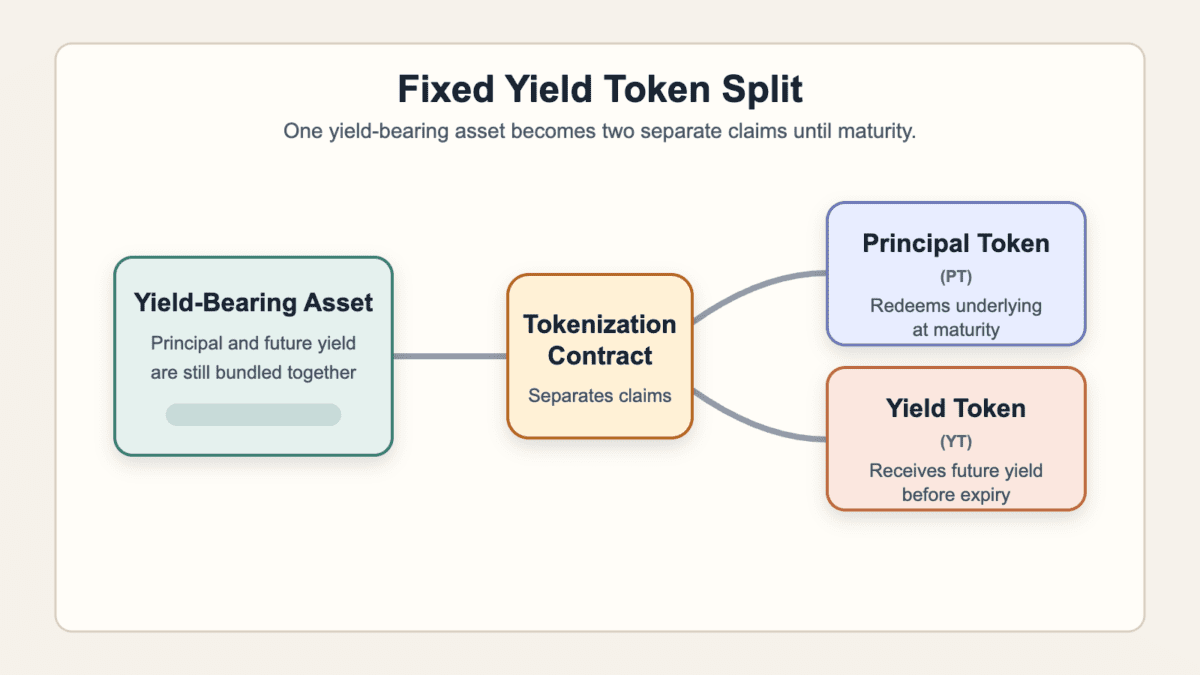
Modern yield tokenization usually splits one yield-bearing asset into two claims. A Chainlink explainer, updated February 27, 2026, uses a Principal Token bought at a 5 percent discount with one year to maturity to show the fixed-yield logic, then defines tokenized yield as separating an asset into a Principal Token and a Yield Token so users can trade principal and future interest separately.
The Principal Token is usually the cleaner fixed-yield side. It represents the claim to the underlying asset at maturity. The Yield Token represents the yield produced before maturity, so its value depends on future rates, incentives, points, and demand for that yield.
Maturity dates shape fixed yield token returns because they anchor the expected result. A fixed yield token may be priced around what it can redeem into on a specific date, not around what a buyer wants to do tomorrow.
Before maturity, the token can trade above or below the neat path shown in an interface. If market rates rise, newer fixed-yield opportunities may look better, and older tokens can price differently. If liquidity dries up, selling early can be painful.
At maturity, the holder usually redeems, rolls into a new maturity, or exits. That creates a simple lifecycle: buy, monitor, hold, redeem, and decide whether the next term is worth the same risks again.
A fixed yield token is the broad idea. A Principal Token is often the modern fixed-yield instrument inside a yield-tokenization market. A Yield Token is usually a different bet altogether.
This distinction saves users from a common mistake. Buying a protocol token such as PENDLE is not the same as buying the fixed-yield position. Buying YT is not the same as buying PT. The tickers can look related while the risk is completely different.
Use this quick split before clicking anything:
| Token Or Product | What The Buyer Is Really Exposed To |
|---|---|
| Fixed yield token | A broad label for a tokenized position with known or pre-priced yield terms. |
| Principal Token | The principal side that usually redeems at maturity and often carries fixed-yield logic. |
| Yield Token | Future yield, points, incentives, or rate movement before expiry. |
| Protocol token | Governance, fees, incentives, or market sentiment around the platform, not the fixed-yield claim. |
| Fixed-term earn product | A platform promise or account claim, often custodial rather than DeFi-native. |
The Principal Token is the one most users mean when they want fixed DeFi yield. It trades at a discount because the buyer waits for redemption and accepts the position’s risk.
The Yield Token is more active. It can benefit if future yield, incentives, or points are worth more than the market expected. It can also decay toward expiry if the future yield disappoints. Same market, very different bet.
So do not stop at “PT/YT market.” Ask which side you are buying. If the answer is YT, you are not buying the boring fixed-yield side. You are buying the part crypto Twitter will call “asymmetric” five minutes before it needs a spreadsheet.
Crypto investors use fixed yield tokens when they want more predictable return math than a floating DeFi APY. The appeal is planning, not magic.
Variable DeFi rates can change quickly. Lending demand cools, incentives expire, utilization falls, and a headline rate becomes less useful. A fixed yield token lets a user lock in an implied return at entry if they hold to maturity and the underlying setup performs.
That can help when a user wants a known end date instead of a daily APY refresh. It also makes the trade easier to compare against a variable lending pool, because the user can see the entry price, time remaining, and redemption target in one calculation.
Common use cases usually look like this:
That predictability has a cost. If variable rates rise after you buy, your fixed position may look less attractive. If a better opportunity appears next week, your capital may be tied to a maturity or a thin exit market.
Fixed yield also changes the workload. Instead of checking APY every day, you check maturity, redemption terms, liquidity, asset quality, and whether the implied yield still compensates you for the risk.
The right comparison is not “fixed yield versus no yield.” It is fixed yield versus the other place your capital could sit, with all costs and failure paths included.
The yield in a fixed yield token can come from several places, and the source tells you more than the APY label. A fixed implied return can be market-priced even when the underlying yield source is still variable.
That sounds contradictory until you separate price from production. The fixed yield token buyer may lock in a return based on today’s discount. The underlying asset may still earn from lending demand, staking rewards, trading fees, incentives, or something less durable.
If the route starts with a liquid staking token, the fixed side still inherits the staking asset’s withdrawal, market-price, and wrapper risks. The fixed yield token packages the exposure. It does not clean the input asset for you.
Check the source before trusting the number:
| Yield Source | What Users Should Verify |
|---|---|
| Lending demand | Is the rate driven by real borrowers, temporary utilization, or one crowded market? |
| Staking rewards | What asset is staked, and can the wrapped asset trade below its intended value? |
| Restaking rewards | Are rewards liquid, delayed, point-based, or dependent on future token assumptions? |
| Protocol incentives | Does the return fall when emissions or reward campaigns end? |
| Points | Are points speculative, non-transferable, or not guaranteed to convert into value? |
| RWA income | What issuer, legal structure, and redemption rules support the yield? |
| Trading fees | Are fees recurring, or did one short burst make the return look better? |
| Leverage | Is the yield boosted by borrowing, looping, or collateral risk? |
The table is not a ranking. It is a fraud-prevention habit in calmer clothing. If the source is unclear, the fixed yield token is harder to evaluate because you cannot tell whether the discount compensates you for the right risk.
Incentives deserve special care. A market can show an attractive implied APY because buyers and sellers are pricing in future points, tokens, or boosted rewards. That can be valid. It can also be a crowded bet on a reward schedule that changes.
The cleanest fixed yield token is easy to explain: asset, maturity, redemption value, and why the discount exists. If the explanation needs seven tabs and a prayer candle, size it like you might be wrong.
A fixed yield token can fail because “fixed” does not protect every condition behind the trade. The return math may be knowable, but the path still depends on assets, contracts, markets, and behavior.
The biggest risks sit in layers. First is the underlying asset. If the asset depegs, loses liquidity, changes redemption behavior, or becomes impaired, the token built on top of it can suffer too.
Then comes protocol risk. Smart contracts can have bugs. Integrations can break. Oracles can be wrong. A position may depend on a lending market, vault, bridge, wrapper, or tokenization contract before it reaches the fixed-yield interface.
Early exits are another weak spot. Selling before maturity depends on buyer demand, pool depth, spreads, and slippage. That is where exit liquidity becomes practical rather than slang: someone has to take the other side at a price that does not erase the return.
Maturity risk is subtler. A user may forget the date, miss a redemption window, misunderstand what asset is received, or roll into a worse term without noticing. The position can be orderly and still annoying.
Stablecoin fixed yield adds depeg risk. A token that redeems into a stablecoin is only as stable as the stablecoin, the issuer route, and the market around it. The fixed yield token does not wrap the asset in bubble wrap.
Borrowed exposure changes the whole trade:
> If you borrow against a fixed yield token, loop it through a money market, or use it as collateral, you add liquidation, oracle, collateral, and timing risk. The base position may be fixed. The stacked strategy is not.
Custody adds another route for failure. A DeFi position held in self-custody has wallet, approval, bridge, and signing risk. A custodial route shifts the problem toward platform rules, withdrawal limits, account access, and terms that may change.
Finally, taxes and records can turn a tidy yield plan into admin work. You may need entries for purchase, sale, redemption, claims, bridging, gas, and token receipts. The blockchain remembers. Your spreadsheet may need coffee.
Evaluate a fixed yield token by tracing what you are buying, what it redeems into, when it matures, and why the return exists. If any of those answers are fuzzy, the APY is not ready to be trusted.
Start with the redeemable asset. Does the token redeem into a stablecoin, ETH, a liquid staking token, a vault share, or something more complex? Then check whether that asset has its own peg, withdrawal, issuer, bridge, or protocol risk.
Use this checklist before buying:
Small positions need extra math. Gas, bridge fees, minimum trade sizes, and redemption costs can turn fixed yield into dust balances with a better marketing outfit.
Wallet route is part of the check. If you interact on-chain, compare crypto wallets by transaction review, network support, hardware-wallet flow, spam handling, and approval visibility. The wallet cannot make a risky yield safe, but it can reduce preventable signing mistakes.
Now compare the premium. If a fixed yield token offers only a small edge over a simpler route, the extra maturity, liquidity, and contract risk may not be worth it. If the premium is large, ask what risk the market is paying you to carry.
The goal is not to find a perfect token. It is to know which failure path you are accepting before the position becomes a real balance.
Fixed yield tokens differ from other crypto yield products because the return is usually priced through a token with maturity. Other routes may be flexible, custodial, variable, or tied to different legal structures.
People often mix these terms. A variable lending pool, a yield farm, a staking position, a CEX earn product, and a tokenized fixed-income security can all sit near “fixed yield” in a user’s mind. They do not create the same claim.
The main trade-offs are easier to see side by side:
| Route | Main Trade-Off |
|---|---|
| Fixed yield token | More predictable implied return, but maturity and early-exit risk matter. |
| Variable lending pool | Flexible rate exposure, but APY can reprice quickly. |
| Yield farm | Incentive-driven upside, but rewards can fade and token risk can dominate. |
| Staking position | Protocol reward exposure, but unbonding, slashing, or wrapped-asset risk may apply. |
| CEX fixed-term earn | Simple interface, but custody and platform terms control the route. |
| Tokenized fixed-income security | Clearer issuer structure, but legal, transfer, and counterparty rules may apply. |
For variable and incentive-driven routes, yield farming is the useful contrast. Farming may chase rewards that move week by week, while a fixed yield token tries to lock a market-priced return for a term.
That does not make fixed yield superior. It makes it different. A user who values liquidity may prefer a variable pool. A user who values custody simplicity may accept a CEX product. A user who wants issuer-backed income may study tokenized fixed-income securities instead.
The fixed yield token fits best when the buyer understands maturity, redemption, source of yield, and exit cost. Without those, the product can become a more technical way to misunderstand APY.
A fixed yield token is a crypto tokenized position where the expected return is known or priced at entry if the position is held under its stated terms. It often works through a discount today and a redemption value at maturity.
No, a fixed yield token is not guaranteed. Fixed yield does not remove smart contract risk, underlying asset risk, depeg risk, liquidity risk, custody risk, maturity risk, or liquidation risk from borrowing.
Often, but not always. In modern PT/YT markets, the Principal Token is usually the fixed-yield side. Older systems and generic fixed-term crypto products may use different labels.
PT usually targets the principal redemption side and is the cleaner fixed-yield position. YT is exposure to future yield, points, incentives, or rate changes before maturity.
Sometimes, if there is enough secondary-market liquidity. The sale price can change with rates, time remaining, buyer demand, pool depth, and slippage.
Higher fixed yield token APYs can reflect incentives, points, lower liquidity, maturity risk, asset risk, borrowed exposure, or buyers paying extra for future-yield exposure. The higher number is a question, not a trophy.
Start with the token’s job. Is it a Principal Token, Yield Token, older fyToken-style position, vault token, or custodial earn claim? The label decides what you are actually exposed to.
Then check the redemption path. Confirm the underlying asset, maturity date, redemption asset, protocol route, wallet route, and whether selling early depends on a thin market.
Then put the term beside your real time horizon. A token that matures after your expected cash need is not a neat fixed-yield play; it is a bet that you can sell early without losing the math.
Use these first actions before putting funds at risk:
After that, compare it with the boring alternative. A lower variable rate with daily liquidity can be better than a higher fixed rate if the fixed route needs bridges, approvals, thin pools, or a maturity you may not hold.
Keep the position small until those checks feel obvious. If you cannot explain the redeemable asset and the failure path in one minute, the interface is moving faster than your understanding.
If the extra return is small, simplicity may win. If the extra return is large, the market is probably paying you for a reason. Find that reason before the maturity date finds you.


