Physical Address
304 North Cardinal St.
Dorchester Center, MA 02124
Physical Address
304 North Cardinal St.
Dorchester Center, MA 02124


A clear guide to holder purge meaning, market signals, and risk checks.
A holder purge in crypto is an informal term for a market washout where weak, late, margin-trading, or underwater holders sell or get forced out.
The idea is that supply moves from nervous holders to buyers with more cash, patience, or conviction. That sounds tidy after the chart bounces. It is much messier while the candle is still red.
The phrase is informal, so context does the heavy lifting. Traders may use it for panic selling, forced liquidations, a meme-coin shakeout, or a smaller protocol event that moves holders out of a deprecated asset.
A holder purge means a market pushes out holders who cannot or will not keep holding through stress. They may be late buyers, overexposed margin traders, underwater investors, or people who bought a story without a plan.
In normal market talk, nobody rings a bell and declares a purge. The label usually appears after price drops hard, liquidations spike, chat sentiment turns sour, and weaker holders start selling into anyone still willing to bid.
A simple example looks like this: a token runs fast, late buyers pile in, price rolls over, and the next red candle scares them out. If larger buyers absorb that selling and price stabilizes, traders may call it a holder purge. If nobody absorbs it, the term starts sounding like cope with better branding.
The key difference is ownership quality. A purge story claims supply is moving from nervous holders to buyers with more patience, cash, or thesis strength. That may be true, but only if buyers actually appear.
That is why the phrase needs skepticism. “Weak hands are gone” is easy to say after a big red move. It becomes useful only when the market shows who took the other side, how much liquidity remains, and whether the asset still has a reason to exist beyond hoping for a bounce.
In practice, a holder purge is part price action and part psychology. The chart shows the selling. The order book shows whether bids are real. The community shows whether people are managing risk or bullying each other into holding bags.
The phrase can also show up in protocol documents, where “purge” may mean forced redemption or cleanup of a deprecated asset. That is a separate meaning. A market holder purge happens because holders sell. A protocol purge happens because rules, contracts, or governance allow an asset to be removed or converted.
Holder capitulation is the measurable cousin of a holder purge. A holder purge is the story traders tell about weak hands leaving. Capitulation metrics are the evidence they may check before trusting that story.
On-chain analysts look for realized losses, profit-and-loss ratios, supply in profit, and cohort behavior. Derivatives traders watch liquidations, open interest, and funding. Spot traders check whether buyers step in after forced selling slows.
The split keeps stories from outrunning evidence. A Telegram chat can call any dump a purge. The evidence asks whether coins moved at a loss, whether margin risk was forced out, and whether spot demand returned once the pressure eased.
For scale, Glassnode reported that on March 30, 2025, 4.7 million BTC were held below their cost basis. A number like that can show broad holder stress, but it still needs price reaction and demand context before anyone calls it a finished purge.
This table separates the phrase from the signals around it.
| Phrase or Signal | What It Tells You |
|---|---|
| Holder purge | Traders think weak or forced sellers have been flushed out. |
| Holder capitulation | Holders are selling under stress, often at a loss. |
| STH SOPR below 1 | Recent coin movers are realizing losses. |
| Realized loss | Coins are moving for less than their prior cost basis. |
| Liquidations | Leveraged positions are being forced closed. |
| Supply in profit | A smaller share of holders has unrealized gains. |
None of these signals proves a bottom by itself. A purge without returning demand is just selling with a nickname.
The same caution applies outside Bitcoin. Many smaller tokens do not have clean on-chain holder cohorts, reliable volume, or deep derivatives data. In those markets, the best evidence may be simpler: who sold, who bought, how much slippage appeared, and whether the project still has users or cash flow after the crowd cools down.
A holder purge happens when pressure arrives faster than holders can rationalize it. Price drops, margin gets called, narratives fade, and the people with the least patience or strongest pain sell first.
The trigger is rarely one clean cause. Large-cap coins may purge after macro risk-off moves, ETF or spot outflows, or crowded margin. Smaller tokens can purge after whale distribution, vesting releases, weak market makers, or a project thesis that stops looking alive.
Common triggers include:
So ask what created the pressure. A margin flush may fade quickly because forced sellers stop once the crowded trade clears. Ongoing vesting supply, insider selling, or a dead roadmap can keep chewing through bids long after the first ugly candle.
Liquidity decides how violent the purge feels. In a deep market, forced selling may clear through normal order flow. In a thin meme coin or old altcoin, the same dollar amount can smash the chart, widen spreads, and turn a modest exit into a public event.
Narrative changes the outcome, too. A token with active users, visible builders, and a clear catalyst can recover from a panic phase. A token held together by slogans has less room for mercy. Once holders realize the only buyer left is another disappointed holder, the purge can become a slow bleed instead of a quick reset.
A holder purge can be bullish after the fact, but it is not bullish by default. It becomes useful only when forced selling fades and real buyers show up without needing social media to chant at them.
This is why traders connect the idea to a bottom signal, but a purge is only one input. The harder question is whether the market can stop making lower lows after the weak supply is gone.
The bullish version has evidence behind it. Liquidations slow, funding cools, spot buyers defend a range, and selling pressure stops getting the same reaction from price. The bearish version feels different: each bounce gets weaker, liquidity thins, and the project needs louder slogans to cover quieter demand.
Read the setup through both columns.
| More Like a Tradable Washout | More Like a Broken Thesis |
|---|---|
| Liquidations spike, then fall. | Vesting supply or insider wallets keep selling. |
| Funding cools from crowded longs. | Liquidity vanishes after the first bounce. |
| Spot buyers defend a range. | Volume looks fake or heavily wash-traded. |
| Realized losses slow after the flush. | The project has no credible catalyst left. |
| Builders, users, or demand remain visible. | Holders rely mainly on shame language. |
The danger is buying because the word “purge” sounds cleansing. Markets do not reward vocabulary. They reward demand, liquidity, and timing.
A useful rule is to wait for behavior, not branding. If buyers absorb supply without a fresh hype wave, the purge may have done its job. If price only bounces when influencers shout at holders to stop selling, the market may be borrowing confidence it has not earned.
This is especially important for newer traders. Buying right after a flush can feel brave, but bravery does not fix a broken thesis. Selling during a flush can feel embarrassing, but risk control is not a moral failure.
A short-term holder purge usually means recent buyers and active traders are exiting fast. These holders have less cushion, less emotional attachment, and less time to build conviction.
A long-term holder purge sounds scarier because older holders are supposed to be the patient ones. In Bitcoin-style cohort analysis, roughly 155 days is the common dividing point between short-term and long-term holder supply.
But older coin movement is easy to misread. Custodian reshuffles, exchange wallets, ETF-related flows, treasury moves, and internal transfers can make on-chain data look more dramatic than the actual selling pressure.
So read it in layers. Short-term holder stress can mark panic. Long-term holder selling can mark distribution, rebalancing, or a serious loss of confidence. You need price reaction, liquidity, and flow context before calling it either.
For short-term holders, the question is usually whether the late crowd has been cleared. Did recent buyers sell at a loss? Did crowded margin unwind? Did funding cool after a crowded long trade? Those clues can support a washout read, but they still need confirmation from spot demand.
For long-term holders, the question is deeper. Are patient holders actually losing faith, or are coins moving for custody, treasury, exchange, or fund-flow reasons? A transfer to an exchange can be a warning. It can also be a reshuffle that never hits the market.
The asset also changes the meaning. Bitcoin has richer cohort data and deeper liquidity than most altcoins. In small tokens, “long-term holder purge” may simply mean early wallets finally found enough late demand to exit. That is a very different signal from a healthy reset.
Holder purges hurt most in meme coins and old altcoins because liquidity is thinner and social pressure is louder. A single whale exit can turn a small selloff into a full chart collapse.
This is where late buyers become exit liquidity for earlier holders. The story often sounds heroic at first: diamond hands, community strength, no sellers left. Then a large wallet sells into that belief, and the late crowd learns what “community-owned” means on a red candle.
Meme-coin communities also use labels like jeets to mock fast sellers. Sometimes that is harmless slang. Sometimes it keeps nervous holders from doing basic risk control.
Old altcoins add another trap. A holder may wait for break-even because selling makes the mistake real. That can turn a market purge into years of opportunity cost.
Liquidity makes the pain worse. A quoted price is not the same as an executable exit. If the order book is shallow, the first serious seller can drag price far below the chart level everyone keeps screenshotting.
Holder concentration adds another layer. When a few wallets control a large share of supply, a purge can be less about “weak hands” and more about one powerful seller testing how much demand is left. The public chart may look like broad panic, while the actual move starts with a small group.
Old altcoins can be quieter but just as punishing. The purge may come after months of fading volume, stale updates, and holders repeating last cycle’s thesis. By the time the final selloff arrives, the market has already been voting with silence.
Separate community language from trade quality. If the only reason to hold is that selling would get mocked, the risk process has already left the room.
A protocol holder purge is different from a market holder purge. In this context, holders may be moved, redeemed, or converted because the token design, governance process, or contract permissions allow it.
This can happen when a protocol deprecates an asset, freezes a synthetic asset, migrates contracts, or removes a market that no longer works. Holders may receive another asset, such as a stablecoin redemption, rather than simply choosing to sell on the open market.
The risk is not only price. It is control. If admin keys, upgrade permissions, blacklist functions, or deprecation rules exist, users need to know what those powers can do before assuming ownership is untouchable.
That does not make every protocol purge abusive. Some cleanups are ordinary maintenance. A broken market may need to be retired, a synthetic asset may need redemption, or a migration may require holders to move into a safer contract.
The details decide whether the cleanup is fair. Check the redemption asset, the conversion rate, the deadline, the voting process, and who can trigger the action. Also check whether inactive holders lose optionality if they miss a claim window or fail to migrate.
This is where token ownership can feel less absolute than the marketing suggested. If a protocol can pause, upgrade, freeze, blacklist, redeem, or migrate assets, those powers belong in the risk review before the purge arrives.
But if a team keeps changing rules while insiders drift out slowly, the situation may look closer to a soft rug than a healthy cleanup.
Before reacting to a holder purge, slow down and separate market stress from your own pain. The worst trade is often the one made to escape embarrassment.
Start with the source of selling. A margin-driven flush can resolve faster than steady spot selling. A whale exit, vesting schedule, or dead narrative can keep pressure alive even after the first bounce.
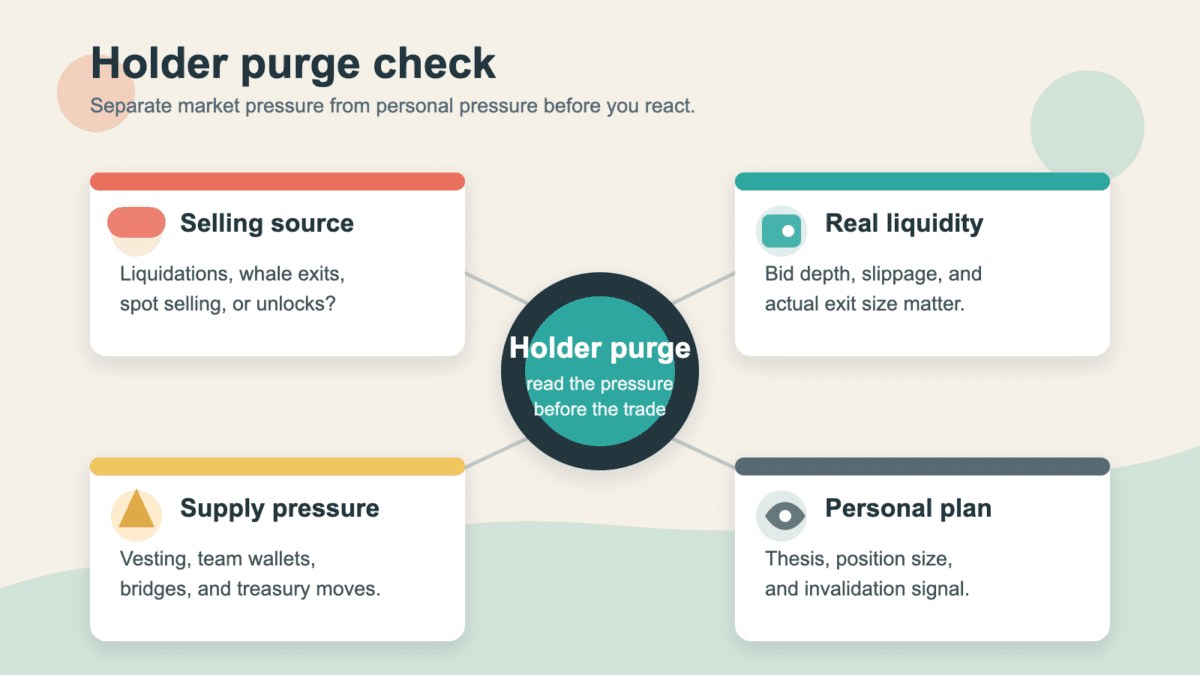
Use this checklist before buying, selling, or holding:
Then check your own reason for holding. A conviction play needs a thesis, a time horizon, and a risk limit. Waiting only because you hate realizing a loss is how a normal holder becomes a bagholder.
Also separate pride from process. Selling is not automatically panic, and holding is not automatically discipline. Your next action should match the facts you can still defend.
Taxes can also enter the picture when selling at a loss. Rules vary by jurisdiction, so this is not tax advice. It is a reminder that the trading decision and the tax consequence are separate problems.
A Bitcoin-style example is recent buyers selling at a loss during a macro risk-off move. Price drops, short-term holder metrics show stress, liquidations clear crowded longs, and traders watch whether spot demand returns.
That example is not automatically bullish. It improves only if selling pressure slows and the market stops punishing every bounce. If spot buyers keep disappearing, the holder purge may simply be one stage in a larger downtrend.
A meme-coin example is uglier. Early wallets distribute into late buyers, the chart breaks, community accounts call sellers weak, and liquidity thins just when everyone wants out. The purge may not be cleansing. It may be the exit.
In that version, social language does a lot of work. Holders are told not to sell, but the order book tells a cleaner story. If big wallets are leaving and new buyers are scarce, the “purge” label can protect promoters more than holders.
An old-alt example starts slower. The token has no fresh narrative, vesting continues, volume fades, and holders keep waiting for a prior cycle’s price. When the final selloff comes, it feels sudden, but the weakness was aging in plain sight.
That example is common because break-even thinking is powerful. A holder may know the thesis has weakened, yet still wait for the chart to return to an old number. The market has no obligation to visit that number again.
A protocol example has a different shape. A project deprecates an asset and uses governance or contract rules to redeem or convert balances. That is not panic selling. It is a rules-based cleanup, and the details live in the protocol design.
These examples point to the same habit: name the mechanism before naming the mood. Is the pressure coming from liquidations, spot selling, whale distribution, stale demand, or contract rules? That answer beats the label.
Holder purge talk often comes bundled with other crypto slang. Some terms describe real behavior. Others are social weapons with candles attached.
Weak hands and paper hands refer to holders who sell quickly under stress. The labels can be descriptive, but they can also shame people for cutting risk. Selling a bad trade is not the same thing as panicking out of a good one.
Bagholder describes someone stuck holding a losing position, often while waiting for break-even. Exit liquidity describes late buyers absorbing the supply that earlier holders want to sell. Both terms fit here because a holder purge often decides who leaves and who gets stuck after the story changes.
Bottom signal and top signal are broader market-read terms. A purge can support either story depending on where it appears in the cycle. Soft rug points to slow extraction or project decay rather than one obvious rug-pull moment.
Translate slang back into behavior. Who is selling? Who is buying? Is liquidity real? What changed? If the phrase cannot answer those questions, it is just market theater.
That translation protects you from the loudest accounts in the room. A good term should clarify risk. If it mostly pressures you to ignore risk, it is doing marketing work, not analysis.
This also keeps the article’s core idea clean. A holder purge is not a magic label for every dump. It is a way to discuss forced or exhausted selling, ownership turnover, and the risk that the market may be moving from weak holders to stronger hands.
Sometimes that turnover is real. Sometimes it is just a nicer word for distribution. The difference shows up in liquidity, buyer behavior, and whether the asset still has a reason to attract fresh demand.
A holder purge in crypto is a market washout where weak, margin-trading, late, or underwater holders sell or get forced out. It is informal slang, not a formal on-chain metric.
No. A holder purge is the trader story around weak holders leaving, while holder capitulation refers to measurable stress such as realized losses, loss-making coin movement, or liquidation pressure.
A holder purge can become bullish if selling pressure fades and real buyers absorb supply. It is bearish when liquidity keeps vanishing, insiders keep selling, or the project thesis is broken.
Yes, long-term holders can sell during deep stress, distribution, or portfolio reallocation. Their movement deserves more attention, but wallet transfers and custody activity can distort the signal.
No. A crash describes a sharp price drop. A holder purge describes who gets forced out during that drop and whether their selling changes the ownership base.
Sometimes. A protocol can force redemption, conversion, or cleanup only if its rules, contracts, or governance powers allow that action. That is separate from a market-driven holder purge.
After a holder purge, start with evidence, not slogans. The market does not care whether a Telegram chat calls you weak or early.
First, separate the market from your position. A purge can describe real selling pressure, but it does not tell you whether your trade is worth keeping. That answer depends on thesis, liquidity, size, and the signal that would prove you wrong.
A useful next pass looks like this:
Then decide what would prove you wrong. That answer is more useful than any label the crowd throws at you.
If you want to buy, wait for proof that demand exists without a cheer squad. If you want to sell, make sure the decision comes from current evidence, not just pain. If you want to hold, write down what has to happen next for the thesis to stay alive.
The best post-purge move is usually boring. Check liquidity, check supply pressure, check the project, check your risk limit, then act. The crowd may still argue about whether it was a purge, capitulation, or a shakeout. Your account balance only cares whether the next decision was defensible.