Physical Address
304 North Cardinal St.
Dorchester Center, MA 02124
Physical Address
304 North Cardinal St.
Dorchester Center, MA 02124


A practical guide to high FDV, low float, token unlocks, and buyer risk.
High FDV means a crypto token’s current price implies a large fully diluted valuation if all tokens that can exist were counted today.
It matters most when market cap is much lower. Locked supply, token unlocks, emissions, team allocations, investor allocations, or airdrops can still enter the market and test whether real demand is there.
High FDV in crypto means the market is pricing a token as if the full possible supply deserves a large valuation. FDV stands for fully diluted valuation.
The phrase usually appears around new listings, presales, airdrops, launchpad tokens, and TGE events. A token can look small by market cap while its full-supply valuation already looks ambitious.
That is the beginner trap. A cheap unit price can hide a big implied valuation.
Say a token trades at $1. If 100 million tokens circulate today, its market cap is $100 million. If 1 billion tokens can eventually exist, its FDV is $1 billion.
The $1 token is not automatically cheap. The current price already implies a $1 billion project once the full supply is counted.
“High” is relative. A $1 billion FDV may be aggressive for an app with few users and thin liquidity. It may be less alarming for a mature network with deep demand, clear revenue, and most supply already circulating.
So high FDV is not a future price target. It is a full-supply assumption at today’s price.
That’s the point. FDV does not say every locked token will sell at once. It says the market price already values those future tokens as if they were included in the math.
Use high FDV as a first question, not the final answer. Ask whether the token’s future demand can absorb the supply that still has to arrive.
High FDV is calculated by multiplying the current token price by total supply or max supply. The formula is simple, but the supply input can get messy fast.
FDV = token price x total supply or max supply
Use the same round numbers. A token at $1 with 100 million circulating tokens has a $100 million market cap. If its max supply is 1 billion, its FDV is $1 billion.
That $900 million gap is not magic upside. It is supply that is not counted in market cap yet.
Before you trust the number, check the inputs behind it:
| Input | What To Check |
|---|---|
| Token Price | Use the same price source for market cap and FDV. |
| Circulating Supply | Confirm how many tokens are counted as live today. |
| Total Supply | Check whether burned or locked tokens are still included. |
| Max Supply | See whether the token has a fixed cap or can mint more. |
| Emissions | Look for new tokens issued through rewards or incentives. |
| Vesting Schedule | Find when team, investor, treasury, and community tokens unlock. |
Data platforms can disagree because token supplies are not always clean. Some projects burn tokens. Some have no hard max supply. Some count treasury wallets differently.
And sometimes the dashboard is simply stale. That is not a spicy conspiracy. It is crypto operations doing crypto operations.
For high FDV risk, the calculation is only the start. You also need the circulating percentage, the unlock calendar, the next cliff size, and the market’s ability to absorb new supply.
High FDV and market cap measure different parts of the same token story. Market cap values the tokens counted as circulating now, while FDV values the full possible supply at today’s price.
The gap between them shows where dilution risk can hide. A low market cap can make a token feel early, but a much higher FDV can mean the public market is already paying a rich full-supply price.
Here is the clean comparison:
| Metric | What It Tells You |
|---|---|
| Token Price | The current quoted price for one token. |
| Market Cap | Price multiplied by circulating supply. |
| FDV | Price multiplied by total or max supply. |
| Circulating Percentage | How much supply is counted in market cap now. |
| FDV To Market Cap Gap | How much future supply is outside today’s market cap. |
A token with a $100 million market cap and a $1 billion FDV has only one-tenth of its full-supply valuation reflected in circulating supply. That does not mean price must fall.
But it does mean future supply still has to meet real buyers.
If more tokens unlock into strong demand, deep liquidity, and real usage, the market may absorb them. If tokens unlock into thin liquidity and fading hype, sellers can lean on price.
That is why a single FDV to market cap ratio is not enough. A large gap should trigger more checks, not a mechanical buy or sell.
Look at timing next. A small daily emission is different from a cliff unlock that releases a large chunk of current float in one week.
Then look at ownership. Team, investor, treasury, market-maker, staking, and community allocations carry different incentives and sell behavior.
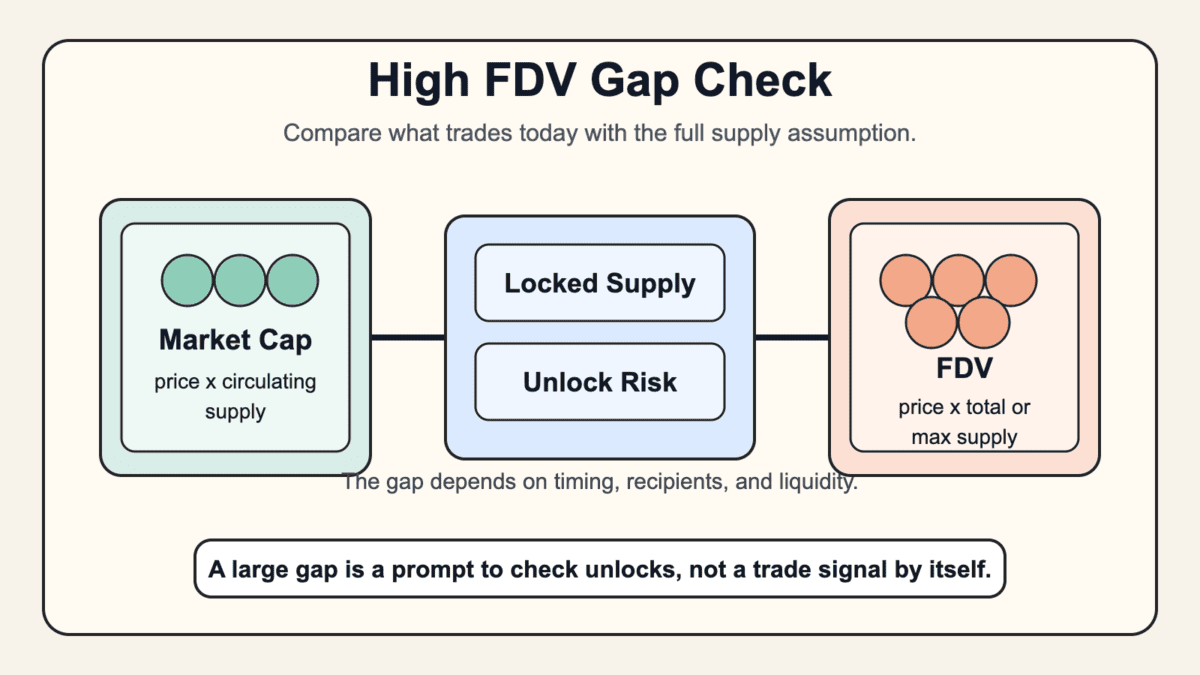
The FDV-to-market-cap gap is where high FDV becomes practical. You are not only asking “is the valuation large?” You are asking “who can sell later, how much, and into what demand?”
Low float makes high FDV riskier because only a small share of supply is trading today. That small float can support a high price, which then creates a large full-supply valuation.
This is where the phrase “low float high FDV” comes from. It is crypto trader shorthand for a launch where public supply is scarce, the implied valuation is large, and future unlocks may still be heavy.
CoinGecko Research, updated April 29, 2026, found that low-float crypto made up 21.3% of the top 300 crypto assets in its May 2024 sample. That study explains why the phrase became more than a niche complaint.
The issue is not scarcity by itself. Scarcity can help a token launch cleanly. The issue is scarcity plus a price that already assumes a rich future.
These phrases show up often around high FDV launches:
| Phrase | What It Usually Means |
|---|---|
| Low Float | Only a small share of supply is circulating. |
| TGE | The token generation event where trading starts. |
| Cliff Unlock | A large release after a vesting delay. |
| Linear Vesting | Tokens release gradually over time. |
| VC Coin | Slang for a token with heavy private-investor allocation. |
| Market-Maker Supply | Inventory used to support launch liquidity and trading. |
Unlocks do not guarantee immediate selling. A treasury may hold. A team may vest slowly. Incentive tokens may go to users who keep participating.
But unlocks create supply that can sell. The market still has to absorb it.
That is why traders worry about becoming exit liquidity in a low-float high FDV launch. The fear is that public buyers provide demand while earlier or better-positioned holders gain a path to sell later.
This language is common in the crypto trenches, where small floats, fast narratives, thin books, and aggressive promotion can collide. The phrase can be useful, but it can also become lazy.
Not every low-float high FDV token is a villain arc. The better question is quieter and more useful: how much supply unlocks, who receives it, and whether demand can keep up.
High FDV is not automatically bad when the token has enough demand, liquidity, transparency, and time to grow into the valuation. It raises the proof burden.
Some tokens look expensive on FDV because they are early in their supply schedule. That can be acceptable if unlocks are slow, public float is rising steadily, and the project already has users who create demand for the token.
The cleaner cases usually share several traits:
None of those traits makes a token safe. They just make high FDV less dramatic.
A mature capped-supply asset can have FDV close to market cap because most or all supply already circulates. A new launch can have a massive gap because public float is tiny.
Those two cases should not be read the same way.
High FDV can also be normal in sectors where investors price future network effects early. That still does not excuse weak tokenomics. It only explains why the market may tolerate a large number for a while.
The danger starts when story outruns evidence. If users, fees, liquidity, and product traction are thin, a high FDV leaves little room for disappointment.
So avoid the blanket rule. High FDV is not a scam label. It is a prompt to ask tougher questions before you buy the shiny thing.
High FDV risk is checked by comparing valuation, supply timing, liquidity, ownership, and demand before you buy or hold. The goal is to spot pressure before price forces the lesson.
Start with the market data page, then verify the supply schedule from tokenomics docs, project announcements, unlock trackers, block explorers, and exchange pages. Any single source can be wrong or late.
Run this checklist before you act:
The unlock size needs context. A 2% unlock may be manageable for a liquid token with growing demand. The same unlock can be brutal for a thinly traded token after the narrative cools.
Recipient groups matter too. Treasury tokens, team tokens, investor tokens, airdrop claims, staking rewards, and market-maker inventory do not create the same pressure.
Investor tokens may have lower cost bases. Airdrop recipients may sell quickly if there is no reason to hold. Treasury tokens may fund development, grants, or market programs.
None of that tells you exactly what will happen. It tells you where the incentives sit.
Now compare liquidity. A high FDV token with shallow order books can move hard when supply appears. Slippage widens, bids thin out, and late buyers can become stuck with bagholder risk.
Promotion is another signal. A high FDV token pushed everywhere after a large run, with weak liquidity and major unlocks ahead, can look like a top signal cluster rather than a clean entry.
The final check is demand quality. Ask what creates buy pressure after the launch campaign ends.
Useful demand can come from fees, collateral use, staking demand, governance power, app usage, burns, or strong network effects. Weak demand often depends on attention alone.
That does not mean attention is useless. Attention moves crypto. But attention without liquidity and supply discipline is a loud trade with a weak base.
Common high FDV mistakes come from reading one number as the whole story. FDV is useful, but it becomes dangerous when traders turn it into a shortcut.
The first mistake is treating FDV as a future market cap prediction. FDV assumes today’s price across the full possible supply. Future price can change long before future supply arrives.
The second mistake is judging by token price alone. A token at $0.02 can be more expensive than a token at $20 if its supply is huge.
Watch for these shortcuts:
That last mistake is common. High FDV can be bad token design, aggressive pricing, or plain market optimism. It is not proof of theft.
A soft rug is different from disclosed dilution risk. A soft rug usually involves slow confidence loss, insider drain, broken promises, or quiet abandonment.
A hard rug is more direct. It can involve malicious contract behavior, drained liquidity, or sudden theft.
High FDV can appear near those problems, but it does not prove them. You need contract checks, wallet behavior, liquidity movement, team conduct, and verified tokenomics before making that claim.
The useful habit is slower and less dramatic. Use high FDV to decide which facts you need next.
Related high FDV concepts help you read the full risk picture instead of staring at one valuation number. The nearby terms all answer a different part of the same question: what supply can trade, when can it trade, and who is likely to sell?
Market cap shows the value of circulating supply. FDV shows the full-supply assumption. Float tells you how much supply is actually available for public trading.
Tokenomics connects the pieces. It covers supply, allocations, emissions, vesting, incentives, and the reasons a token may or may not face future sell pressure.
Token unlocks are the calendar. They show when locked allocations become movable. The date matters, but the size, recipient group, liquidity, and market mood matter just as much.
Exit-liquidity language explains the emotional side of high FDV. Users worry that public demand will absorb supply from earlier holders.
Bagholder language explains the after-effect. A buyer can get stuck holding a token after supply expands and liquidity fades.
Soft rug risk is worth learning next because some high FDV complaints are really about slow trust decay, weak delivery, or insider-friendly supply behavior.
Hard rug risk is a separate check. It points you toward contract permissions, liquidity control, and sudden theft signals instead of disclosed vesting risk.
Low float, emissions, liquidity depth, and CT launch language round out the map. None of them replaces the full check, but each gives you one more angle on the same risk.
If a token has high FDV, do not stop at the headline number. Build the supply story before you build a position.
High FDV is not automatically bad in crypto. It is a warning that the current price implies a large full-supply valuation.
The risk gets stronger when float is low, unlocks are large, liquidity is weak, and demand depends mostly on hype. Strong usage, transparent vesting, and deep liquidity can make the same number less alarming.
Low float high FDV means only a small share of supply trades today while the current price implies a large valuation for the full possible supply.
Traders use the phrase when they worry that launch scarcity is making a token look stronger than it is. Future unlocks can then test whether real buyers still exist.
High FDV is higher than market cap when many tokens are not circulating yet. Market cap counts circulating supply, while FDV counts total or max supply at today’s price.
The gap often comes from team vesting, investor allocations, treasury tokens, emissions, airdrops, or other locked supply. That gap is a supply-overhang signal, not automatic upside.
There is no universal good FDV to market cap ratio. A lower gap usually means more supply already circulates, but the right level depends on the token’s age, sector, liquidity, unlocks, and demand.
Use the ratio as a screen. If FDV is many times market cap, check the unlock schedule and recipient groups before trusting the current valuation.
A high-FDV crypto can still go up if demand grows faster than new supply enters the market. That can happen when usage, fees, liquidity, and narrative strength improve together.
The bar is higher, though. A token with high FDV has less room for weak demand, stale traction, or surprise unlock pressure.
High FDV alone is not a rug pull signal. It can show aggressive valuation or future dilution risk, but it does not prove theft, malicious contracts, or bad-faith behavior.
To assess rug risk, check contract permissions, liquidity movement, wallet concentration, team behavior, and whether tokenomics were clearly disclosed before launch.