Physical Address
304 North Cardinal St.
Dorchester Center, MA 02124
Physical Address
304 North Cardinal St.
Dorchester Center, MA 02124

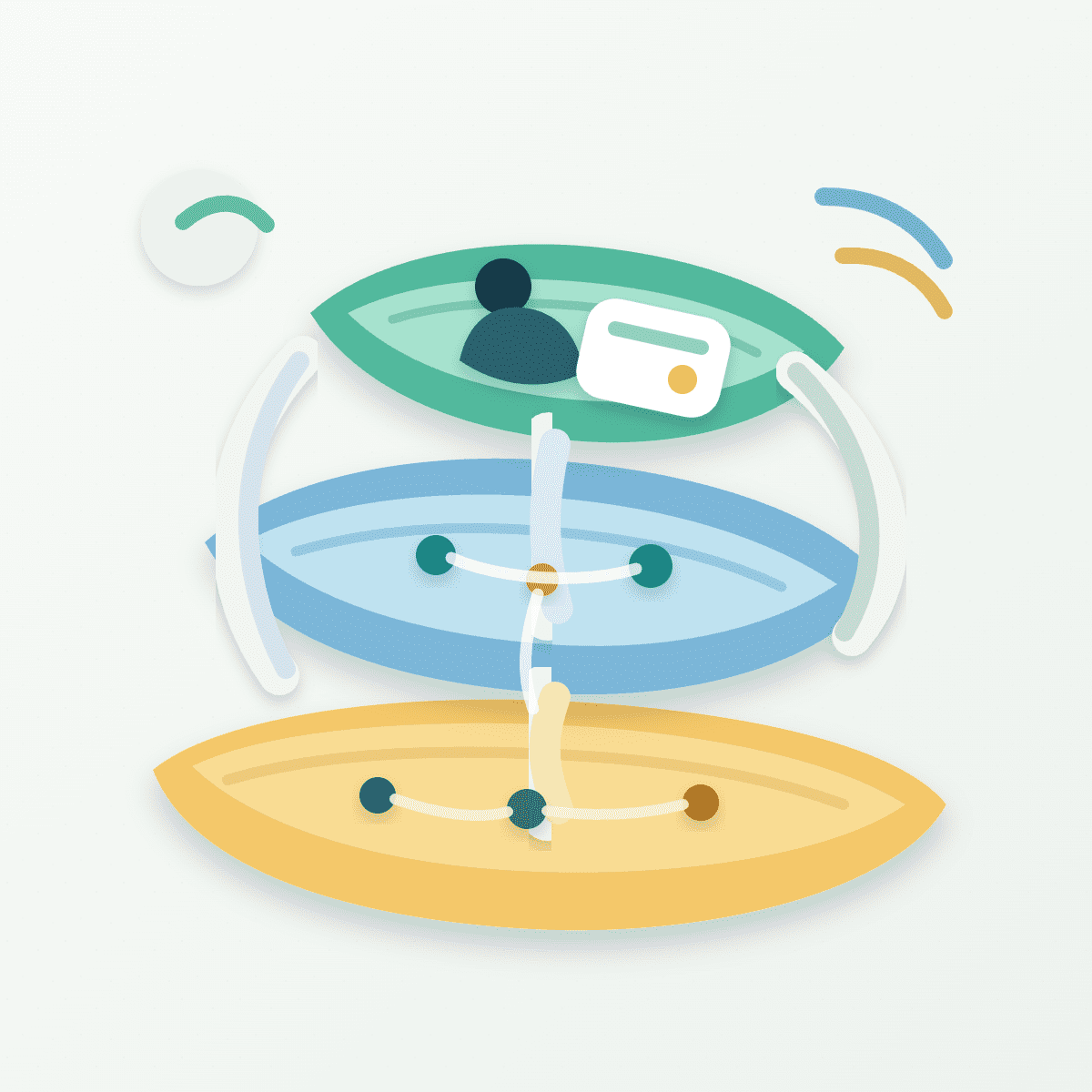
Layer3 explained without the extra-layer fog.
Layer3 is a crypto term that can mean a Layer 3 blockchain architecture, the Layer3 platform, or the L3 token.
That naming mess is the first problem to solve. In one article, “Layer3” might mean app-specific blockchain infrastructure. In another, it might mean Layer3.xyz, quests, CUBEs, staking, and token rewards. Same room, different conversations.
Layer3 in crypto usually means one of three things: a Layer 3 blockchain design, the Layer3 platform, or the L3 token. The spaced version, “Layer 3,” usually points to architecture. The no-space version often points to the Layer3 platform and its token.
That split changes the risk checklist. A Layer 3 blockchain is infrastructure. It may run an app, handle cheap actions, and settle through another chain. The Layer3 platform is a product for onchain discovery, quests, CUBEs, rewards, and token-based participation. The L3 token is a market asset tied to that platform.
The clean meaning map looks like this:
| Term | What It Usually Means |
|---|---|
| Layer 3 Blockchain | App-specific infrastructure built above a Layer 2 or similar scaling layer. |
| Layer3 Platform | A product for quests, rewards, credentials, staking, and onchain engagement. |
| L3 Token | The token connected to Layer3 platform incentives, access, staking, and governance. |
So when someone asks “what is Layer3?” the answer is not a price chart. It is context. Are they asking about a blockchain stack, a reward platform, or a token position?
Once you separate those meanings, the next questions get clearer. Does the app need its own chain? Is the bridge path safe? Is liquidity deep enough? Do token rewards reflect real demand, or just another points treadmill with shinier shoes?
That context also decides what to check first. For architecture, follow the settlement and bridge route. For the Layer3 platform, look at what the quest, credential, or staking action asks from your wallet. For the L3 token, focus on liquidity, reward rules, and whether demand can survive after incentives cool down.
Layer3 fits into the blockchain stack as an app-focused layer above Layer 2. A Layer 3 blockchain may run specific activity, then rely on a Layer 2 and an underlying Layer 1 for parts of settlement, data, or security.
Start with Layer 1. That is the base chain, such as Ethereum, where final settlement and security assumptions often live. A Layer 2 sits above it to process more activity at lower cost. A Layer 3 can sit above that, often tuned for one use case such as gaming, social actions, loyalty, or a high-frequency app.
The roles are easier to scan this way:
| Layer | What It Handles |
|---|---|
| Layer 1 | Base settlement, core security, and final state for the broader chain. |
| Layer 2 | Scaling, batching, cheaper execution, and a bridge back to the base layer. |
| Layer 3 | App-specific execution, custom rules, cheaper actions, and narrower user flows. |
A rollup is one common model for moving activity up the stack. It batches actions, then posts data or proofs elsewhere so another layer can help with verification. An appchain is a chain built for one app or app family. A sequencer orders transactions. A bridge moves assets or messages between layers.
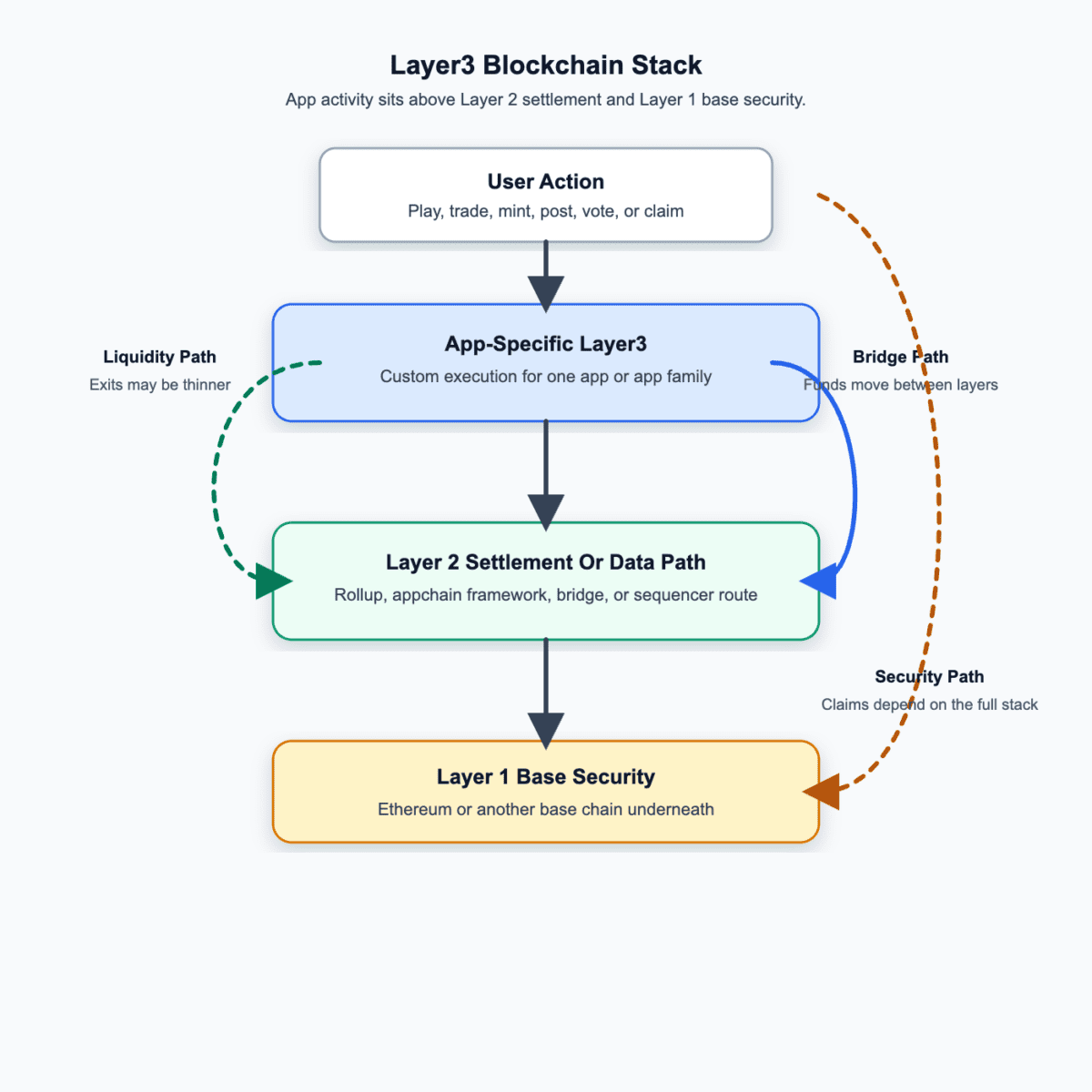
The useful takeaway is not that every app now needs another chain. Many do not. A Layer3 makes more sense when the app needs custom execution, frequent small actions, or a controlled user flow that a general Layer 2 does not handle cleanly.
Layer3 vs Layer 2 is a question about specialization. A Layer 2 usually scales a broader chain for many apps, while a Layer3 can narrow the design around one app, one category, or one community.
That can improve the app experience. Fees may be lower for repeated actions. The app can control more of the wallet flow, transaction rules, incentives, and data design. Builders may also get a cleaner place to tune throughput without competing with every other app on the same general network.
But the tradeoff is real. A Layer3 can add another bridge route, another operator set, another liquidity pocket, and another support burden for wallets and exchanges. Cheap clicks inside an app do not automatically mean easy exits outside it.
Use this comparison before the stack gets fuzzy:
| Question | Layer 2 Vs Layer3 Answer |
|---|---|
| Main purpose | Layer 2 scales many apps. Layer3 often optimizes one app or app family. |
| User fee profile | Layer3 can reduce frequent app-action costs, but bridges and exits may still cost money. |
| Customization | Layer3 usually gives builders more control over execution, rules, and incentives. |
| Liquidity | Layer 2 liquidity may be broader. Layer3 liquidity can be thinner or more fragmented. |
| Security path | Layer3 security depends on the full stack, not a slogan on a homepage. |
The best Layer3 design hides complexity from users. The worst version asks users to understand three layers, two bridges, one token, and a Discord support thread before moving $50.
So ask this: does the extra layer remove friction for the app, or does it push that friction onto the user?
Layer3 shows up where an app needs many cheap actions, custom rules, or a user flow that does not fit neatly on a general Layer 2. The clearest examples are gaming, social apps, loyalty systems, high-frequency DeFi, and reward platforms.
Gaming is the easiest place to see the logic. A game may need constant small actions, inventory updates, item transfers, rewards, or player events. If every action feels like a full crypto transaction, the game stops feeling like a game and starts feeling like paperwork with skins.
That is why GameFi apps often appear in Layer 3 blockchain examples. A gaming-focused L3 can handle frequent actions while keeping final settlement and asset movement tied to deeper layers.
Other use cases follow the same pattern:
| Use Case | Why Layer3 Might Fit |
|---|---|
| Gaming | Frequent low-value actions need cheap execution and smoother account flows. |
| Social Apps | Posts, follows, tips, and badges may need fast, low-cost writes. |
| Loyalty | Brands can track activity, rewards, and credentials in a custom environment. |
| DeFi Apps | Some strategies need fast updates, tailored execution, or narrow liquidity design. |
| Reward Systems | Quests and credentials can run without crowding a general-purpose chain. |
The examples are useful only if they explain the job. Xai, Degen Chain, Orbs, Dojo, Lens-style social infrastructure, and similar names may appear in L3 discussions, but the label alone is not a buy signal.
Ask what the app actually gains. If the gain is cheaper actions, cleaner UX, or custom execution, the Layer3 story has substance. If the gain is only a new token category, you may be looking at narrative packaging with a very confident font.
Layer3 risks come from the extra moving parts: inherited security, bridges, smart contracts, sequencers, operators, and liquidity that may not be deep when users want to leave.
Inherited security is not one magic stamp. A Layer3 may rely partly on a Layer 2, and that Layer 2 may rely on a Layer 1. The app’s bridge, proof system, data path, and operator setup still shape the risk. If one part is weak, the whole route can feel weaker than the marketing copy.
Bridges deserve special attention because they connect the user’s funds to the new environment. A bridge route can involve contracts, message passing, liquidity providers, delays, and different asset versions. The user may only see one button.
Before using a Layer3, run these checks:
Liquidity risk is where the app story meets the exit door. A Layer3 can make in-app actions cheap while still giving users poor exit liquidity when they want to sell, bridge out, or rotate to another venue.
Wallet support is part of that same risk. If a chain needs custom settings, unfamiliar bridges, or unclear asset versions, slow down and check wallet setup before moving funds. The cheapest transaction is not cheap if it sends assets into a route you cannot manage.
None of this means Layer3 infrastructure is doomed. It means cheap app actions and safe exits are separate claims. Good projects make both readable.
Layer3 the platform is not the same as the generic Layer 3 blockchain idea. It is an onchain discovery and engagement platform. Users complete quests, collect credentials such as CUBEs, earn rewards, and may interact with staking or governance features.
That product sits near the reward side of crypto. Users may complete tasks, connect wallets, explore protocols, and receive incentives. Protocols may use those campaigns to attract activity. CUBEs act like credential markers for completed actions and participation history.
The Layer3 Foundation docs describe L3 as connected to staking, governance, quest access, CUBE credential access, incentives, and token distribution mechanics. They also list a fixed total supply of 3,333,333,333 L3. That tells you what the token is meant to do inside the platform. It does not prove token demand by itself.
This is where the word Layer3 can mislead people. Completing quests on Layer3.xyz does not mean every Layer 3 blockchain uses the Layer3 platform. Holding L3 does not mean you own a claim on all Layer 3 infrastructure. The names overlap. The exposure does not.
Reward campaigns can also blur education and speculation. Some users learn real onchain skills through quests. Others chase points, multipliers, and airdrops like it is crypto farming with a cleaner dashboard.
That incentive design also overlaps with the crypto attention economy. Protocols want wallets, actions, and repeat engagement. Users want rewards. The danger is mistaking tracked attention for durable demand.
Keep the platform lens sober. Quests can teach. Credentials can be useful. Staking can create participation incentives. But rewards are still incentives, not income you can schedule into next month’s rent.
Layer3 examples are useful when they show what the extra layer does. They become dangerous when they turn into a coin list with “L3” stamped on anything that moved last week.
Gaming L3s may optimize high-volume game actions. Social L3s may handle posts, follows, badges, or microtransactions. App-specific chains may give one protocol custom execution rules. Cross-chain messaging layers may help apps coordinate activity across networks.
The label needs a job attached to it:
| Example Type | What To Verify Before Trusting The Label |
|---|---|
| Gaming L3 | Whether gameplay needs cheap onchain actions and has real users. |
| Social L3 | Whether the app has activity beyond reward farming. |
| App-Specific Chain | Whether custom execution solves a clear bottleneck. |
| Reward Platform | Whether incentives create durable use after rewards fade. |
| Messaging Or Interop Layer | Whether it handles real cross-chain needs without hiding bridge risk. |
This is also where the market can get sloppy. A Layer3 label can become a narrative coin before the project proves demand, liquidity, or safety. That does not make the project fake. It means the label is only the start of the research.
Live category trackers can help you find names, but they should not write your thesis. Market caps, volumes, and token rankings change. Exchange support changes. Liquidity can disappear quickly after a campaign snapshot.
Use examples to understand use cases, not to outsource judgment. The more specific the app need, the stronger the Layer3 explanation usually is.
Check a Layer3 project by naming the exposure first. Are you using an app-specific chain, completing Layer3 platform quests, holding the L3 token, bridging assets, or buying a token tied to an L3 story?
That single question prevents several bad decisions. A token trade, a bridge deposit, and a quest campaign do not carry the same risk. They may share a brand or a theme, but the failure path changes by route.
Use this checklist before you connect a wallet or buy exposure:
The token checks matter because incentives can mask weak demand. A project can have active quests, loud socials, and thin liquidity at the same time. That mix can still produce volatility. It can also leave late users holding a position they cannot exit cleanly.
For usage, start small. Use official links, read wallet prompts, test withdrawals, and avoid moving serious size through a route you cannot explain to yourself in one minute.
For investing, separate product utility from token demand. A Layer3 app can be useful without making its token a strong trade. A token can rally without proving the infrastructure is useful. Crypto enjoys making both true on different Tuesdays.
Layer3 in crypto can mean a Layer 3 blockchain architecture, the Layer3 platform, or the L3 token. The spaced term usually means infrastructure, while the no-space brand often points to Layer3.xyz and its token.
Start by identifying the context. If the discussion mentions quests, CUBEs, staking, or L3 rewards, it likely refers to the platform. If it mentions rollups, appchains, bridges, or settlement, it likely refers to architecture.
Layer3 is not always the same as a Layer 3 blockchain. “Layer3” can be a brand name, while “Layer 3 blockchain” usually describes app-specific infrastructure above Layer 2.
That naming overlap causes many bad summaries. The Layer3 platform can use onchain activity and rewards, but it is not the generic name for every Layer 3 blockchain project.
Layer 2 usually scales a broader blockchain for many apps, while Layer3 often specializes around one app, one category, or one controlled user flow.
The tradeoff is customization versus added complexity. Layer3 may lower app-action costs and improve UX, but it can also add bridge steps, thinner liquidity, and extra security assumptions.
Layer3 may inherit parts of Ethereum security only through the chain path beneath it. That path can include a Layer 2, bridge contracts, data systems, sequencers, operators, and proof mechanisms.
So the answer is not a simple yes. Check how the Layer3 settles, which Layer 2 it uses, how withdrawals work, and what risks the bridge introduces.
The L3 token is tied to the Layer3 platform, not to every Layer 3 blockchain. It can relate to staking, governance, quest access, credential access, rewards, and incentives inside that platform.
That utility does not remove market risk. Token price, liquidity, unlocks, reward rules, and exchange support still matter before buying or staking.
Layer3 can be an investment theme, but the label alone does not make it a good investment. The answer depends on which exposure you mean: the L3 token, an L3-related coin, an app-specific chain, or a reward campaign.
Check demand, liquidity, bridge safety, token unlocks, and whether the app needs its own layer. If the thesis is only “another layer means another pump,” that is not research. That is a slogan wearing a chart.
Start with the meaning. Layer3 can refer to architecture, the Layer3 platform, or the L3 token, and each one creates a different checklist.
Then move from labels to routes. A useful Layer3 should make an app cheaper, faster, or easier to use without hiding the risk path from the user. If the route is hard to explain, that confusion is part of the risk.
Use these steps before you act:
If you are using Layer3.xyz, separate the learning value from the reward value. A quest can teach you how a protocol works, yet still leave you with a token or credential that has weak demand. If you are looking at a Layer 3 blockchain, check whether the app actually needs custom execution or is just borrowing the latest infrastructure label.
For a token trade, make the exit plan boring. Check liquidity, unlocks, staking rules, and exchange support before the chart gets noisy. Thin liquidity and confusing bridge routes are easier to ignore before they become your problem.
Layer3 is worth understanding because it touches scaling, app design, rewards, and token narratives at once. Just do not let the shared name do the thinking. In crypto, a familiar label can still hide a very different risk path.