Physical Address
304 North Cardinal St.
Dorchester Center, MA 02124
Physical Address
304 North Cardinal St.
Dorchester Center, MA 02124


Lego strategy explained with DeFi examples, yield checks, and stack-risk warnings.
A Lego strategy is a crypto setup that combines separate DeFi tools like building blocks to stack yield, automate trades, or reuse collateral.
The term sounds playful because it comes from money legos and DeFi legos, but the setup can carry several dependencies at once. A simple version might stake an asset, use the receipt in a lending market, borrow against it, then place the borrowed asset in a pool or vault.
The route is not the lesson. The lesson is knowing what each block adds before it gets to vote on your money.
A Lego strategy in crypto is a composable DeFi route. You take separate pieces, such as tokens, smart contracts, vaults, lending markets, bridges, or liquidity pools, and connect them to create one larger position.
The phrase is not a formal product category. There is no official Lego strategy that every trader follows. In most crypto conversations, it means a setup uses money legos or a DeFi position is built from several connected blocks.
That distinction protects you from copying a route that is riskier than it sounds. If someone says they are using a Lego strategy, they may mean something simple, like staking ETH and using the liquid staking token elsewhere. They may also mean something much more fragile, like borrowing against a receipt token, looping the loan, bridging assets to another chain, and relying on a vault to rebalance the final position.
The core idea is composability. DeFi apps can often accept each other’s assets, tokens, and contract outputs. A token from one protocol can become collateral in another. A vault can route through a decentralized exchange. A bridge can move an asset into another market.
That power is useful, but it can get messy quickly.
A good Lego strategy has a clear reason for every block. A bad one has a big APY number, a thread full of screenshots, and a dependency tree nobody wants to draw.
A Lego strategy works by turning one DeFi action into the input for another. The first block creates an asset, token, position, or claim. The next block accepts that output and uses it for lending, liquidity, trading, automation, or collateral.
In DeFi, the cleaner term is permissionless composability. Chainlink puts DeFi above $100B and explains how decentralized applications can connect without a custom business agreement for every integration. For a user, that means one position can move through several tools without leaving crypto rails.
Here is a simple flow:
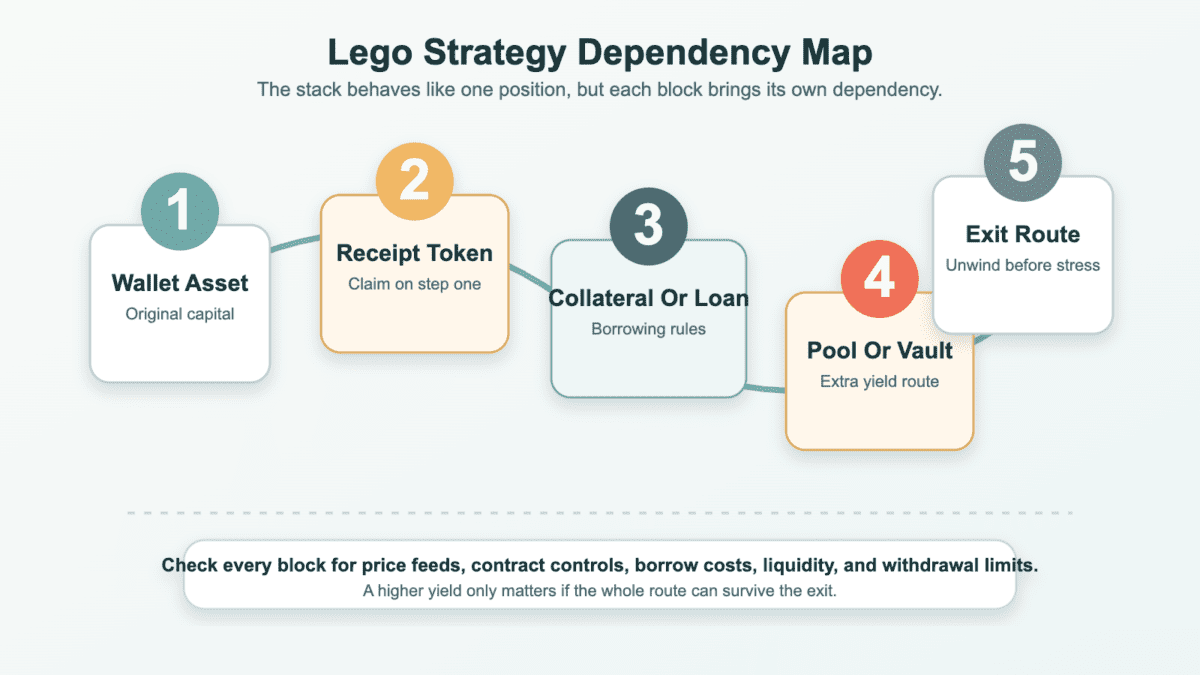
The receipt token is often where the metaphor clicks. Instead of an asset sitting idle, the receipt becomes another building block. A liquid staking token, LP token, or vault share can represent a claim on something else, then get used in a second protocol.
But the stack does not become safer because it looks tidy. If the receipt token depegs, the lending market changes collateral rules, or the vault pauses withdrawals, the whole route can change shape fast. Your wallet may still show one balance, while the risk underneath is no longer one simple asset.
So a Lego strategy is best read as a dependency map. The useful question is not “How many blocks can I stack?” It is “What happens if one block stops working?”
Common Lego strategy examples usually start with a familiar DeFi action, then reuse the output somewhere else. The goal may be extra yield, better capital efficiency, faster execution, or less manual work. The risk changes with the next block.
A liquid staking token stack starts when a user stakes an asset and receives a token that represents the staked position. That token may then be deposited into a lending market, paired in a liquidity pool, or routed through a vault.
The user is trying to keep staking exposure while doing something else with the receipt. The new assumption is that the receipt token holds its expected value and stays accepted by the next protocol.
An LP token stack starts with liquidity provision. The user deposits two assets into a pool and receives a token that represents the pool position. In a more advanced stack, that LP token may be used as collateral.
This can improve capital efficiency, but it also blends pool risk with lending risk. The position can be hit by price movement, impermanent loss, changing borrow costs, and collateral rules at the same time.
Vaults and strategy modules package several actions behind one deposit button. The vault may rebalance, harvest rewards, route through pools, or adjust exposure automatically.
That can make execution easier, especially for users who do not want to click through every DeFi step. But convenience can hide the route. A vault is still a Lego strategy if it depends on several blocks behind the interface.
Cross-chain Lego strategies add a bridge or messaging layer. A user might move assets to another chain, enter a pool there, and later bridge back.
This can open better liquidity or incentives. It also adds bridge risk, chain-specific liquidity, withdrawal delays, and front-end risk. One quiet bridge pause can turn a neat yield route into a waiting room with gas fees.
The table below keeps the examples honest. Each block adds something useful, but it also asks you to accept one more condition.
| Lego Block | What It Adds Or Risks |
|---|---|
| Liquid staking token | Keeps staking exposure, but adds depeg and collateral risk. |
| LP token | Adds trading-fee exposure, but adds pool and range risk. |
| Lending market | Adds borrow access, but adds liquidation and rate risk. |
| Vault | Adds automation, but can hide route and manager risk. |
| Bridge | Adds cross-chain access, but adds bridge and exit risk. |
| Stablecoin route | Adds settlement flexibility, but adds depeg and liquidity risk. |
Many yield routes sit close to crypto farming because incentives often pay users to provide liquidity or activity. A Lego strategy can include farming, but it is broader. The stack defines it, not the reward token.
Crypto traders use a Lego strategy when composability helps capital do more than one job. One asset can earn yield, support collateral, route through a market, or power a trade without starting from scratch each time.
That appeal is real. DeFi would be far less useful if every protocol were sealed off from the next one. Money legos let builders and traders test new combinations quickly. They also let users move between staking, borrowing, liquidity, and automation with fewer manual steps.
The main benefits are usually practical:
But none of those benefits are free. A Lego strategy only earns its complexity when every block has a clear job. If a position needs five protocols to beat a simple yield option by a tiny margin, fees and failure points may be doing more work than the strategy.
Capital efficiency is the usual pitch. A user may want exposure to the original asset while also borrowing stablecoins or earning pool fees. That can work when collateral values are stable, rates stay reasonable, and the exit remains open.
Automation is the other draw. A vault or bundled interface can reduce manual steps, especially when rewards need harvesting or positions need regular adjustment. The tradeoff is visibility. Fewer clicks can also mean fewer chances to notice what changed under the hood.
The sharper version is this: composability is a tool. It is not a permission slip to build a tower of debt and call it research.
A Lego strategy can break when one block fails, changes rules, or stops behaving as expected. The damage can stay local, or it can move through the whole stack because each step leans on the one before it.
Smart contracts are the obvious risk. A bug, exploit, or bad upgrade can damage a protocol directly. But stack risk is wider than code. It can include oracle delays, depegged collateral, bridge pauses, liquidation engines, vault logic, front-end outages, and exit routes that get crowded during stress.
The painful part is inheritance. If your position uses a receipt token as collateral, then your position inherits trust from the receipt token, the issuer, the lending market, the oracle, and the liquidation system. If it crosses chains, it inherits bridge assumptions too.
Use this table as a stress map before money goes in.
| Failure Point | What To Check |
|---|---|
| Smart contract bug | Audit history, upgrade controls, past incidents, and emergency pauses. |
| Oracle delay | Price source, update frequency, and fallback behavior during volatility. |
| Bridge pause | Withdrawal routes, bridge limits, and whether exits need another chain. |
| Collateral depeg | Liquidation threshold, market depth, and accepted collateral rules. |
| Borrow-rate spike | Net yield after interest, fees, and incentives fall. |
| LP range miss | Whether price can leave the active range before fees offset loss. |
| Vault manager error | Who controls strategy changes, pauses, and rebalancing. |
| Exit liquidity | Whether the position can unwind without moving the market. |
Thin exit liquidity is easy to ignore during a calm market. A Lego strategy can look profitable on paper, then become expensive when too many users try to leave through the same pool.
Malicious failure is different from normal strategy loss. A hard rug means users face a sudden, destructive failure such as drained liquidity, blocked selling, or stolen funds. A Lego strategy can lose money without being a rug, but it can also magnify damage when a malicious block sits inside the stack.
Liquidation risk deserves its own mental alarm. If borrowed money is involved, a price move can force selling before the user has time to react. The strategy may still be “right” over a longer period, while the liquidation engine closes it today. DeFi does not give partial credit for being early.
Check a Lego strategy by writing down the route before you fund it. If you cannot explain each protocol, asset, price feed, cost, and exit path in plain English, the setup is too opaque for serious money.
Start with the source of yield. Ask who pays it and why. Trading fees, borrow demand, emissions, staking rewards, and points programs behave differently. If the yield depends on temporary incentives, assume it can fade. If it depends on borrowed money, assume costs can rise.
Then map the control points. Know who holds the assets, which contracts can move them, which front ends you depend on, and whether you can withdraw directly if the interface fails.
Use this checklist before entering:
Wallet hygiene belongs in the strategy check, not after it. If you are testing stacked DeFi routes, use separate wallets, smaller approvals, and clean signing habits. CryptoProcent’s wallet setup coverage can help with the self-custody side. The operational rule is simpler: do not let one experimental route touch everything you own.
The final test is boredom. If the strategy only works while you watch every block all day, it may be a job pretending to be passive yield.
Lego strategy, money legos, yield farming, and composability are related terms, but they do not mean the same thing. Blurring them can make a risky position sound cleaner than it is.
Composability is the property. Money legos or DeFi legos are the building blocks. Yield farming is one possible use. A Lego strategy is the informal route that combines blocks for a specific outcome.
The phrase often appears in CT slang because traders use short labels for complicated setups. That shorthand works in a thread. It is less useful when you are the one signing approvals.
The easiest mistake is calling every yield route a Lego strategy. A single staking position is not much of a stack. A staking receipt used as collateral, borrowed against, then routed into a vault starts to fit the label.
Here is the clean distinction.
| Term | How To Use It Correctly |
|---|---|
| DeFi composability | The ability for protocols, tokens, and smart contracts to connect. |
| Money legos | The individual DeFi blocks that can be combined. |
| DeFi legos | Another phrase for composable building blocks. |
| Yield farming | Earning rewards or yield by providing capital or activity. |
| Lego strategy | A specific stacked route that combines several blocks. |
So a yield farm can be part of a Lego strategy. A bridge can be part of one too. But simply using DeFi does not make every transaction a Lego strategy. The phrase fits best when one position depends on several connected blocks.
This vocabulary helps because it separates the tool from the outcome. Composability tells you why the blocks can connect. The Lego strategy tells you what route someone built with those blocks.
A Lego strategy may be worth using when you can explain every block, cost, risk, and exit route before you enter. It is a bad sign when the only clear reason is a large APY, a viral thread, or a vault label that hides the route.
Ask whether the extra block improves the position enough to justify the new dependency. Sometimes it does. A liquid staking token used carefully in a lending market can make sense for an experienced user with a clear liquidation buffer. A vault can also reduce manual errors when the strategy is transparent and the risk is acceptable.
But complexity can decay. Incentives fade, liquidity moves, teams shift focus, and copied strategies get crowded. That can look like a soft rug when attention and liquidity drain away without one dramatic failure.
A Lego strategy starts to look weaker when these signals appear:
The answer is selectivity. Use Lego strategies for learning first, tiny experiments second, and meaningful capital only after the dependency tree looks boring enough to survive a bad week.
Start with a drawing, not a deposit. A Lego strategy becomes easier to evaluate when you can see the route on one page: asset, receipt, lending market, borrowed asset, pool or vault, and exit path.
Then shrink the strategy. If you are experimenting, test the route with an amount small enough that a bad exit teaches you without changing your week. DeFi lessons are cheaper when paid in curiosity, not rent money.
Next, run the exit before the strategy feels urgent. Withdraw the receipt token, repay the loan, remove liquidity, and check whether the route needs a bridge. A calm test shows whether the interface, contracts, and liquidity path behave as expected.
Use these actions before you build anything larger:
The last point is easy to skip. Write down the kill switch before entering. It could be a collateral depeg, borrow-rate spike, bridge pause, vault change, or reward cut. If that event happens, you do not need a fresh debate with yourself. You already made the call while calm.
Keep the first version boring. One asset, one extra block, one clear exit. If that feels too slow, that is useful information about the real risk appetite behind the strategy.
A Lego strategy in crypto is a DeFi setup that combines separate protocols, tokens, or positions like building blocks. The goal is usually extra yield, better capital efficiency, or automated execution, but the stack can also add hidden dependencies.
A Lego strategy is not exactly the same as money legos. Money legos are the reusable DeFi building blocks, while a Lego strategy is the route that combines those blocks for a specific result.
A Lego strategy is usually not the safest starting point for beginners. A simple stack can be educational, but borrowed assets, vaults, bridges, and receipt tokens can create risks that are hard to spot from one wallet balance.
A Lego strategy can create yield by stacking rewards, lending income, trading fees, staking receipts, or vault automation. The yield is only useful after fees, slippage, borrow costs, and exit risk are included.
Composability risk in a Lego strategy is the chance that one connected block harms the rest of the position. A bad oracle update, collateral depeg, contract bug, or bridge pause can affect a stack that looked like one simple position.
Yes, a Lego strategy can cause liquidation when borrowed assets or collateralized loans are part of the stack. If collateral value falls or borrowing costs rise, the lending market can close the position even if the wider strategy still looks attractive.