Physical Address
304 North Cardinal St.
Dorchester Center, MA 02124
Physical Address
304 North Cardinal St.
Dorchester Center, MA 02124


A plain-English guide to LBP crypto sales and price paths.
A liquidity bootstrapping pool is a DeFi token sale pool that shifts token weights over time so the market helps discover a launch price.
In crypto, LBP usually means this token-launch mechanism, not the Lebanese pound. You will see it on DeFi launch pages, DAO proposals, and fair-launch auctions where a project sells a new token against a reserve asset like USDC, ETH, or WETH.
The price path is only one question. Sale settings, team disclosures, wallet setup, and post-sale liquidity also decide whether buyers get a fair shot after the launch noise fades.
A liquidity bootstrapping pool is a weighted DeFi pool used to launch or distribute a token over a set sale window. The project token sits on one side of the pool. The reserve token sits on the other.
The reserve token is usually the asset buyers spend. It might be USDC, ETH, WETH, or another quote asset. The project token is the new asset being sold.
The key design choice is the pool weight. A normal liquidity pool may keep a steady relationship between two assets. An LBP can change weights over time, often starting with a high project-token weight and a low reserve-token weight.
That starting setup usually makes the token expensive at the beginning. Then the scheduled weight change pushes the implied price lower unless buyer demand offsets it.
Each buyer changes the pool too. When someone spends the reserve token and receives the project token, the balances move, and the displayed price reacts to both the schedule and the trade.
That is why an LBP can feel odd at first. It looks like a sale, behaves like an automated market maker, and borrows high-to-low auction logic without becoming a fixed-price auction.
LBPs are commonly associated with Balancer-style weighted pools. Launchpads and DeFi projects may package the same idea with cleaner interfaces, wallet prompts, and countdown timers. The interface may look polished. The core question stays mechanical: what weights change, over what window, and against which reserve asset?
A liquidity bootstrapping pool changes price through a scheduled weight shift plus live buying pressure. The schedule creates the baseline path. Demand decides whether buyers actually see a clean drop, a slower drop, or a jump.
In Balancer-style designs, the sale starts with one set of token weights and ends with another. Balancer’s LBP design uses a token-launch example that shifts from 90% project token / 10% reserve to 20% / 80%. That makes the weight schedule concrete without turning the article into AMM math.
The common beginner mistake is assuming the price must fall. It often faces downward pressure because the project-token weight falls during the sale. But buyers can push against that pressure.
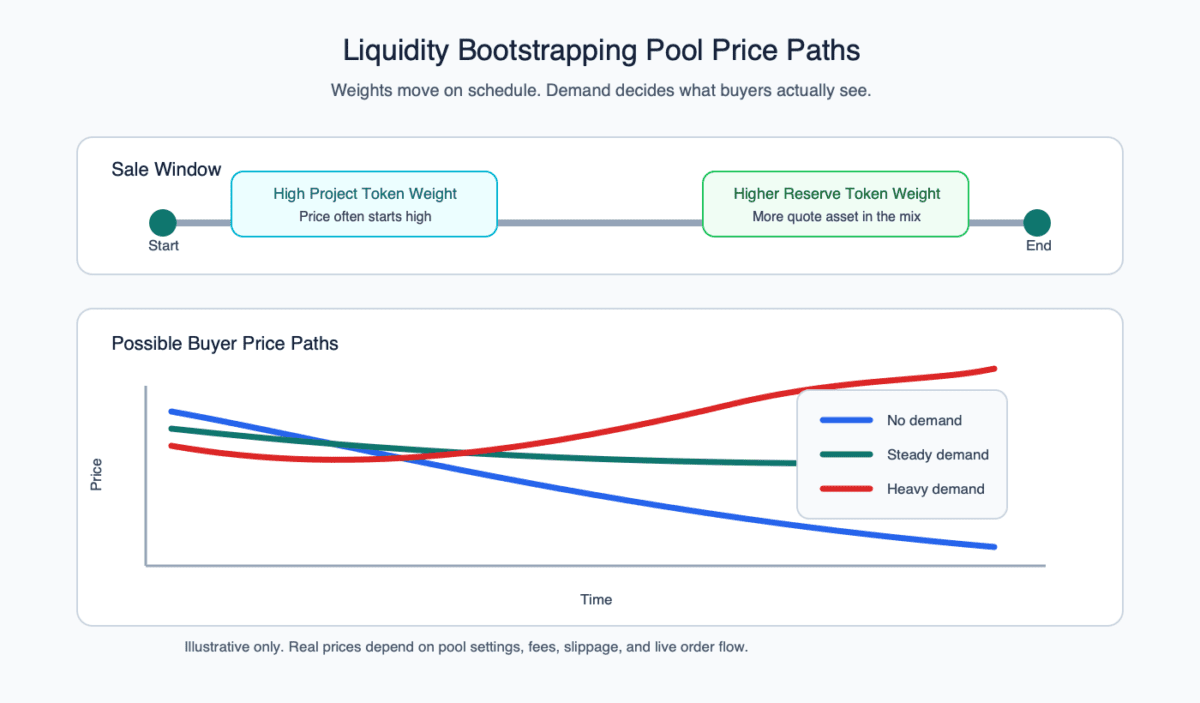
The pattern is easier to read from the buyer’s side:
| Market Pattern | What The Buyer Sees |
|---|---|
| Low demand | Price can keep sliding as the weight schedule pushes it lower. |
| Steady demand | Price may fall more slowly or flatten as buyers absorb supply. |
| Heavy demand | Price can rise even while the scheduled weights keep changing. |
| Late demand spike | Price can jump near the end if buyers crowd into a thin window. |
| Selling into the pool | Price can fall faster if sales are allowed and liquidity is shallow. |
The weight schedule also explains why early entries can be expensive. The high starting price discourages some first-block sniping because buyers are not rewarded simply for being earliest.
But the pool is still a market. If everyone waits for the perfect dip, the “perfect” entry may never arrive. If everyone rushes at once, the price can punish the crowd with impressive efficiency.
Crypto projects use a liquidity bootstrapping pool to distribute tokens, discover a market price, and reduce the amount of upfront reserve capital needed for a launch. It is a launch design, not proof that the project is good.
For a founder or DAO, the appeal is practical. A fixed-price sale can reward whoever gets in first. A thin DEX launch can be easy to snipe. A heavily curated launchpad sale can feel less open.
An LBP tries to solve some of those problems with moving weights and an open sale window. It can let a project start with more project tokens than reserve tokens, then collect reserve assets as buyers enter.
The project-side reasons usually look like this:
For a DAO, that can turn a treasury decision into a public market event. For a new protocol, it can create a reference price before the token moves into deeper liquidity or broader trading venues.
These goals can be useful. They are also easy to overmarket. A fairer mechanism does not make the token useful, audited, liquid, or sensibly valued.
Read the pitch with both eyes open. An LBP can improve the launch structure compared with a chaotic first pool. It cannot make weak tokenomics suddenly behave.
A liquidity bootstrapping pool can make some launch behavior less ugly, but it does not make a token launch automatically fair. The mechanism changes incentives. It does not fix private allocations, weak contracts, or bad actors.
The high starting price is the main fairness tool. It can discourage buyers from racing into the first block just because they have better bots, faster infrastructure, or closer access to launch timing.
The falling schedule also gives ordinary buyers more time to watch demand before entering. That can reduce the pressure to click first and think later, which is a useful improvement in a market that treats countdown timers like cardio.
But fair launch is still a claim to inspect, not a badge to admire. The LBP does not remove insider allocations, hidden wallets, weak vesting, social manipulation, poor audits, or concentrated buying over time.
It also does not stop late buyers from becoming exit liquidity if hype pushes them into a token after better-positioned wallets already have room to sell.
Use this split before trusting the word “fair”:
That is the point. An LBP may improve the auction surface, but the token still needs normal diligence. A clever curve cannot audit a team.
Read a liquidity bootstrapping pool sale page by checking the mechanics before you connect a wallet. The page should make the chain, token, reserve asset, timing, weights, access rules, and post-sale plan clear.
Start with authenticity. Use official project channels to confirm the sale URL, then check whether the launchpad, contract address, and token address match. A fake sale page often becomes obvious only after funds leave, which is too late.
Then read the sale settings. The most important numbers are the start time, end time, starting weights, ending weights, reserve asset, sale cap if any, and swap restrictions. If the page hides those details, you are not looking at a clear LBP.
Use this checklist before buying:
Team identity belongs in the same review. A doxxed team does not remove risk, but hidden founders and vague treasury wallets make hard questions harder.
Wallet setup also belongs before the sale, not during a gas spike. If the LBP runs on a chain you rarely use, compare supported wallets, approvals, hardware-wallet flow, and transaction previews before you sign anything.
Finally, record what you did. Keep the sale page, wallet address, transaction hashes, amount paid, token received, and any KYC or restriction notices. Taxes and disputes become much less fun when your only record is a screenshot named “maybe-lbp-final-final.png.”
People buy during a liquidity bootstrapping pool at different times because the price path is uncertain. Waiting, buying early, and splitting entries each solve one problem while creating another.
Some buyers wait because the scheduled weight shift may push price lower. That can work when demand is light. It can also fail when other buyers arrive first and turn the drop into a flat or rising path.
Some buyers enter early because they believe the starting valuation is already fair. That is a stronger argument when the buyer has studied supply, vesting, product traction, and post-sale liquidity. It is a weaker argument when the only support is “everyone is talking about it.”
Some split entries. They buy a small amount early, then add only if the sale develops well. This can reduce timing risk, but it can also increase gas costs, slippage, and the chance of chasing a move.
The tradeoff is easier to see this way:
| Entry Approach | Main Tradeoff |
|---|---|
| Buy early | More certainty of entry, higher risk of overpaying. |
| Wait for a drop | Better possible price, but demand may erase the dip. |
| Split entries | Less all-or-nothing timing, more fees and complexity. |
| Skip the sale | No launch risk, but no early exposure. |
The worst reason to buy is social heat by itself. If late demand pushes price above a reasonable valuation, the next holder can become a bagholder even when the sale uses a fairer-looking mechanism.
Use LBP strategy for risk control, not as a secret entry formula. Slippage, gas, failed transactions, thin liquidity, and last-minute demand can all change the result faster than a clean chart suggests.
Liquidity bootstrapping pool risk continues after the timer ends because the token still needs a real market. The sale may finish cleanly while post-sale liquidity remains thin, temporary, or poorly explained.
Ask where the pool goes next. Some projects migrate liquidity to a standard DEX pool. Some keep a portion as permanent liquidity. Others depend on market makers, listings, or future promises that are easy to state and harder to verify.
> A sale ending does not mean risk ending. It only means the launch mechanism stopped changing weights.
Liquidity ownership is a serious check. If the team can remove liquidity, change controls, pause transfers, or move treasury assets without clear limits, buyers need to understand that before trading.
A hard rug risk appears when contract controls, liquidity removal, trapped selling, or malicious permissions can cause abrupt damage. The LBP structure does not remove those risks by itself.
A soft rug risk looks slower. The token launches, the team communicates less, delivery weakens, liquidity dries up, and holders are left with a market that exists on paper but feels like an empty shop with the lights on.
Post-sale checks should include:
CEX listing claims deserve caution. “Listing soon” is not liquidity. Neither is a market-maker logo without terms, inventory, or visible depth.
After the sale, ask the blunt question: if you needed to exit, who is the buyer, where is the pool, and how much would your sale move the price?
A liquidity bootstrapping pool differs from other token launch models because price comes from a weighted AMM with a changing schedule and live demand. Other models may use fixed pricing, allocations, or different curve logic.
The terms overlap in launch copy, so keep the comparison narrow. An LBP can feel Dutch-auction-like because the price often starts high and may move lower. But it is not the same mechanism.
Here is the split:
| Model | How It Differs From An LBP |
|---|---|
| IDO | Often uses a launchpad or DEX sale with allocation rules, fixed terms, or pool listing mechanics. |
| ICO | Usually a broader token sale model, often older and less DeFi-native. |
| Dutch auction | Uses high-to-low pricing logic, but not necessarily AMM weights and live pool demand. |
| Bonding curve | Prices tokens along a curve as supply changes, often continuously. |
| Launchpad sale | May add curation, staking gates, KYC, refunds, or allocation tiers. |
| Fixed-price sale | Gives everyone the same price, but can reward fastest access or privileged allocation. |
The main LBP advantage is visible price discovery over a sale window. The main weakness is that visible does not mean simple. Buyers still need to read parameters, demand, liquidity, and post-sale terms.
So compare models by what can hurt you. Ask who sets the price, who can participate, what happens after the sale, and whether the token has enough real liquidity once the launch page stops being exciting.
A simple liquidity bootstrapping pool example starts with a project token and USDC in one weighted pool. The project wants buyers to help discover a launch price instead of setting one fixed number.
Imagine the sale begins with a high project-token weight and a low USDC weight. The sale ends with a lower project-token weight and a higher USDC weight. The exact numbers can vary by platform and project.
At the start, the token is usually expensive. If nobody buys, the scheduled weight shift can push the displayed price lower over time. Buyers may wait because they expect a better entry.
If steady demand arrives, the price may fall more slowly. Buyers are adding USDC and taking project tokens, so the pool changes through both the schedule and real trades.
If heavy demand arrives, the price can rise. That surprises beginners because they were told LBPs “go down.” The schedule may push downward, but strong buying can push harder upward.
Now add one more detail. If selling into the pool is allowed, early buyers or holders may affect the path too. That can add downward pressure, especially when liquidity is not deep.
The example is not a forecast. It is a reading tool. When you see an LBP page, ask what the schedule wants to do, what buyers are actually doing, and whether the resulting price still makes sense after the sale.
Related liquidity bootstrapping pool terms help you read sale pages without getting lost in launchpad shorthand. You do not need AMM math, but you do need the vocabulary around the sale.
An automated market maker is the on-chain market design that prices swaps from pool balances and rules. A weighted pool is a pool where assets do not need equal weights, which is why an LBP can change the project-token and reserve-token relationship over time.
The reserve token is the asset buyers spend, often USDC, ETH, or WETH. The project token is the asset being launched. Slippage is the difference between the expected trade result and the executed result, which can get ugly in thin pools.
Vesting controls when team, investor, or treasury tokens become transferable. That schedule can matter more after the sale than during it, because fresh supply can hit the market once launch attention cools.
A market maker may help create post-sale order-book or DEX depth, but the phrase needs details. Inventory, venue, timing, and visible liquidity matter more than a vague “MM secured” line.
Two adjacent checks deserve their own follow-up. A doxxed team can make founder identity easier to verify, but public names are not the same as accountability. The wallets category is useful when the sale requires a chain, approval flow, or signing setup you do not normally use.
These terms are not decoration. They are the checklist language. If a sale page uses them but cannot explain them, slow down before your wallet does the explaining for you.
No, a liquidity bootstrapping pool is not the same as a Dutch auction. It can feel similar because the price often starts high and may move lower over time. The difference is that an LBP uses weighted AMM mechanics and live pool demand, while a Dutch auction is usually a more direct high-to-low pricing process.
Yes, a liquidity bootstrapping pool price can go up when buying pressure is stronger than the scheduled downward pressure from the weight shift. This is why waiting is not a guaranteed strategy. Heavy demand, thin liquidity, and late crowding can all push the displayed price higher.
A liquidity bootstrapping pool can reduce some first-block sniping incentives, but it does not stop bots and whales by default. Large buyers can still participate, contracts can still have risk, and insiders can still hold allocations. The mechanism improves one part of the launch. It does not make the sale clean by magic.
After a liquidity bootstrapping pool ends, the token usually needs a normal market for trading. That may involve DEX liquidity, pool migration, market-maker support, listings, or a new liquidity plan. Buyers should check who controls liquidity, when team or investor tokens become transferable, and whether exits are possible without major slippage.
Liquidity bootstrapping pools may require KYC, but it depends on the platform, project, jurisdiction, and sale rules. Some are open wallet-based DeFi sales. Others restrict certain countries, require identity checks, or block participation through geofencing. Read access rules before funding the wallet you plan to use.
Beginners should be careful with liquidity bootstrapping pool sales because the interface can look simple while the risks are not. A beginner should understand the weight schedule, contract, wallet route, reserve asset, tokenomics, KYC rules, and post-sale liquidity before buying. Skipping an unclear launch is a valid move.
Start with the official sale source, then move through mechanics, access, and exit checks. A liquidity bootstrapping pool should get clearer as you read. If it gets foggier, that is information.
Separate the decision into three parts. First, can you verify the sale? Then, do the mechanics make sense? Finally, can you exit after the sale without relying on vague promises?
Use this order before participating:
If one part fails, the sale does not need a heroic interpretation. A missing contract, unclear reserve token, hidden weight schedule, or fuzzy liquidity plan is enough reason to pause.
If the sale still looks credible, size the decision around what you can verify, not what the countdown makes urgent. A small test trade may reveal gas, slippage, or wallet friction before a larger entry turns into an avoidable lesson.
Then decide whether the price still makes sense. The LBP mechanism can make a launch more orderly, but it cannot make a weak token worth buying.
The cleanest action may be patience. Watch how demand behaves, save the sale details, and skip the trade if the project cannot explain what happens after the timer reaches zero.