Physical Address
304 North Cardinal St.
Dorchester Center, MA 02124
Physical Address
304 North Cardinal St.
Dorchester Center, MA 02124


Check a migration event before old tokens, portals, or deadlines cost you.
A migration event is a planned crypto change that moves users from an old token, contract, chain, ticker, or support setup to a new one.
That sounds tidy until you are the one holding the old token. A migration event can be automatic on an exchange, manual in a wallet, delayed by staking, unsupported by a venue, or already closed by the time you notice it.
The real question is not just “what changed?” It is “where is my asset, and what must I verify before I touch it?”
A migration event in crypto is an official transition that changes how a token, contract, chain, ticker, or venue support works. It may move holders from an old token to a new token. It may also move support from one chain to another, rename a ticker, retire an old contract, or point users toward a migration portal.
The key word is “official.” A normal wallet transfer is not a migration event. Neither is a random swap on a DEX. A real migration event comes from the project, exchange, wallet provider, or platform support process tied to that asset.
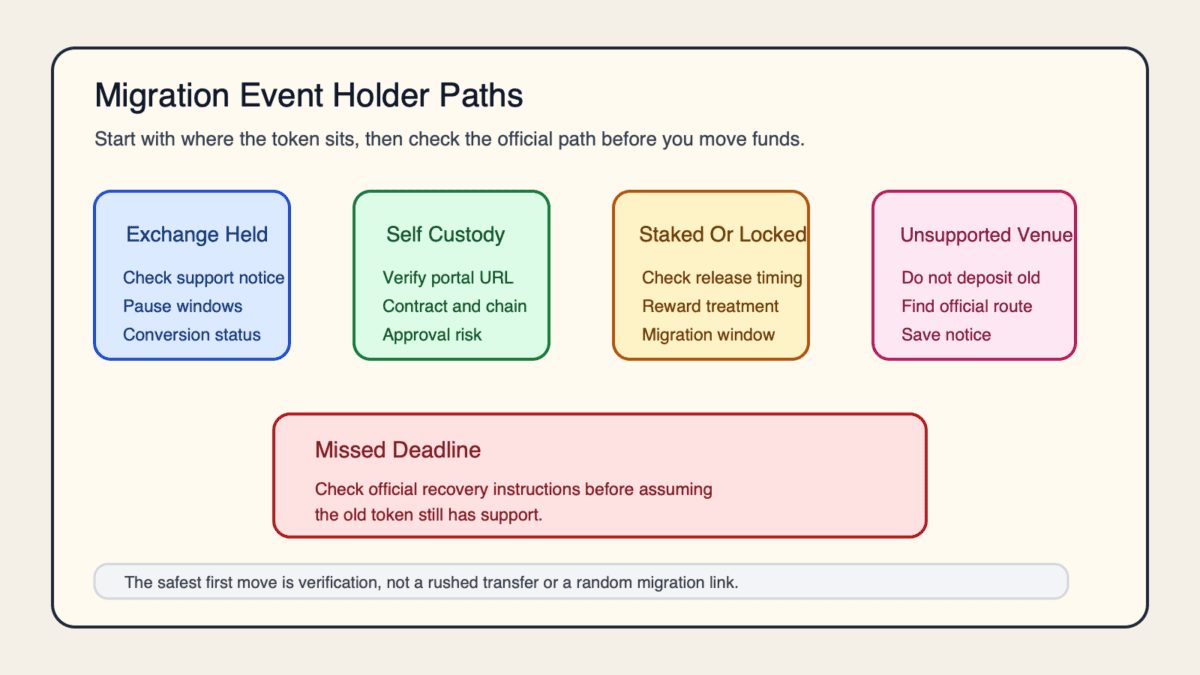
For holders, the event usually creates one of four states. Your exchange may convert the balance for you. Your self-custody wallet may need an official portal. Your staked or locked tokens may follow a special schedule. Or your old token may sit on an unsupported chain or venue where the path is limited.
Migration notices can feel more stressful than the word “upgrade” suggests. A project may be improving its contract, moving to mainnet, changing a ticker, or cleaning up old liquidity. You still need to know whether deposits close, whether withdrawals pause, whether the old token remains useful, and whether the new contract is the real one.
So do not start by moving funds.
Start by identifying your holder state. Once you know where the token sits, the action path becomes much clearer.
A migration event is the wider event. A token migration is one common action inside it. A token swap can be part of a migration, but it can also mean a simple trade. Mixing those terms is how users end up following the wrong instructions.
The confusion happens because crypto uses “swap” for several different things. You might swap ETH for USDC on a DEX. You might swap an old token for a new token through an official migration portal. You might see an exchange call its internal conversion a swap even though you never touched a smart contract.
Use the term map below as a sanity check before taking action.
| Term | What It Means For The User |
|---|---|
| Migration event | The official period or process where support moves from an old token, contract, chain, ticker, or venue setup to a new one. |
| Token migration | The token-specific move from an old asset or contract to a new asset or contract. |
| Token swap | A trade or conversion from one token to another, which may or may not be part of an official migration. |
| Rebrand | A name or ticker change that may include a migration, but sometimes changes only labels and support pages. |
| Redenomination | A supply or unit change, such as replacing one old unit with many new units or the reverse. |
| Network upgrade | A chain-level change that may not require users to exchange tokens. |
| Token generation event | The first creation or distribution of a token, not the same thing as migrating an existing holder base. |
The action path is more important than the label. If it is a normal DEX swap, price, slippage, and route safety come first. If it is a migration event, eligibility, ratio, deadline, official contracts, chain support, and venue support come first.
A clean notice will tell you who must act, who does not, and what happens to the old token. A vague notice leaves you doing archaeology in support pages, block explorers, and Discord announcements.
Crypto migration events happen because the old setup no longer fits what the project, token, chain, or venue needs. Sometimes that is a healthy upgrade. Sometimes it is damage control. Sometimes it is a branding cleanup with more drama than code.
The reason hints at the risk. A planned mainnet move with long notices and exchange support is different from a rushed contract replacement after a security issue. A ticker change is different from retiring an old chain. The holder work can look similar, but the urgency and failure modes are not the same.
Common reasons include:
None of those reasons automatically makes the new token better. A migration can be routine, necessary, or messy. Quality comes from clear notices, enough time, official contracts, supported wallets, exchange coordination, and a realistic path for users who miss the first window.
When the reason is unclear, slow down. A legitimate migration can still create risk. A fake one can look official for just long enough to empty a wallet.
An automatic migration event means a custodian or platform handles the conversion for eligible balances. A manual migration event means the user must take some action, usually through an official portal, bridge, wallet flow, or support process.
The split often follows custody. If the token is held on an exchange before the cutoff, the exchange may migrate balances internally. If the token is in self-custody, the user may need to connect a wallet, confirm the chain, approve a contract, and receive the new token. Those are very different risk profiles.
Still, “automatic” does not mean “ignore it.” Confirm whether your balance qualifies, whether deposits or withdrawals are paused, and whether the venue supports the new token after the event. Assuming no action is how small problems become expensive tickets.
Use this table as a starting point, not a guarantee.
| Where The Token Sits | Likely Migration Event Path And Checks |
|---|---|
| Centralized exchange | The venue may convert eligible balances. Check action-required status, cutoff date, trading pause, withdrawal support, and post-migration ticker. |
| Self-custody wallet | You may need an official portal or bridge. Check contract address, chain, ratio, wallet support, gas token, and approval permissions. |
| Staked or locked position | The protocol or venue may have a special schedule. Check release timing, reward treatment, validator or pool instructions, and whether action is blocked during the event. |
| DeFi liquidity position | You may need to unwind or migrate liquidity. Check pool support, new-token market depth, fees, and whether old liquidity becomes thin. |
| Unsupported venue or chain | You may need to withdraw before a cutoff or use another official path. Check whether old deposits are lost, delayed, or not credited. |
| Missed deadline | Recovery may be limited. Check official recovery notices before trusting third-party helpers or “late migration” portals. |
Manual migrations are where most wallet risk appears. A portal may need a token approval, and that approval can be abused if the site is fake or the contract is malicious. If the portal asks for a seed phrase or private key, leave. That is not a quirky UX choice. That is the trapdoor.
During a migration event on an exchange, your balance may still be visible while deposits, withdrawals, trading, staking, or conversion are paused. That mismatch is normal enough to plan for, but it should never be ignored.
Exchanges need time to stop old deposits, take snapshots, convert balances, test the new asset, update tickers, and reopen support. One venue may finish before another. One venue may support the new token but not the old deposit address. Another may allow trading but hold withdrawals until its own checks finish.
Coinbase Help keeps token migration notices with action-required fields, final migration dates, trading deadlines, migration portal links, and send or receive impact fields. Its MKR-to-SKY row, for example, lists a 1 MKR : 23,520 SKY conversion rate.
That is why migration records need the ratio, not just the ticker.
The exchange details to check are practical:
Old deposit addresses deserve special caution. If a venue says deposits are disabled after a cutoff, do not send the old token there because the address “worked last month.” A visible address is not the same as supported crediting.
Open orders can also get messy. A trading pair may close before conversion. A market may reopen under a new ticker. A balance may show in account history before withdrawals resume. You need the venue’s actual status page or support notice, not a screenshot from someone else’s account.
To verify the right token after a migration event, match the official project or exchange notice against the chain, contract address, ticker, migration ratio, and block explorer data. Do that before adding a custom token, connecting a wallet, or approving a portal.
Wallet confusion is common because the new token may not appear automatically. Your balance might exist on-chain while the wallet UI still hides it. Or the wallet might display a fake token with a familiar ticker. Tickers are cheap. Contract addresses are the harder truth.
If wallet display, network selection, or hardware-wallet support is the problem, CryptoProcent’s wallet support category can help with the custody side of the decision. The migration facts still need to come from the official project or venue notice.
Use this checklist before you trust the new token.
| Check | What To Confirm |
|---|---|
| Official source | The notice comes from the project site, exchange support page, wallet provider, or verified project channel linked from the official site. |
| Chain | The new token is on the expected network, not a lookalike chain or unsupported bridge path. |
| Contract address | The contract matches the official notice and block explorer page. |
| Ticker and name | The ticker change matches the notice, but you do not rely on ticker alone. |
| Migration ratio | The old-to-new conversion ratio matches the official instructions. |
| Portal URL | The portal URL is reached from an official page, not a search ad, DM, or copied social reply. |
| Wallet permissions | Any approval request matches the action you expect and does not grant broad access to unrelated assets. |
| Recovery notes | The notice explains what happens to old tokens, old deposits, and late claims. |
After the checklist, make the smallest reasonable move first when the official process allows it. A tiny test transaction can reveal wrong-chain, gas, display, or deposit-crediting problems before the full balance is involved.
Some migrations do not allow test claims or partial moves. In that case, verification carries more weight. You are trading one kind of risk for another: either you wait and risk missing a window, or you act and risk using the wrong path.
Migration event scams work because real migrations already create urgency. Users expect a deadline, a new contract, a portal, and a confusing support trail. Scammers borrow that shape and add pressure.
The common pattern is simple. A fake account replies under a project post. A search ad points to a cloned portal. A Discord or Telegram DM says support can help. A site asks for a seed phrase, private key, or broad wallet approval. The page may look polished. The request is still wrong.
> Any migration portal that asks for your seed phrase or private key is malicious. Official migrations do not need those secrets.
Fake migration pages can also hide behind “bonus,” “airdrop,” or “late claim” language. The pitch may say you must act in minutes, connect now, or pay an extra fee to recover the old token. Real deadlines exist, but panic is not verification.
The worst version can feel like a hard rug from the user’s side: access disappears, liquidity vanishes, and the official path turns out to be fake or malicious. That does not mean every messy migration is a rug. It means the recovery window is the wrong time to get casual with approvals.
Before using a portal, reach it from the official project site or exchange notice. Compare the contract address on a block explorer. Check whether the project has warned about fake links. If you already approved a suspicious contract, use a reputable allowance-revocation tool from a trusted source and consider moving unaffected assets to a fresh wallet.
A migration event can affect liquidity and price by splitting attention between old and new markets, pausing venues, delaying withdrawals, and confusing tickers. That does not make the event bullish or bearish by itself.
Traders often overread the announcement. A clean migration can still produce weak price action if the market does not care. A messy migration can still rally if speculation outruns the plumbing. The technical move and the chart reaction are related, but they are not the same thing.
Liquidity is the part to watch first. If old-token markets stay open while new-token markets are thin, prices may diverge. If exchange withdrawals pause, arbitrage gets harder. If the old contract still trades on a DEX, late buyers may think they found a discount when they are actually buying an asset with shrinking support.
This is where exit liquidity becomes relevant. In a migration event, the old market can become a place where informed sellers offload risk to users who missed the support notice. That is not always malicious. It can still be brutal.
Other price effects are more mechanical:
So separate migration success from price success. A good migration means eligible users can move or receive the new asset through a clear path. A good trade still needs liquidity, venue support, spread, and timing. Different problem. Same screen, unfortunately.
Tax and portfolio records after a crypto migration event can look strange because software may label the move as a sale, withdrawal, deposit, swap, airdrop, or duplicate balance. The label is not always the tax answer.
Treatment depends on jurisdiction, asset details, and how the migration happened. An off-chain exchange conversion may appear as an internal adjustment. An on-chain portal may create transaction hashes. A staking position may add reward records. A DeFi position may need more cleanup than a simple wallet balance.
Do not let portfolio software be the only record. It is useful, but it may not know the migration ratio, official reason, or whether the old token still has support. Save the raw evidence while the pages are still easy to find.
| Record To Save | Why It Helps |
|---|---|
| Official migration notice | Shows the reason, deadline, ratio, and user action path. |
| Old contract address | Helps explain what asset was replaced or retired. |
| New contract address | Helps match the received token to the official migration. |
| Migration ratio | Explains why the quantity changed or stayed the same. |
| Transaction hashes | Connect on-chain movements to the wallet history. |
| Exchange notice or email | Supports automatic conversion, paused support, or internal balance changes. |
| Screenshots of balances | Helps resolve duplicate, missing, or delayed display in portfolio tools. |
| Tax software labels | Gives your accountant or tax professional the current classification to review. |
Ask a qualified tax professional for jurisdiction-specific treatment, especially if the migration involved staking, a bridge, a DeFi position, a closed portal, or a large position.
The goal is not to decide tax law from a blog post. The goal is to preserve enough detail that the final classification is based on the migration, not on whatever label your import tool guessed that morning.
Before, during, and after a migration event, your job is to verify the official path, avoid rushed moves, and preserve records. The best action is usually boring. Crypto tends to punish users for making “just one quick transfer” during messy support windows.
Before the event, confirm the notice, deadline, ratio, eligible venues, wallet network, gas needs, staking status, and whether your exchange handles the migration automatically. If your tokens are on a venue that will not support the new asset, check the withdrawal cutoff early. Waiting until the last hour is how you meet maintenance mode at the worst possible time.
During the event, avoid sending old tokens to paused deposit addresses. Do not repeatedly retry a stuck portal transaction without understanding the failure. Do not use random links from search ads, replies, DMs, or “support” chats. If the event affects a large balance, keep notes as you go.
After the event, verify the new balance, ticker, contract, chain, wallet display, exchange support, and tax labels. If the old token still appears, check whether it is only a display artifact, an unsupported remnant, or a tradable asset with real liquidity.
Use this simple stage check.
| Stage | Practical Checks |
|---|---|
| Before | Confirm official notice, holder eligibility, deadline, ratio, supported venues, wallet chain, gas token, and staking status. |
| During | Avoid last-minute sends, fake portals, broad approvals, repeated retries, and old deposit addresses after cutoff. |
| After | Verify new token balance, contract address, ticker, venue support, tax labels, screenshots, and old-token instructions. |
| Missed deadline | Check official recovery notes, support channels, old-token market depth, and whether the asset still has practical support. |
If the old token loses support, the risk moves from “migration task” to asset survival. Some projects keep late portals open. Some do not. Confirm the recovery path from official sources before buying, selling, or paying anyone to “fix” it.
Your safest rhythm is slow, verified, documented. It will feel less heroic than rushing through a portal at 2 a.m. That is the point.
Several related terms show up around a migration event, and each one changes the user’s next check. The old token is the asset being replaced or retired. The new token is the asset, ticker, or contract expected after the move. A token contract is the on-chain program or address that defines the token.
A bridge may be part of the migration path when assets move across chains. A migration portal is the official interface for claiming, swapping, or converting assets. A token swap can be an official migration step or a normal market trade, so context controls the next move.
Market slang also appears when a migration goes badly. Dead coin risk is the next concept to check if the old token keeps trading but no longer has real support. A bagholder may be someone stuck with that unsupported asset after liquidity and attention move away. The term is blunt, but it captures the practical risk: ownership alone is not the same as useful market support.
You do not need every term at once. The useful move is recognizing which word changes the action path.
A migration event in crypto is an official move from an old token, contract, chain, ticker, or support setup to a new one. The event may be automatic, manual, optional, required, or unsupported depending on where you hold the asset.
A migration event is the broader process, while a token migration is the token-specific move inside it. A migration event may include a token migration, exchange pauses, wallet instructions, tax-record cleanup, and old-token deadlines.
You may need to act if you hold the token in self-custody, on an unsupported venue, in a staking contract, or after a cutoff notice. If an exchange says it will migrate eligible balances automatically, still verify your eligibility and the post-migration ticker.
If you miss a migration event deadline, recovery depends on the official rules for that asset. Some projects keep a late portal open, some require support contact, and some old tokens may lose practical support.
Yes, an exchange can handle a migration event automatically for eligible balances, but only under its own support rules. Check the exchange notice for cutoff dates, paused deposits, trading deadlines, and withdrawal support before assuming no action is needed.
A migration event may or may not create tax consequences depending on your jurisdiction, the asset, and how the move was handled. Save official notices, contract addresses, ratios, timestamps, transaction hashes, and exchange records so a qualified tax professional can review the treatment.