Physical Address
304 North Cardinal St.
Dorchester Center, MA 02124
Physical Address
304 North Cardinal St.
Dorchester Center, MA 02124


Noise wallet, credits, Base setup, and attention-market risk explained.
Noise wallet is the wallet and account layer users may encounter inside Noise, a Base-linked relevance-market app where traders take long or short positions on trends, brands, and ideas.
That makes the term messy. Some pages use “Noise wallet” to mean a token wallet for a NOISE asset. Noise Labs uses wallet and account tools inside a trading app. The useful question is not only “Can it hold crypto?” It is “What am I connecting, what can I trade, and what risk comes back to my wallet?”
Noise crypto also sits near prediction-market hype, Base apps, and attention-trading chatter. So a useful answer has to separate the wallet layer from the market layer before anyone starts clicking connect buttons. The interesting part is that attention becomes tradable. The rude part is that attention can be noisy in every sense of the word.
Noise wallet is the account and funding layer around Noise, an app for trading attention markets. Noise itself is mainly a relevance-market product, not a standalone wallet. Users can take long or short positions on trends, brands, ideas, and cultural narratives.
That distinction keeps the question from going sideways. A normal crypto wallet helps users store, send, receive, and approve tokens. The wallet part of Noise helps a user access a market interface, deposit value, manage credits, and interact with Base-linked smart contracts.
The label gets messy because several things get squeezed under one name:
Noise wallet belongs closer to a trading surface than a cold wallet for long-term holdings.
That trading surface is the key. Noise turns attention into a market signal, then lets traders express a view on whether relevance will rise or fall. If you came looking for a basic crypto wallet, you may be in the wrong lane. If you came looking for an attention market, the wallet details shape the operational risk before the trade even starts. A clean login only explains access. It does not explain whether the trade is sensible.
Noise wallet pages can point to unrelated products, so users need to verify what each one represents. A wallet landing page, a token price page, and the Noise Labs app can look connected at a glance even when they are not clearly the same product.
The first check is ownership. Look at the domain, chain, app name, contract address, and links from official channels. A price page or wallet template can be useful for identifying an asset, but it is not proof of affiliation with Noise Labs.
| Result A User May See | What To Verify Before Trusting It |
|---|---|
| Noise Labs or Noise.xyz | Confirm the URL, wallet flow, Base context, credit rules, and whether you are in the live app or docs. |
| Bitget-style “noise Wallet” page | Check whether it is a generic token-wallet page, which chain it names, and whether it links back to Noise Labs. |
| Coinbase NOISE token page | Verify the contract, network, trading status, and whether the token is officially connected to the Noise app. |
| Social posts about Noise crypto | Separate product updates from airdrop speculation, influencer clips, and token rumors. |
That table sounds basic because the mistake is basic. Crypto pages often compress different things into one tidy result. A user sees “Noise,” “wallet,” “token,” and “Base,” then assumes the dots are joined.
They may not be.
Before trusting a NOISE token wallet page, verify the contract source and project connection. Before trusting a Noise Labs page, confirm that you are using the current official URL. Before trusting a social thread, assume the poster may be early, late, paid, or simply guessing with better fonts.
Noise wallet connects to a market where attention becomes a tradable signal. Noise measures relevance, converts that signal into market inputs, and lets traders take positions around where attention may move next.
The beginner trap is thinking the relevance signal is the trade price. It is not. The signal can inform an oracle price or reference point. Actual fills still happen in a market with bids, asks, depth, funding, and position risk.
The broad idea comes from the attention economy. Attention has value because users, creators, brands, and traders all compete for it. Noise narrows that idea into a trading venue. Instead of only watching a trend, users can express a market view on its relevance.
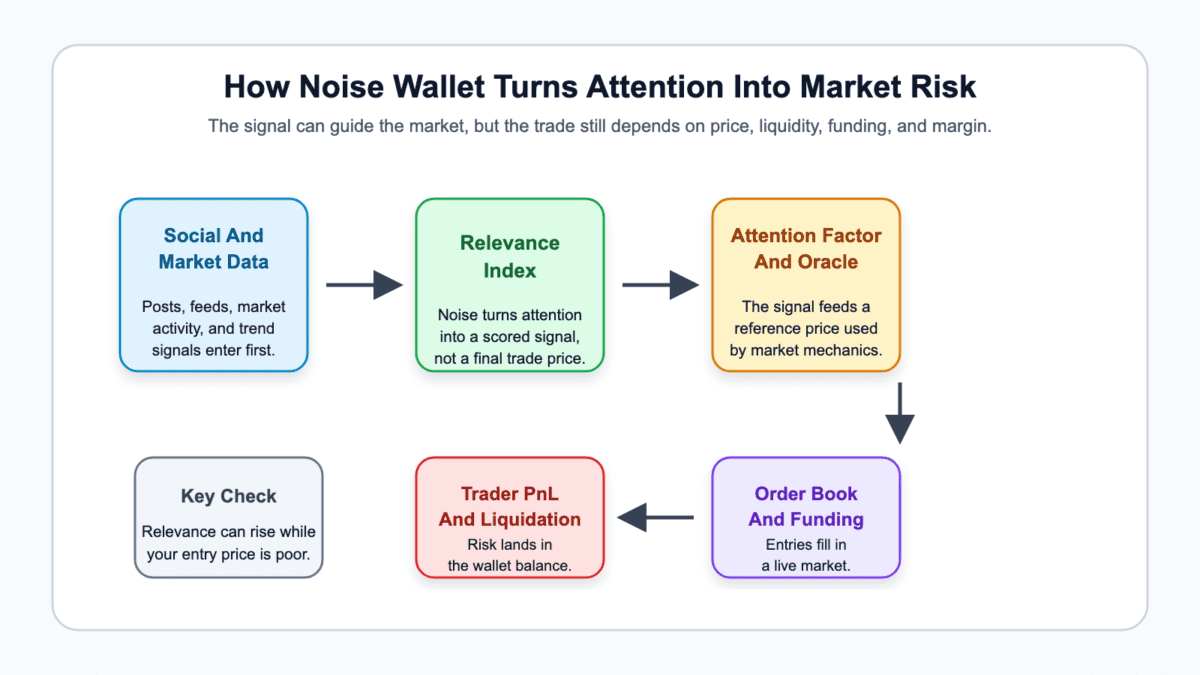
The mechanism is easier to follow as a sequence:
That means a user can be right about attention and still lose money. If a topic is genuinely getting louder but the market already priced that in, the entry may be poor. If liquidity is thin, the fill may be worse than the chart suggests. If funding moves against the position, holding can cost more than expected.
An attention trade needs more than a hot leaderboard. It needs a view on signal quality, entry price, liquidity, funding, and exit depth. Otherwise, the trade is just a social feed with collateral attached.
The wallet part of Noise wallet handles access, funding, approvals, and the account path around the Noise app. It is the layer between the user and the market, not the whole product.
For the wallet layer, the Noise FAQ describes an embedded wallet created through Privy, an external wallet option, credits, deposits, withdrawals, non-custodial wording, and a current 1x exposure setting. That mix deserves a careful read because custody, exposure, and credit rules are high-stakes details.
Still, single-source product details deserve caution. Noise may support an embedded wallet for easier onboarding, but convenience does not remove approval, recovery, phishing, or smart-contract risk. An external wallet can give users more familiar control, but rushed approvals can still expose it to signing mistakes.
Use this split before connecting:
If you only need long-term storage, browse crypto wallets before using a market app as your default home for funds. A trading app wallet and a storage wallet solve different problems.
The unanswered details count, too. Jurisdiction restrictions, fee schedules, exact withdrawal limits, recovery edge cases, smart-contract addresses, and audit status may not be obvious from a landing page. If a detail is not disclosed, do not fill the blank with optimism. Size and connect as if the missing detail could become relevant on the worst day.
What you can lose on Noise wallet is not limited to wallet theft. The more ordinary risk is that a trade goes wrong, costs build up, liquidity disappears, or credits cannot be used the way a beginner expected.
Noise markets involve positions. That means long exposure, short exposure, collateral, order execution, funding, margin, and liquidation can all affect the outcome. A user may start by asking if Noise wallet is safe, then discover the larger risk is market structure.
The credit rules need special care. Credits may be used inside the app as collateral or account value, but users should not assume they behave like cash in a bank account. If credits are non-refundable or non-redeemable under current rules, that changes how much a deposit can really be recovered.
The loss paths are wider than one scary headline:
Late attention is the classic trap. If everyone can already see the trend, a fresh long may be buying after stronger traders positioned earlier. That is where exit liquidity becomes more than slang.
The answer is not to fear every market. It is to name the risk before the trade. Check market depth, understand credit rules, decide your invalidation point, and avoid adding size because the interface makes a trend look obvious. Trend visibility is not the same as tradable edge.
Noise wallet is often compared with prediction markets, but the products ask different questions. A prediction market usually asks whether a defined event will happen. Noise asks how relevant a topic, brand, or idea is, and how that relevance may change.
That difference changes the trade. A binary event market has a clearer settlement question, such as whether a candidate wins or a rate cut happens. A relevance market can be more continuous. That gives traders more ways to express a view, but also more ways to misunderstand the signal.
| Market Type | What The User Is Really Trading |
|---|---|
| Noise wallet markets | Changing relevance, attention, and market demand around trends, brands, or ideas. |
| Prediction markets | Defined event outcomes, usually with a yes-or-no settlement condition. |
The comparison is still useful because both products turn information into markets. Users are not only reading news, memes, feeds, or cultural shifts. They are putting collateral behind a view about what the crowd will recognize next.
If your goal is to compare event-betting venues, a prediction markets guide is more relevant than a Noise wallet walkthrough. If your goal is to understand how attention itself becomes a market input, Noise is the more direct example.
Neither category is automatically safer. Prediction markets can have resolution disputes, thin books, legal limits, and bad odds. Noise markets can have oracle, relevance, liquidity, bot, funding, and liquidation risk. The product label changes the questions. It does not remove the homework.
Check Noise wallet before you connect by verifying the app, wallet type, chain, credit rules, approval flow, liquidity, and withdrawal path. Do that before adding funds, not after the interface starts feeling urgent.
The best habit is to slow down the first session. A new app can make onboarding feel casual, especially with embedded wallets. But any app that touches funds deserves the same boring checks you would use for a swap, bridge, or new trading venue.
Run this checklist before connecting meaningful value:
Base context can make Noise easier to reach, but it does not make every click harmless. Low fees can make small tests cheaper. They can also make repeated impulse trades easier.
The clean safety check is simple. Can you explain what happens if the position moves against you, if attention drops, if funding costs change, and if you want to withdraw? If the answer is mostly shrugging, the trade is not ready. A confused wallet connection is how small curiosity becomes expensive tuition.
Noise wallet is for users who want to trade attention, not users who only want a quiet place to store tokens. It fits people who can separate a cultural signal from a guaranteed trade.
The strongest fit is a user who already understands wallet hygiene, position sizing, and the difference between a signal and an execution price. That includes some narrative traders, Base users, onchain social users, creators, brand watchers, and airdrop hunters who know the difference between product exploration and reckless deposit behavior.
Noise wallet may fit these users:
It is a poor fit for users who want a simple storage wallet, cannot explain credit rules, or feel pressure to trade whatever is trending. It is also a poor fit for anyone who cannot tolerate experimental market structure. If “oracle price versus fill price” already feels like a tax form with candles, pause.
The positive case is real enough to study. Attention is a scarce resource, and crypto has a habit of turning scarce things into markets. The negative case is just as real. Once attention has a price, attention farming gets more profitable. That makes signal quality part of the trade, not a side note.
Related Noise wallet concepts are useful when they explain the product, not when they turn the page into a link pile. The useful neighborhood is attention, trading, custody, and late-trend risk.
Attention economy is the broad idea that attention itself has economic value. Attention trade is the trading expression of that idea, where users take a position around where attention may move. Late-entry risk explains the danger of joining a visible trend after early traders already have profit.
Wallet custody sits beside those concepts because the market still begins with access and signing. A user can understand the attention thesis and still lose money through a bad approval, poor wallet separation, or a deposit they did not understand.
Keep the concepts separate. Noise wallet is not just a wallet category page. It is not only a prediction-market clone. It is not automatically the same as a NOISE token listing. It is a wallet-and-market search term wrapped around an attention-trading product, which is exactly why the first move should be verification, not excitement.
Noise wallet appears to include a real wallet layer, but Noise is not mainly a standalone storage wallet. The wallet layer helps users access the Noise app, connect or create an account, deposit value, use credits, and interact with market contracts. If you only want long-term token storage, use a dedicated wallet setup instead of treating a trading app wallet as your main vault.
Noise wallet is not automatically the same as any NOISE token page you find. Token pages can describe a separate asset, a contract listing, or a generic wallet page. Verify the domain, contract address, network, and official project links before assuming a NOISE token is connected to Noise Labs or the Noise attention-market app.
Noise is linked to Base context, but the exact user flow can depend on whether you use an embedded wallet or connect an external wallet. Check the current app before depositing funds. You should confirm the chain, funding asset, wallet type, gas needs, withdrawal path, and whether your wallet already supports the required Base activity.
Noise wallet safety has several layers. Wallet safety covers the URL, embedded wallet setup, external wallet approvals, recovery, and phishing. Market safety covers credits, liquidity, funding, margin, liquidation, and oracle design. A clean login does not make a trade safe. Start small, separate higher-risk funds, and do not connect a wallet you use for long-term holdings.
Social media bots can affect any market that reacts to online attention, but that does not prove a specific Noise market has been manipulated. The risk is structural. If relevance depends partly on social and market signals, coordinated posting, influencers, algorithms, or bot activity can distort what looks organic. Read the Relevance Index as an input, not a truth machine.
Noise wallet users should verify the current withdrawal rules inside the app before depositing. The important questions are what balance can be withdrawn, what credits can or cannot be redeemed, what chain the withdrawal uses, and whether any limits apply. If a withdrawal detail is not disclosed clearly, size the deposit as if that detail could matter later.


