Physical Address
304 North Cardinal St.
Dorchester Center, MA 02124
Physical Address
304 North Cardinal St.
Dorchester Center, MA 02124


A practical guide to node sale rewards, licenses, and buyer risk.
A node sale is a crypto fundraising model where a project sells a license or right to run, delegate, or earn from a network node.
That license may be a software right, an NFT, a dashboard account, or another access path. Buyers usually expect future rewards, but the sale often happens before the project token is liquid or the network has proven demand.
The definition is only the start. A buyer still has to know what the node does, who pays for that work, how rewards are funded, and whether the license can hold value after launch excitement fades.
A node sale in crypto is a fundraising and distribution model where a project sells access to node participation. The buyer may receive the right to operate a node, delegate operations to someone else, or share in rewards tied to node activity.
The word “node” carries real weight here. A normal blockchain node stores, verifies, relays, or serves network data. A node sale adds a commercial wrapper around that role. Now the buyer has price risk, setup duties, reward assumptions, and contract terms to evaluate.
In practice, that commercial wrapper usually combines three parts:
For the buyer, each part can fail separately. The node may run, but rewards may vest slowly. Rewards may accrue, but the token may trade thinly. The license may be real, while resale rules remain vague.
A Transak explainer frames blockchain node sales as both network participation and fundraising, noting that Aethir’s public node sale brought in about $65 million within its first hour. That scale is why the mechanics need a simple example: an AI or DePIN project might sell “checker node” licenses before its token trades.
The buyer pays now, sets up software or delegates the node, and hopes future rewards become valuable later. That can support a real network if the node performs useful work. It can also become a token presale in technical clothing: more complex, more confusing, and not automatically safer.
A node sale usually works in stages, from announcement to sale access, then license purchase, setup, node status, rewards, vesting, and possible resale. Each stage can change the buyer’s cost, effort, and exit route.
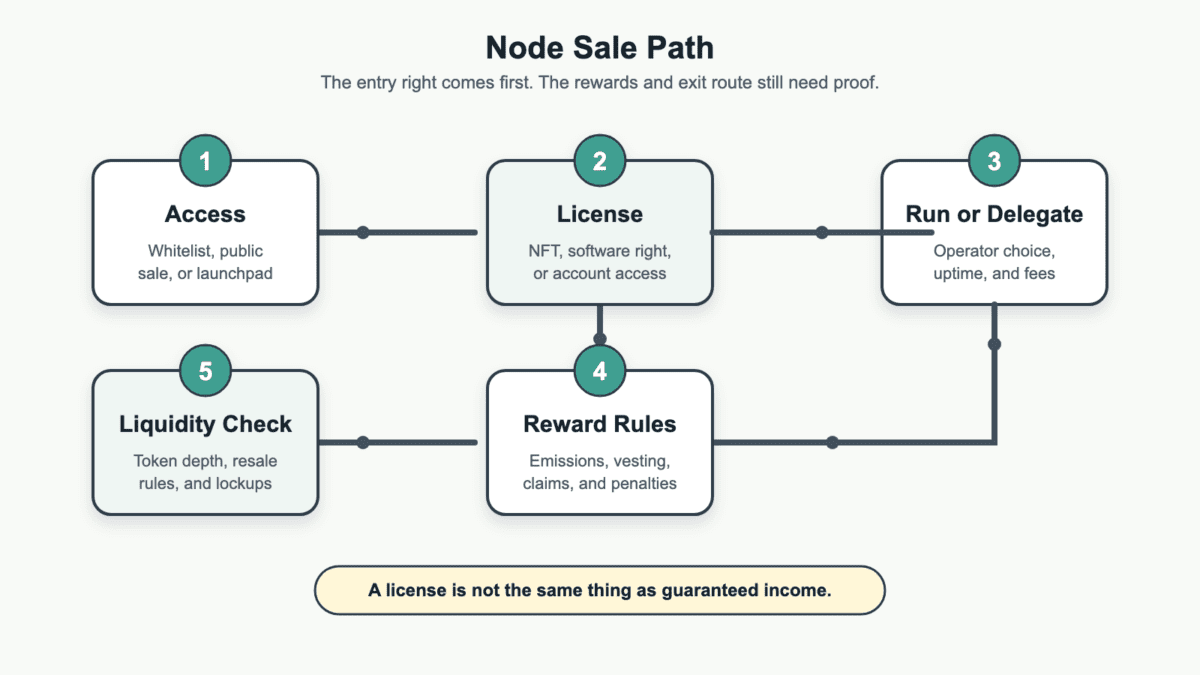
The order is not universal. Some projects sell publicly. Some gate access through allowlists, KYC, launchpads, community tiers, or regional restrictions. Some require a wallet connection before the sale page reveals the final steps, which is exactly when calm checking helps.
The typical flow looks like this:
A node license is the most common buyer-facing object in a node sale. It may be represented by an NFT, a numbered license, a contract claim, or a platform account.
That object is not always the node itself. It can be the right to register one node, run one worker, claim rewards, or delegate the work to a managed operator. The exact wording decides whether you own a transferable asset or only access inside one project dashboard.
Setup decides whether the node sale is hands-on infrastructure work or mostly a reward claim. Some buyers need a server, GPU, wallet, software install, and uptime monitoring. Others click “delegate” and let a third party run the node.
Delegation reduces effort, but it adds another dependency. Before relying on it, check who controls keys, who receives rewards first, how fees are deducted, what happens during downtime, and whether support can actually fix failed nodes.
What you buy in a node sale is usually a right, not a guaranteed stream of income. The right may connect to software, rewards, resale, governance, or a future token, but the details vary by project.
Crypto marketing can blur normal nodes, validators, node licenses, and token allocations. The table below separates the common objects before they get folded into one sale pitch.
| Thing | What It Usually Means for the Buyer |
|---|---|
| Normal node | Software that connects to a network, stores or relays data, and may not earn anything. |
| Validator node | A node with a formal security role, often tied to staking, slashing, or consensus duties. |
| Node license | A paid right to run, register, delegate, or benefit from one project-specific node. |
| License NFT | A transferable or semi-transferable wrapper for a license, if the project allows transfers. |
| Delegated node | A node operated by someone else while the buyer keeps some reward right. |
| Token presale allocation | A direct purchase or claim on tokens, usually without node operation attached. |
A node sale can include more than one of these. A license NFT might open node software and future token rewards. A delegated setup might look passive, while still depending on uptime and operator fees.
The hard part is transferability. If you can resell the license, the market still needs buyers. If you cannot resell it, your only exit may be future rewards. If rewards are locked or thinly traded, the license can feel liquid on the dashboard and illiquid in real life.
Crypto projects run node sales because they can raise funds, recruit early operators, and distribute a network role before a token is widely traded. The sale can turn future users into early infrastructure participants.
That can be reasonable. A project may need storage providers, checker nodes, verifier nodes, GPU operators, data availability participants, or other distributed work. Selling licenses can help seed that supply before normal customer revenue exists.
The project-side motives usually look like this:
But there is also a marketing angle. Node sales can create scarcity, tiers, referral loops, and social proof before the product is fully tested. Much of that demand starts on Crypto Twitter, Telegram, Discord, launchpads, and influencer threads.
Projects also like the optics. “We sold nodes” can sound more decentralized than “we raised money from buyers.” That difference is real only if node buyers perform useful work and the project explains the job clearly.
Some service providers even package node sales for founders, including tokenomics, sale contracts, landing pages, and campaign support. That does not make every sale weak, but it does mean users should remember that a node sale is also a launch product.
A node sale can fund useful infrastructure. It can also move early project risk onto buyers before demand, liquidity, and reward value are visible.
Node sale rewards usually come from token emissions, a reward pool, fee share, or a mix of those sources. They are not automatic passive income unless the network, token, uptime, and liquidity all cooperate.
The reward pitch often starts with a simple number. The real math is wider. You need the license price, total node count, reward allocation, emission schedule, uptime rules, delegation fee, vesting, token liquidity, and operating cost.
Break-even starts with one plain question: how much value must the node produce before the buyer recovers the purchase price and costs?
| Variable | Why It Changes the Outcome |
|---|---|
| License price | Higher entry cost means rewards need more time or more value to break even. |
| Total licenses | More active nodes can split the same reward pool into smaller pieces. |
| Reward allocation | A small node allocation limits upside even if the project grows. |
| Uptime rules | Missed uptime can reduce rewards or delay eligibility. |
| Delegation fees | Managed operation can eat into the return. |
| Vesting and locks | Rewards may exist on paper before they can be sold. |
| Token liquidity | A reward token needs buyers, depth, and venue access. |
| Operating cost | Servers, GPUs, bandwidth, monitoring, and time reduce net return. |
“Passive income” language gets slippery here. A delegated node may feel passive, but the economics are still active. Token price, node dilution, lockups, and market demand keep moving.
If the reward only becomes valuable when later buyers create liquidity, the buyer has to think about exit liquidity risk. If resale never develops and rewards stay locked, the buyer can become a bagholder with a node dashboard instead of a liquid position.
Avoid exact ROI math unless the project gives enough inputs to verify it. Even then, model ranges. A low token price, more active nodes, delayed claims, or thin exchange books can turn a headline return into a long wait with a dashboard login.
Node sale risks start with uncertainty. The buyer may pay before the network has users, before token liquidity exists, and before the node’s actual job has been tested at scale.
The worst sale pages hide that uncertainty behind urgency. They emphasize limited tiers, whitelist windows, famous backers, and reward language while leaving transfer rules, emissions, audits, and node utility vague.
Use this red-flag list before sending funds:
A fast failure can look like a hard rug if funds vanish, contracts are abandoned, or the promised product never appears. Do not throw the label at every live project, but know the pattern.
A slower failure can look more like a soft rug. The project keeps posting updates, the node dashboard still loads, but rewards, demand, liquidity, or development drift until the license loses practical value.
Before buying, put the boring documents in one place:
Those files are often more useful than another hype thread.
Node sale wallet safety starts before the wallet connects. Fake sale pages, copied domains, fake support accounts, custom RPC prompts, and broad approvals can turn curiosity into a very expensive click.
Start with official sources. Use the project’s verified site, verified social profile, documented launchpad, or contract address. Avoid links from replies, DMs, Discord impersonators, Telegram support accounts, or screenshots with shortened URLs.
These checks are worth doing before any node sale interaction:
Wallet hygiene is part of the purchase, not a separate chore. If the sale requires approvals, bridging, token claims, or delegation, your wallet setup is part of the risk surface.
Hardware checks matter too. A buyer should know whether the node needs a VPS, GPU, minimum bandwidth, specific operating system, uptime monitoring, or a managed operator. If the answer is “later,” the cost is not fully known yet.
A node sale looks closer to real infrastructure when the node has a clear job, the work can be measured, and the network needs many independent operators for a reason. A buyer should be able to explain the node’s function without repeating a slogan.
Stronger sales often have visible testnets, usable software, credible docs, transparent reward logic, uptime standards, and a reason distribution helps the network.
The node should do a job users can describe:
AI compute, DePIN, gaming, data availability, and verifier networks can all use node-sale language. The category alone proves nothing. A GPU node should connect to real compute demand. A checker node should check something meaningful. A gaming node should support more than a token story with nostalgia attached.
Good signs usually stack together:
None of those signs guarantee profit. They simply make the sale easier to evaluate. A real node job can still be overpriced, overfunded, or badly timed.
The strongest version of a node sale leaves you with boring clarity: what runs, what it verifies, what it costs, what it earns, and what happens if demand is weaker than hoped.
A node sale starts looking like a fundraising wrapper when infrastructure language carries more weight than the actual node job. The sale may still be public and active, but the buyer is mainly funding a launch story instead of a tested service.
The warning signs are familiar. The node verifies little, reward value depends on token hype, active node count is unclear, and the network has little usage. Scarcity gets more space than utility.
The pitch is weaker when these pieces dominate:
This is how a node sale can become part of a crypto meta. A hot narrative forms, early projects raise attention, copycats arrive, and buyers start chasing the category instead of the project mechanics.
Watch the economics too. If the project can sell thousands of licenses before proving demand, it may have solved fundraising faster than infrastructure. That gap is where buyers get stuck with the risk the project has not worked through yet.
Ask three hard questions:
If the node’s job, reward pool, transfer rights, and token liquidity cannot be explained plainly, skip the sale. There will always be another dashboard asking for your wallet.
Compare node sales by checking the mechanism, not the leaderboard. Dashboards can help you find upcoming sales, but they cannot tell you whether the license is worth buying. If every comment section sounds certain, attention may have outrun utility.
Start with the project purpose. Then move through the node job, sale terms, reward design, technical burden, transfer rights, and liquidity assumptions. If any answer is missing, mark the sale as incomplete rather than “early.”
Use this comparison table before building a shortlist:
| Check | What a Good Answer Looks Like |
|---|---|
| Node job | The node verifies, serves, computes, stores, routes, or checks a real task. |
| Sale price | Tiers are clear, and later prices do not rely only on urgency. |
| License supply | Total licenses, caps, and future issuance are disclosed. |
| Rewards | Reward pool, schedule, vesting, and penalties are documented. |
| Hardware | Device, server, GPU, bandwidth, and monitoring needs are known. |
| Delegation | Fees, control, downtime handling, and support are explicit. |
| Transferability | Resale timing, market rules, and restrictions are written down. |
| KYC and region | Eligibility limits are disclosed before the wallet step. |
| Security | Contract addresses, audits, and official links can be verified. |
| Liquidity | Token listing, claim rules, and sale depth are assumptions, not promises. |
The strongest comparison work happens off the sale page. Read the docs, inspect the contract, check the token allocation, compare community questions, and ask what would make the node useful without fresh buyer demand.
Do not turn “upcoming node sales” into a shopping habit. Slow it down: find the sale, map the risk, model a weak-case outcome, and only then decide whether the license deserves capital.
No. A node sale usually buys a license, right, NFT, or access path tied to node participation. A token purchase gives you a liquid or future-liquid asset, while a node license may depend on setup, rewards, vesting, and resale rules.
A node sale can produce rewards, but calling it passive income is risky. Rewards may depend on uptime, delegation fees, token emissions, vesting, active node count, and whether the reward token has real liquidity.
Sometimes. Some node sales require a server, GPU, stable internet, or monitoring. Others allow delegation through a managed operator. Always check hardware, uptime, and key-control rules before buying.
A node sale is not automatically a scam. It becomes dangerous when the project hides the node job, promises guaranteed returns, uses fake urgency, lacks contract clarity, or pushes users through suspicious wallet links.
Start with license price, operating cost, reward allocation, expected active node count, vesting, token price assumptions, delegation fees, and liquidity. Then model a weak-case result, not only the promotional upside.
Start with the boring checks before the sale timer starts pushing you around. A node sale is easiest to misread when urgency replaces documentation.
Before you shortlist any sale, separate curiosity from commitment. Curiosity means reading docs, checking contract addresses, and watching how the community asks hard questions. Commitment starts only when you know the license terms, reward rules, setup burden, and exit route.
Check the sale page against the project docs, not against social posts. A real offer should make the same claims in the terms, tokenomics, support channels, and wallet flow. If those sources disagree, pause.
Use this short workflow:
After that, write down the weak case. Use lower token prices, more active nodes, slower claims, delegation fees, and operating costs. If the sale only works under perfect assumptions, the timer is doing more work than the node.
Set a maximum loss before connecting a wallet. A node license can be harder to sell than a token, and a delegated setup can still leave you exposed to downtime, fees, and delayed rewards.
Also decide what would prove you wrong after purchase. Missed uptime, delayed claims, rising operator fees, vague updates, or weak token depth should not become excuses you invent later.
If those checks still leave basic gaps, wait. Missing clarity before purchase usually becomes worse after the wallet has paid.