Physical Address
304 North Cardinal St.
Dorchester Center, MA 02124
Physical Address
304 North Cardinal St.
Dorchester Center, MA 02124


Learn NFTfi before borrowing against an NFT.
NFTfi is NFT finance: using NFTs as collateral, loan assets, or financial positions in crypto markets.
The word also creates a naming trap. NFTfi can mean the broad category of NFT lending, fractionalization, rentals, and derivatives. It can also point to NFTfi.com, a specific NFT-backed lending protocol with its own history and shutdown timeline.
NFTfi in crypto means using NFTs in financial markets instead of leaving them as static collectibles. The main use case is NFT lending, where someone borrows ETH or stablecoins against an NFT and the lender receives interest for taking collateral risk.
The category is wider than loans. NFT finance can include fractional ownership, rentals, pricing tools, refinancing, buy-now-pay-later models, and NFT derivatives. The shared idea is simple. If an NFT represents ownership, access, or a scarce asset, someone may try to price it, lend against it, split it, or build a market around it.
Plenty of valuable-looking NFTs still make bad collateral. A rare trait can impress collectors and confuse lenders. A gaming item can have use inside a game but weak bids outside it.
Read the term this way:
Imagine a collector who owns a CryptoPunk but does not want to sell into a weak bid. NFTfi lets that collector seek a loan against the NFT. The borrower keeps market exposure, the lender gets a possible yield, and the NFT sits under contract rules until the loan ends.
That is useful. It is also a sharp tool with a very small handle.
The NFTfi protocol question is about NFTfi.com, not the whole NFT finance category. In June 2026, NFTfi said it would sunset after the NFT market no longer supported the cost of operating the protocol. The same post put the protocol’s historical scale at more than $737 million in loan volume, which is why the shutdown matters even if the broader NFT finance category continues.
The update affects anyone with active loans, lending positions, or old bookmarks to the app. New loan origination ended. Existing loans continue under their original terms. Refinancing is time-limited, and the front end is scheduled to go offline on August 31, 2026.
The user-impact dates are the part to keep straight:
Other NFTfi models can still exist. Gondi, BendDAO, Blend-style lending, Arcade-style loans, and other NFT finance experiments sit outside the exact NFTfi.com shutdown. Some may grow. Some may fade. Some may become cautionary footnotes in someone else’s risk section.
The lesson is narrower and more useful: protocol status is part of loan risk. A smart contract can keep running after a website retires, but the user experience, support path, refinancing route, and documentation can change fast.
NFTfi turns NFTs into collateral by locking or controlling the NFT under loan terms while the borrower receives funds. If the borrower repays on time, the NFT returns. If the borrower defaults, the lender can claim the collateral.
The roles are familiar once the jargon is gone. The borrower owns the NFT and wants liquidity. The lender supplies ETH, stablecoins, or another accepted asset. The principal is the amount borrowed. Interest is the lender’s return. Duration is the loan window. Collateral is the NFT at risk.
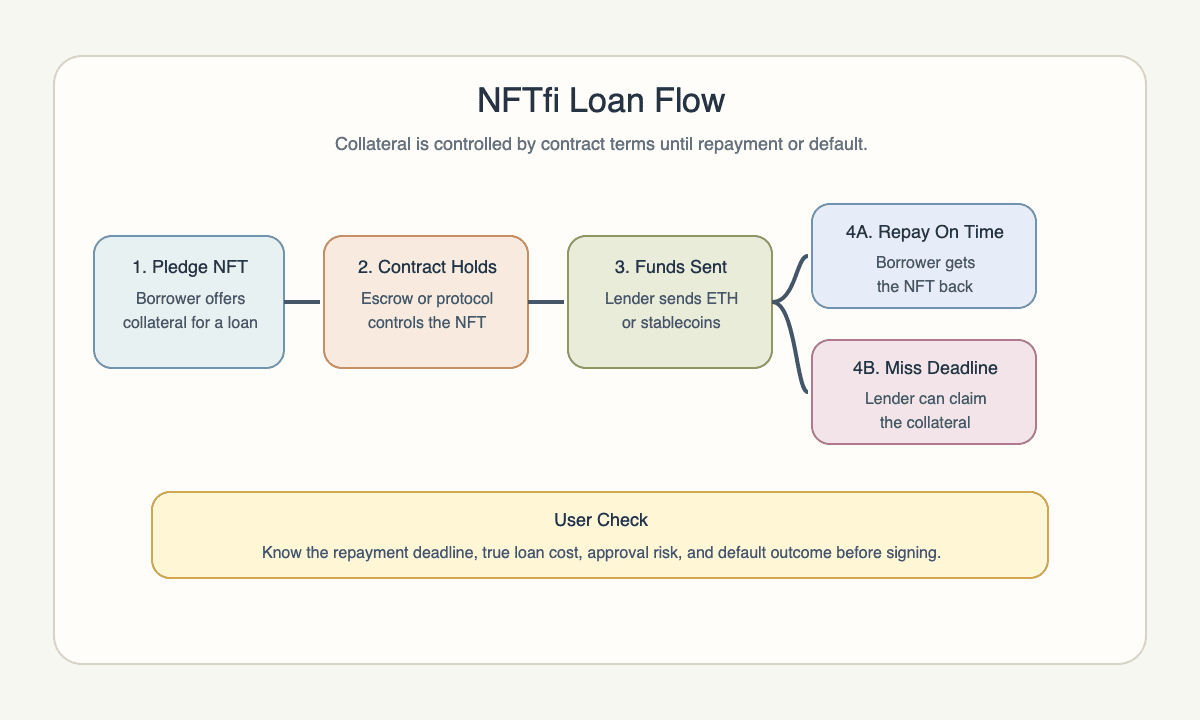
The basic NFTfi loan flow starts before a signature. A borrower needs an NFT that a protocol or lender will accept, a wallet that can approve the right contract, and a repayment plan that does not rely on vibes wearing a tiny hat.
The usual sequence looks like this:
Wallet approvals deserve their own caution. A user is not only comparing rates. They are letting contracts touch NFTs or repayment tokens, so wallet setup and approval hygiene should sit in the setup checklist, not in the panic after signing.
Default in NFTfi means the borrower misses the repayment terms, and the lender can claim the NFT. The exact process depends on the protocol, but the outcome is simple enough: the collateral can leave the borrower for good.
That is the trade the borrower accepts. The loan can avoid an immediate sale, but it adds a deadline. If the NFT falls, the borrower may decide repayment is not worth it. If the NFT rises, missing the deadline can be brutally expensive.
The lender also takes a real risk. A default can hand the lender an NFT that looks valuable on paper and slow on exit. That is how a yield position can become a bagholder position with better branding.
So the loan value must be lower than a hopeful sale price. The lender is asking two things at once: what is this NFT worth now, and would I be comfortable owning and selling it if the borrower walks away?
Traders use NFTfi instead of selling when they want liquidity without giving up the NFT. That can make sense when bids are thin, the collector expects future upside, or the borrower needs short-term funds for another trade.
Selling an NFT is cleaner than borrowing against it. You exit the asset, receive the proceeds, and move on. But NFT markets are often lumpy. One collection may have a visible floor, a few serious bids, and a long drop after that. Selling quickly can mean accepting a worse price than the headline floor suggests.
That gap is where NFTfi can look tempting. A borrower may think the NFT is worth more than today’s bids, or may need ETH for a short window while still wanting the asset back later. The loan only helps if the repayment plan is stronger than the hope behind it.
Borrowing can solve a few specific problems:
That last point is a recordkeeping warning, not tax advice. NFT-backed loans can create interest, collateral, repayment, default, and valuation entries that tax software may not classify cleanly.
Borrowing swaps sale risk for interest, timing, contract, and default risk. That swap can be rational. It can also become a very elaborate way to lose the asset you were trying not to sell.
NFTfi models differ because “NFT finance” is a category, not one product. Borrowing against an NFT, renting access to an NFT, and splitting ownership of an NFT are separate actions with separate risks.
This map keeps the main models apart:
| Model | What It Means For The User |
|---|---|
| Peer-to-peer NFT loan | One borrower and one lender agree on collateral, amount, interest, and duration. |
| Peer-to-pool NFT loan | Borrowers draw from a pool, while lenders share exposure across accepted collateral. |
| Refinancing | A borrower replaces an existing NFT-backed loan with new terms. |
| Buy-now-pay-later | A user gets NFT exposure before paying the full purchase price. |
| Rental | A user borrows NFT utility or access without owning the NFT outright. |
| Fractionalization | An NFT is split into tradable shares or claims. |
| Derivatives | Traders speculate on NFT prices or traits without holding the original asset. |
The loan models center on collateral. The rental model centers on temporary use. Fractionalization centers on splitting exposure. Derivatives center on price movement. Those differences shape what can break.
A borrower using a peer-to-peer loan needs to understand the lender’s offer and the default date. A lender using a pool needs to understand pool rules, accepted collections, and concentration. A rental user needs to know whether the NFT’s access rights can be transferred safely. Same umbrella, very different weather.
The common thread is liquidity. NFTfi products try to make NFTs easier to finance, trade, or use. But they cannot magically turn a thin market into a deep one.
NFTfi risk starts with a harsh fact: NFTs are not as liquid as major crypto assets. A floor price can move fast, bids can vanish, and one rare trait can be hard to price under stress.
Borrowers and lenders see the same market from opposite sides. Borrowers fear losing an NFT they wanted to keep. Lenders fear inheriting collateral they cannot sell at the value assumed in the loan.
Floor price is the cheapest listed NFT in a collection. It is a useful signal, but it is not the same as loan value. Loan value depends on real bids, trait demand, collection depth, and how quickly the asset could sell after default.
Thin bid depth creates the biggest trap. A collection can show a tidy floor while only a few buyers are willing to pay near that level. If everyone needs to exit at once, exit liquidity becomes the real price discovery engine.
Rare traits create a second trap. A borrower may believe a rare NFT deserves a premium. A lender may discount it because the buyer pool is smaller. Both can be right until repayment day, which is when the contract stops caring about vibes.
Wash trading suspicion adds another layer. If volume looks manufactured, recent sales may not represent real demand. Lenders should prefer bids they can verify over screenshots that look heroic.
APR in NFTfi can make short loans look stranger than they are. A high annualized rate over a short duration may translate into a smaller absolute interest payment, while a moderate APR over a longer duration can cost more in total.
Borrowers should calculate the actual repayment amount, not only the displayed APR. Lenders should ask whether the rate pays enough for collateral risk, contract risk, and the chance of receiving the NFT after default.
Use this risk checklist before comparing offers:
| Check | Risk Signal |
|---|---|
| Bid depth | A floor without firm bids can overstate collateral value. |
| Loan-to-value | High borrowing against thin collateral leaves little room for a price drop. |
| Duration | Short deadlines can punish slow repayment planning. |
| True loan cost | APR alone may hide the actual repayment amount. |
| Trait pricing | Rare NFTs may need specialist buyers. |
| Collection concentration | One project collapse can damage many similar loans. |
Use the table to slow the decision down before a wallet signature turns theory into moving collateral.
Smart-contract risk is separate from market risk. A loan can have fair terms and still expose users to contract bugs, unsafe approvals, frontend shutdowns, or confusing contract interaction after support changes.
Project risk is separate again. If a collection team disappears, metadata breaks, mint authority is abused, or the market believes a hard rug happened, the loan collateral may lose value for reasons the lender did not model.
Tax tracking also belongs here. A borrower may need records for loan proceeds, interest, repayments, and defaults. A lender may need records for interest, collateral claims, and disposal later. The exact treatment depends on jurisdiction, so keep exports before a protocol front end becomes harder to use.
NFTfi gets unsafe when pricing, contracts, records, and user assumptions drift apart. One bad click can hurt, but quiet misunderstandings can do plenty of damage too.
NFTfi can fit NFTs with clear ownership, enough demand, and a market that lenders can evaluate. It does not fit every NFT that once had a loud Discord and a floor chart with ambition.
Collateral quality changes by asset type. A blue-chip PFP may have deep collector attention but still face sharp bid gaps. Digital art may have strong cultural value but fewer comparable sales. Gaming assets may have utility, but that utility can depend on a game’s health and transfer rules.
Common NFTfi candidates include:
Gaming NFTs are a useful example because they show the difference between utility and collateral. A GameFi asset can be useful inside a game, but the lender still needs buyers outside the borrower’s plan.
Real-world asset NFTs add another caution. An onchain token may represent a claim, but the lender must understand the offchain legal right, transfer process, custody, and enforcement path. If those are unclear, the NFT may shine in a pitch deck and fail as loan collateral.
Before a lender accepts collateral, the NFT has to pass a harsher check: can it be priced, claimed, and sold if the borrower defaults?
An NFTfi protocol should be checked before any loan is signed because protocol status affects repayment, refinancing, records, support, and collateral recovery. The smart-contract terms are only one part of the user experience.
Start with the basics: what collateral the protocol accepts, what currencies it supports, how contracts hold collateral, and what happens if the website goes offline. Then check whether you can export records and revoke approvals later.
Use this pre-flight table before borrowing or lending:
| Check | What To Verify |
|---|---|
| Contract status | Whether the loan contracts are active, paused, retired, or replaced. |
| Frontend access | Whether users can repay, refinance, or claim collateral through the app. |
| Direct contract path | Whether instructions exist for interacting without the website. |
| Audits and incidents | Whether security reviews or exploit history are documented. |
| Supported collateral | Which NFT standards, collections, and traits are actually eligible. |
| Accepted currency | Which asset funds the loan and which asset repays it. |
| Approval scope | Which NFTs or tokens the wallet allows the contract to move. |
| Records export | Whether loan, interest, repayment, and default data can be downloaded. |
Use the table to locate the risk before the loan starts. A protocol with clean terms but poor shutdown communication is a different problem from one with clear records and weak collateral standards.
Borrowers should also plan repayment before borrowing. Lenders should plan ownership before lending. If either side is surprised by the default outcome, the loan terms were not understood well enough.
NFTfi examples work best when they stay close to real user motives. They show how ownership can become collateral, access, or tradable exposure without pretending the market became deeper overnight.
Three examples cover most beginner confusion:
Notice what changes in each case. The NFT keeps its market risk, but the financial wrapper changes who can use it, claim it, sell it, or wait on it.
These examples also show why NFTfi is not one decision. Borrowing, lending, renting, and fractionalizing all move different rights around. The same NFT can be a collectible to one user, collateral to another, and a headache to the person who wins it after default.
That rights question is the useful part. A borrower should know exactly when control leaves their wallet. A lender should know whether they are being paid enough to hold unwanted collateral. A renter or fractional buyer should know whether they are getting utility, exposure, or a claim that only works while the underlying project stays healthy.
Good NFTfi analysis starts with the boring questions. Who controls the asset? Who can sell it? Who pays if the market moves? Who is stuck with the NFT if the plan fails?
No. NFTfi can mean the whole NFT finance category, while NFTfi.com is one specific NFT-backed lending protocol. The distinction is important because NFTfi.com has a planned sunset, but other NFTfi models and protocols can still exist.
Yes. If you borrow against an NFT and miss the repayment terms, the lender may be able to claim the NFT. Read the duration, repayment asset, default rules, and contract path before signing.
The market decides through bids, offers, sales, collection demand, and lender judgment. A protocol may show floor prices or valuation tools, but a lender still decides whether the NFT is good enough collateral.
NFTfi is risky for lenders because the collateral can be hard to price and harder to sell. Lenders should check bid depth, collection quality, contract risk, default rules, and whether they would want to own the NFT.
NFTfi loans can create tax records, but the exact treatment depends on jurisdiction and the loan outcome. Keep transaction exports for proceeds, interest, repayment, default, collateral claims, and later sales.
Where to start with NFTfi depends on whether you are borrowing, lending, or just learning the market. Begin with the collateral before comparing any rate.
For borrowers, that means checking whether the NFT has real bids and whether repayment is realistic before the deadline. A loan can feel like breathing room, but the calendar still wins if funds are not ready when repayment is due.
For lenders, the first step is different. Assume default is possible, then decide whether the NFT would still make sense to own. Yield looks cleaner on a screen than it does when the collateral needs a buyer.
Use this order before taking action:
After that, protocol status becomes part of the decision. A working contract, a reachable front end, clean records, and clear approval controls all matter before money moves.
If you cannot explain the default outcome in one sentence, do not sign yet. NFTfi can make NFTs more financially useful, but it also turns a collectible into collateral with deadlines. That is a different asset than the one sitting quietly in a wallet.