Physical Address
304 North Cardinal St.
Dorchester Center, MA 02124
Physical Address
304 North Cardinal St.
Dorchester Center, MA 02124


A plain-English guide to Notional TVL, real deposits, and DeFi risk.
Notional TVL is the headline value of a DeFi position, vault, or strategy counted by face-value exposure. It can be larger than actual user deposits when borrowing, receipt tokens, or multi-step strategies are involved.
Notional Finance is a DeFi protocol. This guide covers the broader metric idea: Notional TVL as exposure size, not always a clean count of cash sitting in a contract.
Make that distinction before you trust a vault, a dashboard, or a token pitch. A large number can show real activity. It can also hide borrowed capital, repeated collateral, reward-chasing deposits, or liquidity that looks deep until everyone tries to leave.
Notional TVL means a DeFi position is counted by face value or exposure size. It answers “how large is this strategy on paper?” before it answers “how much new money did users deposit?”
The word “notional” comes from finance. It usually means the face value used to calculate exposure, payments, or risk. A derivatives trader may have a notional position larger than the cash posted as collateral. A DeFi vault can work the same way when it borrows, redeposits, wraps assets, or holds receipt tokens.
That does not make the metric useless. It can be fair when a product needs to show strategy capacity, credit exposure, derivative size, or how much collateral is moving through a vault.
The problem starts when Notional TVL is displayed like normal TVL. A user may read it as “that much money is deposited here.” That can be wrong. The actual deposit base may be smaller. Withdrawable liquidity may be thinner. Net capital after debt may be lower than the headline.
So read Notional TVL as an exposure metric first. Then ask what sits underneath it. Is the number backed by stablecoins, ETH, liquid staking tokens, real-world credit, borrowed assets, or a looped position? Is the same dollar counted once, twice, or more through different layers?
The useful version is simple: Notional TVL shows scale. It does not prove safety, demand, or an easy exit.
Notional TVL sits beside several metrics that sound similar but answer different questions. You need the map before any vault number makes sense.
Plain TVL usually means the total value of assets locked in a protocol’s smart contracts. User deposits focus on first-dollar capital. Net TVL subtracts debt or related liabilities when that data is available. TVR, or Total Value Redeemable, focuses on what users could actually redeem rather than what a dashboard can count.
A BIS working paper on TVL verifiability examined 939 Ethereum DeFi protocols and highlighted a core problem: TVL methods are not standardized, and independent verification can be hard when off-chain data, wrapping, or repeated positions enter the count.
| Metric | What It Tells You And What It Can Hide |
|---|---|
| TVL | Shows assets counted inside a protocol, but can hide leverage, price swings, and repeated collateral. |
| Notional TVL | Shows face-value exposure, but can be larger than user deposits or redeemable liquidity. |
| User Deposits | Shows first-dollar capital from users, but may miss borrowed exposure built on top. |
| Net TVL | Shows a cleaner capital base after debt, but depends on good liability data. |
| TVR | Focuses on redeemable value, but may be harder to calculate across complex strategies. |
| Open Interest | Shows derivatives exposure, but does not show contract TVL or cash available for withdrawals. |
| Borrow TVL | Shows assets borrowed in lending markets, but can double-count against deposited collateral. |
No single metric wins every case. A lending protocol, perp DEX, fixed-yield vault, and RWA credit product all need different context.
Read the metrics together. Pair Notional TVL with user deposits, net debt, volume, fee revenue, active users, collateral quality, and withdrawal terms. If the notional number is the only number being promoted, the dashboard is asking for trust before it has earned attention.
Notional TVL can be bigger than real deposits because DeFi lets capital move through several steps without adding the same amount of fresh outside money each time.
A simple vault may hold one asset and report one deposit value. A more complex strategy may deposit collateral, borrow against it, redeposit the borrowed asset, receive a tokenized claim, pledge that claim elsewhere, or route the position through another protocol. Each step can carry its own face value.
That creates a real accounting puzzle. A loop can increase exposure and capital efficiency. It can also make one dollar look like more than one dollar if every layer gets counted as fresh TVL.
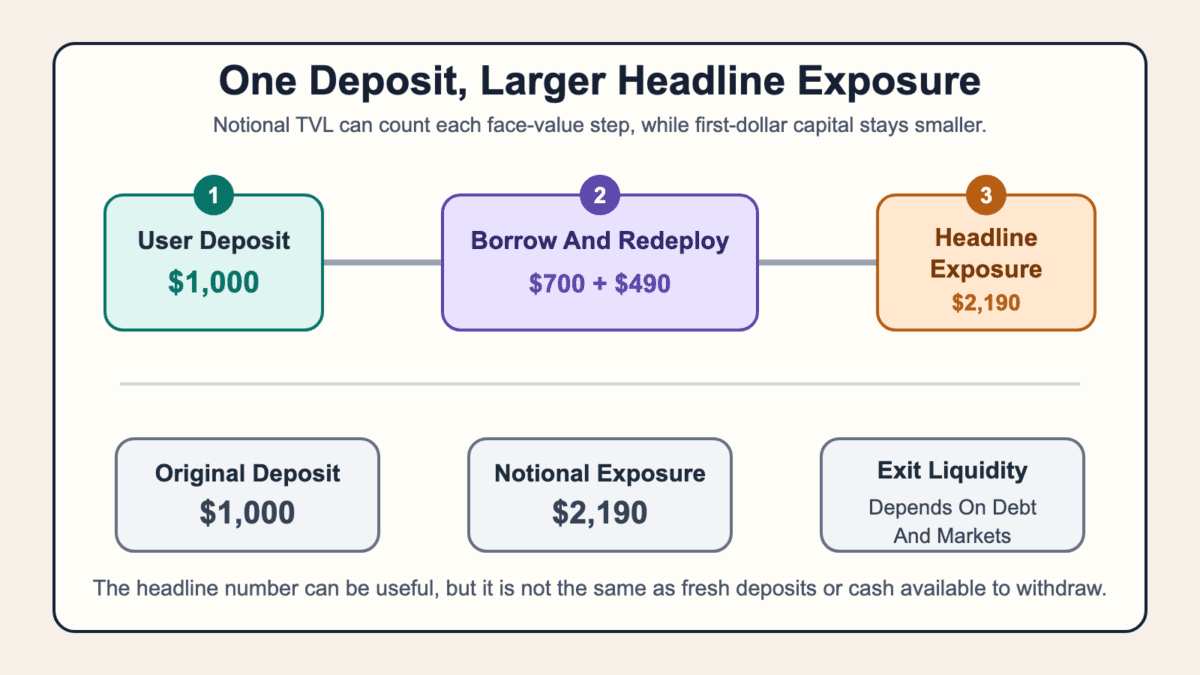
Borrowed assets are the easiest example. If a user deposits collateral, borrows stablecoins, and redeposits those stablecoins, the position now has more gross exposure than the original deposit. The user also has debt. The headline can grow while the margin for error shrinks.
Receipt tokens and wrappers add another layer. A user may deposit ETH, receive a liquid staking token, place that token into a vault, and then use the vault token elsewhere. Each token represents a claim on something underneath. Counting every layer as separate capital can overstate how much unique value exists.
RWA and credit strategies can create a similar problem. A vault may show notional exposure to loans, invoices, or structured credit. That may help size the book, but it does not automatically show cash reserves, default risk, collateral recovery, or how quickly users can redeem.
The practical risk is exit depth. A high Notional TVL can sit above a much smaller pool of liquid assets, so users still need to understand exit liquidity before using the number as comfort.
Legitimate capital efficiency and double counting can look similar from a distance. The difference is disclosure. A good protocol shows deposits, debt, methodology, and redemption terms beside the notional number. A weak one waves the headline and hopes you stop reading.
Notional TVL is useful when you need to understand exposure size, strategy capacity, or risk limits. It works best when shown beside cleaner capital metrics.
For a borrowing-heavy vault, notional exposure may tell you how much market exposure the strategy controls. For a fixed-yield product, it may show the face value of positions tied to future yield. For a derivatives venue, notional size may be closer to open interest than to simple deposits.
That can help users compare scale across products that do not hold capital in the same way. Two vaults may each accept stablecoin deposits, but one may use light lending while another loops collateral several times. Their notional figures may reveal very different risk profiles.
Use Notional TVL when it answers one of these specific questions:
This is where Notional TVL can be more honest than plain TVL. If a product manages exposure larger than deposits, hiding that fact would be worse. The useful version says: here is the gross exposure, here are the deposits, here is the debt, and here is how withdrawals work.
The metric earns trust when the methodology is boring and clear. If users can see the assets, liabilities, wrappers, price feeds, caps, and redemption mechanics, Notional TVL becomes a risk lens. If those details are missing, it becomes a billboard.
Notional TVL misleads investors when it turns exposure into a safety signal. A large number can make a protocol look adopted, liquid, or battle-tested before the underlying details support that story.
The first trap is false comfort. TVL does not audit code. It does not fix oracle design. It does not remove admin-key risk. It does not prove a strategy can exit during stress. It only shows value counted under a chosen method.
The second trap is incentive-driven growth. A protocol can attract deposits with rewards, points, native-token emissions, or short-term APY campaigns. That can be a normal bootstrapping tool. But if the rewards fade and deposits leave, the earlier Notional TVL may have reflected paid attention more than durable demand. That is one route to a soft rug feeling: no dramatic theft, just incentives, silence, and fading liquidity.
Asset composition changes the read too. TVL backed by ETH, major stablecoins, and liquid collateral is different from TVL backed mostly by a protocol’s own token. Native-token-heavy TVL can rise when the token price rises, even if user deposits do not grow. It can also fall hard when confidence breaks.
Circular lending is another warning sign. If the same collateral supports deposits, loans, redeposits, and more loans, Notional TVL can climb while liquidation risk climbs with it. The strategy may be rational in calm markets. It can become painful when prices move, borrow rates rise, or liquidity dries up.
Wallet concentration matters too. If a few wallets control most of the capital, the number may be less stable than it looks. One large withdrawal can change the chart, widen slippage, or expose a thin redemption path.
Token investors need extra discipline here. A protocol may use rising Notional TVL as proof that a token is undervalued, but a metric story can break faster than a price chart. That is how late buyers drift into bagholder risk while early depositors, insiders, or reward farmers move on.
So do not ignore Notional TVL. Use it as a prompt to inspect. A high number should start better questions, not end the conversation.
Check Notional TVL by comparing the headline number with the capital, debt, liquidity, and control risks underneath it. The goal is not to become an auditor. The goal is to avoid obvious traps before depositing, lending, LPing, or buying a token around a TVL story.
Start with the gap. If Notional TVL is much larger than user deposits, ask why. Borrowed assets, wrappers, derivatives, and credit exposure can all explain the gap. A good dashboard should make that explanation easy to find.
Then check whether usage supports the number. Real volume, fee revenue, utilization, active users, and repeat deposits tell a better story than a single headline metric. If TVL is up while volume, fees, and users are flat, price movement or incentives may be doing more work than adoption.
Use this checklist before trusting the number:
| Check | What It Helps You Catch |
|---|---|
| User deposits versus Notional TVL | Shows whether exposure is much larger than first-dollar capital. |
| Net debt and borrow rates | Reveals how much leverage supports the headline. |
| Collateral composition | Spots native-token reliance, thin assets, or unstable backing. |
| Real volume and fee revenue | Tests whether capital is being used or only parked for rewards. |
| Active users and wallet concentration | Shows whether activity is broad or controlled by a few wallets. |
| Audit date and contract changes | Flags old audits or new code added after review. |
| Withdrawal queues and caps | Shows whether users can exit during normal and stressed markets. |
| Admin keys and upgrade controls | Reveals who can change rules, pause withdrawals, or move strategy risk. |
| Oracle design | Checks whether collateral values depend on fragile price feeds. |
| Incentive schedule | Shows whether deposits may leave when rewards decline. |
The table gives you a first pass, not a verdict. If one or two checks look weak, slow down. If many look weak, the high number may be doing more marketing than risk disclosure.
Pay close attention to control risk. Admin keys, pausable withdrawals, upgradeable contracts, and strategy managers can be legitimate tools, but they also create trust assumptions. Notional TVL cannot protect you from hard rug mechanics if contracts or funds can be abused.
Size your own risk with the same care. A high-notional strategy can look safer because many others are present, but crowding does not reduce your personal downside. Avoid full porting into one vault just because its dashboard looks large.
The useful question is simple: what happens if yields fall, borrow costs rise, or withdrawals spike? If the answer is unclear, the Notional TVL number is not enough.
Notional TVL becomes clear in a simple lending loop. The numbers below are hypothetical, but the accounting pattern is common in borrowing-heavy DeFi strategies.
Imagine a user deposits $1,000 of collateral. The strategy borrows $700 against it, then redeposits that borrowed amount. It borrows $490 against the second deposit and redeposits again. The user started with $1,000, but the gross position now has more face-value exposure.
| Step | What The Number Shows |
|---|---|
| Deposit $1,000 | The user’s original capital enters the strategy. |
| Borrow $700 | Debt creates more deployable capital, but also creates repayment risk. |
| Redeposit $700 | Gross exposure rises without a new outside deposit. |
| Borrow $490 | The loop adds another layer of debt. |
| Redeposit $490 | The notional exposure reaches $2,190. |
The original user deposit is still $1,000. The notional exposure is $2,190. The net position depends on asset values, debt, interest costs, collateral rules, and liquidation thresholds.
This is why a notional number can be both real and incomplete. The strategy really does control more gross exposure. But the user did not add $2,190 of fresh capital. The extra exposure came from borrowing and redeploying.
Now add market stress. If collateral prices fall, the vault may need to unwind. If borrow rates rise, the yield spread can shrink. If many users withdraw at once, the strategy may need to repay debt before returning funds. That is when the gap between notional exposure and redeemable liquidity becomes very concrete.
A clean dashboard would show the loop plainly. It would separate user deposits, borrowed assets, gross exposure, net exposure, and withdrawal liquidity. If it only shows the biggest number, you are being asked to admire the scoreboard without seeing the game.
Start with comparison, not trust. A high Notional TVL is a reason to inspect the structure behind the number.
You do not need to solve every accounting problem in DeFi. You do need enough context to avoid mistaking exposure for deposits or leaderboard size for safety.
Look for plain disclosure, not perfect certainty. A useful dashboard will split deposits, borrowed assets, gross exposure, net exposure, and withdrawal limits. A weak one makes the biggest number easy to find and the method hard to explain.
Use these checks before you act:
Then decide whether the metric helps your exact action. A trader may care about exposure and liquidity. A yield user may care about debt, exit timing, and collateral quality. A token investor may care whether TVL growth comes from sticky usage or temporary rewards.
Keep your position size tied to what you can verify. If you cannot explain where the extra notional exposure comes from, you probably should not let the headline number choose your risk for you.
The best Notional TVL number is not the largest one. It is the one you can reconcile with deposits, debt, risk limits, and exits without squinting.
No. Notional TVL is not always the same as money deposited by users. It can include face-value exposure created through borrowing, redepositing, wrapped assets, receipt tokens, or derivatives. User deposits are the cleaner measure of fresh capital entering a strategy. Notional TVL can still help, but only when the protocol also shows deposits, debt, and redemption terms.
A high Notional TVL is neither good nor bad by itself. It can show scale, liquidity demand, or strategy capacity. It can also reflect borrowing, incentives, price appreciation, or repeated collateral. Read it beside user deposits, fee revenue, active users, collateral quality, and withdrawal liquidity.
Notional TVL can be made to look better through aggressive counting, incentive campaigns, circular lending, native-token price moves, or unclear methodology. Manipulation does not always mean theft. Sometimes it means a metric is presented in the most flattering way possible. If the dashboard does not explain how Notional TVL is calculated, read the number as incomplete.
DeFi vaults report Notional TVL and net deposits separately because they answer different questions. Notional TVL shows gross exposure or strategy size. Net deposits show a cleaner capital base after accounting for debt or related liabilities. Seeing both helps users understand whether growth comes from new deposits, borrowing, asset prices, or repeated positioning.
No. Notional TVL does not make a protocol safer. It does not audit smart contracts, protect oracles, remove admin-key risk, or guarantee withdrawals. It may show that a strategy is large, but size and safety are different claims. Use Notional TVL as one input beside audits, code history, controls, liquidity, and collateral quality.
Check user deposits, net debt, collateral composition, volume, fee revenue, utilization, active users, wallet concentration, audit age, contract changes, withdrawal queues, admin keys, oracle design, and incentive schedules. The point is to learn what supports the headline number. If Notional TVL is high but those support signals are weak, slow down.