Physical Address
304 North Cardinal St.
Dorchester Center, MA 02124
Physical Address
304 North Cardinal St.
Dorchester Center, MA 02124


A plain-English guide to oracle risk, bad data feeds, and DeFi losses.
Oracle risk is the risk that a smart contract uses wrong, stale, manipulated, delayed, or unavailable external data and then executes exactly as coded on a bad input.
In crypto, that usually means blockchain and DeFi data risk, not Oracle the software company. A protocol can have clean code, clear rules, and public transactions, then still hurt users because the price, event, reserve, or settlement feed was wrong.
Automation does not remove trust when it needs facts from outside the chain. It moves that trust into feeds, data providers, update rules, fallback logic, and governance controls.
Oracle risk in crypto is the chance that an automated onchain system accepts the wrong outside fact and then acts on it. The fact might be an ETH price, a collateral value, a stablecoin reserve signal, a tokenized-stock price, a weather result, or a prediction-market outcome.
That input becomes part of the contract’s decision path. A bad dashboard quote is annoying. A bad collateral price, settlement price, or event result can move money before anyone has time to argue with the screen.
The important part is “accepted by the protocol.” A smart contract does not need to know whether the data feels fair. If the feed clears the protocol’s rules, the contract can update a loan, settle a perp, pay a market, pause a vault, or liquidate collateral. Oracle risk shows up anywhere a contract needs outside information:
That is why oracle risk is not just a developer concern. It can become a user balance, margin call, frozen market, or broken exit. The code may do exactly what it was designed to do, which is oddly rude when the input is bad.
Oracle risk exists because blockchains are deterministic systems. Every validator needs to reach the same result from the same inputs, so a chain cannot casually browse the web, call an exchange API, or ask a news site what happened in the outside world. That creates the oracle problem.
Smart contracts can verify onchain state, but they still need outside data for prices, interest rates, weather, sports scores, stock values, reserves, shipping events, and legal or market outcomes. An oracle brings that data onchain. This is where trust re-enters the system. The contract may be public, but the input pipeline has its own assumptions:
Oracle risk is different from wallet control. A user with strong wallet custody can still enter a DeFi position that depends on an outside price feed. Self-custody controls the keys. It does not control the feed.
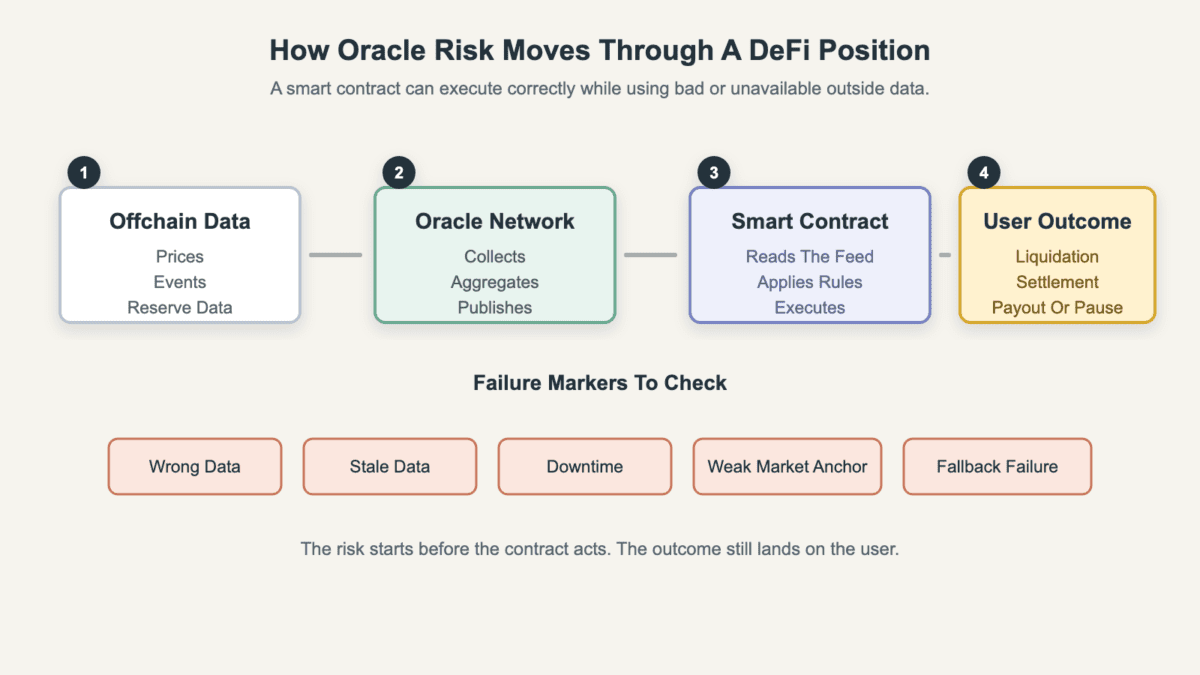
Oracle risk hits DeFi traders and investors when a feed affects money movement. The user can be right about the market and still lose because the protocol reads a bad input at the wrong time.
In lending, a collateral feed can change borrow limits or liquidation thresholds. In perps, an oracle can affect mark prices, funding, settlement, and forced exits. In yield, one weak data dependency can sit under several layers of strategy risk. The damage varies by product type:
This is why yield farming needs more than an APY check. A vault can sit on lending markets, LP positions, stablecoins, bridges, and price feeds. The visible rate may be only the top layer.
The hardest version is the “I was right but still lost” case. A trader may predict the broader price move correctly, yet get liquidated because one accepted feed was stale, distorted, or unavailable when the protocol needed it.
Oracle risk is the umbrella category. Oracle manipulation is one way it can happen, usually through active abuse of a feed, reference market, or update mechanism.
Price oracle manipulation often targets weak reference markets. If a protocol reads a shallow DEX pool, an attacker may move that pool briefly, make the oracle accept the distorted price, then borrow, liquidate, mint, or settle against the bad value. Keep the categories separate because not every oracle failure is an attack:
| Term | What It Means For Users |
|---|---|
| Oracle risk | The protocol depends on external data that can be wrong, stale, delayed, unavailable, or poorly integrated. |
| Oracle manipulation | Someone actively distorts the feed or reference market so the protocol accepts a bad value. |
| Smart contract risk | The code, permissions, upgrade path, or protocol design fails even if the data is accurate. |
| Market manipulation | A market price is distorted, which may or may not become oracle input. |
These risks can overlap. A weak contract can integrate a weak feed. A thin market can be manipulated before the oracle reads it. Governance can make a rushed parameter change after a feed breaks.
The label changes what a user should inspect next. Manipulation points toward market depth, update windows, and attack incentives. Stale data points toward freshness checks and pause rules. Bad integration points toward the contract’s own safeguards.
So do not stop at the word “oracle.” Ask whether the problem is data quality, feed design, reference-market depth, contract integration, admin control, or a live attack. The fix depends on the failure path.
Common oracle risk types include bad source data, stale updates, downtime, weak market anchors, bad fallback logic, and governance controls. The details sound technical, but the user question is simple: what can the protocol believe at the worst possible moment?
On June 21, 2026, DeFiLlama oracle rankings listed Chainlink at about $30.4 billion in total value secured. That does not mean Chainlink itself is a single point of failure, but it shows why oracle risk checks should include dependency concentration alongside data quality and timeliness.
| Risk Type | What To Check |
|---|---|
| Bad source data | Whether the feed uses reputable sources and filters out obvious outliers. |
| Stale feed | How old a price can be before the protocol rejects it. |
| Delayed updates | Whether fast markets can move before the oracle catches up. |
| Oracle downtime | What happens if the feed cannot publish. |
| Single-source dependency | Whether one source, node, or venue can drive the result. |
| Data-provider concentration | Whether several feeds still rely on similar underlying data. |
| Fallback failure | Whether backup feeds activate clearly or create new bad inputs. |
| Governance override | Who can pause, change, or override the feed path. |
| Thin market anchor | Whether the referenced market has enough depth to resist distortion. |
| Event dispute | Who decides truth when an outcome is unclear. |
Thin reference markets deserve special attention. If a small token, private-market perp, or obscure pair lacks deep trading, the oracle may be reading a market that is easy to move and hard to exit. That can turn oracle risk into exit liquidity risk very quickly.
TWAP and VWAP designs can help smooth noisy prices, but they are not magic shields. Smoothing can reduce brief manipulation, yet it can also lag during real moves. The right design depends on the asset, venue depth, update rules, and what the protocol does with the feed.
Protocols reduce oracle risk by making bad inputs harder to publish, harder to accept, and less damaging when they slip through. Good design uses several controls instead of trusting one clean-looking feed.
Multiple data sources and node operators can reduce single-source failure. Aggregation can filter outliers. Heartbeats can force regular updates. Deviation thresholds can trigger faster updates when prices move sharply. Stale-price guards can stop a protocol from accepting old data. The control stack usually includes several pieces:
Chainlink, Pyth, UMA, Chronicle, and similar oracle systems use different designs for sourcing, publishing, dispute handling, and update timing. Chaos Labs and other risk teams also help protocols monitor market conditions and parameter risk. The useful point is not which name sounds safest. It is whether the protocol integrates the feed well.
> A decentralized oracle can reduce some single-source and manipulation risks, but it does not remove every data, governance, market-depth, or integration assumption.
For users, the warning is practical. A strong oracle network can still feed a protocol that has weak liquidation rules, poor fallback behavior, shallow collateral markets, or concentrated governance. The feed is one layer, not the whole shield.
You can check oracle risk before you deposit by looking at the feed, the asset, and the protocol action that depends on that feed. If a protocol cannot explain those pieces plainly, size down or skip it.
Start with the asset. ETH/USD and BTC/USD feeds usually have deeper reference markets than a new token, a tokenized stock, a private-market perp, or a thin LP token. The weaker the market anchor, the more the protocol’s oracle design has to carry. Then check the protocol’s controls:
For lending and perps, liquidation rules deserve extra focus. A price feed may only be wrong for a short period, but liquidation can be permanent. If the protocol has no grace logic, delay, or emergency control, the user eats the mistake faster.
For vaults and yield products, map the dependencies one layer deeper. The vault interface may show one position, while the strategy depends on lending markets, collateral feeds, LP tokens, bridges, or stablecoins. The cleanest UI can hide the messiest stack.
Oracle risk changes position size because a position with more external assumptions should usually be smaller, carry less borrowing, or be easier to exit. Higher APY or larger upside should pay for added risk, not distract from it.
This is most obvious in debt-heavy lending positions and perps. A small feed error can become a forced liquidation when collateral is tight. A position with a thin health buffer may survive normal volatility but fail during a feed delay, depeg, or abrupt market pause.
Size also depends on how reversible the damage is. A temporary bad quote on a spot chart may pass. A temporary bad collateral price can force a sale. The less time you have to react, the smaller the position should be. Before sizing up, ask these questions:
Avoid turning uncertain oracle exposure into a full-port position. All-in sizing is already fragile. Adding a feed dependency makes it more dependent on timing, liquidity, and protocol response.
That does not mean every oracle-dependent position is reckless. It means the position should match the confidence level. Clear feed design, deep markets, conservative liquidation rules, and easy exits can support more size than opaque feeds and thin anchors.
Oracle risk in RWAs, synthetics, and prediction markets gets harder because the source of truth may be delayed, disputed, private, or legally separate from the token. The oracle is not just reading a deep spot price. It may be interpreting a claim.
Timing is the trap. Traditional markets close. Private-market marks can be sparse. Event outcomes can be contested. A blockchain transaction may be instant, but the fact it depends on may arrive late or under dispute.
Tokenized stocks and RWAs are a good example. A token can offer price exposure without giving the same ownership, redemption rights, or legal claim as the underlying asset. The oracle may track a market price, reserve value, issuer update, or broker data, while the user’s actual rights depend on the product structure. The risk changes by product type:
Each case is different from a deep BTC/USD or ETH/USD feed. If the reference market is closed, thin, private, delayed, or disputed, the position can behave differently from the thing it imitates.
Do not label an incident as an oracle exploit just because social posts say so. Wait for a reliable postmortem or primary source. Crypto rumor mills are fast, loud, and often allergic to boring facts.
Start by naming the exact outside fact the protocol needs. Is it a token price, collateral value, reserve value, event result, reference-market mark, or proof-of-reserve signal?
Then connect that fact to the action it controls. A feed used for a dashboard is lower stakes than a feed that controls liquidations, settlement, minting, redemption, or withdrawals. The same data can have different risk depending on what the contract does next.
Ask one blunt question: what happens if this input is wrong during stress? If the answer is “a chart looks off,” the risk may be tolerable. If the answer is “collateral sells, a perp settles, or withdrawals pause,” slow down before adding size. Use these next actions before committing real money:
If you cannot find the feed design, do not fill the gap with optimism. Smaller size, simpler exposure, or a deeper market can be the better trade. The point is to know which assumption you are accepting before the contract accepts it for you.
The aim is not to become an oracle engineer. The aim is to avoid treating a clean interface as proof that the data path is clean. In DeFi, the boring feed can become the trade.
Yes, oracle risk can liquidate you in some DeFi lending or perp systems if the protocol accepts a bad price for your collateral, debt, or mark price. The exact result depends on the liquidation rules.
Check the health factor, collateral liquidity, stale-price guard, and whether the protocol has pauses or delays for abnormal feed behavior. A correction after liquidation may not make you whole.
No, oracle risk is not the same as smart contract risk. Smart contract risk comes from code, permissions, upgrade design, or protocol logic. Oracle risk comes from the outside data that the contract accepts.
They can combine. A contract can be coded poorly around an oracle, or a strong contract can still act on a bad feed. Separate the input risk from the execution risk before judging the position.
No, Chainlink does not remove oracle risk completely. A well-integrated decentralized oracle network can reduce single-source and manipulation risk, but the protocol still depends on source quality, update rules, fallback behavior, and governance.
Ask how the protocol uses the feed, not only which provider name appears. Integration quality and asset liquidity can matter as much as the oracle brand.
Low-liquidity tokens have higher oracle risk because their reference markets are easier to move and harder to exit. A shallow pool or thin order book can produce prices that do not reflect durable market value.
That can hurt lending, perps, synthetics, and vaults. The oracle may be reading a market that looks tradable on screen but cannot absorb real size during stress.
Some DEXs have oracle risk, and some simple swaps may not need an external oracle at all. It depends on the design. AMM swaps can price from pool balances, while lending, perps, synthetics, and routed products may rely on oracle data.
Do not assume “DEX” means safer. It may reduce custody risk while adding smart contract, liquidity, oracle, bridge, or governance assumptions.
Insurance can cover oracle risk only when the policy or protection product clearly includes that trigger. Coverage terms may separate oracle manipulation, smart contract exploits, governance attacks, depegs, and market losses.
Read the trigger language before relying on coverage. If the event definition is narrow, a real loss may still fall outside the claim path.