Physical Address
304 North Cardinal St.
Dorchester Center, MA 02124
Physical Address
304 North Cardinal St.
Dorchester Center, MA 02124


Order routing explained for crypto traders checking fills.
Order routing is the path a crypto buy, sell, or swap takes from your order screen to the place it gets executed. That path can point to a market maker, partner exchange, order book, DEX pool, aggregator route, RFQ source, solver, bridge path, or OTC desk.
The route can affect your final fill. It sits apart from your order type, fee, quoted price, or exchange account. A market order says “fill now.” A limit order sets a boundary. Order routing decides where and how the system turns that instruction into a fill.
Order routing in crypto means deciding where a trade request goes for execution. The route is the “where and how” of the trade, while the order type is the instruction you gave the platform.
A crypto route can be simple. A centralized exchange may match your order against its own order book. A broker app may send it to a market maker or liquidity provider. A wallet swap may pass it to a DEX router that checks pools and hops before asking your wallet to sign.
Two quick examples show the difference:
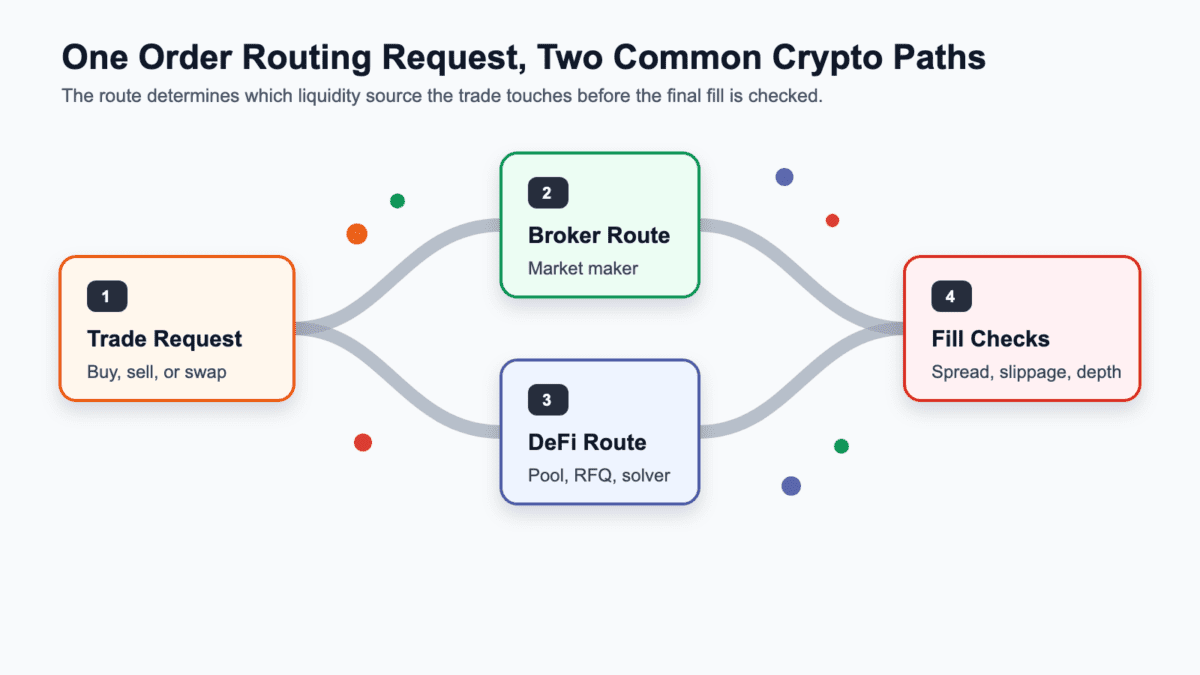
That same request can move through a broker, an exchange, or a DeFi path before it reaches final execution.
The user sees a button. The routing layer sees venues, liquidity, fees, depth, speed, and failure risk. That gap is where confusion starts.
This is why order routing often gets blamed for every bad fill. Sometimes the route is poor. Sometimes the token is illiquid. Sometimes a market order simply crossed a wide spread.
Start by separating the route from the market conditions around it. If the route had deep liquidity and clear pricing, the fill problem may be timing or order type. If the route hid spread, depth, or venue choice, the routing layer deserves closer inspection.
Order routing can be manual, fixed, or automated. Smart order routing is the automated version that compares more than one possible path before sending the trade.
A smart order router may check price, depth, fees, gas, speed, rejection risk, and settlement odds. In DeFi, it may split a swap across pools or use an intermediate token. In broker or exchange settings, it may compare partner exchanges or liquidity sources.
Route types worth knowing:
Smart order routing improves the search process. It does not rewrite the laws of liquidity, which remain annoyingly stubborn.
> Smart order routing is a search tool, not a price guarantee.
If a token has thin depth, a smart route may reduce price impact, but it cannot make deep demand appear. If gas spikes or a chain delays the transaction, the final fill may still drift. And if your slippage setting is too loose, the route may be allowed to execute a trade you would have rejected after a calmer look.
Read smart order routing as a practical comparison tool. It can compare execution paths, but it cannot promise a perfect final fill.
Order routing on crypto exchanges and broker apps decides who receives your trade request and what liquidity fills it. That can mean an internal order book, a partner exchange, a market maker, an RFQ liquidity provider, or another execution partner.
A useful broker example is Robinhood’s crypto order-routing support page, which reported that as of May 18, 2026, Robinhood Crypto received $0.95 for every $100 of notional crypto order volume executed through market maker routing. Use that as one platform-specific model, not as a universal map for every crypto platform.
These terms explain most app-fill surprises:
| Term | What It Changes For Your Fill |
|---|---|
| Bid price | The estimated price buyers are willing to pay. |
| Ask price | The estimated price sellers want before they sell. |
| Mid price | The midpoint between bid and ask, often close to the chart price. |
| Spread | The gap between bid and ask, which can act like a hidden cost. |
| Market maker | A liquidity provider that quotes prices and may fill the order. |
| Maker/taker fee | An exchange fee tied to adding or removing liquidity. |
The chart price is often not the execution price. A buy normally interacts with the ask. A sell normally interacts with the bid. That is why a no-commission screen can still produce a worse cash result than the chart suggests.
Broker routing also changes what you can inspect. Some apps show bid and ask before confirmation. Some show only a preview price. Advanced exchange screens may show the order book, depth, maker/taker fees, and limit-order controls. The more the platform hides, the more you need to slow down before pressing buy.
The useful check is all-in cost. Look at spread, visible fee, expected fill, withdrawal cost, and whether you can transfer the asset afterward. Routing is only one line in that bill, but it can be a loud one.
Order routing in DeFi swaps decides which onchain path your token trade uses. That path may touch one liquidity pool, several pools, an aggregator, an RFQ quote, a solver, or a bridge route before the final settlement.
Automated market makers do not work like a normal order book. They price trades from pool balances and liquidity curves. Concentrated liquidity can make a route excellent near one price and weak outside that range. A small swap may barely move the pool. A larger swap can push through worse pricing fast.
A wallet can make this feel like one approval, but the wallet swap route still decides which venues, quotes, and custody assumptions sit behind the screen.
Use the route details to check what the swap is actually doing:
| Route Element | What The User Should Check |
|---|---|
| Pool or DEX | Is the route using deep liquidity or a thin pool? |
| Multi-hop path | Is the swap going through an intermediate token? |
| Split route | Is the trade divided across sources to reduce price impact? |
| RFQ quote | Is a market maker offering a firm or time-limited price? |
| Solver route | Who is responsible for finding and settling the fill? |
| Bridge path | Does the route add chain, bridge, or settlement risk? |
The quote is not the whole story. You also need minimum received, price impact, gas, priority fee, token address, and whether the route can still land under the same conditions.
DeFi routing can scan fragmented liquidity well. It can also hide complexity behind one cheerful button. The button is convenient. The route is still the trade.
Crypto order routing looks different depending on where the trade starts. The route is still the path to execution, but the controls and risks change by venue.
This table gives the practical map:
| Route Type | What Changes For The User |
|---|---|
| Broker app | Convenience is high, but spread and routing disclosure matter. |
| Centralized exchange order book | Depth, limit orders, and maker/taker fees become visible. |
| Direct DEX swap | The trade depends on one pool or protocol path. |
| DEX aggregator | The route can scan and split across sources. |
| RFQ or solver route | A third party may quote, compete, or settle the trade. |
| OTC desk | Large trades may avoid public-book market impact. |
| TWAP | Size is sliced over time to reduce one-shot impact. |
No route type is always best. A small BTC buy, a large stablecoin swap, and an illiquid meme-coin exit need different checks.
The broker route may win on simplicity. The exchange order book may win on price control. The aggregator may win on route search. OTC and TWAP may win when size is the main risk.
The user-control level also changes. A broker app may offer fewer knobs but more convenience. A DEX route may expose more detail while moving more responsibility onto your wallet, approvals, and slippage settings.
That is the main lesson. With order routing, fit matters more than rank. The path should match the asset, size, speed, custody outcome, and risk you are accepting.
Order routing matters for your final price because it decides which liquidity your trade touches. The same visible quote can lead to different outcomes if the route changes, the pool moves, or the order hits a wider spread than expected.
The biggest hidden costs are usually not mysterious. They have names:
Thin markets make routing more fragile. A route can look fine for entry, then break down when people rush for the exit. That is where thin exit liquidity turns a clean-looking chart into an expensive sale.
Bad routing and normal market movement can also look similar. If the market moves while your order travels, the fill may be worse even if the route was reasonable. If a token has shallow depth, any route may produce ugly price impact. If an app only shows the mid price, the bid and ask may already explain the gap.
So diagnose a bad fill from the full chain, not the final price alone. Check the spread, route, size, depth, slippage, and timing together. One culprit is tidy. Crypto rarely offers that luxury.
Best quote and best execution answer different questions in order routing. A quote is a preview under current conditions. Execution is the final result after the trade reaches the venue, liquidity source, or chain.
In a DeFi swap, the quote may be a snapshot from an aggregator. Your review screen may also show minimum received. That minimum is the protection line, not the target. If the route changes or the transaction lands later than expected, the final fill can be lower while still staying inside your settings.
The difference usually comes from a few moving parts:
For broker apps, the quote can also differ from execution because the screen may show a chart price, while the fill uses bid or ask. That can be normal market structure, not automatically abuse. The problem is when the user cannot easily see the all-in cost before committing.
The distinction matters at approval time. The best displayed route is only useful if it still executes well. A route that looks slightly worse but lands reliably with lower price impact can beat a prettier quote that fails, expires, or exposes you to a bad onchain path.
Before approving, compare the expected output with minimum received. Then check whether the route uses thin pools, intermediate tokens, a bridge, or a solver you do not understand. A beautiful quote can still be a terrible receipt.
Smart order routing can improve route selection across fragmented crypto liquidity. It can compare venues, split size, avoid weak paths, and reduce price impact when better alternatives exist.
But smart routing cannot rescue every trade. It cannot make a malicious token safe, make shallow liquidity deep, prevent every MEV outcome, or guarantee the final price. It also cannot fix a trade size that is too large for the market.
> Smart order routing can search better paths. It cannot make a bad market good.
Smart routing can help with these problems:
It cannot remove these problems:
This is where PVP trading becomes relevant. In crowded, bot-heavy markets, a smart route may reduce some execution pain, but it does not remove the competition around the trade.
Keep the expectation modest and useful. Smart order routing may improve the route search. You still need to inspect the trade, token, size, liquidity, and settings.
The hard part is knowing which problem you are solving. If the issue is fragmented liquidity, smart routing can help. If the issue is a toxic token, a reckless approval, or a wildly loose slippage setting, the smarter move may be to skip the trade.
Order routing, MEV protection, and slippage tolerance are different layers of a DeFi trade. Mixing them together makes bad settings look like bad routing, and bad routing look like bad luck.
Route selection chooses the path. Slippage tolerance sets how much worse the fill can be before the trade fails. MEV exposure depends on how the transaction is seen, ordered, or competed over before settlement.
These layers do different jobs:
| Layer | What It Controls |
|---|---|
| Route selection | Which pools, venues, hops, or solvers handle the trade. |
| Slippage tolerance | How much worse the final fill may be. |
| Private submission | Whether the transaction avoids some public mempool exposure. |
| Solver competition | Who competes to settle the intent or swap. |
| Priority fee | How quickly the transaction may land. |
A route can reduce exposure by avoiding weak paths or using a design that limits public mempool risk. That does not mean it blocks every sandwich attack or price move. It also does not mean a high slippage setting is safe.
Slippage deserves special attention. Too tight, and the trade may fail. Too loose, and the route has more room to fill badly. The right setting depends on liquidity, volatility, chain speed, and trade size.
If a DeFi swap looks expensive, do not stop at “the router failed.” Check the pool, route, slippage, priority fee, minimum received, and whether the token is already moving hard. Execution risk has layers. Annoying, but useful.
Crypto order routing needs a different plan when size changes the market around the trade. A route that works for a small buy can become expensive once the order is large relative to available liquidity.
The issue is not only price. Large orders can trigger partial fills, wider impact, worse slippage, failed swaps, and visible signals that other traders react to. If the route is thin, the market notices before you are done.
Oversized position moves are where a full port trade can turn routing into a real risk. Putting too much size through one thin path makes every weakness louder.
This is also where route transparency matters more. Before sending size, you want to know whether the route has real depth, whether the order can sit as a limit, and whether splitting the trade reduces impact.
Better large-order routing usually means slowing the trade down:
This is execution hygiene, not personal advice. If the order is big enough to move the visible market, the route is no longer a background detail.
The core question is size versus depth. If your order is small compared with available liquidity, routing may be a cost check. If your order is large, routing becomes the trade plan.
Check order routing before you trade by looking past the button and into the fill conditions. You do not need to become a market-structure engineer. You do need to know which warning signs belong on the screen before approval.
Use this quick check before a routed trade:
For broker or exchange trades, the strongest checks are bid, ask, spread, fee, order type, and transfer outcome. For DeFi swaps, the strongest checks are token address, route, minimum received, price impact, slippage, gas, and whether the route touches a bridge or unfamiliar token.
Small trades still deserve this check when the token is illiquid. Repeated small buys through a wide spread can also add up over time. The cost may not look dramatic on one ticket, but execution drag is patient.
For larger trades, slow down. Compare routes, use limit orders when available, and avoid assuming “smart” means “safe.” If a route is opaque and the trade size is meaningful, that is already information.
You cannot fully control order routing on every platform. But you can control what you approve, what you compare, and when you walk away from a route that asks for too much trust.
Order routing in crypto sends a buy, sell, or swap request to the venue or liquidity source that will try to execute it. That could be an exchange order book, market maker, partner exchange, DEX pool, aggregator, solver, RFQ source, bridge path, or OTC desk. The route affects how the trade reaches liquidity and what costs may appear before the final fill.
Smart order routing in crypto compares multiple execution paths before sending a trade. It may evaluate price, depth, fees, gas, speed, and likelihood of settlement. In DeFi, it can search pools, split trades, or use RFQ and solver routes. On broker or exchange platforms, it may compare partner venues. It improves route search, but it does not guarantee the best final price.
Your crypto order routing may fill at a different price because the quote was only a preview. The final fill can change because of bid and ask spread, market movement, thin liquidity, price impact, slippage settings, route changes, partial fills, gas delays, or onchain settlement risk. Start by checking whether the screen showed a chart price, a quote, or a true executable price.
A DEX aggregator usually includes an order-routing system, but the terms are not identical. The aggregator is the user-facing service that scans liquidity sources. The router is the logic that chooses paths, pools, hops, splits, RFQ quotes, or solvers. In normal use, people often blur the terms because the aggregator hides the routing work behind one swap screen.
Crypto order routing can reduce some MEV exposure in certain designs, but it is not full MEV protection by itself. Route choice, private transaction submission, solver design, slippage tolerance, and pool liquidity all matter. A protected route can still fill badly if slippage is wide, liquidity is thin, or the market moves before settlement.
Order routing and payment for order flow describe different things. Order routing is the broader process of deciding where an order goes for execution. Payment for order flow is one compensation model where a broker may receive payment or value for routing orders to certain execution venues. In crypto, the exact model depends on the platform’s disclosures and route settings.