Physical Address
304 North Cardinal St.
Dorchester Center, MA 02124
Physical Address
304 North Cardinal St.
Dorchester Center, MA 02124


A practical guide to crypto points, airdrops, and hidden costs.
Crypto points are project-run scores that track user activity and may influence future rewards, but they are not money by default.
That distinction saves people from a surprisingly expensive mistake. A points dashboard can look like a balance, but it usually sits under rules the issuer controls: seasons, caps, eligibility filters, claim windows, and maybe no reward at all.
Crypto points can still be useful because they show activity, rank users, and sometimes feed an airdrop or perk. The smart move is to read them as a scoreboard first and a possible reward second.
Crypto points are scores created by a crypto project, app, exchange, wallet, or protocol to measure user activity. They may count swaps, deposits, referrals, trading volume, quests, liquidity, wallet use, or other behavior the issuer wants to reward.
The closest normal-world analogy is loyalty points. You do something the platform values, then a number appears beside your account. The crypto version is trickier because earning the points can require gas fees, smart contract approvals, bridges, deposits, or real trading exposure.
Several things can be true at once:
Galaxy Research described points programs as a way for crypto projects to track and incentivize user behavior before or around token plans. The July 2024 report looked at five points-program case studies launched from 2022 to 2024, a useful reminder that rules, seasons, and outcomes can vary widely. That is the clean starting point: points are a scoring layer, not automatically the reward.
So crypto points are best read as controlled scorekeeping. They can become important, but the project usually decides how important.
Crypto points usually work by connecting user activity to an internal scoring system. The app watches what you do, applies its rules, and displays a number, rank, tier, or multiplier in a dashboard.
Some points are tracked off-chain in the project’s database. Others are calculated from on-chain wallet activity, then shown in an app. Either way, the visible number can be useful without becoming a token in your wallet.
The common lifecycle looks like this:
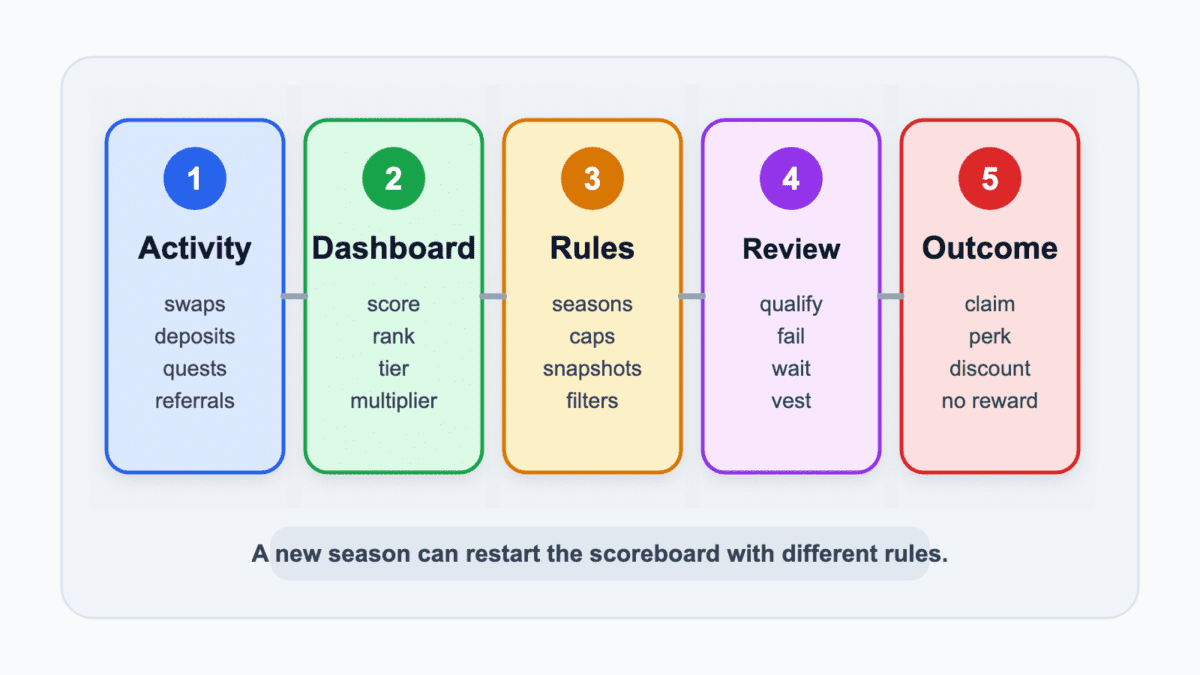
This is where the dashboard can fool people. A score may update daily and still be non-transferable. A leaderboard may show your rank and still say nothing about a final conversion ratio. A campaign may advertise a season without naming a token generation event, or TGE.
Points also turn attention into measurable behavior. That is why they fit the wider attention economy in crypto: projects can reward repeat visits, referrals, quests, and social engagement before they reveal what the scoreboard is worth.
Crypto projects use points because points create activity before token details are final. A token launch is public, tradable, and hard to unwind. A points program is more flexible.
For a project, points can help with user acquisition, liquidity, product testing, referrals, retention, and community ranking. They can also help a team observe which wallets are real users and which wallets only appeared for a possible airdrop.
That early signal has value before any token exists. If users return weekly, bridge funds, test a feature, or invite others, the project learns what people will do when a reward is only possible. It can then tune incentives before supply, listings, and token expectations become public commitments.
Common project goals include:
That flexibility is also the tradeoff for users. The same system that lets a project adjust rewards can leave users guessing about ratios, caps, snapshots, and timing. The project gets useful data. The user gets a number with uncertain value.
Points became part of the broader crypto meta because they gave traders a new thing to chase before tokens listed. Once that story gets hot, people start treating activity itself as a position, even when the scoreboard is still useful marketing and product data for the issuer.
Users earn crypto points by doing actions the program says are eligible. The risky part is that “eligible” can change by project, chain, wallet, season, partner app, and timing.
Basic tasks can be simple: connect a wallet, complete a quest, refer a friend, or use a product. DeFi-heavy programs can ask for swaps, bridges, deposits, liquidity, borrowing, lending, restaking, or trading volume. That is where the cost meter starts running.
Before doing any action, check what the action actually exposes you to.
| Action | What To Check Before Doing It |
|---|---|
| Swaps or trading volume | Fees, slippage, wash-trading rules, and whether volume is capped. |
| Bridges | Bridge risk, destination-chain gas, and whether the route is approved. |
| Deposits or liquidity | Withdrawal rules, smart contract risk, and idle capital cost. |
| Referrals | Whether advice is biased by rewards and whether spam is punished. |
| Quests or social tasks | Whether the account link is official and worth the time. |
Layered points make the picture messier. One user might earn protocol points, partner app points, referral multipliers, and campaign badges from the same transaction. That can sound efficient, but it also makes the reward path harder to audit.
Do not only ask, “how many points can I earn?” Ask what you are paying, risking, or signing to earn them. If that answer is unclear, the points number is doing too much emotional work.
Crypto points can turn into rewards when the issuer connects the score to a real benefit. That benefit might be a token allocation, NFT, fee discount, wallet perk, access right, rank badge, whitelist spot, or later eligibility check.
They can also turn into less than users expected. A project may apply caps, Sybil filters, minimum activity thresholds, regional restrictions, vesting, non-transferability, or delayed claim windows. A campaign can end with a small reward, a non-cash perk, or no reward at all.
The key moment is when the issuer publishes actual terms. Before that, the dashboard only shows activity under current rules. After that, users can check whether the reward is claimable, transferable, locked, region-limited, or tied to another task.
The issuer usually controls the key variables:
That control can make two users with similar scores end up with different outcomes. One wallet might pass the filter and claim. Another might miss the window, hit a cap, fail a region check, or receive a locked reward it cannot sell yet.
Pre-market prices can make points feel more concrete than they are. Some traders may buy or sell expected allocations, points claims, or IOU-style exposure before a token launches. That market is speculation, not proof that your dashboard balance has fixed value.
Read it plainly: crypto points can become rewards, but the reward path is not complete until official rules, eligibility, claim mechanics, and transferability are clear. Until then, points are a possibility with terms attached.
Crypto points differ from tokens because points are usually controlled by the issuer and shown in a dashboard. Tokens are assets that may live in a wallet, transfer between users, and trade on markets if liquidity exists.
The confusion starts when every reward-like thing appears in one app. A points balance, staking reward, airdrop claim, and DeFi yield estimate can all look like “earnings” on a screen. They are not the same thing.
This comparison keeps the categories separate.
| Term | How It Differs From Crypto Points |
|---|---|
| Token balance | A wallet-held asset, while points are often an internal score. |
| Airdrop | A distribution or claim event, while points may only influence eligibility. |
| Staking rewards | Protocol or network rewards, not a discretionary campaign score. |
| Yield farming | A strategy for earning fees or incentives, not just collecting a dashboard score. |
| Exchange or wallet rewards | Platform perks tied to account terms, often with limited outside utility. |
Points farming also differs from broader crypto farming. Farming can involve yield, incentives, liquidity rewards, emissions, or airdrop eligibility. Points farming is narrower: the user performs activity mainly because a score might influence future rewards.
That difference changes the risk. With staking rewards or yield, there may be a stated rate, contract, or reward token. With crypto points, the main asset today may be only your hope that the issuer later values your score.
The main risk of crypto points farming is spending real resources for a reward that may never arrive. The score can feel free, but the path to the score often is not.
Costs can include gas, slippage, trading fees, bridge fees, funding rates, liquidation risk, tax records, locked capital, and time. If a strategy needs constant monitoring, the mental load is part of the cost too. Crypto has a talent for turning “free” into admin work with wallet prompts.
Watch these cost and risk checks before farming points:
The reward side can disappoint for normal reasons. A project may cap whales, remove Sybil wallets, change formulas, exclude regions, delay claims, or launch a token into weak liquidity. If many users farmed mainly to claim and sell, late buyers may become exit liquidity for early recipients.
Opaque rule changes create another problem. If a project keeps moving the goalposts, users may describe the result as a soft rug even when the project still operates. Fake dashboards, fake claim windows, spoofed emails, and broad approval prompts are more urgent. They can drain a wallet faster than a weak token allocation can disappoint it.
Crypto points may be worth farming when the product is useful without the points. That keeps the score in its proper place: extra upside, not the whole reason to take risk.
A reasonable points program has written rules, clear eligible actions, low direct cost, official claim channels, and an activity level you can stop without regret. It should not require borrowed exposure, mystery approvals, or deposits you cannot afford to lock.
Budget is the honest filter. If a campaign needs constant transactions, frequent bridging, large deposits, or leveraged trades, the points have to clear a higher bar. Most programs do not give enough certainty to justify turning a small possible reward into a large current risk.
Use this filter before you farm:
Also check how easily you can leave. A campaign that lets you stop, withdraw, revoke approvals, and ignore the next season is easier to manage. A campaign that keeps adding multipliers and deadlines can turn into sunk-cost theater with gas fees.
The positive case is not “points always pay.” It is narrower. Points can be worth attention when they sit on top of useful activity you already understand.
That keeps the risk contained. If the reward comes, fine. If it does not, you did not build a whole strategy around a scoreboard.
Check a crypto points program before connecting a wallet because claim pages and dashboards are prime scam targets. If a page says rewards are live, your first job is to prove the page is real.
Start from the official project domain, app, documentation, or verified social profile. Do not start from a search ad, DM, random Discord post, Telegram link, spoofed email, or AI-generated summary. Those can point to lookalike claim pages.
Then separate research from wallet action. You can often read rules, seasons, FAQs, and claim notices without signing anything. A seed phrase request is a hard stop, and a broad approval prompt deserves the same level of suspicion.
Run this pre-connection checklist:
Wallet hygiene is not optional here. If the campaign requires active self-custody, start with safer wallet setup habits before chasing a dashboard score.
Also check whether the product is useful without rewards. If the only reason to connect is “maybe airdrop,” the scam surface is doing more work than the product. That is usually a bad sign.
Several related terms sit near crypto points, but they do different jobs. Keeping them separate helps you read dashboards without turning every number into a promise.
Choose the next read based on the confusion you are trying to solve:
Other concepts are useful as checks, even when they do not need a separate link here. Offchain points explain where the score is recorded. Protocol-specific points explain who controls the rules. Pre-market points trading explains why some users speculate before the reward is settled.
Use those labels as questions, not answers. A neat chart can still hide the boring checks: who controls the score, what can it become, and what did you risk to get it?
No. Crypto points are usually a project-controlled score, while tokens are assets that may sit in a wallet and trade if liquidity exists. Points can sometimes influence a later token allocation, but they are not the token itself.
Yes, crypto points can turn into an airdrop if the project uses the score for eligibility or allocation. The project can still apply caps, filters, regional limits, vesting, claim windows, or other rules before any reward reaches users.
Crypto points are worth money only if a credible path gives them value. That path might be an official conversion rule, a claim, a perk, or a speculative pre-market trade. Without that path, the points are a score, not a balance.
Sometimes users can sell exposure to crypto points or expected allocations through pre-market or OTC-style markets. That does not mean the points have fixed value. The trade can carry counterparty risk, delivery risk, thin liquidity, and wrong assumptions about final rules.
Crypto points farming is the practice of doing eligible actions mainly to earn points before a possible reward. It can include swaps, deposits, trading volume, referrals, quests, bridging, or liquidity. The risk is paying real costs for uncertain rules.
Start from the official project domain or verified channels, not ads, DMs, search snippets, or forwarded links. Never enter a seed phrase. Review wallet approvals, use a separate wallet when possible, and ignore claim pages that rush you to sign.
Start with the boring checks. Crypto points can be useful, but they are not a reason to skip wallet safety, cost math, or common sense.
The best first step is to write down what you think the points can become. If the answer is “a token, maybe,” keep going only after you can name the rules, issuer, costs, and claim path.
Then separate interest from action. Reading the rules, checking the domain, and estimating fees does not require a signature. Connecting a wallet, approving a contract, bridging funds, or creating trading volume usually does. Put the low-risk work first.
Use this short action list:
If the campaign still looks reasonable, set a stop point before you start. That can be a gas budget, a maximum deposit, a date, or a rule that you will not use leverage for points. The point is to prevent a scoreboard from deciding for you.
If the answers are missing, wait. A real opportunity should survive one more day of checking. A fake claim link, a bad approval, or an overbuilt farming route often depends on speed, confusion, and the feeling that everyone else is already ahead.
Then decide whether you would still use the product if the points paid nothing. If yes, the points are optional upside. If no, you are probably buying a lottery ticket with extra wallet prompts.