Physical Address
304 North Cardinal St.
Dorchester Center, MA 02124
Physical Address
304 North Cardinal St.
Dorchester Center, MA 02124


A plain-English guide to restaking, AVSs, rewards, and risk.
Restaking means using already-staked crypto, usually staked ETH or staking-token receipts, to help secure extra services for possible rewards and added risk.
For an ETH holder, the pitch sounds efficient: one staked position can support more than the base network. The catch is that each extra security job brings its own contracts, operators, service rules, reward timing, and exit path.
That makes restaking different from normal staking, compounding rewards, lending a liquid staking token, yield farming, or buying a token linked to a restaking project. The useful idea is shared security. The dangerous shortcut is treating restaking like a cleaner APY button. Either way, you are adding another obligation chain to a position that was already doing work.
Restaking in crypto is a shared-security mechanism. A user takes an asset that is already staked, or a receipt token tied to staked assets, and opts into extra security work through a restaking protocol.
The Ethereum.org restaking overview defines the core model as using already-staked ETH to secure additional services called AVSs, with possible extra rewards and extra risk for the staked ETH. It also notes that EigenLayer has grown to thousands of people restaking millions of ETH. At that scale, operator, AVS, and exit-route questions are practical rather than theoretical.
That is the clean version: the user is not minting a second pile of ETH. They are letting an existing staking position support more work.
The basic flow has five parts:
EigenLayer is the best-known restaking example, especially on Ethereum. But restaking is bigger than one brand. You may also see names such as Symbiotic, Karak, ether.fi, Renzo, Kelp DAO, and Puffer in related routes.
The core trade is simple. Restaking is not magic yield. It may open extra reward streams, but it also gives another system a claim on how your staked position behaves.
That claim can be useful when the extra service has real demand and clear rules. It gets fragile when the user only sees a headline rate, a points campaign, or a token narrative. Restaking should make the security job more legible, not hide it behind a bigger number.
So define the route before judging the reward. If you cannot name the staked asset, protocol, operator, AVS, penalty rule, and exit path, you do not yet understand the restaking position.
Restaking works by connecting a restaked position to operators that perform work for AVSs. Most users do not run the extra software themselves, so delegation becomes the bridge between the wallet and the service work.
AVS means Actively Validated Service. In plain English, an AVS is a service that wants security from staked assets. It could need validation, data availability support, oracle-style work, execution checks, or another task that benefits from economic penalties.
The operator is the work layer. It runs infrastructure, accepts AVS obligations, and may earn rewards for doing the job correctly. If the operator breaks rules, fails duties, or signs something it should not, penalties can reach the restaked position depending on the protocol design.
Before the APY number gets a vote, map the actors.
| Role | What It Does In Restaking |
|---|---|
| Restaker | Supplies staked ETH, an LST, or another eligible staked position. |
| Restaking protocol | Tracks deposits, delegation, reward rules, withdrawals, and penalty conditions. |
| Operator | Runs software and performs work for one or more AVSs. |
| AVS | Receives security from restaked assets and may pay rewards for useful work. |
| LRT protocol | Packages restaked exposure into a liquid restaking token when that route exists. |
| Wallet or custodian | Controls how the user approves, holds, exits, or delegates the position. |
The table keeps the cast straight. Real positions can get messier. A single user may hold an LST, deposit it into a liquid restaking protocol, receive an LRT, and then use that token elsewhere in DeFi. The wallet balance looks tidy. The backing route is doing several jobs at once.
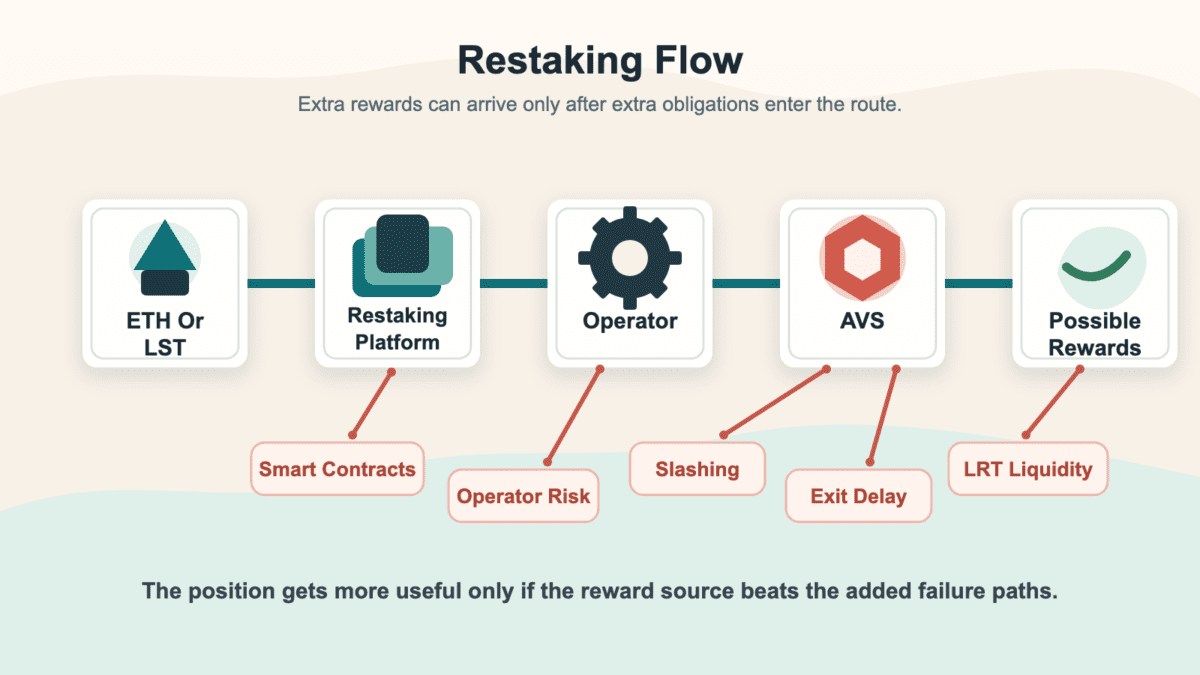
The sequence matters. If rewards appear before you understand the operator and AVS, the dashboard is leading the conversation. That is backwards. First identify the service being secured, who performs the work, what rules trigger penalties, and how the user can exit.
Restaking can make newer services easier to launch because they do not need to build their own security base from scratch. For users, the trade is less romantic. You are trusting a chain of contracts, operators, service rules, and exit mechanics to handle an already-staked position.
Restaking is not the same as staking, liquid staking, or liquid restaking. These routes can touch the same ETH, but they change different parts of the user’s position.
Normal staking puts assets to work securing a base network. Liquid staking gives the user a transferable receipt for a staked position. Restaking adds extra service obligations to already-staked exposure. Liquid restaking wraps that restaked exposure into a transferable token, usually called an LRT.
Here is the clean route comparison before the acronyms start elbowing each other.
| Route | What Changes For The User |
|---|---|
| Normal staking | The user earns base staking rewards and accepts validator, custody, lockup, or platform risk. |
| Liquid staking | The user receives an LST such as stETH or rETH, adding issuer, liquidity, and redemption risk. |
| Native restaking | A validator or staked position opts into extra service rules while staying closer to the base asset. |
| LST restaking | The user restakes a liquid staking token, adding restaking risk on top of the LST route. |
| Liquid restaking | A protocol issues an LRT that represents restaked exposure and may trade in DeFi. |
| Holding an LRT | The user owns a market token tied to restaked exposure, liquidity, redemption, and pricing. |
The common mistake is comparing all six routes by one displayed yield. That turns route design into a horse race. Bad math, worse vibes.
A user who simply stakes ETH has one main job: understand the staking route and exit process. A user who restakes an LST has to understand the LST issuer, the restaking protocol, the operator set, AVS rules, reward accounting, and the exit path.
Liquid restaking can feel cleaner because the LRT is movable. But liquid does not mean simple. If the LRT trades below its backing, sits in a shallow pool, or has a slow redemption path, the user may exit at a discount even when the underlying protocol is still alive.
So the comparison is not “which route pays more?” Ask the sharper question instead: which risks did I add, and am I being paid enough for each one?
Restaking rewards can come from several sources, and they do not all deserve the same trust. A dashboard may show one rate, but that number can blend base staking rewards, AVS rewards, tokens, points, incentives, fees, and market movement.
Base staking rewards are the starting point. They come from the normal staking route. Restaking rewards are separate. They may come from AVSs paying for security, protocol incentive campaigns, future token distributions, or LRT market demand.
Separate the sources before comparing any APY.
| Reward Source | What To Check |
|---|---|
| Base staking rewards | Whether the route separates normal staking yield from extra restaking yield. |
| AVS payments | Which service pays, in what asset, and under which rules. |
| Protocol incentives | Whether rewards are active, claimable, vested, or temporary. |
| Points | Whether points have stated value or only possible future eligibility. |
| Token rewards | Whether token supply, vesting, and liquidity can dilute the headline return. |
| LRT market pricing | Whether gains come from real income or a premium that can fade. |
| DeFi reuse | Whether extra yield comes from using the LRT in another market. |
On a dashboard, restaking can start to resemble yield farming. Both can show extra rewards. But the engine is different. Farming often pays from emissions, trading fees, lending demand, or campaign budgets. Restaking should be tied to security services, operator work, and AVS demand.
Points deserve special caution. They may be useful if a protocol later assigns value. They may also become a loyalty score with no clean exit. A points screen is not the same as paid ETH, and calling it yield too early is how people end up doing accounting cosplay.
Fees, spreads, tax treatment, withdrawal delays, and LRT discounts can also cut into returns. Keep the reward check specific: who pays, why do they pay, when can I claim, and what can change before I exit?
Restaking risks extend beyond slashing. Slashing matters, but users can also lose money through smart contract bugs, operator failure, AVS rules, LRT discounts, withdrawal queues, custodial terms, wallet approvals, fake sites, and crowded exits.
The route decides where each risk enters. Native restaking puts more focus on validator and operator behavior. LST restaking adds the liquid staking issuer. LRT routes add token liquidity and wrapper accounting. Custodial products add platform terms.
> If a restaking page asks for a strange approval, pushes a copied URL, or appears through a direct message, stop before signing. Real yield should not need a panic click.
Use the risk table as a route map, not a doom list.
| Risk | Where It Shows Up |
|---|---|
| Slashing | Operator or validator failures tied to restaking or AVS rules. |
| Smart contract risk | Restaking protocols, LRT issuers, vaults, bridges, and DeFi integrations. |
| Operator risk | Poor uptime, bad configuration, weak monitoring, or concentration in a few operators. |
| AVS rule risk | Services with complex obligations, unclear penalties, or changing requirements. |
| LRT liquidity risk | Thin markets, discounts, slow redemption, or depeg-style pressure. |
| Custody risk | Exchange, wallet, or managed product terms that limit control. |
| Scam risk | Fake restaking sites, cloned apps, phishing links, and malicious wallet approvals. |
Wallet behavior deserves its own warning. Connecting a wallet is not the dangerous part by itself. Approving token movement, signing unclear transactions, or trusting a fake support link is where the damage usually starts. If wallet permissions feel fuzzy, pause and review basic crypto wallets safety before adding restaking exposure.
Fake restaking products are another problem. A scam can copy the language of AVSs, rewards, points, and early access while routing funds somewhere else. That is where a hard rug style failure can look dressed up in protocol vocabulary.
Centralization is quieter but still real. If most restaked assets delegate to a small operator group, the system may become efficient at the cost of resilience. A user does not need to solve that alone, but it should affect which operators, LRTs, and products they trust.
Native restaking, LST restaking, and LRT exposure are different decisions because the user holds different claims and accepts different failure paths. The word restaking can cover all three, which is exactly why it gets messy.
Native restaking usually sits closest to the validator or staked ETH route. It may suit users who already understand validator operations or delegation. The tradeoff is that added AVS obligations can still affect the staked position.
LST restaking starts with a receipt token such as stETH or rETH. The user already depends on the liquid staking route. Restaking adds another layer above it, so the final risk stack includes the LST, the restaking protocol, operators, AVSs, rewards, and exit mechanics.
LRTs add a wrapper. A liquid restaking token can make the position easier to move, trade, or use in DeFi. It can also create market-price risk. The LRT may not trade exactly at the value users expect, especially when liquidity thins or withdrawals slow.
Keep these exposures separate before sizing the position.
Do not blur that last point. Buying a restaking-related token can be a narrative coin trade. It may benefit from attention around the sector, but it is not the same as restaking ETH, holding an LRT, or earning AVS rewards.
So define the exposure before defining the opinion. If someone says “I am in restaking,” the follow-up should be: native route, LST route, LRT, exchange product, vault, or token bet?
A restaking opportunity should pass a basic safety check before you connect a wallet, approve tokens, or trust the displayed APY. The goal is not to find a perfect setup. It is to catch obvious mismatches before they cost real money.
Start with the route. Are you restaking native ETH, depositing an LST, minting an LRT, joining a vault, using an exchange product, or buying a token? If that answer is unclear, the product is not ready for your funds.
Then move through the practical checks.
This checklist is not financial advice. It is plumbing inspection. Restaking has enough moving parts that “the APY looked fine” is not a serious process.
A good product should make the route understandable. You should know what you hold, what backs it, who operates the service work, where rewards come from, how penalties apply, and how you leave. If those answers are hidden behind branding, delay the deposit.
Also watch the support path. Real protocols do not need private-message recovery agents. If a stranger offers to help “unstick” a restaking balance through a special link, that is not support. That is the part where your wallet learns new swear words.
Restaking can be worth it for users who already understand staking, can evaluate the route, and accept added risk for possible extra rewards. It is usually a poor fit for someone who only wants simple ETH yield or cannot tolerate delays.
The honest answer is conditional. Restaking is useful infrastructure when AVSs pay for real work and users are compensated for the added risk. It is weak when the return depends mostly on points, token hopes, shallow LRT liquidity, or a crowded late-cycle trade.
Use this quick fit check before the reward number takes over.
| Better Fit | Poor Fit |
|---|---|
| You understand staking and validator or delegation risk. | You want the simplest possible ETH yield route. |
| You can explain the operator, AVS, and reward source. | You only know the displayed APY. |
| You can wait through exits or tolerate market discounts. | You may need fast, full-value liquidity. |
| You size the position modestly. | You are chasing points with money you cannot lock. |
| You know whether you hold ETH, an LST, an LRT, or a token. | You blur every restaking route into one bet. |
The hype cycle can also confuse the answer. Restaking attention may cool after airdrops or points campaigns. That does not prove the infrastructure idea is dead. It does mean late entrants can become exit liquidity if they buy into crowded tokens or thin LRT markets after the easy excitement has already moved on.
So restaking is not automatically good or bad. It is a trade with more moving parts than plain staking. If the extra reward source is durable, the route is transparent, and the exit path is realistic, it may deserve a small place in a wider strategy. If the main pitch is “more APY” with a fog machine, pass.
Start with normal staking before restaking. If base staking, LSTs, validators, withdrawals, and wallet approvals still feel vague, restaking will not make them clearer. It will only add acronyms.
The next move is to map the exact route. Write down what enters, what you receive, who operates the AVS work, where rewards come from, what can trigger penalties, and how you exit. If you cannot complete that map, wait.
Use these next actions before risking funds.
Restaking is easy to misuse when it is sold as passive income. It can feel hands-off after setup, but the work moves to monitoring, security, and exit planning. That is still work, just with fewer buttons and more consequences.
Keep a simple written note for any position you open. Include the entry asset, protocol URL, transaction hash, reward source, withdrawal path, and the reason you sized it that way. If the route changes later, you will have something better than dashboard memory to compare against.
The sober starting point is this: do not chase restaking until you can explain what gets restaked, who uses it, who pays, what can fail, and how you get out.
Restaking means using already-staked crypto to help secure extra services for possible extra rewards. The tradeoff is that the staked position can take on more risk, including penalties, contract risk, or slower exits.
Restaking works by routing a staked position through a protocol that connects it to operators and AVSs. Operators perform the extra work, AVSs receive security, and rewards or penalties flow through the route rules.
No. Staking helps secure a base network. Restaking reuses already-staked assets to support additional services, so it can add reward paths and risk paths beyond ordinary staking.
Yes. Restaking can create losses through slashing, smart contract bugs, LRT discounts, withdrawal delays, bad wallet approvals, custodial restrictions, or scam sites. The exact risk depends on the route.
An AVS, or Actively Validated Service, is a service that receives security from restaked assets. Operators do work for the AVS, and the AVS may pay rewards if that work is useful.
A liquid restaking token, or LRT, is a transferable token that represents restaked exposure. It can make a position easier to move, but it also adds liquidity, redemption, and token-pricing risk.