Physical Address
304 North Cardinal St.
Dorchester Center, MA 02124
Physical Address
304 North Cardinal St.
Dorchester Center, MA 02124


Learn how sandwich protection reduces MEV risk on DEX swaps.
In crypto, sandwich protection is a set of swap controls that reduce the chance bots can exploit your visible DEX trade.
The problem starts when a pending swap is easy to see, size, and trade around. Sandwich protection tries to hide, reshape, limit, or reroute that swap before it lands, so the final fill is harder for bots to squeeze.
Sandwich protection in crypto means a tool, route, or setting that tries to stop a DEX swap from being bracketed by another trader’s transactions. It usually targets one problem: a visible pending trade gives bots time to move the pool price before and after your swap.
That makes sandwich protection narrower than general trade safety. It is about execution, not investment quality. A protected swap can still buy a weak token, pay a bad price in a thin pool, or lose money after confirmation.
The phrase can cover several controls:
The common thread is timing. If bots can see your transaction early and predict how it will move an automated market maker, they may try to trade ahead of it and behind it. You still get a valid transaction, but the price can be worse than the quote that made you click.
That is why the word “protection” needs a little suspicion. It reduces a known execution risk. It does not protect every route, chain, token, wallet, or market condition. If a product implies otherwise, slow down.
> Before trusting the label, check what actually changes in the swap.
Does the tool hide the pending transaction? Does it cap the fill through minimum received? Does it use solvers, auctions, or private routing? If the answer is vague, the protection may be more label than layer.
A sandwich attack works by trading around your DEX swap after your pending transaction becomes visible. The bot tries to buy before you, let your swap push the price higher, then sell after you for a profit.
The attack can happen even when your transaction is valid. That is the annoying part. Your wallet did what you approved, but the surrounding order flow made the execution uglier.
Here is the basic path:
| Stage | What Happens |
|---|---|
| You Submit A Swap | Your wallet signs a DEX trade with slippage and minimum received settings. |
| The Swap Becomes Visible | A public route exposes the pending transaction before it settles. |
| A Bot Front-Runs | The bot buys the asset first, moving the pool price against you. |
| Your Swap Executes | You receive fewer tokens, as long as the result stays above your minimum. |
| The Bot Back-Runs | The bot sells after your swap and pockets the price movement. |
Minimum received is the plain-English field to watch. It is the least output you agree to accept before the trade should fail. If you set slippage wide enough, a bot has more room to move the price while your transaction still clears.
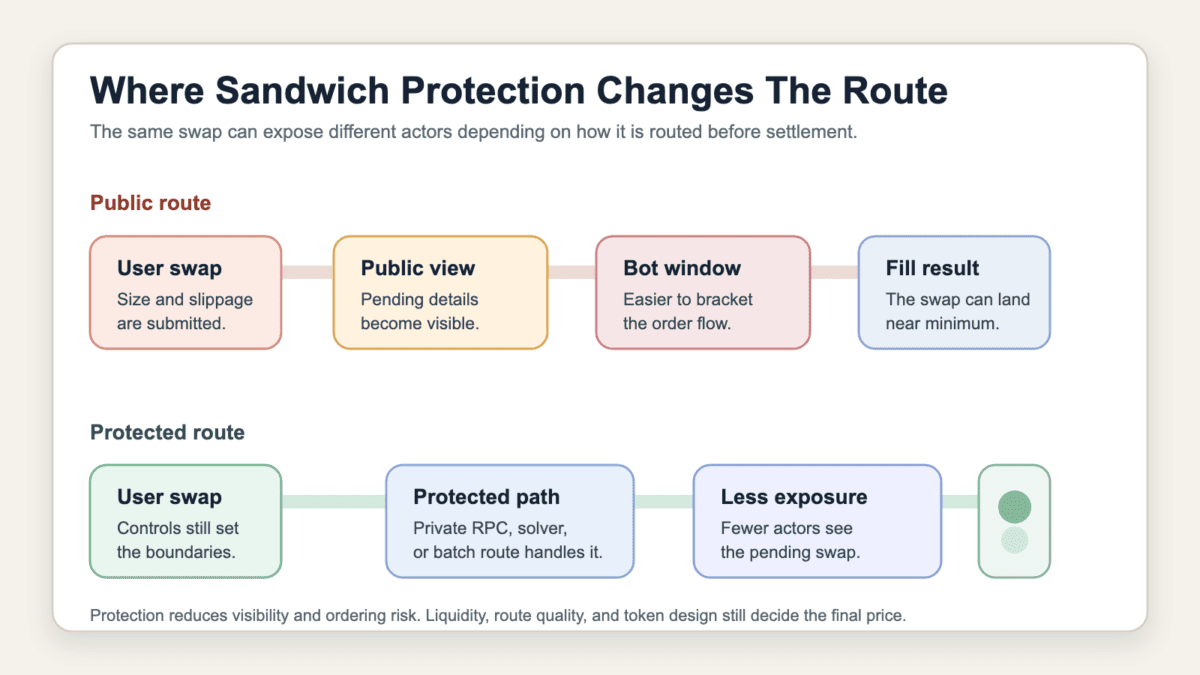
_A public route exposes the pending swap sooner. A protected route reduces who can see or handle the order before settlement._
Sandwich protection helps by changing one or more parts of that path. It can reduce visibility, change routing, tighten the accepted output, or make exact ordering less exploitable.
But the attack is not the only reason a fill can disappoint you. Thin liquidity, token taxes, stale quotes, volatile markets, and bad routing can all look similar from the wallet screen. The right fix depends on which problem caused the damage.
The main types of sandwich protection change visibility, price limits, or execution design. Some tools hide pending swaps. Others change who competes to fill the order. Some only cap the damage if the price moves too far.
This is where marketing gets slippery. “Anti-MEV protection” can mean a private RPC, a wallet default, a DEX aggregator route, an intent system, a batch auction, or a chain-level design. Same badge, different plumbing.
Use this table as a translation layer:
| Protection Method | What It Changes |
|---|---|
| Tight Slippage | Sets a stricter minimum received, so ugly fills fail sooner. |
| Private RPC | Sends the transaction through a private route instead of a public path. |
| Private Mempool | Limits who can inspect the pending swap before inclusion. |
| Wallet-Level Protection | Adds protected routing inside the wallet’s swap flow. |
| Intent-Based Swap | Lets solvers compete to deliver an outcome, not just one exposed AMM route. |
| Batch Auction | Groups orders so exact transaction order matters less. |
| Encrypted Mempool | Hides transaction details until ordering is harder to exploit. |
| Limit Order | Avoids immediate market execution at an unknown final price. |
| Smaller Orders | Reduces price impact and the profit window for bots. |
| Deeper Liquidity | Makes the same order harder to move against itself. |
Every row has a tradeoff. Tight slippage can fail honest swaps during volatile moves. Private routes require trust in the RPC, relay, builder, wallet partner, or app path. Solver routes can improve execution, but the solver set and fallback behavior matter.
Before trusting any method, ask four quick questions:
Wallet protection is often the most familiar user-facing layer because the route appears inside a normal swap screen. If you compare wallets, look for clear chain support, route details, fallback behavior, and transaction preview fields rather than a shiny “protected” toggle with no explanation.
On Ethereum, Flashbots Protect is a concrete private-routing example. Its default Protect RPC pays 10% of MEV-Share refunds to validators, which shows that protection is not only privacy. It also changes who sees the order flow and who gets paid for helping it land.
> Protected routes do not remove trust. They move trust to a different part of the transaction path.
Intent-based swaps and batch auctions take a different path. They may ask solvers to compete for the outcome, match orders at a shared clearing price, or reduce the importance of one user’s exact transaction position.
They can help, but they also move trust. Instead of trusting only the public route, you may trust a solver, auction system, app, private relay, or sequencer path. Sometimes that trade is worth making. It just should be visible before you sign.
Slippage is sandwich protection because it defines the worst price movement your swap will accept. A tighter setting gives bots less room to move the pool against you while still letting your trade clear.
But slippage is a blunt tool. Set it too wide, and you accept a worse fill. Set it too tight, and a valid trade may fail because the market moved, liquidity shifted, or the quote expired.
Here is what tight slippage can help with:
Now the part people skip:
Price impact is different from slippage. Price impact is how much your own trade moves the pool. Slippage tolerance is how much worse the final execution can be compared with the quote. A large swap in a small pool can have high price impact before any bot shows up.
Token taxes add another wrinkle. Some tokens charge transfer fees, block sells, or route through strange contract logic. A user may blame a sandwich attack when the token design was the actual problem.
> Slippage can make a bad idea fail faster. That is often better than letting it clear.
So slippage belongs in the protection stack, but it should not be the only check. If the route shows high price impact, a shallow pool, a suspicious token contract, or a big minimum-received gap, reducing slippage is not enough. It may only reject the swap sooner, which is still better than learning by impact crater.
Sandwich protection can still fail when the route, chain, token, liquidity, or protection provider does not match the trade. The toggle may be on, but the actual order may not be protected in the way you think.
Common failure points are boring and expensive. The wallet may support protection on one chain but not another. The DEX route may fall back to a public path. The private route may be slow. The solver may not find a better fill. The pool may be too thin for your size.
Watch these weak spots before approving a swap:
Thin pools deserve extra attention. Even without a bot, a large trade can move a pool hard enough to leave you with an ugly fill. That is where thin exit liquidity turns execution risk into a practical loss, especially in smaller tokens.
Malicious token design can look similar from the wallet screen. A token team can remove liquidity, block sells, change fees, or route transfers through hostile rules. That is closer to a hard rug problem than a sandwich problem.
> If a Telegram bot asks for private keys, seed phrases, or broad wallet access because it claims anti-MEV protection, stop. That is not protection. That is a trap wearing a helmet.
A credible claim should stay modest. Sandwich protection can reduce exposure to a specific attack pattern. It cannot verify the token, deepen the market, remove contract risk, or promise the best possible price.
Sandwich protection changes by chain because transaction flow changes by chain. Ethereum, Solana, and L2s do not expose pending swaps through one identical pipeline.
Ethereum is the classic public-mempool example. A transaction may become visible before inclusion, which gives searchers time to simulate, reorder, and trade around it. Private RPCs and protected mempools try to reduce that early visibility.
Use this chain check before assuming a tool covers every swap:
| Environment | What To Check |
|---|---|
| Ethereum Mainnet | Whether the route avoids public mempool exposure and supports your transaction type. |
| EVM L2 | Whether the sequencer, wallet, or app route changes ordering and fallback behavior. |
| Solana | Whether the wallet, RPC, or DEX route protects the exact swap path you use. |
| App-Routed Swaps | Whether protection is built into the app or only available through a specific mode. |
Solana needs its own care. Users often talk about “getting meved” there too, but copying Ethereum private-RPC advice word for word can mislead. Solana transaction routing, validators, leaders, priority mechanics, and app routes have their own failure points.
L2s add another layer. Many rollups depend on sequencers, and that can change the visibility and ordering surface. A route may avoid Ethereum-style public-mempool exposure while still depending heavily on the sequencer or app infrastructure.
> If a provider explains only Ethereum while you swap on Solana or an L2, assume chain coverage is unproven until the route details match your trade.
A chain-specific protection claim should also explain fallback behavior. If the private route fails, does the app cancel, retry, use a public route, or ask you again? A quiet fallback can remove the protection you thought you had.
Check a swap before using sandwich protection by reading the route, liquidity, slippage, and minimum received before you approve. The goal is to catch obvious execution problems while the transaction is still just a preview.
Start with the token. Confirm the contract address from a trusted source, not a social post or sponsored result. Then look at the pool, route, price impact, and transfer behavior.
Use this quick pre-approval routine:
Low-liquidity launch trading needs extra caution. In the meme-coin trenches, bots, thin pools, token taxes, fast repricing, and social pressure can arrive in the same tiny window. Sandwich protection helps only with part of that mess.
The route preview should make the real risk easier to see. A good swap screen shows price impact, minimum received, fee path, route, chain, and slippage. A weak screen hides those details behind one happy number.
> A good checklist catches boring problems before they become expensive ones.
After the swap, compare the expected output, minimum received, and actual fill. If the trade landed near the minimum, do not assume one cause. Check the pool movement, transaction ordering, token rules, and broader market move.
You are not trying to become a forensic MEV analyst for every small trade. You are building a habit: verify the thing that can hurt you before the approval button becomes expensive.
Sandwich protection is worth using for larger or MEV-sensitive DEX swaps when it is built into a reputable wallet, DEX, aggregator, or RPC route. It is especially useful when your trade size can move a pool or your route would otherwise expose pending flow.
It is less important for simple transfers. Sending tokens from one wallet to another is not the same as swapping through an AMM pool. There is no pool price to push against you in the same way.
Use sandwich protection when:
Do not rely on it when:
Small-cap trading can feel adversarial even without a visible attack. That is why PVP trading is useful context: other participants may be trying to exit, snipe, front-run, or dump into the same liquidity you need.
The answer is measured. Turn on reputable protection when available. Then still check liquidity, slippage, route, token rules, and chain support. A protected bad trade is still a bad trade. It just arrives with better manners.
Sandwich protection is a type of MEV protection, but the two phrases are not identical. Sandwich protection focuses on DEX swaps that can be bracketed by front-run and back-run trades. MEV protection is broader and can include liquidations, order-flow auctions, private routing, rebates, mints, and other ordering-related value.
So if a wallet says it has MEV protection, check which MEV problem it handles. For a swap, the relevant question is whether it reduces sandwich exposure on your chain and route.
No, sandwich protection does not stop all MEV. It mainly reduces the chance that a visible swap gets targeted by a sandwich attack. Other MEV patterns can still exist around liquidations, oracle updates, NFT mints, block building, validator incentives, and app-specific order flow.
It also cannot stop normal price movement, bad token design, or weak liquidity. Think of it as a specific swap-execution control, not a universal shield for every onchain transaction.
Yes, you can still get a bad price with sandwich protection on. A protected route can reduce one attack path, but your final fill still depends on liquidity, route quality, price impact, slippage, fees, and market movement.
If the trade lands near your minimum received, inspect the route before blaming bots. The cause could be a thin pool, stale quote, token tax, volatile market, unsupported chain, or fallback to an unprotected path.
Tight slippage is useful sandwich protection, but it is not enough by itself. It limits how much worse the final output can be before the swap fails. That can make sandwich attacks less profitable and stop some ugly fills.
But tight slippage can also fail legitimate swaps in fast markets. It does not hide the transaction, deepen liquidity, check token rules, or improve route quality. Pair it with good liquidity checks and reputable protected routing when available.
A private RPC can provide sandwich protection when it routes a swap away from public pending-transaction exposure. That can reduce the chance that public mempool bots see and bracket the trade before it settles.
The tradeoff is trust. You now depend on the RPC provider, relay, builder path, wallet route, or app partner. Check supported chains, transaction types, privacy terms, fallback behavior, and whether the tool actually covers swaps.
Yes, Solana swaps can use sandwich protection when the wallet, DEX, RPC, or app route supports it for the exact swap path. But Solana protection is not just Ethereum private-RPC advice copied with a new logo.
Check the provider’s chain support, route design, priority handling, and fallback behavior. Also avoid random anti-MEV bots that ask for sensitive wallet access. Protection should reduce execution risk, not create a new custody problem.
Start with the swap screen, not the slogan. If the app cannot show route, slippage, minimum received, price impact, and chain support, the protection claim is not enough.
Keep the process boring. Boring is underrated when bots are waiting for excited clicks.
Use these steps before your next DEX swap:
If the route looks vague, slow down. A protected route should make the trade easier to inspect, not harder. You should know what chain it covers, what path it uses, and what happens if that path fails.
Large swaps deserve one extra pause. If the expected price impact is high, splitting the trade or using deeper liquidity may reduce the bot opportunity better than any toggle. For a new or thin token, a small test swap can also reveal transfer fees, strange routing, or a minimum-received gap before the larger approval.
Then review the result. If the fill looks bad, compare expected output, minimum received, actual output, and pool movement. That gives you a cleaner signal than guessing from the loss alone.
Sandwich protection is worth learning because it teaches the right habit. Do not only ask whether a trade can execute. Ask who can see it, who can route it, how bad the accepted fill can be, and what still breaks if the protection works.