Physical Address
304 North Cardinal St.
Dorchester Center, MA 02124
Physical Address
304 North Cardinal St.
Dorchester Center, MA 02124

A plain-English guide to Scratcher wallet, Verse Scratcher, and wallet safety checks.
Scratcher wallet is not a standard crypto-wallet category. In crypto, it usually points to Bitcoin.com’s Verse Scratcher dApp or to unrelated products with similar names.
The risk starts with that ambiguity. A user may be looking at a Verse Scratcher page, a generic Scratch Wallet app, a token wallet page for SCRATCH, a loyalty product, or a fake link dressed up with familiar words. Before you connect a wallet, install an app, or buy a ticket, you need to know which one is actually in front of you.
Scratcher wallet in crypto usually refers to a naming collision. Unlike “hardware wallet,” “mobile wallet,” or “self-custody wallet,” the phrase does not point to a clear product category.
In crypto, the phrase often points to Bitcoin.com’s Verse Scratcher. That product is a scratch-and-win dApp where users buy digital tickets and reveal results. It involves VERSE rewards, wallet signing, and Polygon gas.
But the same words can lead somewhere else. That is where the trapdoor opens.
The phrase may point to several different things:
So start here: Scratcher wallet is a phrase to verify, not a wallet to trust on sight. The exact product behind the phrase decides the risk.
If you mean Verse Scratcher, you are looking at an on-chain game or rewards product. If you mean a storage wallet, the important questions are custody, recovery phrase control, device security, and whether the app is really the one you meant to install.
A good first check is the action requested. Storage wallets ask you to manage accounts and backups. Verse Scratcher asks for dApp interactions. Token pages ask for swaps or transfers. Those are different risk lanes.
Scratcher Wallet, Verse Scratcher, and Scratch Wallet can sound like versions of the same thing. They are not always related, so identify the product before you connect anything.
Start by identifying the name, operator, and action being requested. A real wallet app asks you to create or import a wallet. A dApp asks your wallet to connect or sign. A token page may show buy, sell, or swap steps. A fake page may imitate any of those.
| Name You May See | What It Usually Means |
|---|---|
| Scratcher Wallet | A loose search phrase that may refer to Verse Scratcher or unrelated products. |
| Verse Scratcher | Bitcoin.com’s scratch-and-win dApp using VERSE and Polygon. |
| Bitcoin.com Wallet | A self-custody wallet app that can access Bitcoin.com Web3 services. |
| Scratch Wallet | A separate app-store style wallet name, not automatically Verse Scratcher. |
| SCRATCH Token Wallet | A wallet or exchange page for a token named SCRATCH. |
| Scratcher Loyalty Wallet | A non-crypto rewards or promotional wallet product. |
That table is not trivia. Each name points to a different check.
If the page asks you to connect a wallet, you are in dApp territory. If it asks for a recovery phrase, stop. A real scratch-ticket style dApp does not need your seed phrase to show a prize.
If you are installing an app, verify the publisher, website, reviews, permissions, and support route. App-store presence is useful, but it is not a safety certificate. Fake and low-context apps can still look tidy enough to fool someone in a hurry.
When you mean Verse Scratcher, Scratcher wallet works more like a crypto scratch ticket than a storage app. You connect a wallet, buy a ticket, reveal a result, and claim a VERSE prize if the ticket wins.
The Bitcoin.com Support FAQ describes Verse Scratcher as a self-custodial dApp where users buy digital tickets, scratch to reveal numbers, and receive VERSE prizes when three numbers match. The same FAQ puts the product on Polygon and names MATIC or POL as the gas token.
That makes the flow different from opening a normal wallet. You are not just storing funds. You are signing transactions with a dApp.
Buying a ticket starts with access. Users may reach Verse Scratcher through the Bitcoin.com Wallet app or through the web version, then connect a wallet before buying a ticket.
The connection is the first risk point. A wallet prompt should match the action you intend. Buying a ticket is different from giving broad token approval, signing a strange message, or approving access to assets that have nothing to do with the game.
You may also need the right funds. Verse Scratcher uses VERSE for tickets and Polygon gas for on-chain actions. If you only hold Bitcoin in a wallet, that does not mean you have the right asset or network to play.
After purchase, the ticket reveals numbers. If the required match appears, the prize is paid in VERSE after the user claims it.
The “provably fair” angle is easy to overread. A verifiable random function can support the randomness claim. It does not prove that the game has positive expected value, that a prize token will hold value, or that every link using the Scratcher name is safe.
Think of randomness as one control, not the whole safety story. The wallet prompt, official URL, network, fee, prize rules, and token exit route still matter.
Winning VERSE is not the same as realizing clean profit. You still hold a token that may need to be swapped, bridged, transferred, or sold through supported markets.
This is where exit liquidity enters the picture. A prize can look valuable on-screen while the real exit depends on token liquidity, slippage, fees, and whether you can reach the market you need.
Keep the arithmetic plain. Ticket cost, gas, token price movement, and swap friction all affect the outcome. If those inputs are unclear, the win is not as clean as the animation makes it feel.
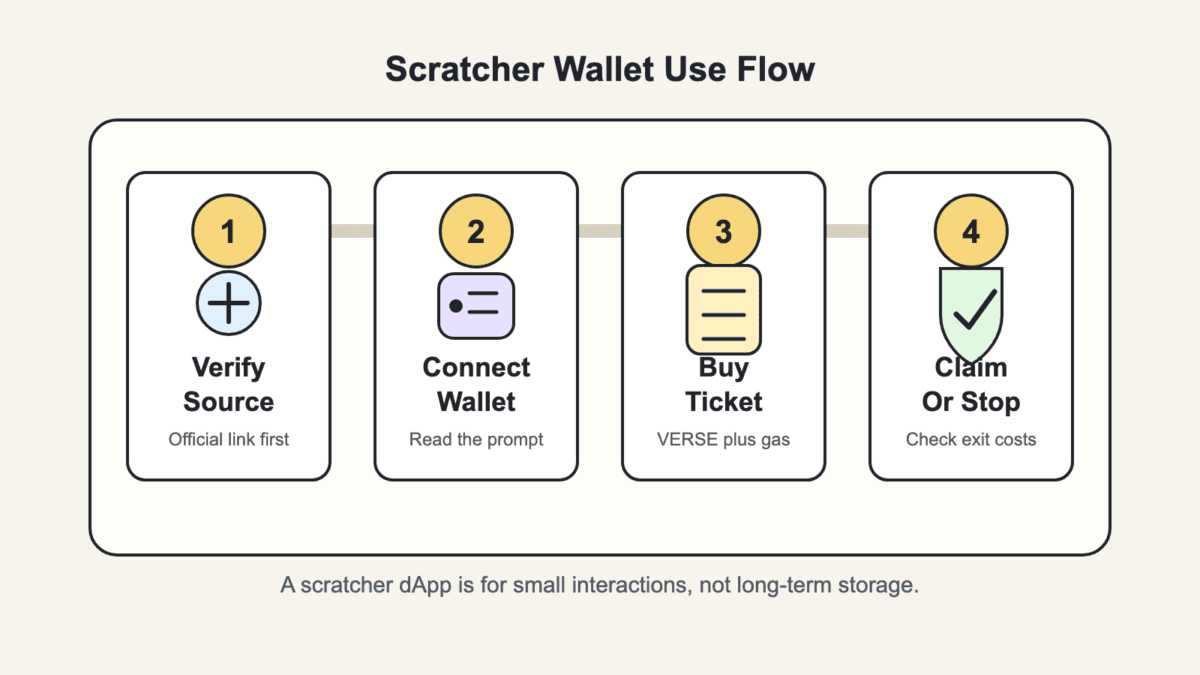
Before using Scratcher wallet, verify the exact product, link, wallet prompt, network, and cost. Most mistakes happen before the ticket is bought.
Use this checklist when a link, app, or social post sends you toward anything called Scratcher wallet:
If you are comparing self-custody apps, start with a clear list of crypto wallets instead of trusting the first app-store result that matches the words. A name match is not the same as a verified product match.
The biggest warning sign is a request that does not fit the action. A ticket purchase may need a transaction. A prize claim may need gas. A website asking for your seed phrase is not asking for normal dApp access. It is asking for the keys to the house.
Small test amounts help, but they do not fix a bad approval. If a prompt gives a contract broad permission over tokens you do not intend to use, cancel and investigate before signing.
No. Scratcher wallet is not a storage category at all, because a scratcher dApp is not a storage wallet. It is an app you may access through a wallet.
If you mean Verse Scratcher, the storage question belongs to the wallet you connect. That could be Bitcoin.com Wallet or another compatible wallet. The safety depends on recovery phrase handling, device security, wallet updates, transaction review, and whether you avoid malicious links.
If you mean a separate Scratch Wallet app, evaluate it as a wallet app. Look at the publisher, official website, age, public reputation, permissions, recovery model, and whether the app has enough credible history for the amount you plan to hold.
> Never enter a recovery phrase into a Scratcher page, prize-claim page, support chat, or scratch-off seed card.
A recovery phrase is not a login code. It is the control key for the wallet. Anyone who gets it can move funds without asking again.
Separate wallets can reduce the blast radius when you experiment:
This split also means support cannot always reverse mistakes. In self-custody, a wrong signature, lost phrase, or malicious approval can become a user-controlled loss very quickly. Crypto can be efficient like that. Sometimes rudely so.
For serious balances, separate storage from experimentation. Keep long-term funds in a wallet setup built for storage, and use a smaller wallet for dApps, games, claims, and tests.
Scratcher wallet is closer to on-chain gameplay or promotional rewards than investing when it means Verse Scratcher. It uses tickets, random results, and token prizes, so the risk sits closer to scratch-card economics than portfolio building.
That does not mean every jurisdiction classifies it the same way. Local rules can treat prize products, promotions, and games differently. The user takeaway is simpler: do not size it like an investment position.
These phrases are easy to overread:
| Phrase | What It Should Not Be Mistaken For |
|---|---|
| VERSE Rewards | Guaranteed profit or income. |
| Provably Fair | Proof that users should expect to win money. |
| Self-Custodial | Proof that every connected site is safe. |
| Ticket Prize | A liquid cash payout with no fees or slippage. |
| Scratch-And-Win | A portfolio strategy. Please do not make the spreadsheet cry. |
The broader GameFi frame helps here because on-chain games can use wallets, tokens, NFTs, rewards, and smart contracts without becoming investments. The presence of crypto rails does not change the basic math of chance.
A scratch-card format is also close to a lottery ticket in crypto because most value comes from uncertain outcomes. Some users may win. Many may not. Reinvesting small wins can feel active, but it can also turn entertainment spend into a quiet leak.
So keep the budget boring. Use money you can afford to lose, know the gas and exit path, and stop if the reward language starts sounding like yield.
Scratcher wallet scams usually exploit confusion around the name. A fake page does not need to beat your security if it can make you rush.
Lookalikes often copy the shape of a real product. They may use similar domains, sponsored search ads, social links, fake prize messages, or app-store naming that feels close enough. The whole trick is making the wrong action feel normal.
A confusing wallet or prize-page name is not a tiny edge case. It sits near the same scam patterns as fake airdrops, clone domains, and support impersonators.
Watch for these red flags before you connect or install:
> A scratch-off seed phrase card is not a cute backup method. If someone else generated the phrase, assume the wallet is already compromised.
The same caution applies to “free prize” links. If a page promises a large reward but needs a wallet connection, a signature, or a small payment first, slow down. Real dApps still require careful signing. Fake ones rely on impatience.
After any dApp session, review connected sites and token approvals if your wallet supports it. Disconnecting a site is not always the same as revoking token approval, so learn the difference before your first scare.
You might use Scratcher wallet for small entertainment money if you have verified the official source, understand the wallet prompt, and accept the game-like risk. You should not use it for storage, income, or investment capital.
The boring approach is the right one here. Verify first, connect with limits, keep amounts small, and understand what happens after a win before chasing one.
Use this order:
Set a ceiling before you start. If that amount would annoy you to lose, it is too high for a scratch-ticket product. The cleanest control is choosing the loss limit before the wallet prompt appears.
Decide what you would do after a win before you play. If the plan is “figure it out later,” the exit path is still untested. That is how small games become messy token chores.
If the product is not the one you meant, walk away. If the wallet prompt asks for more than the action needs, walk away. If the expected reward only makes sense after ignoring fees, slippage, and token volatility, also walk away.
That is not cynicism. It is how you keep a scratch-ticket experiment from becoming a wallet-security lesson with tuition.
No. Scratcher wallet usually refers to Verse Scratcher or a confusing search phrase, while Bitcoin.com Wallet is a self-custody wallet app that may be used to access Bitcoin.com services.
The split changes your risk because storage risk and dApp risk are separate. A wallet holds and signs. A dApp asks the wallet to interact with a specific contract or service.
You may need VERSE if by Scratcher wallet you mean Verse Scratcher, because tickets are tied to VERSE. You may also need Polygon gas for transactions.
Check the product screen before buying anything. Token requirements, gas names, and supported routes can change.
Scratcher wallet itself should not be treated as a Bitcoin storage wallet. A scratcher dApp is not the same thing as a wallet built to hold Bitcoin.
If you are using Bitcoin.com Wallet, that app may support Bitcoin. The Scratcher product and the wallet app still do different jobs.
Scratcher wallet is only as safe to connect as the exact link, wallet prompt, and product you are using. Verify the official source before signing.
Never connect through a random social link, sponsored clone, or private-message prize page. And never type a recovery phrase into any Scratcher-branded page.
Yes. You can lose money with Scratcher wallet through ticket cost, gas fees, token price movement, bad swaps, malicious lookalikes, or careless wallet approvals.
Even a legitimate scratch-and-win product can be negative after fees and chance. Use entertainment money, not a yield budget.
Not automatically. Scratch Wallet app results can refer to a separate wallet product, while Verse Scratcher is a Bitcoin.com scratch-and-win dApp.
Check the publisher, website, app listing, support route, and what the app asks you to do. Similar names are not proof of a shared operator.