Physical Address
304 North Cardinal St.
Dorchester Center, MA 02124
Physical Address
304 North Cardinal St.
Dorchester Center, MA 02124

A practical guide to testnet farming, airdrop uncertainty, and wallet safety.
Testnet farming is using a crypto project’s test network to build early activity that may count toward a future reward.
It usually means trying a product before mainnet, requesting test tokens from a faucet, completing quests, and leaving a wallet history that a project might later use for an airdrop. The quiet part is important: testnet farming can teach you a lot, but it can also expose your wallet, social accounts, identity, or mainnet funds if you connect too quickly.
Testnet farming in crypto is a reward-seeking version of product testing. You use a project’s testnet, perform useful actions, and hope that activity later helps you qualify for points, status, or a token claim.
A testnet is separate from a mainnet. Mainnet transactions use real assets and settle real value. Testnets use test tokens so developers and early users can try wallets, contracts, bridges, swaps, games, or trading flows before money is on the line.
Keep these pieces separate before you chase any campaign:
The official Ethereum.org network guide explains that testnet ETH can be requested from faucets and is intended to have no real value. That same idea applies across most test networks: faucet tokens pay test gas, not rent.
This is where testnet farming differs from broader farming in crypto. A DeFi farm may involve deposited capital, yield, and smart contract exposure. Testnet farming usually involves time, wallet connections, test transactions, social tasks, and reward uncertainty.
The basic bargain is simple. Projects get testers, usage data, feedback, and early community activity. Users get practice and a possible spot in a future reward list. Nobody should confuse that bargain with a paycheck.
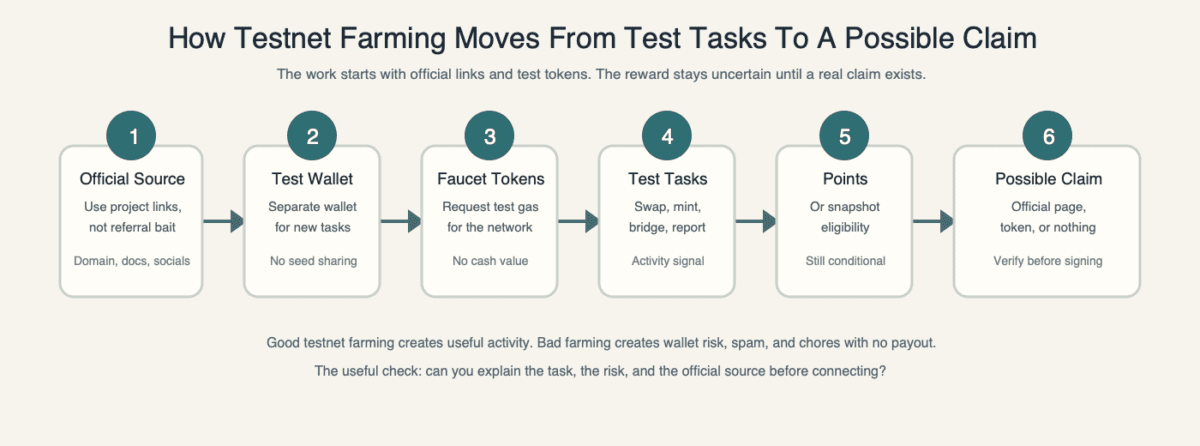
Testnet farming works as a chain of small actions that may become eligibility signals. The common path starts with official project links, then moves through wallet setup, faucet tokens, test activity, points or snapshots, and a possible claim.
The flow sounds neat on a diagram. Real campaigns are messier. Tasks change, faucets run dry, quest platforms miss confirmations, and reward rules may not exist until much later.
A simple farming sequence often looks like this:
The key word is “possible.” A snapshot may happen before you notice. Points may convert to nothing. A claim page may never appear. And if a claim does appear, fake copies usually show up quickly enough to make speed feel dangerous.
Good testnet farming treats each step as conditional. You are building a record, not buying a ticket with printed odds.
Crypto projects use testnet farming because real users break things differently from internal teams. A small public test can reveal wallet errors, confusing screens, slow transactions, failed bridges, broken price displays, and smart contract edge cases.
That is the useful side. A strong testnet gives builders more data before mainnet, and it gives early users a way to learn the product before real funds are involved. Bug reports, repeat usage, and clear feedback can be more valuable than a thousand empty quest clicks.
A serious testnet campaign can help a team check several things:
Projects also use farming because it creates attention. Points, roles, leaderboards, and possible airdrops pull people into Discord servers, quest pages, and product demos. Some teams want real testers. Others mostly want numbers for a launch narrative.
That distinction changes how you should read a campaign. Useful participation and farming behavior overlap, but they are not identical. A user who tries a feature, reports a bug, and returns later creates a better signal than a wallet that only presses every button once.
Some campaigns never pay because there was no token plan, no budget, no claim design, or no reason to reward low-quality activity. Farming can help a project find early users, but it can also bury the product under bots, referrals, and spam.
Testnet farmers complete actions that may prove interest, product usage, technical skill, or community involvement. The best actions have a clear reason inside the product. The weakest ones exist only to inflate a leaderboard.
Common tasks range from harmless test transactions to privacy-heavy identity checks. Before doing any of them, ask what the project learns from the action and what you give up by completing it.
| Task | What It May Prove Or Risk |
|---|---|
| Faucet claim | Proves you can access the test network, but faucets can collect wallet and social data. |
| Swap or mint | Shows product usage, but repeated empty clicks can look low-quality. |
| Bridge test | Tests cross-chain flow, but real bridges may require mainnet gas or deposits. |
| Lending or perps test | Shows deeper usage, but complex apps create more signing risk. |
| Contract deployment | Signals technical effort, but it is not relevant for every user. |
| Bug report | Adds real value if specific, reproducible, and submitted through official channels. |
| Discord role or social task | Proves community activity, but it can become noisy referral farming. |
| KYC or identity check | May reduce Sybil risk, but it raises privacy and data questions. |
The table is a filter, not a scoreboard. A hard task is not automatically better. A task only deserves time when it fits the product and the project has a reason to measure it.
The strongest farming record usually looks consistent and human. It shows you used the product more than once, understood the steps, avoided spammy wallet patterns, and kept notes. That beats frantic clicking across twenty campaigns while half-asleep.
Testnet farming is worth considering when the learning value, possible upside, and time cost make sense together. It is not worth it when the only reason to continue is a vague promise that “early users may be rewarded.”
The appeal is obvious. Some airdrops create large gains for early users, and testnet farming can feel like lottery-ticket upside without buying the token. But the ticket can cost hours, attention, gas on related mainnet tasks, privacy, and wallet risk.
Testnet farming tends to fit these users best:
It tends to fit badly when these points apply:
A good answer is usually boring: pick fewer campaigns and do them better. If one testnet has a real product, clear docs, active builders, and sensible tasks, it deserves more attention than ten vague farms yelling about “confirmed” rewards.
Testnet farming risk starts before the first transaction. The dangerous moment is often the wallet connection, signature request, browser extension install, or fake claim page that looks close enough to the real one.
A dedicated wallet helps because it limits what a bad campaign can touch. If you need a refresher on wallet types and basic setup, CryptoProcent’s crypto wallets section is the safer place to start than a random campaign thread.
| Check | Why It Matters |
|---|---|
| Official domain | Fake domains copy logos and claim pages to steal signatures. |
| Wallet separation | A test wallet limits damage if a campaign is malicious. |
| Seed phrase request | No legitimate testnet task needs your seed phrase. |
| Token approval | Broad approvals can expose assets on connected networks. |
| Extension install | Extensions can watch browsing, inject pages, or request risky permissions. |
| KYC or social link | Identity and social data can outlive the campaign. |
| Reward wording | “Potential” and “confirmed” are not the same promise. |
| Multi-wallet pattern | Repetitive wallet behavior can trigger Sybil filters. |
Some risk is financial. Some is privacy. Some is plain old time theft wearing a leaderboard hat.
Sybil filtering is the awkward one. Multiple wallets can increase activity count, but obvious repetition can make every wallet look fake. If a project wants real users, cloned behavior can backfire.
Also watch for campaigns that slowly fade after collecting attention. That is closer to soft rug risk than a classic wallet drain. You may not lose funds, but you can still lose time, data, and trust.
The hard rule is simple. If a task asks for a seed phrase, unlimited permission, unrelated KYC, or a browser extension you cannot verify, skip it. There will be another farm. There is always another farm.
A good testnet farming opportunity has a real product path, official sources, sensible tasks, and honest reward wording. A weak one leans on referrals, countdowns, copied branding, and huge implied rewards with no clear rules.
Start with source quality. Check the official website, verified social channels, docs, and product links before opening a quest. Team transparency can help too, though a doxxed team is only one signal, not a magic shield.
Use three labels when you read a campaign post:
Most testnet farming lives between inferred and speculation. That is not automatically bad, but you should price it like uncertainty. A task that takes five minutes may be fine. A task that asks for deposits, identity checks, or weeks of daily activity needs a stronger reason.
Then look at task fit. A decentralized exchange asking you to test swaps makes sense. A bridge asking for bridge tests makes sense. A random campaign asking for KYC, five social accounts, and a referral chain before showing a product deserves a raised eyebrow.
Finally, keep a tracking plan. Record the official link, wallet used, date, tasks completed, costs, and any points shown. If a claim appears months later, your notes beat memory. Memory is a terrible portfolio manager.
Testnet farming is one form of airdrop farming, but the two are not identical. Airdrop farming can include many activity types across mainnet, social platforms, NFT markets, staking, liquidity, trading, referrals, and holding assets.
Testnet farming is narrower. It focuses on pre-mainnet or test-environment activity, usually with faucet tokens and unfinished products. That can reduce capital risk, but it does not remove wallet, privacy, Sybil, or time risk.
| Difference | What It Means For The User |
|---|---|
| Network used | Testnet activity uses test tokens, while mainnet activity uses real assets. |
| Cost profile | Testnet tasks may be low-cost, but mainnet tasks can require gas, deposits, or trading volume. |
| Signal quality | Real usage can look stronger, but testnet feedback can matter before launch. |
| Risk type | Testnets reduce direct capital exposure, while wallet and phishing risk remain. |
| Reward timing | Testnet rewards often depend on future snapshots, TGE plans, or claim rules. |
The best choice depends on your goal. If you want product practice and low-capital exposure, testnet farming can be useful. If you want stronger on-chain activity, mainnet farming may carry more signal and more downside.
Many serious hunters combine both. They test early, then decide whether a mainnet campaign deserves real funds. That second step needs a stricter filter because the money stops being imaginary.
If testnet farming pays out, slow down before claiming. A real airdrop can attract fake claim pages, copied contract links, fake support accounts, and phishing messages within hours.
Use the same wallet notes you kept during the campaign. Find the official claim page from verified sources, check the token contract through official channels, and avoid signing anything that asks for unrelated approvals.
Before claiming or moving tokens, run a short post-claim check:
Liquidity is the sneaky part. A token can look valuable on paper while actual buyers are thin. If early recipients all rush for the door, late buyers can become exit liquidity for sellers who planned better.
None of this is tax, legal, or financial advice. It is just the part of farming that hype threads often skip. Getting the drop is not the finish line if the claim, records, liquidity, or wallet security are sloppy.
Start with one campaign, one test wallet, and one written task log. Testnet farming gets messy when you chase every thread at once and forget which wallet touched which app.
A simple first setup keeps the blast radius small:
Skip any campaign that pressures you to rush. Real opportunities do not need your seed phrase, and good products do not hide behind copied domains.
After your first campaign, review the result. Did you learn the product? Did the tasks make sense? Did you expose any data you regret sharing? The answers matter more than a points number on a dashboard.
Testnet farming can be free in direct token cost, but it is not free in time, attention, privacy, or wallet risk. Some campaigns also add mainnet tasks that require real gas, deposits, or trading costs.
Testnet farming can lead to real rewards if a project launches a token and includes testnet activity in eligibility. But no payout is guaranteed, and many campaigns produce small rewards or none at all.
Testnet tokens in testnet farming normally have no cash value. They exist so users can test transactions without spending real assets, although scammers may still try to sell fake “valuable” testnet tokens.
You should not use your main wallet for testnet farming if it holds meaningful funds or long-term assets. A dedicated wallet reduces exposure to bad links, risky signatures, and messy permission history.
Multiple wallets can hurt testnet farming eligibility if the behavior looks repetitive, automated, or fake. Projects may use Sybil filters to remove wallets that appear to be one user farming many accounts.
Testnet farming is one type of airdrop farming. Airdrop farming can also include mainnet usage, staking, liquidity, NFT activity, social quests, holding assets, referrals, or trading volume.