Physical Address
304 North Cardinal St.
Dorchester Center, MA 02124
Physical Address
304 North Cardinal St.
Dorchester Center, MA 02124


A practical guide to tokenomic crime, rug pulls, honeypots, and bad tokenomics.
Tokenomic crime is a crypto scam or abusive token design where the token’s supply, ownership, liquidity, permissions, or reward rules extract value from buyers.
The phrase is an umbrella term, not a settled legal label. In real crypto conversations, people usually call the same risk a rug pull, honeypot, bad tokenomics, dev-wallet dump, or exit-liquidity trap.
Tokenomic crime in crypto means economic abuse built into or around a token. The harm can come from supply control, insider ownership, liquidity setup, transfer rules, promised rewards, or hype that hides those risks.
The word “crime” should be handled carefully. A bad chart, failed roadmap, or ugly token allocation does not prove fraud by itself. The useful question is whether the token design gives insiders a hidden or unfair path to extract value from late buyers.
Look at what the design lets someone do:
That makes tokenomic crime different from ordinary market loss. Crypto prices can fall because demand fades, timing is poor, or the product fails. Tokenomic crime points to something sharper: the rules were built, changed, or marketed so normal buyers become the weak side of the trade.
So the term is best used as a risk label. It tells you to inspect the token’s mechanics before trusting the story around it.
People use sharper slang because tokenomic crime often shows up through familiar crypto losses. A trader may not say “tokenomic crime.” They may say they got rugged, trapped in a honeypot, dumped on by dev wallets, or used as exit liquidity.
Those phrases overlap, but they are not identical. A hard rug is usually sudden: liquidity vanishes, the team disappears, or selling becomes useless almost overnight. A honeypot is more specific. Buying works, but selling fails, costs absurd slippage, or only works for privileged wallets.
Use this quick translation:
The social language is useful because most users meet this risk on CT slang, Telegram, Discord, Reddit, DEX tools, or launchpad dashboards. The formal tokenomics page may look clean while the community is already arguing about mint authority, freeze authority, LP locks, snipers, and dev wallets.
A slow extraction can look different. Insiders may keep marketing while they sell into each pump, delay bad news until unlocks hit, or keep attention alive just long enough for retail to become a bagholder.
The label is less important than the mechanism. If the token’s rules make exits worse for ordinary holders while insiders keep better options, the risk deserves attention before the candle gets theatrical.
Tokenomic crime is not the same as every weak token design. Crypto has plenty of bad ideas that fail without hidden minting, blocked sells, or deliberate deception. Some are just poorly built. Some are openly predatory. Some are closer to fraud.
That distinction keeps the article useful. Calling every loss a crime makes the word useless. Ignoring predatory design because it was technically disclosed is not much better.
| Category | What It Means For A Holder |
|---|---|
| Malicious or deceptive design | The token rules, permissions, liquidity, or marketing hide a trap that helps insiders extract value. |
| Predatory but visible design | The risks are visible, but the design still favors insiders through heavy emissions, low float, high FDV, or aggressive unlocks. |
| Ordinary project failure | The token loses value because demand, execution, timing, or product quality failed without clear deception. |
A soft rug sits near the messy middle. The project may still exist, but insiders extract attention, liquidity, or credibility while the market slowly realizes there is no real support under the token.
Avoid legal accusations unless there is evidence. You can still act on risk without pretending to be a court. If sellability, liquidity, holder distribution, permissions, and team behavior all look hostile, that is enough reason to reduce size or skip the trade. A failed token disappoints holders. A tokenomic crime sets the holders up.
Tokenomics can trap buyers when the token’s rules make entering easy and exiting hard. The trap may sit in liquidity, supply, wallet ownership, contract permissions, or incentives that look attractive until the bill arrives.
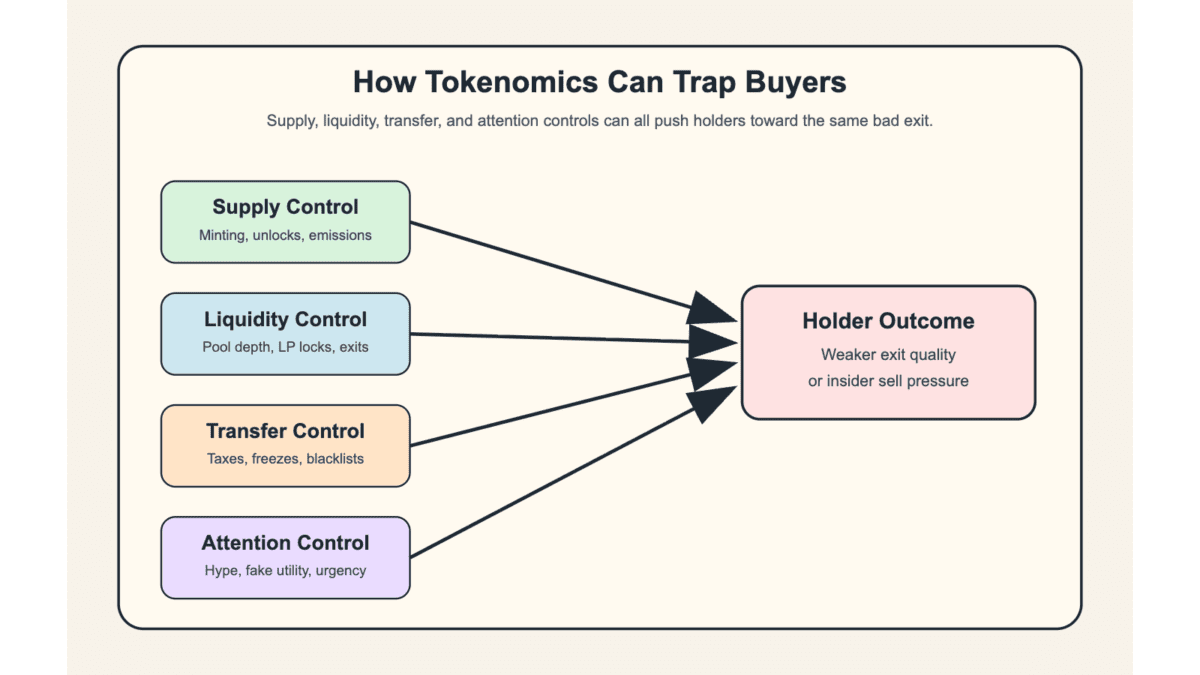
Liquidity traps make a token look tradable until you try to leave. A pool can be thin, unlocked, controlled by insiders, or paired with too little real value to support exits.
A honeypot is the nastier version. The contract may let you buy, then block sells, punish sells with extreme taxes, or require slippage so high that the exit becomes comedy with fees.
Check these before trusting a chart:
Locked liquidity helps, but it is not a halo. A token can have locked liquidity and still have dangerous mint permissions, concentrated holders, or transfer controls.
Insider supply traps buyers when a few wallets can move the market. The danger is not just one large wallet. It is related wallets, snipers, team wallets, and unlabeled clusters that can dump into thin demand.
Wallet clustering is important because supply can be split on purpose. Ten wallets holding five percent each may create the same dump risk as one wallet holding half the float. The chart will not warn you kindly.
Look for these fragile holder-map signs:
This is where tokenomic crime can feel like PVP trading. The market is open, but the players do not have the same information, timing, or exit quality.
Contract controls can turn tokenomics into a trap because permissions define what insiders can change later. On Solana, mint authority and freeze authority are common checks. On EVM chains, owner roles, blacklists, tax functions, and proxy controls matter.
Renounced ownership or revoked authority is helpful, but it does not prove the token is safe. It only closes one path. Other risks can still sit in liquidity, holder concentration, metadata, upgrade paths, or tax logic.
Watch for controls that change the holder’s exit:
If a token scanner flags these terms, slow down. The scanner is not sentencing the project. It is telling you which doors still have keys.
Some traps do not need a classic liquidity pull. A token can launch with low circulating supply, a huge fully diluted valuation, and future unlocks that create sell pressure after retail attention arrives.
Fake yield creates a similar problem. A large APY can look generous while rewards are paid through token inflation. Holders receive more units while each unit bleeds value. Number goes up. Account value does not always follow. Rude, but common.
Ask what supports the token after hype fades:
This is where a narrative coin can become dangerous. If the story is stronger than actual demand, insiders may use the narrative as cover while emissions, unlocks, or wallet sales do the real work.
Bad tokenomics can be enough to walk away. You do not need proof of malice to avoid being the buyer who absorbs the next unlock.
Common tokenomic crime patterns often stack. One weak signal can be explainable, but several together can turn a normal speculation into a bad exit with extra steps.
Use the table as a scanner-to-meaning bridge. The goal is not to memorize every scam type. The goal is to connect the warning to the holder harm.
| Pattern | What To Check |
|---|---|
| Liquidity pull | LP lock, pool depth, deployer permissions, and recent liquidity removals. |
| Honeypot or seller block | Sell simulation, transfer restrictions, blacklist functions, and tax changes. |
| Concentrated holder supply | Top holders, related-wallet clusters, snipers, and team-controlled wallets. |
| Retained mint authority | Mint authority, owner roles, token cap, and who can create more supply. |
| Freeze or blacklist controls | Freeze authority, blacklist logic, transfer limits, and privileged wallet behavior. |
| Low-float high-FDV unlock | Circulating supply, FDV, unlock calendar, and unlock size versus normal volume. |
| Fake yield emissions | Reward source, emission schedule, real fees, and whether demand absorbs new supply. |
| Fake utility or copied roadmap | Product status, app usage, whitepaper originality, and community questions. |
Several patterns together should change your behavior. That may mean skipping the token, reducing position size, waiting for more data, or treating the trade as a short-term speculation rather than an investment.
The most dangerous setup is clean marketing over dirty mechanics. A polished website can hide a brutal holder map. A busy Telegram can hide thin liquidity. A scanner score can miss human behavior. Boring checks still win.
Tokenomics red flags should be checked in the order that affects your exit first. If you cannot sell, the whitepaper can wait.
Start with sellability, then move outward. Scanners can help with contract and liquidity checks, but they cannot prove clean wallets, honest teams, future unlock discipline, or real demand.
Run the checks in this order:
Team identity is one signal, not a seatbelt. An anon dev can ship honest work, and a doxxed team can still design ugly incentives. The difference is what each side can do with supply, liquidity, and permissions.
Context changes the risk. In the trenches, speed creates pressure. A coin can trend because everyone wants the same fast exit, not because the mechanics are safe.
Heavy promotion can be its own warning when the token already has insider concentration or weak liquidity. A top signal is not proof of tokenomic crime, but it can mark the moment late buyers become the easiest exit. If you find three or four serious red flags, do not negotiate with the chart.
A rugged token can still show trades because the market interface may record activity after the useful exit is gone. Residual liquidity, bots, dust trades, privileged wallets, and fake-looking volume can keep a chart moving.
That confuses holders. If a token was rugged, why are there still transactions? Because “still trading” does not mean “safe to exit.” A pool may have tiny leftover liquidity. Some wallets may retain better sell routes. Bots may trade small amounts because volatility or spreads remain.
Activity can continue for boring reasons:
Picture a token where most liquidity was removed, but a small pool remains. A few automated wallets trade dust, a chart prints candles, and the price appears alive. For a normal holder, the exit may still be terrible because slippage eats the trade or there is not enough real liquidity behind the quote.
That is how a token can become a dead coin while still showing motion. The screen is not lying, exactly. It is just showing activity without telling you whether holders can recover meaningful value.
Check the pool, not only the candle. Look at liquidity depth, holder behavior, recent swaps, and whether ordinary wallets can sell without getting wrecked by slippage or restrictions.
If you suspect tokenomic crime, stop adding money first. More buys rarely fix a hostile token design, and scammers love the phrase “average down” when someone else is paying.
Then preserve evidence before links, chats, and websites vanish. You are not building a courtroom case inside Telegram. You are protecting your own records and avoiding new mistakes.
That record-keeping is not just admin: Chainalysis estimates that crypto scams and fraud stole $17 billion globally in 2025, so addresses, hashes, and timestamps matter more than angry screenshots.
Use this order:
Do not connect your wallet to random “claim recovery” pages. Recovery scammers target people already embarrassed, rushed, and angry. That is a good market for bad humans.
If approvals or malicious dapps are involved, take wallet hygiene seriously. Move unaffected assets to a clean wallet when needed, but do not rush in a way that creates new signing mistakes. You may want to argue with promoters, expose the team, or chase every wallet. Document first. Decide second. Post third, if posting helps anyone.
Related terms help because tokenomic crime rarely announces itself with that exact phrase. The risk usually appears as slang, scanner warnings, or holder outcomes.
These terms are useful because each one names a different part of the trap:
Use these terms to name the mechanism. Naming the mechanism helps you avoid turning every ugly token chart into the same vague accusation.
Start with the token contract and pool before the chart. A chart shows what already happened. The token rules show what can still happen to your exit.
If the token is tiny, new, or hype-heavy, size it like a speculation until the mechanics prove otherwise. A lottery ticket trade can be a deliberate small bet. It should not quietly become your serious portfolio position.
Keep the next steps simple:
Then decide whether the token deserves your money, your attention, or neither. Many bad trades become worse because the buyer keeps looking for permission to ignore the first answer.
If you already bought, shift from hype mode to evidence mode. Save addresses, review approvals, check whether selling works, and stop arguing with strangers who need you to hold longer.
Tokenomic crime in crypto is an abusive token setup where supply, liquidity, ownership, permissions, or rewards are used to extract value from buyers. It is an umbrella phrase for risks people often describe as rug pulls, honeypots, insider dumps, or exit-liquidity traps.
Tokenomic crime is not a settled legal category. Some conduct may become illegal when it involves deception, theft, market manipulation, false statements, or securities-law violations, but a bad token design does not automatically prove a crime.
Bad tokenomics are not always a scam. A token can have poor emissions, weak utility, ugly unlocks, or bad incentives without hidden deception. Still, bad tokenomics can be enough reason to avoid the trade.
No. Meme coins are risky because they often move fast, rely on attention, and trade with thin liquidity, but that does not make every meme coin tokenomic crime. The real checks are sellability, liquidity, holder concentration, permissions, and disclosure.
Token scanners are useful triage tools, not safety certificates. They can flag contract permissions, liquidity issues, holder concentration, and taxes, but they cannot prove honest teams, future unlock behavior, clean wallet clusters, or real demand.
Yes. A rugged token can still show trades through residual liquidity, bots, dust swaps, privileged wallets, or fake-looking activity. Ongoing chart movement does not prove that normal holders have a good exit.