Physical Address
304 North Cardinal St.
Dorchester Center, MA 02124
Physical Address
304 North Cardinal St.
Dorchester Center, MA 02124

Trenches PTSD is slang for post-rug caution. Learn why it changes risk checks and how not to chase recovery hype.
Trenches PTSD is crypto slang for the caution, regret, and stress traders joke about after getting rugged, rekt, liquidated, or repeatedly burned in fast meme coin markets.
It is not a medical diagnosis. In crypto, the phrase usually points to post-loss behavior: checking charts too often, selling too early, distrusting every launch, and reacting to a new pitch that promises safety after a rough run.
Here is what this term does in practice:
Trenches PTSD is the post-loss caution traders describe after damage in risky meme coin markets. It grows out of crypto trenches slang, where thin liquidity, loud social pressure, and sudden exits are common.
The phrase is joking shorthand. A trader might say they have “Post-Trench Stress Disorder” after a rug pull, a failed Pump.fun launch, a liquidation, or a chart that looked strong before it was not. It is gallows humor with a wallet attached.
The useful meaning is behavioral, not medical. Someone with trenches PTSD may distrust every new dev, sell at the first green candle, or refuse to hold through normal volatility because the last “community gem” ended in a crater.
That is different from living in the trenches broadly. Living there describes exposure to early-token chaos. Trenches PTSD describes the decision noise that follows repeated losses.
Traders use Post-Trench Stress Disorder because loss memory rewires how they react to new trades. After enough rugs, fake recoveries, and rushed exits, even a normal pullback can feel like the start of another collapse.
The phrase often shows up around repeat situations like these:
| Trigger | What It Can Change |
|---|---|
| Rug pull | Makes every dev wallet look suspicious |
| Hard rug | Trains users to expect sudden collapse |
| Soft rug | Makes slow bleeding feel familiar |
| Bagholding | Creates fear of being the last holder |
| Selling too early | Turns caution into regret |
| Private-group exit | Makes “alpha” chats feel predatory |
| Wallet mistake | Raises fear around every signature |
| Liquidation | Makes borrowed trades feel radioactive |
| Repeated Pump.fun losses | Turns each new launch into deja vu |
The table is not a diagnosis. It is a map of how market pain can shape trading behavior.
A hard rug sign can teach healthy caution. A soft rug exit can teach patience, because not every collapse happens in one candle. The problem starts when every new decision becomes a fight between revenge and panic.
That is how a user becomes afraid of being the bagholder in crypto again. They do not just remember the loss. They remember being late, hopeful, and loud in the wrong chat.
Trenches PTSD is not clinical PTSD, and crypto slang should not be treated as a diagnosis. The phrase borrows serious language for a market joke, so that boundary matters.
The National Institute of Mental Health describes PTSD as a condition that can follow traumatic events and interfere with daily life. A bad meme coin trade is financial stress, not automatically a mental-health condition.
Trading stress can become real distress. If chart checking, losses, debt, or shame starts affecting sleep, work, relationships, or safety, the next step is not another token call. It is stepping away and getting qualified support.
That sensitivity does not kill the slang. It just keeps the joke in its lane.
PTSD can mean several things in crypto content. The safest read is to separate slang, entertainment, token pages, and real mental-health language before assuming one result explains another.
Here is the clean split:
| Search Result | What It Means |
|---|---|
| Trenches PTSD slang | A meme for post-rug caution and stress |
| PTSD Show | A Web3 animated series using the Post-Trench Stress Disorder theme |
| Post-Trench Stress Disorder show branding | Entertainment branding around crypto chaos |
| Post Trench Stress Disorder token hub | A token result, not a definition by itself |
| Post Trench Sol Disorder token pages | Solana-style token branding around the same phrase |
| Post Traumatic Solana Disorder social post | A social-token phrase, not the same as the slang |
| Post Traumatic Stress Doge article | A different PTSD-themed meme coin angle |
The official PTSD Show frames PTSD as “Post-Trench Stress Disorder” in a dark-comedy crypto series. That is a media project. It can overlap with the slang, but it does not make every PTSD ticker, chart page, or social post part of the show.
Token pages create the biggest beginner trap. A PTSD token result may borrow recovery language, trench humor, or mental-health vocabulary, but branding does not reduce contract risk, liquidity risk, or top-wallet concentration.
So read the acronym slowly. A show is entertainment. A token is a risky asset. A trader saying “I have trenches PTSD” usually means they have been burned before and are reacting like it.
Trenches PTSD usually comes from repeated losses in markets where public buyers arrive late and exits disappear quickly. The feeling is strongest when users believe they were not just wrong, but used as someone else’s liquidity.
That is why exit liquidity risk sits at the center of the phrase. A user sees a green chart, buys after the post spreads, then watches early wallets sell into the new demand. The chart was real. The timing was not.
Market-manipulation data shows why that suspicion sticks. In a January 2025 analysis updated in February 2025, Chainalysis reported that 3.59% of tokens launched in 2024 matched patterns linked to pump-and-dump behavior. It identifies behavior patterns, not motives, which is the key distinction trench buyers should keep in view.
Several risk layers often stack together:
That setup feels like PvP in crypto because the trade depends on someone else entering later. It is not just “buy a thing and wait.” It is “buy before the next person realizes they are the exit.”
An anon dev risk does not mean every anonymous builder is malicious. It means accountability is harder to judge when the contract, liquidity, and promotion are already moving fast.
The emotional result is predictable. After enough bad entries, a trader may stop asking whether the setup is good and start asking whether they can escape before the next holder wakes up.
Trenches PTSD changes trading behavior by turning old losses into new reflexes. Some reflexes protect users. Others quietly make the next loss more likely.
Common shifts include:
Some caution is rational. If a trader got trapped once, learning jeeting in crypto helps explain why early selling becomes tempting. The same pattern can also turn into overcorrection, where every normal dip feels like doom.
That tension matters too. Jeets are often mocked, but post-rug sellers may simply be protecting themselves from another collapse. The joke hides a real tension between survival and upside.
The most dangerous version is revenge sizing. A user who got burned may full port in crypto because the next trade feels like repair. That usually repairs nothing. It is the market offering a second lesson at full price.
A trenches PTSD pitch should be read as marketing until the token mechanics prove otherwise. Trauma-themed branding, recovery language, and “we all got rugged” solidarity do not make a token safer.
A clean read runs mechanical checks before attention turns into a trade.
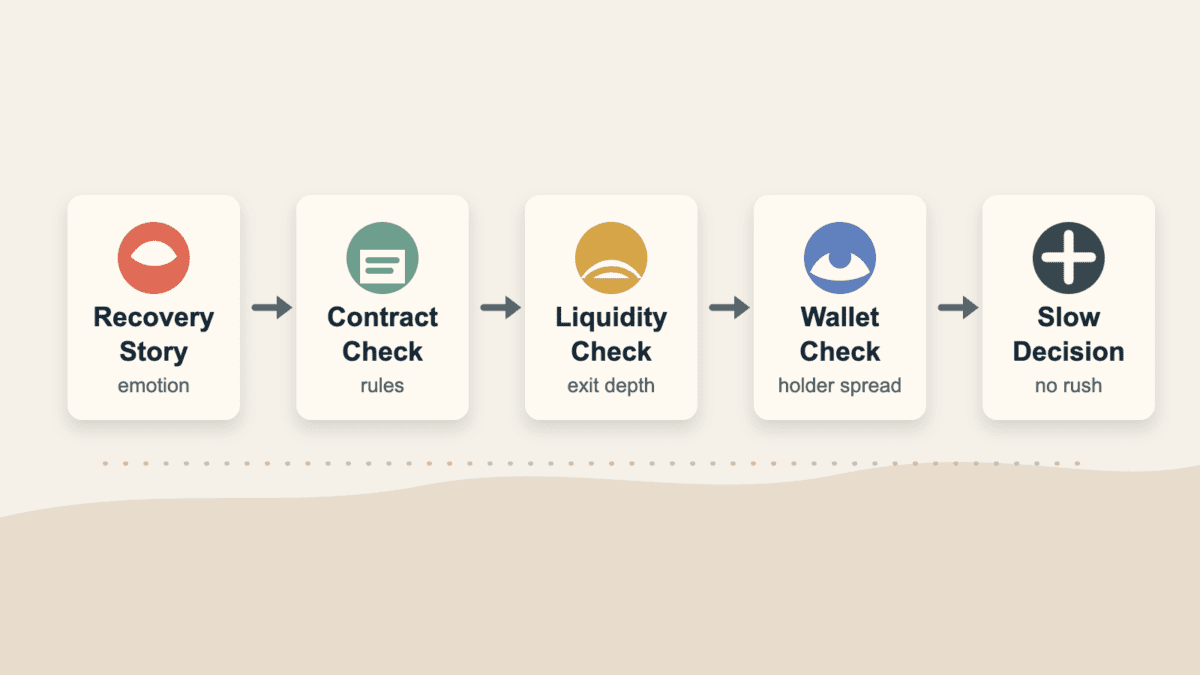
Watch for these pressure signals before giving the pitch attention:
The point is simple: emotional branding is not a control audit, a liquidity lock, or a substitute for reading the contract.
The SEC staff statement on meme coins described many meme coins as speculative and limited in utility, while also noting that fraud can still be pursued under other laws. That should lower overconfidence, not raise it.
If a pitch uses past pain to create new urgency, slow down. A real opportunity can survive questions. A bad one often needs you excited, loyal, and moving before your brain catches up.
Trench trading stops being fun when the chart starts controlling the day. If trading stress spills into sleep, work, relationships, or basic mood, the issue is no longer just a bad ticker.
Use these checks before sending more funds:
The crypto casino slang comparison exists for a reason. A tiny lottery ticket in crypto can be entertainment if it is sized that way. A recovery trade funded by panic is a different risk.
That does not mean every small meme coin position is reckless. A real conviction play in crypto starts with a reason and a limit. Trenches PTSD often starts with a scar and a countdown.
These related terms help decode trenches PTSD without turning the page into another general trench guide. Each one explains a specific part of the phrase.
They are useful because trenches PTSD usually comes from market behavior, not language alone. The links below keep that behavior in context.
For more plain-English explainers, the CryptoProcent guide library is the better next stop than another anonymous Telegram promise.
If you want the strongest next step, choose one related term and follow its practical checks before moving on to another recovery pitch.
Trenches PTSD means the caution, regret, and stress traders joke about after repeated losses in fast meme coin or micro-cap token markets. It usually points to post-rug behavior, not a formal condition.
No. Trenches PTSD is crypto slang, not a clinical diagnosis. Real PTSD is a mental-health condition, and serious distress should be handled with qualified support.
No. PTSD Show is a Web3 animated series that uses the Post-Trench Stress Disorder theme. Trenches PTSD slang is the broader community phrase for post-loss caution and stress.
Yes, PTSD-themed token results exist, but a token result is not the same as the slang or the show. Evaluate any PTSD token like a separate risky asset that needs contract, liquidity, wallet, and promotion checks.
They usually mean past rugs changed how they react to new trades. They may sell too early, mistrust every launch, over-check charts, or chase a recovery trade.
Beginners should usually pause before trading again. A short break, a smaller budget, and written risk limits are more useful than trying to win back a rug while tilted.