Physical Address
304 North Cardinal St.
Dorchester Center, MA 02124
Physical Address
304 North Cardinal St.
Dorchester Center, MA 02124


A plain-English guide to altcoin beta and high-beta crypto risk.
Altcoin beta measures how strongly an altcoin tends to move relative to a benchmark such as Bitcoin, Ethereum, or a crypto sector.
Traders use altcoin beta to describe extra market exposure. If Bitcoin moves and a smaller alt tends to move harder, that alt may have high beta to Bitcoin for that period. That sounds neat. It is also where people get clipped. Altcoin beta can help with sizing, stress tests, and portfolio checks, but it cannot tell you whether the coin is good, liquid, or early.
Altcoin beta in crypto is a way to describe how much an altcoin tends to move when a reference asset moves. The reference asset might be Bitcoin, Ethereum, SOL, a DeFi basket, or a wider altcoin market measure.
A beta above 1 means the altcoin has historically moved more than the benchmark. A beta below 1 means it has moved less. A negative beta would mean it tends to move the other way, though that is less common and often unstable in crypto.
The core readings are simple:
Here is the simple version. If BTC rises 1% and an altcoin tends to rise 1.8% over the same measured window, that alt has roughly 1.8 beta to BTC for that window.
That example also shows the catch. Altcoin beta describes a relationship during a measured period, not a permanent personality trait.
It can change after listings, token unlocks, liquidity shifts, narrative rotation, regulatory news, or one ugly selloff. So the number is useful only after you name the benchmark, the time window, and the market conditions behind it.
Altcoin beta works by comparing an altcoin’s returns with a benchmark’s returns over a chosen period. The benchmark decides what question the beta reading can answer.
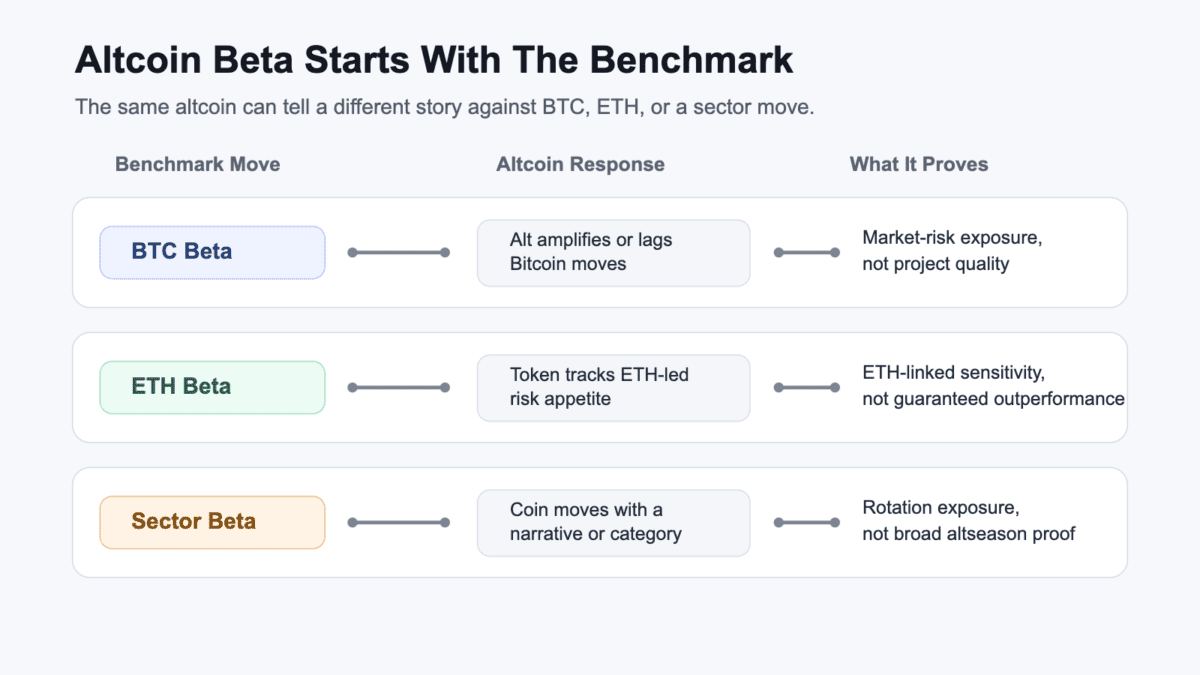
BTC beta asks how strongly an altcoin tends to respond to Bitcoin. It is useful when Bitcoin is the main market driver and traders want to know which alts act like more sensitive BTC exposure.
ETH beta asks a narrower question. It looks at whether a token behaves like a higher-sensitivity expression of Ethereum. Layer 2 tokens, DeFi tokens, and ETH-linked meme coins may get described this way during Ethereum-led rallies. The same coin can look different under each lens.
The benchmark changes the answer because beta is a relationship, not a standalone score. A SOL-to-BTC reading asks whether SOL has amplified Bitcoin moves. A layer 2 token-to-ETH reading asks whether that token has amplified Ethereum moves. A meme coin may be beta to a meme category, not to ETH itself.
Use this quick map before trusting the number:
| Benchmark Choice | Question It Answers |
|---|---|
| BTC beta | Does the altcoin amplify or lag Bitcoin moves? |
| ETH beta | Does the token behave like a higher-sensitivity Ethereum expression? |
| Sector beta | Does the coin move with a specific narrative or category? |
| Basket beta | Does a group of alts share one crowded market exposure? |
The table does not rank the benchmarks. It shows why “beta to what?” comes before “is the beta high?”
Correlation and R-squared help separate useful beta from noisy movement. Beta can look high because the altcoin had a few violent candles, even if it does not reliably move with the benchmark.
Correlation asks whether the assets usually move together. R-squared asks how much of the altcoin’s move the benchmark relationship explains. If both are weak, a high beta number may be more chart decoration than risk control. That is common in crypto.
High altcoin beta can increase exposure to a strong market move, but it can also make losses arrive faster. The upside and downside are linked.
Upside beta is the part traders like to talk about. If Bitcoin is grinding higher and liquidity rotates into alts, a high-beta altcoin may rise faster than the benchmark.
That can help when the move is broad, liquid, and still early. It is why traders hunt for “faster horse” assets after BTC or ETH proves strength. The smaller coin gives more sensitivity to the same market direction. But upside beta is not alpha.
Downside beta is the part that empties accounts with impressive efficiency. When BTC drops, high-beta alts can fall harder because buyers disappear, spreads widen, and leveraged traders unwind at the same time.
That is why a full-port trade in a high-beta altcoin can be so punishing. The position is already sensitive. Oversizing it turns ordinary volatility into a forced decision.
> High beta does not make a smaller asset safer than leverage. It adds project risk, liquidity risk, and execution risk on top of market exposure.
Liquidity changes the result because beta is measured on past prices, while trades happen in live order books. A coin can show attractive upside beta on a chart, then punish size with slippage when you enter or exit.
The difference is easiest to see in stress:
| Benchmark Move | What High-Beta Exposure Can Do |
|---|---|
| BTC rises steadily | A liquid alt may amplify the move. |
| BTC chops sideways | A weak alt may bleed while waiting. |
| BTC drops sharply | A high-beta alt may sell off faster. |
| Liquidity leaves | Slippage can exceed the chart move. |
The useful takeaway is not “avoid all high beta.” It is “size high beta as high beta.” If the downside would force a panic exit, the position is too large for the exposure.
Altcoin beta is a sensitivity measure. Altseason is broad market participation across many altcoins. Confusing the two makes one strong alt move look like a market-wide signal.
A beta move happens when one altcoin, or a narrow group, responds harder to Bitcoin, Ethereum, or a sector benchmark. The move can be real without being broad.
For example, an ETH-linked token can rally hard while many other altcoins stay weak. That may be ETH beta, not a full altcoin market rotation.
Sector rotation happens when capital moves from one crypto theme into another. AI tokens, DeFi tokens, meme coins, liquid staking, and layer 2 tokens can each have their own mini-cycle.
Crypto rotation signals help because they show whether liquidity is moving through the market or staying concentrated. A high-beta coin can benefit from rotation, but it does not prove rotation by itself.
Broad altseason needs wider participation. Traders usually watch BTC dominance, ETH/BTC, TOTAL3, spot volume, market breadth, and stablecoin liquidity before calling it.
Those signals can still mislead you:
| Signal | How It Can Fool You |
|---|---|
| Falling BTC dominance | BTC may be dropping faster, not alts winning. |
| ETH/BTC strength | ETH may lead while smaller alts lag. |
| TOTAL3 expansion | A few large alts may carry the whole move. |
| Rising spot volume | Volume can cluster in one hot sector. |
| Stablecoin share changes | Stablecoins can distort dominance reads. |
So a high-beta altcoin pump is evidence of sensitivity. It is not proof that everything with a ticker is about to do something heroic.
Traders use altcoin beta to size exposure, compare portfolio risk, and avoid confusing volatility with edge. The useful version is practical and slightly boring.
Position sizing is the first use. If an altcoin behaves like 2 beta to BTC, a smaller position may create similar market exposure to a larger BTC position.
That does not mean the beta estimate is exact. It means the position deserves respect. If the same account-risk limit applies, high-beta exposure should usually take less capital, not more.
Risk budgeting asks how much total market exposure the portfolio carries. Ten altcoins can look diversified by ticker, while still acting like one crowded crypto-beta basket.
A useful risk check looks at the whole group. If every coin dumps when BTC slips, the portfolio is not diversified in the way many beginners expect.
Hedging expectations need humility. A trader may short BTC or ETH to reduce market exposure, but the hedge can fail if the altcoin’s beta changes, liquidity vanishes, or coin-specific news takes over.
That is where altcoin beta becomes a guide, not a guarantee. It can frame the hedge. It cannot promise the hedge will hold through a messy market.
Alpha and beta answer different questions. Beta is exposure to a market driver. Alpha is outperformance after accounting for that driver.
A real conviction play needs more than “it moves harder.” It needs a thesis, liquidity, invalidation, and a reason the market has not already priced the move. Use this checklist before calling high beta a trade:
That last point saves people from pretending a volatile altcoin is a cleaner version of leverage. It is usually messier.
Altcoin beta can mislead you when the past relationship breaks. Crypto does this often because liquidity, narratives, exchange access, and token supply can change fast.
Old data is a common trap. A beta table from a prior cycle may describe a market that no longer exists.
Exchange listings change. Liquidity migrates. Dead coins disappear from comparison sets. A token that once tracked BTC may later trade on its own bad news, weak demand, or shrinking community attention. A 2025 Financial Innovation study found that historical crypto betas explained less than 20% of one-year-ahead beta variation, versus 58% to 60% for similar US equity betas.
Thin liquidity can turn a tidy beta reading into a rough execution problem. The chart may show a 15% move, but your own exit may face a wider spread and worse fills.
This is especially relevant in small and mid caps. A coin can appear to offer clean upside beta while the actual order book says, “Sure, but not at your size.”
Token unlocks, exchange delistings, hacks, lawsuits, governance fights, and protocol failures can overpower beta. The benchmark may be rising while the token drops for its own reasons.
That is why beta cannot replace project-specific risk checks. A token with bad supply pressure can have high beta during good weeks, then fail when fresh supply meets thin demand.
Survivorship bias makes altcoin baskets look cleaner than they felt in real time. If a data set only keeps surviving tokens, it may understate the damage from dead coins, delistings, and liquidity decay.
The main traps are easy to miss:
| Beta Trap | What To Check |
|---|---|
| Stale beta | Recalculate after regime shifts. |
| Weak fit | Compare beta with correlation or R-squared. |
| Thin liquidity | Check depth before sizing. |
| Token events | Watch unlocks, listings, and one-off news. |
| Survivorship bias | Ask which dead or delisted coins disappeared. |
Late beta chasing can also turn you into someone else’s exit liquidity. When everyone discovers the same high-beta trade after the easy move, the chart may be inviting buyers at the worst point.
You can check altcoin beta by choosing a benchmark, matching the measurement window to the trade, and testing whether the relationship still looks useful. Keep it simple.
Choose the benchmark before looking for the answer. BTC beta, ETH beta, and sector beta all describe different risks.
If your thesis is “this token should outperform ETH,” compare it with ETH. If your thesis is “this is a risk-on alt,” compare it with BTC or a broader alt basket.
Match the window to the trade horizon. A 12-month beta may not help a two-week swing trade. A seven-day beta may overreact to one news event.
Rolling windows are useful because they show whether beta is stable or drifting. If the relationship keeps changing, use the number as a rough clue.
Check liquidity before position size. Look at exchange venues, spreads, daily volume, order-book depth, and how the coin behaved during recent selloffs.
Use a practical checklist:
The checklist will not make the trade safe. It will stop you from dressing up a guess as measurement.
Stress test the drawdown before dreaming about upside. Ask what happens if BTC drops 5%, ETH lags, or the sector narrative cools for a week.
Also ask when you discovered the trade. If the token already went viral, high beta may be a top signal rather than a fresh setup. The clean version is boring by design.
Altcoin beta connects to several crypto terms that appear in the same trading conversations. Together, they help separate market exposure from timing risk, crowding, and actual trade quality.
Rotation is the closest next concept because beta often shows up when capital moves from Bitcoin or Ethereum into riskier pockets of the market. A high-beta altcoin can rally during rotation, but rotation asks a wider question: is liquidity spreading through a sector, or is one coin simply moving harder than the benchmark?
Exit liquidity is the sharper risk term. It shows up when a high-beta trade becomes obvious late, attention arrives after the easy move, and new buyers give earlier holders a cleaner way out. That is the ugly version of beta chasing.
Alpha, correlation, and BTC dominance also belong in the same mental folder. Alpha asks whether the coin is outperforming after market exposure is stripped out. Correlation asks whether the beta relationship is reliable enough to care about. BTC dominance frames broad participation, but it cannot tell you whether one altcoin position is sized well or already crowded.
The shared lesson is simple. Altcoin beta can name the exposure, but these related terms explain whether that exposure is broad, crowded, reliable, or already late. That is the difference between measuring risk and dressing up FOMO with a cleaner label.
Altcoin beta means an altcoin’s historical sensitivity to a benchmark such as Bitcoin, Ethereum, or a crypto sector. A beta above 1 means it has tended to move more than the benchmark over the measured period.
High altcoin beta is neither automatically good nor bad. It can help in a strong, liquid market, but it can also create sharper drawdowns, worse slippage, and false confidence.
You calculate altcoin beta against Bitcoin by comparing the altcoin’s returns with Bitcoin’s returns over a chosen period. In formal terms, beta is often estimated from covariance with the benchmark divided by benchmark variance, or from a regression slope.
Altcoin beta is not the same as leverage. Leverage borrows or uses margin to increase exposure, while high-beta altcoins add sensitivity through the asset itself, plus project, liquidity, and execution risk.
Altcoin beta cannot predict altseason by itself. It can show whether a coin has amplified a benchmark, but broad altseason needs wider participation, liquidity, market breadth, and rotation signals.
High-beta altcoins can fall harder than Bitcoin because liquidity is usually thinner and risk appetite leaves smaller assets first. During stress, wider spreads, liquidations, and fewer buyers can magnify the move.